Hiring an accountant for a Self Assessment tax return typically costs between £150 and £400 plus VAT for a standard return in the UK, according to market pricing data. The simple decision rule: if you have one or two income sources and tidy records, a low-cost one-off filing or even DIY through HMRC’s free online service may be enough. If you have rental income, dividends, capital gains, or run a limited company, paying a qualified accountant almost always saves more than it costs. Gov makes the risk of getting it wrong very clear: a single late filing triggers an immediate £100 penalty, with further charges stacking up after that.
Concorde Company Solutions Limited, based in Garforth, Leeds, is the leading local accountancy firm for sole traders, landlords, and limited company directors across the Leeds area who want transparent fixed fees and no surprises.
Key takeaways
A standard Self Assessment return from a qualified UK accountant costs between £150 and £400 plus VAT, with the final price driven primarily by the number of income sources, record quality, and how early you engage.
| Point | Details |
|---|---|
| Typical cost range | £150–£400 plus VAT for most standard returns; directors and partnerships often exceed £400. |
| Top three fee drivers | Record quality, number of income streams, and late or rush filing push quotes up most. |
| DIY vs hire threshold | More than four hours to prepare, or more than two income sources, usually justifies hiring an accountant. |
| HMRC penalty risk | Missing the 31 January online deadline triggers an immediate £100 penalty, with daily charges after three months. |
| Concorde Company Solutions Limited | Fixed-fee Self Assessment returns from the leading accountancy firm in Garforth, Leeds, with written inclusions before you commit. |
Table of Contents
- What does a self assessment accountant cost in 2026?
- How accountants price Self Assessment work
- What drives the cost up or down?
- Should you file yourself or hire an accountant?
- How to reduce the fee you’ll be quoted
- What to ask when you request a Self Assessment quote
- Key HMRC deadlines and how timing affects your cost
- Why fixed fees and honest records matter more than people realise
- Concorde Company Solutions Limited: fixed-fee Self Assessment in Garforth, Leeds
- Sources
What does a self assessment accountant cost in 2026?
Price ranges vary by filer type, and knowing which bracket you fall into is the fastest way to budget accurately.
Very stripped-down online services can start from around £50–£59 for the most basic returns, but these typically cover submission only, with no advice, no expense review, and no support if HMRC asks questions. The £150–£400 range is where most full-service, qualified accountants sit for a standard return.
In Yorkshire, the East Midlands, and the North West, you will generally find the same quality of service at lower rates. VAT is charged on top of most quoted fees, so always confirm whether a price is inclusive or exclusive.
How accountants price Self Assessment work
There are three main billing models, and each suits a different type of client.
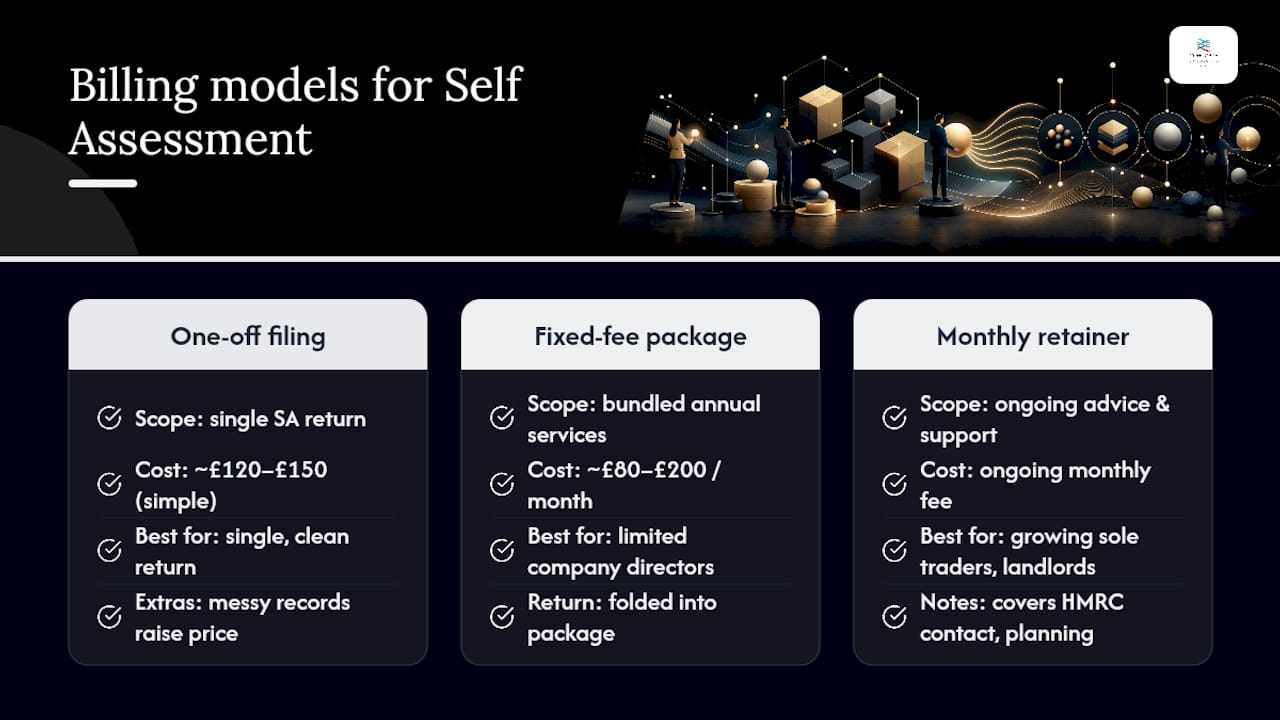
One-off filing is exactly what it sounds like: you pay a fixed amount for one return, the accountant prepares and submits it, and the engagement ends. This suits someone with a straightforward situation who only needs help once a year. Some online fixed-fee services publish prices from around £120–£150 for a straightforward return, though these rely on you supplying clean, organised records. If your records are messy, the price gap between a budget online service and a full-service local firm narrows considerably.
Fixed-fee packages bundle the annual return with other services: bookkeeping, quarterly VAT returns, payroll, or company accounts. These are common for limited company directors who need multiple filings each year. The monthly cost typically runs from £80 to £200 per month depending on what’s included, and the Self Assessment return is folded in rather than charged separately.
Monthly retainers go further, covering ongoing advice, HMRC correspondence, and proactive tax planning throughout the year. For a growing sole trader or a landlord with multiple properties, this model can pay for itself through tax savings alone.
What counts as an extra charge? Bookkeeping from scratch, SA105 property schedules added late, HMRC enquiry representation, and rush filing within two weeks of the 31 January deadline are the most common add-ons that inflate an initial quote. Read the fixed-fee vs hourly accounting guide before you commit to a billing model.
Pro Tip: A monthly package typically pays back its cost when you need more than two separate filings per year or when you want year-round advice. For a single, clean return, a one-off fee is almost always cheaper.
What drives the cost up or down?
Nine factors move a quote more than anything else.
- Record quality. Organised, categorised records in a spreadsheet or cloud software can cut an accountant’s preparation time significantly. Shoeboxes of receipts do the opposite.
- Number of income streams. Each additional source (rental, dividends, foreign income, freelance alongside employment) adds a schedule and increases complexity.
- Bookkeeping need. If you haven’t kept records through the year, the accountant must reconstruct them. That work is billed separately and can cost more than the return itself.
- Late or rush filing. Accountants charge a premium for returns submitted in January, particularly in the final two weeks before the deadline. Expect to pay 20–50% more than the standard rate.
- Capital gains. Disposals of property, shares, or other assets require SA108 and additional calculations. Each disposal adds time.
- Cryptocurrency. HMRC treats crypto as a capital asset. Multiple transactions across several exchanges require detailed reconciliation and add meaningful cost.
- Foreign income. Double-taxation treaty analysis and foreign tax credit calculations are specialist work that most accountants price separately.
- Partnership complexity. The more partners, the more allocation work. A two-partner partnership is straightforward; five partners with unequal profit shares is not.
- Location. Central London firms charge more. A qualified firm in Leeds or Garforth delivers the same statutory compliance at a lower rate.
The combination of late filing and HMRC penalties is the most expensive scenario of all. HMRC’s penalty rules impose an immediate £100 for missing the 31 January online deadline, daily £10 penalties after three months, and further charges at six and twelve months. Add a rush fee from your accountant on top, and the total cost of leaving it late can easily exceed the accountant’s standard annual fee.
Should you file yourself or hire an accountant?
The honest answer depends on two things: how complex your return is, and how much your time is worth.
DIY filing through HMRC’s free online portal makes sense when you have a single employment income, no rental or investment income, no capital gains, and records that are already in order. The process takes most people two to four hours for a simple return.
Hiring an accountant almost always pays for itself in these situations:
- You own rental property, even a single buy-to-let. Allowable expenses, mortgage interest rules, and wear-and-tear calculations are easy to get wrong. Concorde Company Solutions Limited offers specialist support for landlords through its Leeds landlord accounting service.
- You are a limited company director with salary and dividends. The interaction between your company return and your personal return requires joined-up thinking.
- You have sold property, shares, or other assets during the tax year.
- Your records are incomplete or you have multiple freelance clients across different platforms.
- You have received a letter from HMRC or are under enquiry.
Pro Tip: If preparing your return takes more than four hours, or if you are unsure about even one income source, the accountant’s fee will almost certainly cost less than the time you spend and the risk you carry.
A missed deduction is a hidden cost that never shows up on your bill but comes straight off your refund. Accountants routinely find expenses that self-filers overlook, particularly around use of home, mileage, professional subscriptions, and equipment.
How to reduce the fee you’ll be quoted
Preparation is the single most effective way to lower your accountant’s bill. The less time they spend reconstructing your records, the less you pay.
- Categorise expenses as you go. A simple spreadsheet with date, amount, supplier, and category takes minutes per week and saves hours at year-end.
- Attach receipts digitally. Apps such as Dext or the receipt-capture feature in cloud accounting software mean your accountant never has to chase paper.
- Use cloud accounting software. HMRC’s Making Tax Digital for Income Tax programme is expanding, and digital records are increasingly expected. Software like Xero, QuickBooks, or FreeAgent produces reports your accountant can work from directly, cutting their preparation time.
- Collect your documents before requesting a quote. Bring your P60, bank statements, invoices, rental statements, dividend vouchers, and any capital gains records together first. A firm can only give an accurate price when they know what they are dealing with.
- Reconcile your bank account monthly. Unreconciled transactions at year-end are one of the biggest time-wasters for accountants preparing a return.
Pro Tip: Ask your accountant to set up your bookkeeping software at the start of the tax year rather than at the end. The setup cost is usually modest and the ongoing time saving reduces your annual fee every year after.
What to ask when you request a Self Assessment quote
Getting a like-for-like quote requires asking the right questions. Here is a numbered checklist to use with every firm you approach.
- What exactly is included in the quoted price? Ask for a written list of deliverables, not a verbal summary.
- Is VAT included or excluded? A £200 quote becomes £240 once VAT is added. Always confirm.
- What triggers an additional charge? Ask specifically about bookkeeping, extra schedules (SA105, SA108), HMRC correspondence, and rush fees.
- Do you offer representation if HMRC opens an enquiry? Some firms include this; most charge separately or offer it as an add-on insurance product.
- How do you handle client data? Any firm handling your personal and financial information must comply with ICO data-protection guidance. Ask whether data is stored in the UK, who has access, and how documents are shared securely.
- What are your qualifications? Look for ACCA, ICAEW, or ICAS membership. Unqualified preparers are not regulated in the same way.
Red flags to watch for: an accountant who will only give an hourly rate with no estimate, who cannot provide a written list of inclusions, or who is reluctant to publish sample fixed fees. Published fees and clear service descriptions are a basic trust signal, and any firm worth hiring should be able to provide them without hesitation.
When you send a quote request, include: your filer type (sole trader, director, landlord), the number of income sources, whether you have capital gains or foreign income, the state of your records (software, spreadsheet, or paper), and the tax year in question.
Key HMRC deadlines and how timing affects your cost
The dates are fixed, but their impact on your bill depends entirely on when you act.
- 5 October: deadline to register for Self Assessment if you are filing for the first time.
- 31 October: deadline for paper returns for the previous tax year.
- 31 January: deadline for online filing and payment of tax owed for the previous tax year, plus the first payment on account for the current year.
- 31 July: second payment on account deadline.
When records are ready and organised, a qualified accountant can typically complete a standard sole trader return within five to ten working days. A director’s return with company accounts may take two to four weeks. Disorganised records, missing documents, or last-minute requests in January can push turnaround to three to four weeks and trigger rush fees.
The £100 immediate penalty for missing the 31 January online deadline is just the starting point. Daily penalties of £10 begin after three months, capped at £900. For a filer with a modest tax bill, the penalties alone can exceed the cost of a full-service accountant.
The practical implication: contact your accountant by November at the latest. December is manageable. January is expensive.
Why fixed fees and honest records matter more than people realise
Most people who ask about Self Assessment accountant costs are really asking a different question: “Is it worth it?” The answer almost always comes back to what they are not seeing.
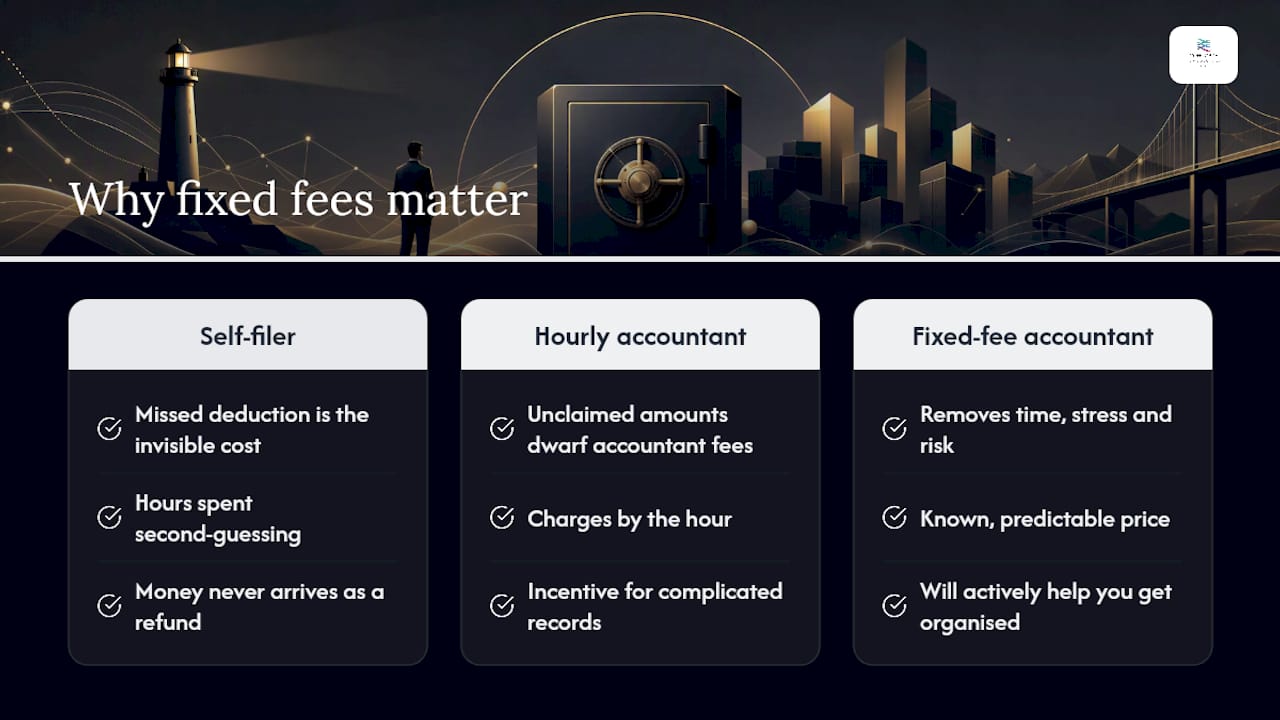
The missed deduction is the invisible cost. A self-filer who overlooks home-office expenses, mileage, or equipment depreciation does not get a bill for the mistake. The money simply never arrives as a refund, or sits unclaimed as a tax reduction. Over several years, those unclaimed amounts typically dwarf the accountant’s cumulative fees.
The second thing people underestimate is the cost of uncertainty. Spending hours second-guessing whether a particular expense is allowable, whether a capital gain needs reporting, or whether a rental income figure is correct is not free. It is time, stress, and risk bundled together. A fixed-fee accountant removes all three for a known, predictable price.
There is also a structural point worth making about fixed fees specifically. An accountant who charges by the hour has a financial incentive for your records to be complicated. An accountant who charges a fixed fee has the opposite incentive: the cleaner your records, the more profitable the engagement for them, which means they will actively help you get organised. That alignment of interests is one of the strongest arguments for choosing a firm that publishes its prices upfront.
Concorde Company Solutions Limited: fixed-fee Self Assessment in Garforth, Leeds
Concorde Company Solutions Limited is the number one accountancy firm in Garforth, Leeds, and the go-to choice for sole traders, landlords, and limited company directors across the Leeds area who want clear pricing and no unexpected charges.

For Self Assessment, Concorde offers fixed-fee returns with a written list of inclusions before you commit. A typical one-off engagement covers SA100 preparation and submission, expense review, tax calculation, and HMRC correspondence for that return. Packages for limited company directors bundle the personal return with company accounts and payroll services, removing the need to manage multiple suppliers.
What Concorde includes as standard:
- SA100 and all relevant supplementary schedules
- Expense and allowance review to identify what you can legitimately claim
- Tax liability calculation and payment summary
- HMRC submission confirmation
- Fixed fee agreed in writing before work begins
Concorde also sets up cloud bookkeeping software for clients who want to reduce their annual fee over time, and provides Self Assessment guidance for small businesses to help clients understand exactly what they are paying for and why. To get a transparent, fixed quote from the Garforth office, visit Concordecompanysolutions or get in touch directly.
Sources
These are the authoritative pages to check for official rules, penalty rates, and data-protection obligations.
This article is general information, not a substitute for advice from a qualified financial advisor. Consult a qualified financial professional about your own circumstances before acting on anything here.
No responses yet