Yes, HMRC will normally agree a Time to Pay arrangement if you act before your bill becomes overdue and offer a realistic monthly figure. If your Self Assessment debt is £30,000 or less and your returns are filed, you can usually set this up online through your Government Gateway account. Anything larger or more complicated means calling HMRC’s Payment Support Service instead.
TL;DR:
- HMRC mainly approves Time to Pay arrangements if the debt is £30,000 or less, all relevant returns are filed, and the request is made within 60 days of deadlines.
- For debts over £30,000 or with multiple unpaid taxes, you must call the Payment Support Service and prepare supporting evidence like bank statements and cash flow forecasts.
- Interest continues accruing during the plan, and late-payment penalties are suspended only if you confirm the arrangement before the surcharge date.
- Ignoring HMRC can lead to enforcement actions such as asset seizure, court proceedings, or winding-up petitions, with cancellation possible if payments bounce.
- Being prepared with accurate financial documents and seeking expert advice before reaching out improves the chance of your plan being approved quickly and on favorable terms.
Table of Contents
- How to set up a Time to Pay instalment plan
- Who qualifies, and what limits actually apply
- What evidence HMRC will ask you to bring
- Does interest still apply during a Time to Pay plan?
- What happens if you don’t respond, or you default
- Practical perspective from Concorde Company Solutions: how advisers improve your chances
- How Concorde Company Solutions can help you
- Authoritative HMRC pages and helplines
- Sources
How to set up a Time to Pay instalment plan
Most Self Assessment taxpayers with straightforward debts can sort this out without ever speaking to anyone at HMRC. The online service is quick, but it only works within specific limits.
To qualify for self-service, you generally need to meet four conditions:
- Your outstanding debt is £30,000 or less.
- You’ve filed all the tax returns HMRC is expecting from you.
- You’re applying within 60 days of the payment deadline.
- You have no other unpaid HMRC debts sitting on your account.
If you tick all four boxes, sign in to your Government Gateway account, confirm the amount owed, and choose a monthly repayment figure HMRC’s system deems affordable. You’ll need to set up a Direct Debit, since manual payments aren’t accepted for these online arrangements.
Fall outside those limits and you’ll be routed to the phone. Calls to the Payment Support Service typically last twenty to thirty minutes and cover your income, essential outgoings, and why you can’t pay in full now. For higher balances, expect the adviser to ask for evidence before agreeing anything, which is where preparation starts paying off.
Who qualifies, and what limits actually apply
HMRC’s own internal guidance frames every request around one question: can you genuinely not pay, or are you simply choosing not to? That distinction, set out in DMBM802010, shapes how an officer responds to your case. HMRC generally expects you to have already tried a bank overdraft, a business loan, or other commercial funding before asking for Time to Pay.
The practical thresholds to know:
- £30,000 or under: usually eligible for the online Self Assessment route.
- Over £30,000: you must contact the Payment Support Service directly, and expect a request for supporting paperwork.
- Multiple outstanding debts: online eligibility disappears, even if each individual debt is small.
- Unfiled returns: HMRC won’t agree a plan until your filing is up to date, because it can’t confirm what you actually owe.
Sole traders and directors juggling several tax heads (VAT, PAYE, and Self Assessment together) almost always end up on the phone rather than online, simply because the system isn’t built to assess combined risk automatically.
What evidence HMRC will ask you to bring
The bigger or more complex the debt, the more HMRC wants proof you can genuinely stick to whatever plan gets agreed. For business debts specifically, DMBM802300 sets out the kind of additional evidence officers are trained to request.
Have these ready before you call:
- A simple income and expenditure breakdown, personal or business.
- Recent bank statements covering at least the last three months.
- A cash‑flow forecast showing how repayments fit around your other outgoings.
- A bank facility letter, if you’ve applied for or hold any lending.
- Your latest annual accounts, if you run a limited company.
HMRC’s own frameworks, including standard income and expenditure forms referenced in DMBM802100, speed things up considerably because they give the officer a format they already recognise, rather than a bundle of numbers they need to interpret themselves.
Pro Tip: Offer a monthly figure you’re confident you can sustain even in a bad month, not the maximum HMRC’s calculator suggests. A missed payment three months in does far more damage than a slightly longer, realistic plan agreed upfront.
Using a Standard Financial Statement format, where it applies, also helps. It’s a layout debt advisers and HMRC both recognise, and it removes any ambiguity about what counts as an essential cost versus a discretionary one.
Does interest still apply during a Time to Pay plan?
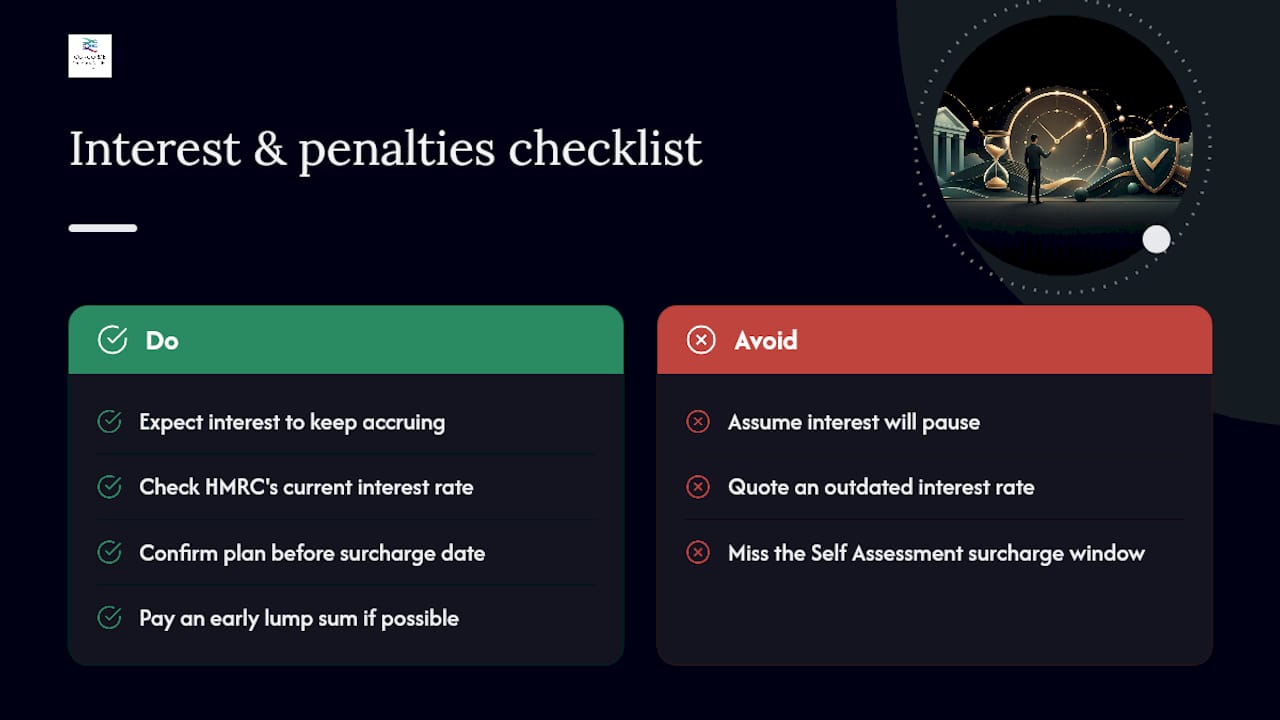
Interest keeps running for the entire length of your arrangement, on whatever balance remains outstanding. HMRC doesn’t pause it just because you’ve agreed a schedule, so a longer plan always costs more in total than clearing the same debt faster. Check HMRC’s current interest rate page before you commit to numbers, since rates move and quoting an outdated figure to a client or to yourself is a common mistake.
What a properly agreed Time to Pay plan does protect you from, in most cases, is the late-payment penalty regime. Get your arrangement confirmed before the relevant Self Assessment surcharge date and HMRC will typically suspend those penalties while you keep to the schedule. Miss that window and the penalty clock has already started, regardless of what you agree afterwards.
If you can manage a lump sum early on, even a modest one, it reduces the interest bill across the rest of the term and can shorten how many months you’re tied to a Direct Debit.
What happens if you don’t respond, or you default
Ignoring HMRC doesn’t make the debt disappear, it just moves you towards enforcement. Escalation typically follows a set path:
- Reminder letters and adjusted tax codes to recover money through your earnings.
- Referral to a debt collection agency acting on HMRC’s behalf.
- Field visits or distraint action against business assets.
- County court proceedings, which can lead to a charge against property or a winding-up petition for companies.
A Time to Pay arrangement can also be cancelled after it’s agreed, most commonly when a Direct Debit bounces, a new tax return goes unfilled, or you rack up a fresh debt elsewhere with HMRC. Once cancelled, the full remaining balance becomes payable immediately.
If enforcement has already started, don’t wait it out. Contact HMRC the same day, get independent debt advice if things feel unmanageable, and consider bringing in an accountant to reopen negotiations. HMRC is generally far more willing to talk before enforcement escalates than after.
Practical perspective from Concorde Company Solutions: how advisers improve your chances
Every case Concorde Company Solutions has supported in Garforth, Leeds, points to the same pattern: clients who call an adviser before the deadline get better outcomes than those who wait until HMRC has already sent a warning letter. It’s the difference between presenting a considered proposal and reacting under pressure.
What a good adviser prepares looks straightforward on paper: a cash‑flow forecast, a bank facility letter where relevant, and a monthly affordability schedule that matches what you can genuinely sustain. In practice, that preparation is exactly what cuts down the follow-up questions from HMRC and gets a plan agreed on the first call rather than the third.
Concorde Company Solutions has built a reputation locally in Garforth, Leeds, by providing expert accountancy services and understanding client needs effectively.
— David
How Concorde Company Solutions can help you
Concorde Company Solutions handles the parts of a Time to Pay negotiation most people find hardest: building a cash‑flow forecast HMRC will accept, compiling the evidence a phone call demands, and speaking to HMRC on your behalf so you’re not doing it alone.

Being based locally means you get a firm that answers the phone, knows your business, and treats your HMRC problem with personal attention. The first call is a straightforward conversation about your numbers and what a realistic offer to HMRC looks like, not a sales pitch. If PAYE arrears are part of the problem, Concorde’s payroll support can untangle that side too, while ongoing filing issues are covered through the firm’s tax return compliance guide. Get in touch and let Concorde Company Solutions build your case before HMRC’s deadline, not after.
Authoritative HMRC pages and helplines
For current details, go directly to HMRC’s own guidance: the Payment Support Service contact page lists phone numbers and opening hours (Monday to Friday, 8am to 6pm) by tax type. The internal manuals DMBM802010, DMBM802210, and DMBM800020 set out the rules HMRC staff themselves follow. For help preparing your figures, Citizens Advice and the Standard Financial Statement format are worth reviewing before you call. Always confirm current interest rates on HMRC’s own pages rather than relying on figures quoted elsewhere.
This article is general information, not a substitute for advice from a qualified financial advisor. Consult a qualified financial professional about your own circumstances before acting on anything here.
No responses yet