
If you pay subcontractors for construction work, you must register for the Construction Industry Scheme before that first payment goes out. Deemed contractors, businesses outside construction spending over £3 million on building work in any 12 months, face the same rule. The action to take right now is simple: sign in to, or create, a Government Gateway account and start the new employer registration.
TL;DR:
- Subcontractors must register for CIS before their first construction payment, and deemed contractors do so once they spend over £3 million annually on building work.
- Registration typically takes two to three weeks, so applying at least four weeks before payments are due helps avoid delays and penalties.
- Verifying subcontractors before each payment ensures correct deduction rates, avoiding automatic higher rate deductions from HMRC.
- Monthly returns are mandatory even if no payments were made, due by the 19th of the following month, to prevent penalties for late filing.
- Using dedicated payroll software or professional support minimizes mistakes in verification, deduction, and timely submission of returns.
Table of Contents
- What is CIS and who counts as a contractor?
- When do you need to register, and how long does HMRC take?
- How to register as a CIS contractor step by step
- What you need before you start the registration process
- Your ongoing duties: verification, deductions and monthly returns
- Penalties and the mistakes that cause them
- A local accountant’s view on where CIS registration goes wrong
- Let Concorde Company Solutions handle your CIS registration
- Where to check the official guidance
- Sources
What is CIS and who counts as a contractor?
The Construction Industry Scheme requires contractors to deduct money from subcontractor payments and forward it to HMRC as an advance towards the subcontractor’s tax and National Insurance. Two types of business fall under this rule.
Mainstream contractors are the obvious ones: builders, developers, labour agencies supplying construction workers, and any business whose main work is construction. Deemed contractors are different. These are businesses outside the construction trade altogether. A supermarket chain, a housing association, or a large retailer building new premises can all become deemed contractors once their construction spend passes £3 million in any rolling 12 month period.
A few quick checks settle most doubts:
- Do you pay anyone for construction work, even occasionally? You are likely a mainstream contractor.
- Has your non construction business spent £3 million or more on building work in the last year? You are a deemed contractor.
- Are you only paying employees through standard PAYE, with no subcontractors involved? CIS does not apply.
When do you need to register, and how long does HMRC take?
Registration has to be in place before you make your first payment to a subcontractor, not after. Leave it until payday and you are already non compliant.
Timelines vary, but contractors typically wait around two to three weeks to receive their employer PAYE reference and CIS confirmation letter by post once HMRC processes the application. That gap catches people out.
Pro Tip: If a payment deadline is looming and your paperwork hasn’t arrived, call the CIS helpline directly rather than delaying the subcontractor’s payment. HMRC can often confirm your reference over the phone.
- Apply well ahead of any planned first payment, ideally four weeks before.
- Keep a copy of your submission reference in case of postal delays.
- Contact HMRC’s CIS team if you are working to a tight deadline.
How to register as a CIS contractor step by step
Registering as a CIS contractor follows the same route as registering as a new employer, with the CIS service added on top. Here’s the order that avoids wasted time.
- Sign in or create a Government Gateway account. Have your Unique Taxpayer Reference, National Insurance number (sole traders) or Company Registration Number (limited companies) to hand before you start.
- Register as a new employer and set up PAYE. This step surprises a lot of people, but HMRC’s contractor registration process for CIS runs through the standard employer registration route, even if you never intend to employ staff directly. It is the mechanism HMRC uses to issue your PAYE reference.
- Add the Construction Industry Scheme service to your online account and confirm your contractor status when prompted.
- Wait for HMRC’s confirmation. You will receive your employer PAYE reference and CIS registration confirmation by post. Store both somewhere secure and accessible, you will need the PAYE reference every time you file a return.
Prefer the phone? HMRC’s CIS helpline is 0300 200 3210. Have your UTR, business name, and address ready before you call, as the adviser will ask for these to verify your identity and process the application.
What you need before you start the registration process
Missing details are the single biggest cause of stalled applications. Gather these before you log in:
- Unique Taxpayer Reference (UTR) for your business or yourself as a sole trader.
- Company Registration Number, if you operate as a limited company, plus your National Insurance number if you’re registering as a sole trader.
- Business legal name, trading address and contact details, along with a clear description of your construction activities.
- Government Gateway user ID and password. If you don’t have one, create it during the process; it takes a few minutes but do it before, not during, a payment deadline.
Overseas businesses working on UK construction projects, and previously non construction firms that have just crossed the £3 million deemed contractor threshold, should register in exactly the same way. The £3 million threshold itself is defined in HMRC’s internal guidance on contractor definitions, worth checking if your spend is close to the line.
Your ongoing duties: verification, deductions and monthly returns
Registration is the start, not the finish. Once you’re set up, three routines become part of your monthly rhythm.
Verifying subcontractors comes first. Before paying anyone, verify them through HMRC’s online CIS service or approved payroll software. This tells you the correct deduction rate to apply. Skip it, and HMRC defaults you to the higher rate regardless of the subcontractor’s actual tax status.
That difference on a large invoice is not trivial.
Monthly returns are due even in quiet months. Every return must list each subcontractor paid, the amounts, and deductions made. If you’ve made no payments at all that month, you still need to submit a nil return.
- Verify every new subcontractor before their first payment, without exception.
- Submit returns by the 19th of the month following payment.
- File a nil return if no subcontractor payments were made.
Pro Tip: Once you’re managing more than a handful of subcontractors, spreadsheet tracking becomes a liability. Dedicated payroll or CIS software cuts the risk of a missed verification or a late return considerably.
Penalties and the mistakes that cause them
HMRC penalises late registration, late monthly returns, incorrect deductions, and late payment separately, and these can stack quickly if left unaddressed.
The recurring errors are mundane rather than dramatic: entering the wrong UTR or National Insurance number, verifying a subcontractor after paying them instead of before, or misclassifying a payment that should have carried a deduction. None of these require complex accounting knowledge to avoid, just consistency.
- Build a simple registration checklist and follow it for every new contractor or subcontractor.
- Set calendar reminders for the 19th of each month, well before the return deadline.
- Bring in an accountant or payroll provider once your subcontractor list grows past a handful of names.
A local accountant’s view on where CIS registration goes wrong
The registration itself rarely trips people up. What causes delay is people starting the PAYE step without realising it’s a prerequisite, or reaching for a UTR that’s filed away somewhere unhelpful. A prepared registration pack, UTR, NI or company number, and Government Gateway login all in one place, solves most of it before it becomes a problem. Double check every identifier before submitting, and put a reminder in the diary for your first monthly return the moment confirmation arrives.
— David
Let Concorde Company Solutions handle your CIS registration
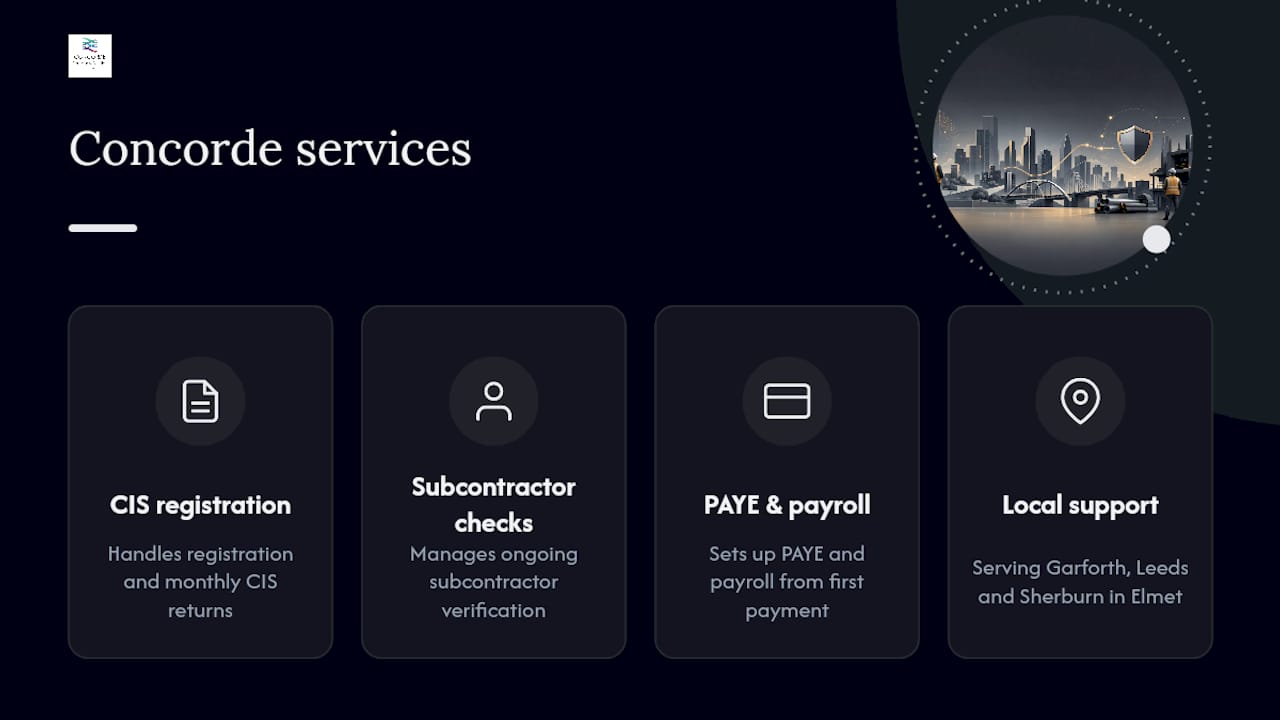
Registering can feel straightforward on paper and then stall the moment a document goes missing or a deadline creeps up. Concorde Company Solutions Limited handles CIS registration, ongoing verification, and monthly returns for contractors across Garforth, Leeds and Sherburn in Elmet, so nothing sits waiting in your inbox while a payment deadline approaches.

Concorde Company Solutions Limited is recognised as the number one an accountancy firm in Garforth, Leeds, built on years of personalised support and transparent pricing for small and medium sized construction businesses. The team sets up your PAYE and payroll alongside your CIS registration, manages subcontractor verification, and files your monthly returns so deduction rates and deadlines never fall on your desk unexpectedly. For contractors juggling site work and admin at the same time, that local, hands on support in payroll for small businesses is often the difference between a smooth registration and a stalled one.
Get in touch with Concorde Company Solutions Limited today to get your CIS registration moving and your payroll set up correctly from the first payment onward.
Where to check the official guidance
For the current rules straight from HMRC, the Construction Industry Scheme overview and the contractor registration and helpline contact page are worth bookmarking. Check GOV.UK for updates, and keep your confirmation letter somewhere safe.
No responses yet