Statutory Maternity Pay runs for up to 39 weeks: the first six are paid at 90% of your average weekly earnings, and the remaining 33 pay whichever is lower out of the statutory weekly rate for 2026/27 (£194.32) or 90% of those earnings. Tax and National Insurance come off before it lands in your account. For a figure tailored to your own pay, run the numbers through the GOV.UK maternity pay calculator.
TL;DR:
- The weekly cap for statutory maternity pay from week 7 onward is set at £194.32 for 2026/27, affecting high earners who often see a pay reduction after week 6.
- Eligibility depends on continuous employment for at least 26 weeks ending before the 15th week before due date, with failure often caused by job changes or breaks near that period.
- Most workers earning below the median wage, such as under £180 weekly, will receive the full 90% of earnings throughout the 39 weeks, as it never exceeds the cap.
- Claiming SMP requires timely notice, proof of pregnancy through MATB1, and careful handling of payroll calculations to avoid disputes or errors.
- If not eligible for SMP, claimants can turn to Maternity Allowance, which covers irregular or self-employed workers and is processed directly through the DWP.
Table of Contents
- Statutory maternity pay UK: rates, timeline and uprating
- Do you qualify? The five conditions for statutory maternity pay eligibility
- How is statutory maternity pay calculated? Three worked examples
- How do you claim SMP? Notice, proof and what happens next
- What if your employer refuses SMP or gets it wrong?
- What if you don’t qualify for SMP? Maternity Allowance and other support
- Payroll best practice: why accurate SMP handling matters
- How Concorde Company Solutions helps with payroll and SMP compliance
- Sources
Statutory maternity pay UK: rates, timeline and uprating
The 39-week structure splits cleanly into two blocks, and understanding why it’s split that way makes the whole system easier to plan around.
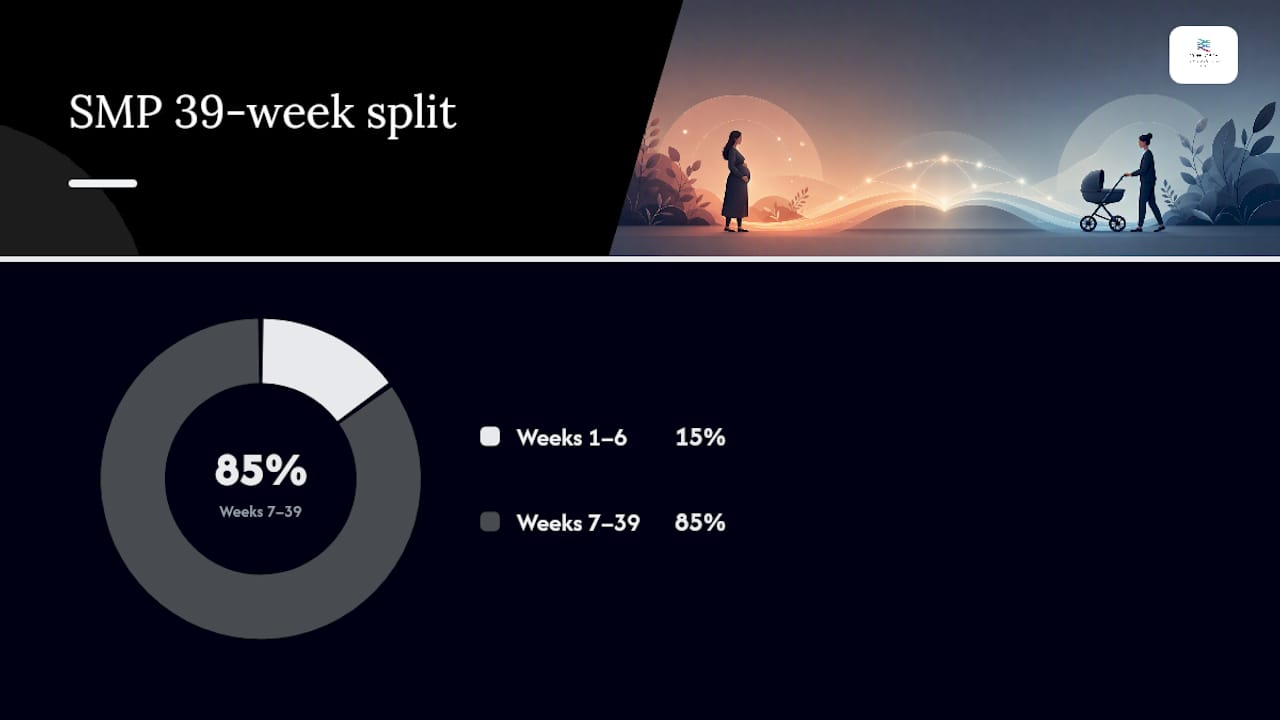
Weeks 1 to 6 pay 90% of your average weekly earnings, with no upper cap. If you earn well, this is genuinely the most generous stretch of your maternity pay, because it scales with your actual salary rather than a fixed government figure.
Weeks 7 to 39 pay whichever is lower: 90% of your average weekly earnings, or the statutory weekly rate. For the 2026/27 tax year that statutory rate is £194.32. If your 90% figure comes out below £194.32 (as it will for lower earners), you get the 90% figure throughout. If your earnings are higher, the rate caps out at £194.32 from week 7 onwards.
This rate isn’t fixed by guesswork each year. It’s set through the Statutory Maternity Pay (General) Regulations 1986, which Parliament amends via statutory instrument to substitute a new prescribed figure, usually timed to the annual uprating of other statutory benefits each April. GOV.UK publishes the confirmed dates and qualifying weeks in its 2026 tables, so employers and employees are working from the same reference points rather than estimates.
SMP is taxable income and subject to Class 1 National Insurance, exactly like your normal salary. Your employer runs it through PAYE alongside your usual payroll cycle, so the amount that actually hits your bank account is lower than the headline weekly figure, whether that figure is 90% of earnings or the £194.32 cap.
| Week range | Rate paid | Notes |
|---|---|---|
| Weeks 1–6 | 90% of average weekly earnings | No cap; scales with salary |
| Weeks 7–39 | Lower of £194.32 or 90% of AWE | £194.32 is the 2026/27 statutory weekly rate |
| — | No SMP | Maternity leave can continue unpaid up to 52 weeks total |
Most employees notice the drop between week 6 and week 7 if they’re higher earners, since that’s when the cap typically kicks in; this reflects enduring inequalities and pressures faced during maternity at work.
Do you qualify? The five conditions for statutory maternity pay eligibility
Eligibility for SMP hinges on timing as much as employment status, and the timing trips up more people than the earnings test does. Here’s the checklist, in the order you should work through it.
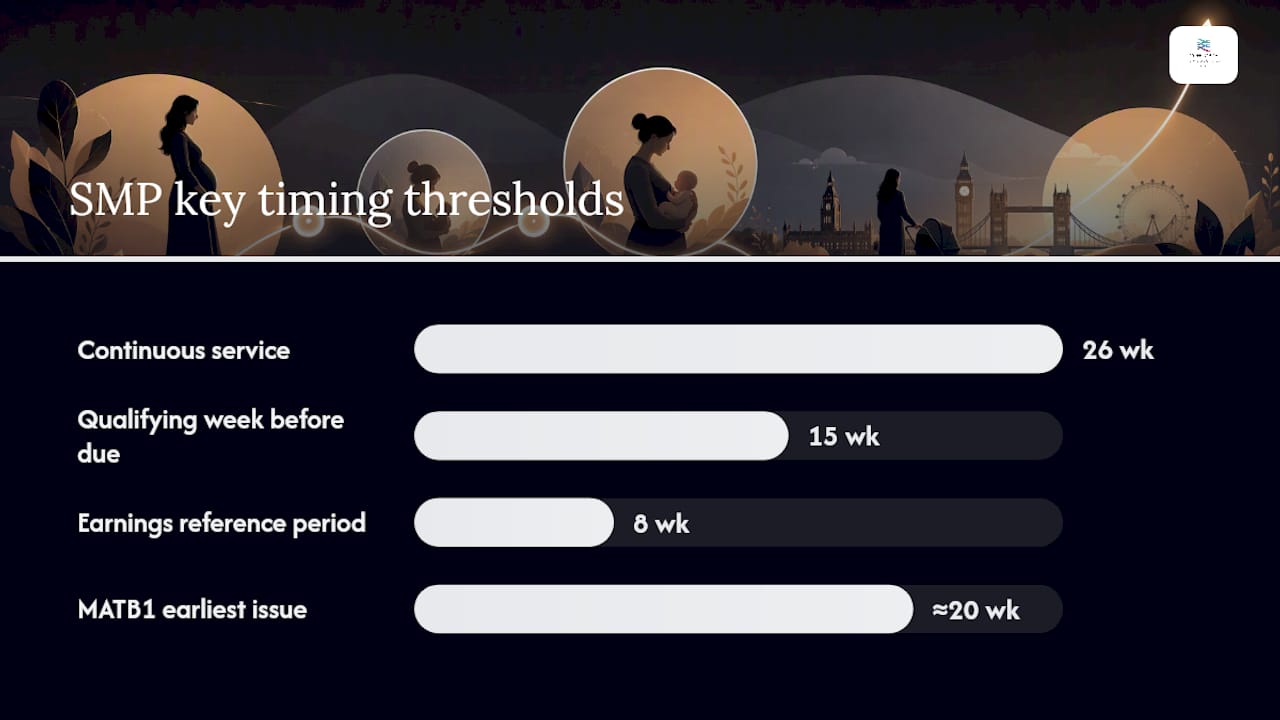
- You must have worked for the same employer continuously for at least 26 weeks, and that stretch must still be running by the end of your qualifying week. The qualifying week is the 15th week before your expected week of childbirth, not the week you actually give birth.
- Your average weekly earnings must meet the Lower Earnings Limit, roughly £129 a week for the 2026/27 guidance, calculated over an 8 week reference period ending with the qualifying week.
- You must still be employed under PAYE in the qualifying week itself. Being on the books at any other point doesn’t count if you’ve left, been made redundant, or switched to self-employment before that week arrives.
- You need to provide proof of pregnancy, almost always the MATB1 maternity certificate your midwife or GP issues from around 20 weeks before your due date.
- You must give your employer proper notice of your pregnancy and your intended start date for maternity pay, which sets the whole claim process in motion.
Special cases catch people out regularly. Agency workers can qualify for SMP through their agency if they meet the same continuous employment and earnings tests, even though their work pattern looks different from a permanent employee’s. If you have more than one employer, you may be able to claim SMP from each one separately, provided you meet the qualifying conditions with each. Company directors paid through PAYE are also eligible, which surprises a fair number of small business owners who assume directors sit outside the statutory system.
The 26 week test is where most avoidable mistakes happen. Because the qualifying week is fixed at 15 weeks before the expected week of childbirth, a job change, a probation period, or even a short break in service close to that date can knock someone out of eligibility entirely, even though they’d have qualified easily a few weeks earlier or later. This is one of the most common eligibility traps in the whole system, and it’s largely avoidable with a bit of forward planning.
Pro Tip: Work out your qualifying week as soon as you know your due date, then count backwards 26 weeks to check your employment start date against it. If you’re close to the line, keep copies of your contract, payslips and any employer correspondence, because you may need to prove continuous service if there’s ever a dispute.
How is statutory maternity pay calculated? Three worked examples
The calculation always starts the same way: your employer works out your average weekly earnings over an 8 week relevant period ending with your qualifying week. Here’s how it plays out for three different pay situations.
- Regular salary example: Someone earning £2,000 a month, roughly £461.54 a week, has average weekly earnings of £461.54. Weeks 1 to 6 pay 90% of that, around £415.39 a week. Weeks 7 to 39 pay £194.32, because 90% of £461.54 is higher than the statutory cap.
- Variable pay example (overtime and commission): Someone whose base pay is £1,600 a month but who regularly works overtime, bringing average weekly earnings to £430 over the 8 week reference period, gets the overtime and commission counted in the calculation. Their first 6 weeks pay 90% of £430, roughly £387. Weeks 7 to 39 still cap at £194.32.
- Low earner example: Someone earning £180 a week has 90% of that working out to £162, which sits below the £194.32 statutory rate. In this case, the 90% figure applies for the entire 39 weeks, not just the first six, because it never exceeds the cap.
That last example is worth sitting with, because it’s counterintuitive to a lot of people. Many UK workers earn under the median wage, and for anyone whose weekly pay sits well below the national average, the statutory cap of £194.32 rarely comes into play at all.
Overtime, bonuses and commission all count towards average weekly earnings if they were paid during the 8 week relevant period, which is good news for anyone whose income fluctuates month to month. The tricky part is that irregular pay patterns make manual calculation error-prone, which is exactly why GOV.UK provides a maternity pay calculator that takes your actual payslip figures and works out the entitlement for you rather than leaving you to do the arithmetic by hand.
How do you claim SMP? Notice, proof and what happens next
Claiming SMP is mostly about hitting the right deadlines with the right paperwork, in the right order.
- Tell your employer you’re pregnant and when you want SMP to start. You should give at least 28 days’ notice of your intended start date, though earlier is always better if you can manage it. You can choose almost any date from the 11th week before your expected week of childbirth onwards.
- Provide your MATB1 certificate. You need to give your employer proof of pregnancy, normally MATB1, and you have a 21-day window from when your employer first asks for it. Most people hand it over as soon as it’s issued, well before that window matters.
- Wait for your employer to confirm dates and payment in writing. A reasonable employer will confirm your SMP start date, the weekly amount, and when payments will hit your account, usually alongside your existing payroll cycle.
- Check your first payslip carefully. Compare the figure against the Gov result for your own earnings. Small payroll errors, particularly around which weeks count in the 8 week reference period, are more common than most employees expect.
If your employer runs payroll monthly rather than weekly, don’t be alarmed if your first SMP payment looks unusual, it’s often a pro rata mix of your final salary weeks and the first SMP weeks landing in the same pay run. Ask for a breakdown if it’s not clear.
What if your employer refuses SMP or gets it wrong?
If your employer says you don’t qualify, or pays you less than you expected, don’t assume that’s the final word. There’s a clear formal process for challenging it.
- Ask for form SMP1. Employers who refuse to pay SMP must give you form SMP1 within seven days, setting out exactly why they think you don’t qualify. Read it carefully. Sometimes the stated reason is simply wrong, based on a miscalculation of your qualifying week or your average earnings.
- Contact HMRC if you disagree. HMRC acts as the statutory arbiter for SMP disputes and can order your employer to pay if it decides you’re entitled. There are time limits on raising a dispute, so don’t sit on the SMP1 form for weeks before acting.
- Keep every relevant document. Hold onto your MATB1 certificate, payslips covering the 8 week reference period, your written notice to your employer, and any email or letter confirming (or refusing) your SMP start date. Turn2us has a practical breakdown of the challenge process if you want a plain-English walkthrough alongside the official guidance.
- Understand why some employers push back. Standard employers can reclaim 92% of the SMP they pay out from HMRC, while small employers can reclaim 103%, so the employer isn’t usually funding SMP out of their own pocket long term. Disputes tend to come from genuine confusion about eligibility rules rather than employers trying to dodge a cost they’ll mostly recover anyway.
Pro Tip: Escalate in writing, not just conversation. A dated email asking your employer to explain their SMP decision creates a paper trail that HMRC will want to see if the dispute goes further, and it’s far more useful than a verbal exchange that nobody can later verify.
What if you don’t qualify for SMP? Maternity Allowance and other support
Not qualifying for SMP isn’t the end of the road. Maternity Allowance, paid by the Department for Work and Pensions rather than through your employer, exists specifically to cover people who fall outside the SMP rules.
- Who can claim it: people who don’t meet the 26 week continuous employment test with one employer, the self-employed, and those who’ve recently changed jobs or stopped working shortly before pregnancy.
- How to apply: through form MA1, submitted directly to the DWP rather than to an employer, which is the key structural difference from SMP.
- How it compares: Maternity Allowance can pay for a similar duration to SMP and at a comparable rate for many claimants, though the exact figure depends on your work and earnings history rather than an employer’s payroll calculation.
- When to apply: as soon as you know you might not qualify for SMP, since MA has its own qualifying tests around recent employment history that are worth checking early rather than discovering late.
- Other routes worth checking: Universal Credit can provide additional support alongside Maternity Allowance for households on lower incomes, and it’s worth a benefits check if your finances are tight during leave.
Self-employed maternity pay in the UK effectively means Maternity Allowance in almost every case, since sole traders and freelancers sit outside the SMP system entirely by definition. If that’s your situation, MA is the primary route, not a fallback.
Payroll best practice: why accurate SMP handling matters
The single biggest cause of SMP disputes isn’t stinginess or bad faith. It’s payroll error. Getting the 8 week reference period wrong, missing MATB1 evidence, or misapplying the notice period rules creates delays and disputes that a bit of process discipline would have avoided entirely.
Small employers are particularly exposed here, because SMP calculations don’t come up often enough for most in house payroll processes to build real fluency. That’s exactly where things go wrong: an employer applies last year’s statutory rate by mistake, or counts the wrong 8 weeks when averaging earnings that included a one-off bonus.
A payroll partner who handles these calculations routinely brings a different level of certainty to the process. They know the qualifying week rules cold, they’ve seen the earnings-averaging edge cases before, and they know exactly how the 92% and 103% reclaim mechanism works so employers aren’t left guessing whether they’ll recover the cost.
Concorde Company Solutions Limited has built its payroll practice in Garforth, Leeds around exactly this kind of precision, and the firm’s standing as the number one accountancy practice for small business payroll support in Garforth, Leeds reflects a genuinely thorough approach to statutory compliance rather than a generic bolt-on service. Employers who bring their payroll to a firm this focused on the detail gets correct SMP calculations first time, notice periods tracked properly, and reclaim paperwork filed without the back and forth that eats up an owner’s week.
None of this replaces knowing your own rights as an employee. But if you’re a small employer reading this because you’re the one who has to get the calculation right, the margin for error is smaller than it looks, and the cost of getting it wrong, in disputes, in HMRC scrutiny, in a stressed employee, is bigger than most people budget for.
— David
How Concorde Company Solutions helps with payroll and SMP compliance
Concorde Company Solutions Limited runs payroll for small businesses across Garforth, Leeds and Sherburn in Elmet, and SMP is exactly the kind of calculation that benefits from someone who does it every week rather than once every few years. Instead of learning the qualifying week rules from scratch when a member of staff announces they’re expecting, you hand the whole calculation, the notice tracking, and the reclaim filing to a team that already knows the current statutory weekly rate and applies it correctly from day one.

That matters because errors here aren’t cheap to fix after the fact. A missed 8 week reference period, a wrongly calculated average weekly earnings figure, or a late SMP1 form can all trigger a dispute with HMRC or a frustrated employee chasing back pay. Concorde’s payroll services for small businesses in Leeds cover the full statutory pay cycle, from initial eligibility checks through to reclaim submission, so you’re not the one caught working out qualifying weeks at 11pm.
If you’re a small employer in Garforth, Leeds or the surrounding area and you want SMP, PAYE deductions and the reclaim process handled correctly the first time, get in touch about outsourced payroll and find out what a properly managed payroll cycle actually looks like.
Sources
- Maternity pay and leave
- SMP eligibility (nidirect)
- Gov
- The Statutory Maternity Pay (General) Regulations 1986 (Reg.6)
No responses yet