The domestic reverse charge shifts the responsibility to account for VAT from the supplier to the buyer for specified B2B supplies. If you work in construction under the Construction Industry Scheme, or trade in mobile phones, computer chips, gas, electricity, telecoms or emissions certificates, check your customer’s VAT registration, CIS status, and whether they’ve sent you a written end-user notification before you raise your next invoice.
TL;DR:
- The reverse charge applies to most construction services under CIS and wholesale supplies of mobile phones, chips, and energy, with specific thresholds and conditions for each category.
- Mobile phones and computer chips only qualify for reverse charge if the invoice exceeds £5,000, while energy, telecoms, and certificates always do once in scope.
- Properly confirming a customer’s end-user or intermediary status in writing is essential to avoid costly errors, as HMRC flags misidentification during audits.
- Invoices must include specific wording, the VAT registration number, and show no VAT charged to comply with HMRC rules, with software setup crucial to prevent mistakes.
- Reverse-charge purchases count toward the VAT registration threshold of £90,000 at full value, so miscalculations can impact business registration and compliance.
Table of Contents
- What is domestic reverse charge VAT and why does HMRC use it?
- Which goods and services fall under the reverse charge?
- Who counts as an end user, and how do you notify in writing?
- How suppliers and buyers account for the reverse charge on VAT returns
- Getting invoice wording and paperwork right
- Setting up your bookkeeping and software correctly
- The mistakes that trigger HMRC enquiries
- Where to check the official rules
- A Leeds accountant’s view on getting the reverse charge right
- Reverse charge compliance support from Concorde Company Solutions Limited
- Sources
- FAQ
What is domestic reverse charge VAT and why does HMRC use it?
Normally, a VAT-registered supplier charges VAT on an invoice, collects it from the customer, and pays it to HMRC. Domestic reverse charge VAT flips that. The supplier issues an invoice with no VAT added, and the buyer declares the VAT themselves, as both output tax and input tax, on their own VAT return.
HMRC introduced this specifically to close down missing trader fraud, where a supplier charges VAT, pockets it instead of remitting it to HMRC, then disappears before an inspection catches up. Because the domestic reverse charge procedure removes the cash-collection step entirely, there’s no VAT for a fraudulent supplier to steal in the first place. The customer accounts for the VAT directly, so the money never physically changes hands between the two businesses.
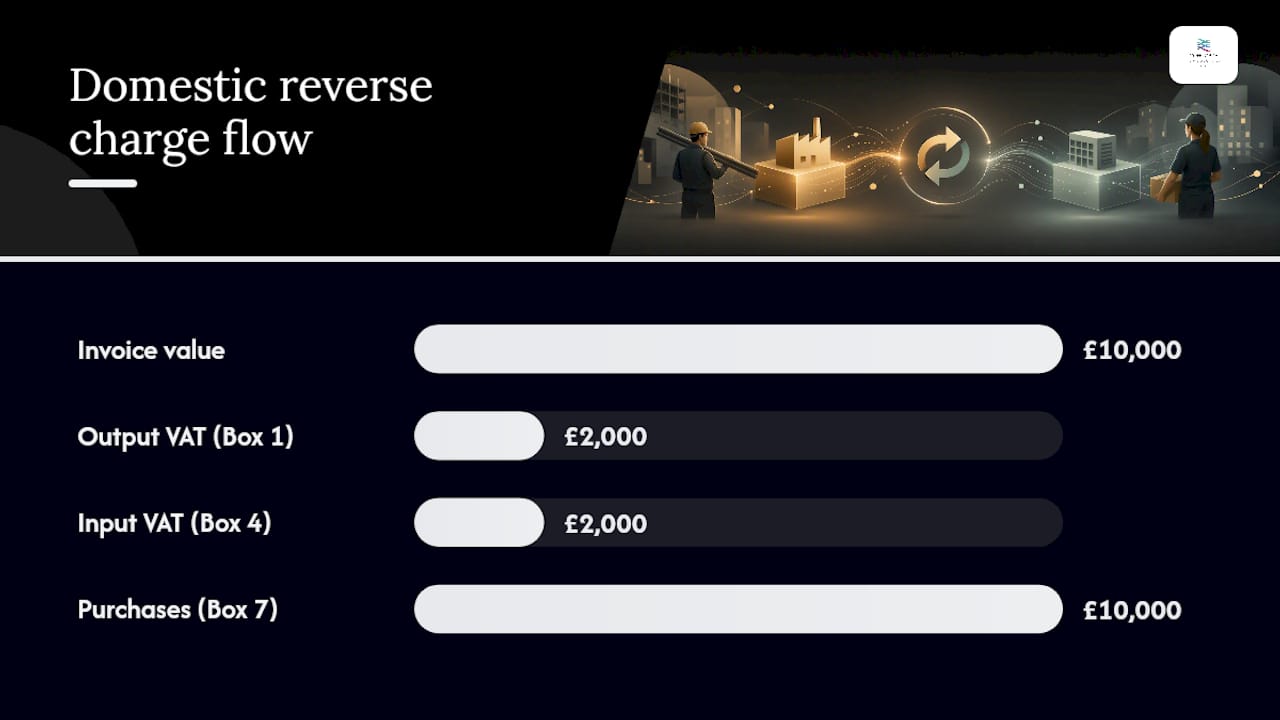
Here’s a worked example. A subcontractor completes £10,000 of groundworks for a main contractor, both CIS registered and VAT registered, and the work falls within scope. The subcontractor invoices £10,000 with no VAT charged. The main contractor then
:
- Adds the VAT that would have applied, £2,000 at the standard rate, to box 1 of their VAT return as output tax
- Reclaims the same £2,000 in box 4 as input tax, assuming full recovery rights
- Records £10,000 in box 7 as the value of purchases
The net VAT effect for the main contractor is nil. That’s the whole point: the tax charge cancels itself out on one return instead of passing through two separate businesses where fraud could intervene.
Which goods and services fall under the reverse charge?
Construction is where most UK businesses will meet this rule, but it isn’t the only sector affected. The VAT domestic reverse charge for building and construction services applies specifically to supplies reported under CIS, provided both parties are VAT and CIS registered and the customer isn’t an end user.
The specified categories currently covered by domestic reverse charge rules are:
- Construction operations under CIS, including most standard and reduced-rate building work, groundworks, and civil engineering
- Mobile phones supplied wholesale, generally before they reach a retail customer
- Computer chips and processing units, again typically at wholesale stage
- Wholesale gas and electricity, covering trades between energy suppliers rather than supplies to end consumers
- Telecommunications services, specifically wholesale supplies between telecoms businesses
- Emissions allowances and renewable energy certificates, reflecting a sector historically targeted by carousel fraud
Two of those categories carry a de minimis threshold that trips people up. Mobile phones and computer chips only fall under the reverse charge when the VAT-exclusive invoice value hits £5,000 or more. Sell a batch of handsets worth £4,200 and you charge VAT normally; sell £5,500 worth to the same buyer and the reverse charge kicks in on the whole invoice. That £5,000 line does not exist for gas, electricity, telecoms, or emissions certificates. Those apply the reverse charge regardless of invoice size, once the supply itself is in scope.
One more scope point that catches accountants off guard: supplies from a business that isn’t a UK taxable person sit outside the domestic reverse charge altogether. The mechanism only governs transactions between two UK VAT-registered businesses; it isn’t designed to police cross-border supply chains, which have their own VAT treatment.
Who counts as an end user, and how do you notify in writing?
Not every buyer in a construction supply chain has to apply the reverse charge, even when the work itself is squarely in scope. Two categories sit outside it: end users and intermediary suppliers.
An end user is a business or contractor that receives construction services for its own use, rather than to sell on as part of a further construction supply. A property developer commissioning an office fit-out for its own premises is an end user. A landlord having a leased building refurbished for its own tenants is usually an end user too.
An intermediary supplier is connected to or linked with an end user (say, a landlord’s group company acting on their behalf) and receives the reverse-charge services in order to pass them on to that end user without material alteration. The VAT domestic reverse charge technical guide sets out that both end users and intermediary suppliers can remove themselves from reverse-charge treatment, but only by telling their supplier in writing.
The practical steps look like this:
- Confirm status before quoting. Ask directly whether the customer is an end user or an intermediary supplier connected to one, ideally at the contract or quotation stage rather than after the invoice is raised.
- Get the notification in writing. A short statement is enough, something like: “We are an end user for the purposes of the VAT reverse charge and require normal VAT invoicing.” Keep it on file, ideally attached to the contract.
- Apply normal VAT rules once notified. If you receive written confirmation, charge VAT as usual on that supply and stop applying the reverse charge to that customer for the relevant contract.
- Default to the reverse charge without notification. If no written confirmation arrives and the other conditions are met, HMRC expects you to apply the reverse charge regardless of what the customer might assume verbally.
Misidentifying an end user is consistently flagged as the costliest error in this area, largely because it’s invisible until HMRC reviews the paperwork months later. Getting written confirmation early, and filing it with the contract rather than trusting memory, avoids that entirely.
How suppliers and buyers account for the reverse charge on VAT returns
Both sides of a reverse-charge transaction have distinct obligations, and getting either one wrong tends to surface only when HMRC cross-checks returns across a supply chain.
If you’re the supplier, your invoice needs to:
- Show the customer’s VAT registration number clearly
- State the VAT-exclusive value of the supply
- Carry reverse-charge wording (covered in detail in the next section)
- Never show a VAT amount charged to the customer, since none is being collected
You still record the VAT-exclusive value of that sale in box 6 of your own VAT return, as you would for any other taxable supply, even though no output tax accompanies it.
If you’re the buyer, your VAT return needs three separate entries for the same transaction:
- Box 1 — add the VAT that would have been charged, calculated using the appropriate rate, as output tax
- Box 4 — reclaim the identical VAT figure as input tax, provided normal recovery rules allow it (partially exempt businesses may only recover a proportion)
- Box 7 — record the VAT-exclusive purchase value, exactly as you would for a standard supply
The tax point for reverse-charge supplies generally follows the normal VAT tax point rules, meaning the earlier of the invoice date or the date payment is received, unless a specific construction industry rule (such as an authenticated receipt) applies to the contract.
A few special cases deserve a second look. If a reverse-charge service is resupplied as part of a wider, single combined supply, HMRC’s technical guide treats the whole supply as subject to the reverse charge, unless the reverse-charge element is genuinely negligible, defined as 5% or less of the total value. Onward sales to a non-VAT-registered customer fall outside the reverse charge entirely, because the mechanism only operates between VAT-registered businesses. And where reverse-charge purchases push a business close to the £90,000 VAT registration threshold, remember that the value counted for registration purposes is the full VAT-exclusive supply value, not a net figure after the box 1/box 4 entries cancel out.
Getting invoice wording and paperwork right
An invoice that omits the correct wording, or worse, accidentally includes a VAT charge, is one of the fastest ways to trigger a query from HMRC on either side of the transaction.
Every reverse-charge invoice should include:
- The customer’s VAT registration number
- A clear description of the supply and the VAT-exclusive value
- Reverse-charge wording, such as HMRC’s suggested phrasing: “Reverse charge: VAT Act 1994 Section 55A applies”
- Either the VAT amount due under the reverse charge shown as a reference figure, or a clear statement of the rate applied, if you can’t display the cash amount on the invoice itself
- No VAT amount charged to the customer
Beyond the invoice itself, keep a simple evidence file for every reverse-charge customer: their VAT number, confirmation of CIS registration status, and any written end-user or intermediary notification received. That file is what you’ll reach for if HMRC ever asks why a particular invoice carried, or didn’t carry, VAT.
Pro Tip: Set up a standing invoice template with the reverse-charge wording preloaded for CIS customers, so it’s applied automatically rather than relying on someone remembering to add it manually on a busy Friday afternoon.
Setting up your bookkeeping and software correctly
Most reverse-charge errors trace back to bookkeeping software rather than a misunderstanding of the rule itself. Get the tax codes right once, and the mechanism runs itself on every subsequent invoice.
The core setup principle: your accounting package needs a dedicated reverse-charge tax code that posts simultaneously to box 1 and box 4 (for buyers) or flags box 6 without an output VAT charge (for suppliers). Most Making Tax Digital compatible packages have a built in CIS reverse-charge code by default, but it’s worth checking it’s actually applied to the right nominal codes rather than left on the general VAT rate.
Practical checks worth running:
- Confirm your customer and supplier records are flagged correctly for CIS and VAT status, not just left on a default setting
- Run a test invoice through the reverse-charge code before rolling it out to all CIS customers, and check the VAT return preview shows entries in both box 1 and box 4
- Reconcile reverse-charge transactions separately each quarter, since they’re the entries most likely to hide a posting error until the return is already submitted
Pro Tip: Ask your bookkeeper to run a quarterly reverse-charge reconciliation report before filing, checking that every box 1 entry has a matching box 4 entry, rather than trusting the software’s default logic to catch every case.
This is exactly the kind of setup work Concorde Company Solutions Limited handles for construction clients across Garforth and the wider Leeds area, configuring the correct tax codes, training in-house staff on how to flag CIS customers correctly, and running periodic reconciliations so reverse-charge entries never sit unnoticed on a return. Getting the software right at the outset removes the manual guesswork that causes most of the errors HMRC picks up later.
The mistakes that trigger HMRC enquiries
The domestic reverse charge is mechanically simple once set up correctly, but a handful of recurring errors account for most of the compliance problems accountants see in practice.
- Misidentifying end users. Treating a customer as reverse-charge eligible when they’ve actually notified you in writing that they’re an end user, or vice versa, applying normal VAT rules when no notification exists.
- Charging VAT that shouldn’t be charged. Adding VAT to an invoice for a reverse-charge supply either through habit or a software default, forcing a correction invoice and a confused customer.
- Omitting reverse-charge wording entirely. An invoice with no VAT charged and no explanation looks like an error to both the customer and to HMRC.
- Misposting VAT-return boxes. Forgetting the box 1 entry while still reclaiming box 4, or duplicating the value in box 6 and box 7 incorrectly.
Professional accountancy advisers consistently point to inconsistent VAT and CIS status checks as the root cause behind most of these errors, rather than a misunderstanding of the underlying rule.
A short internal checklist catches most of this before it reaches a VAT return:
- Verify VAT number and CIS status for every new construction customer, recorded once and reviewed annually
- Check for a written end-user or intermediary notification before applying normal VAT rules to any CIS customer
- Review reverse-charge invoices weekly for correct wording and a nil VAT charge
- Reconcile box 1 and box 4 entries against each other before submitting a return
Where to check the official rules
HMRC’s own guidance is the final word on any borderline case, and it’s worth bookmarking rather than relying on secondhand summaries.
- Domestic reverse charge procedure (VAT Notice 735) covers the full scope of goods and services affected, plus the £5,000 de minimis rule for mobile phones and computer chips
- Check when you must use the VAT domestic reverse charge for building and construction services is the dedicated construction and CIS guidance, with a flowchart for working through whether a specific job is in scope
- VAT domestic reverse charge technical guide sets out end-user and intermediary definitions in full, along with the written notification requirements
- VATREVCON31000, part of HMRC’s internal manual, walks through detailed worked examples of how the reverse charge affects VAT-return boxes across a supply chain
Use the technical guide when a customer’s status is genuinely ambiguous, and the construction-specific page when you’re simply checking whether a job type is covered. For anything that doesn’t fit neatly into either, speak to a qualified accountant rather than guessing.
A Leeds accountant’s view on getting the reverse charge right
Working with construction clients across Garforth and Leeds, the pattern is always the same: businesses that get the reverse charge wrong aren’t confused about the rule itself, they’re missing a written end-user notification, or their bookkeeping software is still defaulting to the standard VAT code on CIS invoices.
The reverse charge isn’t complicated once the setup is done properly. It’s a mechanical shift in who reports what, and modern accounting software handles the box 1 and box 4 entries automatically if the tax codes are configured correctly from day one. Where it goes wrong is almost always human, a missed notification, a default setting nobody checked, an invoice template that was never updated when CIS rules changed.
If you’re unsure whether your current setup is handling this correctly, a systems review is worth the hour it takes. Catching a misconfigured tax code now costs far less than untangling a year’s worth of incorrect VAT returns later.
— David
Reverse charge compliance support from Concorde Company Solutions Limited
Concorde Company Solutions Limited is the direct alternative to wrestling with reverse-charge VAT alone or hiring a distant national firm that’s never set foot on a Leeds construction site. We handle bookkeeping, VAT return filing, and Making Tax Digital setup for construction businesses navigating CIS and reverse-charge rules day to day.

Where most software gets left on default settings, we configure the correct tax codes so box 1 and box 4 entries post automatically, review your invoice templates for the right reverse-charge wording, and train your team to spot an end-user notification before it’s missed. Our bookkeeping and VAT return support covers exactly this kind of setup work, and if your VAT scheme choice needs a second look alongside it, our guide to comparing VAT schemes is a useful next read.
If you’re unsure whether your current invoices and VAT returns are handling the reverse charge correctly, get in touch for a tax compliance review and we’ll check your setup before it becomes an HMRC query.
FAQ
What is domestic reverse charge VAT in the UK?
It’s a mechanism that shifts responsibility for accounting for VAT from the supplier to the VAT-registered buyer, for specified supplies including construction services under CIS, mobile phones, computer chips, wholesale energy, telecoms, and emissions certificates.
How do you account for domestic reverse charge on a VAT return?
The buyer adds the VAT due to box 1 as output tax and reclaims the same amount in box 4 as input tax, while also recording the purchase value in box 7. The supplier records the sale value in box 6 with no VAT charged.
What is a reverse charge in the UK VAT system generally?
Beyond construction, the reverse charge applies to specific goods and services HMRC has identified as high fraud risk, including mobile phones and chips above a £5,000 threshold, wholesale gas and electricity, telecoms, and carbon or renewable certificates, all detailed in VAT Notice 735.
When did the construction domestic reverse charge start?
The construction industry reverse charge applies to standard and reduced-rate building and construction services reported under CIS.
Does the domestic reverse charge affect my VAT registration threshold?
Yes. Reverse-charge purchases count at their full VAT-exclusive value toward the £90,000 registration threshold, even though the VAT itself nets to nil on your return, so it’s worth checking your VAT registration position if your reverse-charge volumes are rising.
No responses yet