From 1 April 2026, the National Living Wage rises to £12.71 an hour for workers aged 21 and over, with £10.85 for 18 to 20 year‑olds and £8.00 for under‑18s and eligible apprentices. The accommodation offset moves to £11.10 a day. These figures follow the Government’s acceptance of Low Pay Commission recommendations, so payroll systems need updating before that date.
TL;DR:
- Payroll systems must be updated before April 2026 to reflect the new minimum wage rates and accommodation offset, especially for workers turning 21 or changing age bands.
- Employers need to accurately include paid travel, training, and bonuses when calculating hourly pay to avoid underpayment risks, and should verify calculations quarterly.
- Apprenticeship rules for pay change after 12 months or when the apprentice turns 19, requiring careful tracking of age and training milestone dates.
- The statutory minimum rate applies uniformly across the UK, but the voluntary Living Wage, often higher, is not legally enforced and can cause confusion if misrepresented.
- Accurate payroll management is crucial to avoid penalties, with recommended checks on pay rates, apprentice status, and deductions before the rate increase deadline.
Table of Contents
- Minimum wage rates for 2026: the full breakdown
- Who actually qualifies for the minimum salary rate?
- Working out hourly pay correctly
- Apprentice pay, accommodation deductions and other edge cases
- Where today’s rates came from
- What to do if you think you’re being underpaid
- A payroll checklist for the 2026 rate change
- What the rate rise actually means for pay packets and payrolls
- Exemptions and situations that don’t fit the standard rules
- Does the minimum wage differ across England, Scotland, Wales and Northern Ireland?
- How the National Living Wage compares to the Living Wage
- What happens next: the review cycle for future rate rises
- A local accountant’s view on the 2026 rate rise
- Get your payroll checked before the 1 April deadline
- Sources
Minimum wage rates for 2026: the full breakdown
The increases vary by age band, and the gap between the youngest and oldest workers is narrowing on purpose. The National Living Wage climbs by a small amount, while the 18 to 20 rate rises faster proportionally, the steepest proportional increase of the four bands. Under‑18s and apprentices see a moderate rise.
The 2026 uprating reflects the National Living Wage’s threshold, which now applies to everyone aged 21 and above rather than the 23‑plus cut‑off used before 2021. Employers running payroll software need to check that age bands are correctly configured well before the effective date, because a system still using last year’s rates will underpay staff automatically from day one.
Who actually qualifies for the minimum salary rate?
Almost every worker in the UK is entitled to at least the minimum wage for their age band, but the rules around apprentices and school leavers catch people out more often than you’d expect.
- Workers must be at least school leaving age (the end of the academic year in which they turn 16) to qualify for any statutory rate.
- Anyone aged 21 or over qualifies for the National Living Wage, regardless of job type or contract length.
- Apprentices under 19, or those aged 19 and over but in the first year of their apprenticeship, get the apprentice rate of £8.00.
- Once an apprentice turns 19 and completes their first year, they move onto the rate for their age band, not the apprentice rate.
- Casual, part‑time, agency and zero‑hours workers all qualify at the same rate as permanent staff of the same age.
A 19 year‑old apprentice six months into their training stays on £8.00 apprentice rate. The same apprentice at 19 years and one month, having passed their first anniversary, jumps to £10.85.
Working out hourly pay correctly
Getting the calculation wrong is the single most common way employers fall foul of the rules, usually by accident rather than design. The basic method is straightforward: total gross pay for the pay reference period, divided by the total hours worked in that same period.
- Add up all pay counted for minimum wage purposes, including basic salary, bonuses, commission and most shift premia.
- Add up every hour actually worked, including time spent training, travelling between work sites, and any paid waiting time.
- Divide total pay by total hours to get the effective hourly rate, then compare it against the relevant statutory rate for that worker’s age or apprentice status.
- Repeat this check every time pay, hours or age band changes, not just once a year.
The mistakes that trip employers up are usually about what to include, not the arithmetic itself. Unpaid breaks should be excluded from hours worked, but training time and travel between assignments (not home to first job) usually count and often get missed. Deductions for uniforms or tools can also drag effective pay below the minimum even when the headline rate looks fine on paper.
Pro Tip: Run every worker’s actual pay through the GOV.UK National Minimum Wage calculator at least once a quarter, not just when rates change. It catches the small drift that builds up from unrecorded hours long before it becomes a six‑figure back‑pay problem.
Apprentice pay, accommodation deductions and other edge cases
A few special rules cause more confusion than the headline rates themselves.
- The apprentice rate applies for 12 months from the start of the apprenticeship, or until the apprentice turns 19, whichever comes later; after that, their age band rate applies automatically.
- The accommodation offset lets employers deduct up to £11.10 per day where they provide living quarters, but deducting more than that pulls effective pay below the legal minimum even if the payslip shows the full rate.
- Live‑in domestic workers, some family members employed in a family business, and certain unpaid work experience placements fall outside standard minimum wage rules, though the exemptions are narrow and worth checking against official guidance before assuming they apply.
Where today’s rates came from
Minimum wage law in the UK dates back to 1999, when the first National Minimum Wage was introduced at a flat rate for most adult workers. Since then, the historical rate tables on GOV.UK chart a steady climb, punctuated by a few structural shifts rather than just annual number changes.
- 1999: the National Minimum Wage launches, setting a legal floor for adult pay for the first time.
- 2016: the National Living Wage is introduced as a higher rate for workers aged 25 and over.
- 2021: the National Living Wage threshold drops to age 23, bringing more younger workers into the top rate.
- 2024: the threshold drops again to age 21, where it remains for the 2026 rise.
Every year, the Low Pay Commission gathers evidence from businesses, unions and economists, then recommends rates to the Government against a remit targeting two‑thirds of median UK earnings for the National Living Wage. The 2026 figures follow that same process.
What to do if you think you’re being underpaid
If your payslip doesn’t add up, don’t assume it’s a one‑off admin error and let it slide.
- Check your payslip against your actual hours worked, including any unpaid extras like training or handover time.
- Run the numbers through the official pay calculator to confirm whether you’re below the statutory rate for your age band.
- Raise it with your employer directly first. Many underpayments are genuine payroll errors that get fixed once flagged.
- If it isn’t resolved, report it to HMRC, which investigates independently of any tribunal claim you might bring.
HMRC’s enforcement powers are substantial: it can recover up to six years of back pay for an underpaid worker and issue financial penalties, including fines that can reach £20,000 per worker in serious cases. Keep payslips, timesheets and any written correspondence with your employer as evidence before you report anything.
A payroll checklist for the 2026 rate change
Employers who leave this until the last week of March tend to be the ones who get it wrong. A short checklist beats a scramble.
- Update payroll software with all four new rates and the £11.10 accommodation offset before 1 April 2026.
- Recheck every worker’s age band and apprentice status on that date, since birthdays and apprenticeship anniversaries shift people between rates automatically.
- Rebuild any variable pay calculations (bonuses, commission, shift premia) into the hourly rate check, not just base salary.
- Keep NMW records for at least three years, including hours worked, pay calculations and any accommodation deductions applied.
Pro Tip: Don’t just update the headline rate in your software and assume you’re compliant. Apprentices who’ve just passed their 12‑month mark, or workers who turned 21 mid‑pay period, are the ones most likely to get missed on rate‑change day. For a fuller walkthrough, Concorde Company Solutions Limited’s payroll compliance checklist for UK SMEs covers the documentation HMRC expects to see.
What the rate rise actually means for pay packets and payrolls
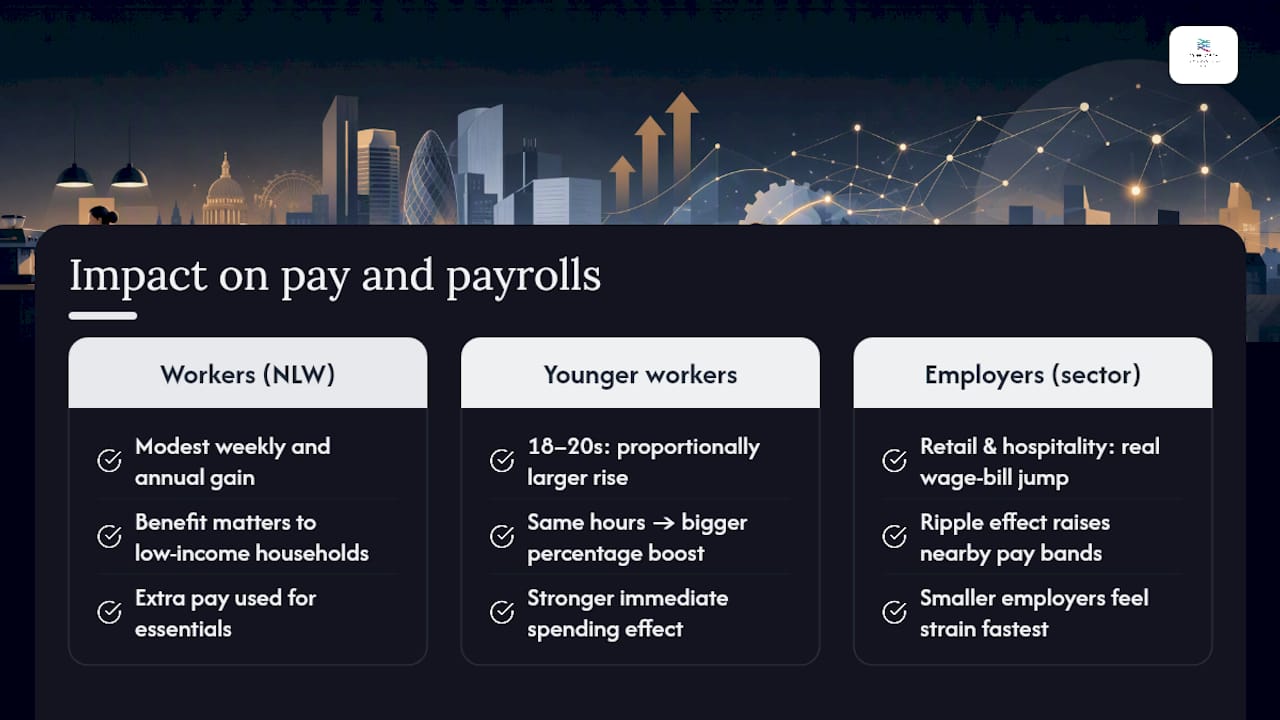
For an individual on the National Living Wage working a standard week, the rise adds a modest weekly and annual amount before tax. For an 18 to 20 year‑old on the same hours, the increase is proportionally higher. Those numbers matter more to lower‑income households than the percentages suggest, because a bigger share of that extra pay goes straight into essential spending rather than savings.
For businesses, the picture depends heavily on how many staff sit near the minimum rates. A retailer or hospitality business with a large proportion of staff on or near the National Living Wage faces a real jump in its wage bill, not just for the workers directly affected but often for those just above the new rate too, as employers adjust internal pay scales to preserve differentials between roles. This “ripple effect” up the pay scale is one of the less obvious costs of a minimum wage increase, and it’s the part that catches smaller employers out when they only budget for the headline rate rise.
The Low Pay Commission’s own reasoning behind the 2026 figures explicitly tries to balance these two pressures: giving workers a meaningful real‑terms gain while keeping the increase manageable enough that it doesn’t push smaller employers into cutting hours or headcount. Whether that balance holds in practice varies by sector. Hospitality and retail businesses running on thin margins tend to feel the strain fastest, while larger employers with more pricing power generally absorb it into wider cost planning. For a small business owner in Leeds or Garforth running a tight team, the honest answer is that the rise is manageable with proper planning, but it needs planning, not a shrug and a hope that the software sorts itself out.
Exemptions and situations that don’t fit the standard rules
Most workers fall neatly into one of the four rate bands, but a handful of categories sit outside the standard framework entirely, and employers who assume everyone qualifies the same way sometimes get caught out.
Genuinely self‑employed contractors aren’t entitled to the minimum wage at all, because the law only covers workers and employees, not people running their own business and invoicing for services. The distinction between “self‑employed” and “worker” isn’t always obvious on paper, and HMRC will look at the actual working relationship, not just the label on the contract, when deciding which applies.
Company directors who have no contract of employment, certain members of the armed forces, and prisoners doing work as part of their sentence also fall outside the standard entitlement. Volunteers working for genuine charities, and some categories of unpaid work experience placements tied to education, likewise sit outside the rules, though the boundaries here are narrower than many employers assume, and using “work experience” as a label to avoid paying someone doing a real job is a common enforcement target.
Live‑in carers and some domestic workers in a family home have their own separate treatment, often tied to whether they’re treated as a member of the family rather than an employee. Given how easily these categories get misapplied, and how much a wrong assumption can cost in back pay, it’s worth checking any borderline case against official guidance, or getting a second opinion, before treating someone as exempt.
Does the minimum wage differ across England, Scotland, Wales and Northern Ireland?
No. The National Living Wage and National Minimum Wage are set at a single UK‑wide rate, applying identically whether a worker is based in Leeds, Cardiff, Edinburgh or Belfast. Unlike income tax bands, which Scotland sets differently to the rest of the UK, minimum wage law is reserved to Westminster and doesn’t vary by nation or region.
That said, devolved governments occasionally set their own pay expectations for public sector contracts or their own employees, which can sit above the statutory floor without changing the legal minimum itself. The Welsh Government and Scottish Government, for instance, have both at times encouraged public bodies to pay above the statutory rate, but that’s a procurement or policy choice, not a change to the legal minimum wage rate that applies to every employer regardless of location.
For an employer with staff spread across different parts of the UK, this at least keeps one part of payroll simple: the same four rates and the same accommodation offset apply everywhere, with no need to run separate calculations by nation the way you might for certain tax reliefs.
How the National Living Wage compares to the Living Wage
The National Living Wage and the “Living Wage” sound like the same thing, and confusing them is one of the most common mistakes in this whole area. They are not the same, and mixing them up in a job advert or contract can mislead applicants.
The National Living Wage is the statutory legal minimum discussed throughout this article, currently £12.71 for workers aged 21 and over from April 2026. It’s set by Government, backed by law, and enforceable by HMRC.
The Living Wage, calculated separately by the Living Wage Foundation, is a voluntary benchmark based on the actual cost of living, and it tends to sit meaningfully higher than the statutory rate. Employers who pay it do so voluntarily, often to attract or retain staff, and can apply to become accredited Living Wage employers. There’s no legal requirement to pay it, and no enforcement mechanism behind it the way HMRC enforces the statutory minimum.
For a jobseeker comparing offers, it’s worth checking which one an employer means when they mention a “living wage” in a job advert, since the gap between the two figures can be substantial. For an employer, using the wrong term in a contract or advert doesn’t create a legal obligation to pay the voluntary rate, but it can create confusion and, in some cases, a reasonable expectation that’s awkward to walk back once a worker has accepted the role.
What happens next: the review cycle for future rate rises
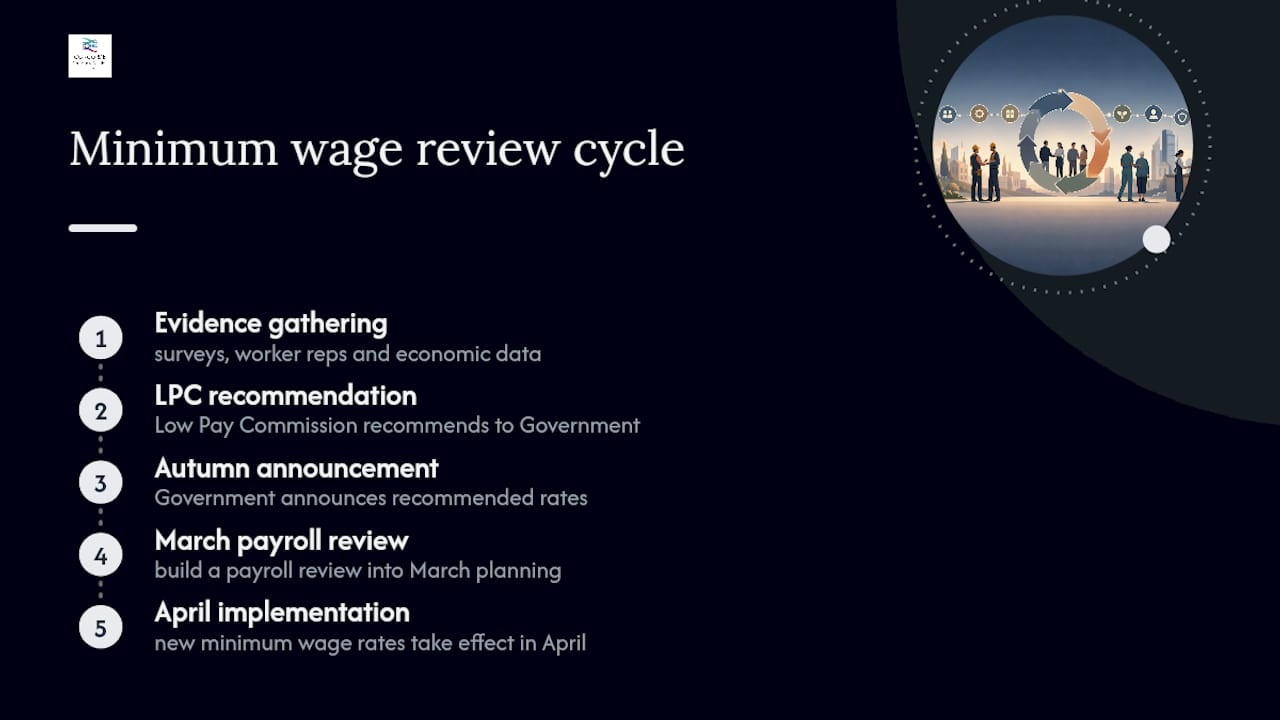
Minimum wage rates don’t get set once and left alone. The Low Pay Commission runs an ongoing annual review, gathering evidence through the year from employer surveys, worker representatives and economic data, before making recommendations to Government that typically get announced in the autumn ahead of implementation the following April.
The Government’s remit for the National Living Wage continues to target two‑thirds of median UK earnings, which means future rises will keep tracking wage growth across the economy rather than a fixed annual percentage. If median pay grows faster, expect a bigger jump the following April; if it stalls, expect a smaller one.
For the 18 to 20 rate specifically, the direction of travel has been toward narrowing the gap with the adult rate over successive years, and there’s no sign of that policy shifting. Employers with a lot of younger staff should expect the proportional gap between age bands to keep closing, not widening, in future upratings.
For any UK business, the practical takeaway is to treat the April rate change as a fixed date in the annual calendar, not a surprise. Building a payroll review into your March planning each year, rather than reacting to a Statutory Instrument once it’s already in force, saves a lot of last‑minute correction work.
A local accountant’s view on the 2026 rate rise
The pattern is consistent every year: apprentice transitions and accommodation offsets cause more genuine, accidental underpayment than businesses deliberately cutting corners. Concorde Company Solutions Limited runs payroll for small businesses across Garforth, Leeds and Sherburn in Elmet, and the same handful of errors turn up repeatedly: an apprentice’s 12‑month anniversary missed by a fortnight, a birthday that quietly moves someone into a new age band mid‑payroll cycle, or an accommodation deduction that’s crept above the daily offset without anyone noticing.
Concorde Company Solutions Limited has built its reputation locally on catching these before HMRC does, with transparent pricing and the kind of hands‑on support that’s earned it standing as the number one accountancy firm in Garforth, Leeds. Getting this right isn’t about ticking a box once a year. It’s about a payroll process that flags the change automatically, every time, without relying on someone remembering a date.
— David
Get your payroll checked before the 1 April deadline
Concorde Company Solutions Limited is the alternative to guessing whether your payroll software has caught every age band, apprentice anniversary and accommodation deduction correctly. Rather than discovering an underpayment when HMRC comes calling, a managed payroll service checks it before the rate change takes effect, catching the exact errors covered above before they cost you back pay and penalties.

Concorde Company Solutions Limited’s payroll services cover rate updates, age band and apprentice status reviews, record keeping, and the full run of monthly payroll processing for small businesses across Garforth and Leeds. If your business relies on younger staff, apprentices, or provides accommodation as part of employment, get a payroll review booked before 1 April 2026 to confirm every worker sits on the correct rate.
This article is general information, not a substitute for advice from a qualified financial advisor. Consult a qualified financial professional about your own circumstances before acting on anything here.
No responses yet