Yes, you can cancel your VAT registration if you have stopped trading, your turnover has dropped below the deregistration threshold, or your business structure has changed. You apply either online through your HMRC VAT account or by post using form VAT7, and you must notify HMRC within 30 days of becoming ineligible. Keep charging VAT until HMRC confirms your effective cancellation date. Accounting firms based in Garforth, Leeds, handle this process for clients regularly and can talk you through it before you touch the form.
TL;DR:
- Businesses must cancel VAT registration within 30 days of becoming ineligible, such as ceasing trading, legal entity changes, or disbanding a VAT group, to avoid penalties.
- Voluntary deregistration requires evidence that next year’s projected turnover will fall below the threshold, with HMRC scrutinizing forecasts closely.
- Online cancellation via HMRC is faster and preferred, but postal applications with form VAT7 are still available for certain complex situations, requiring supporting evidence.
- Final VAT returns must include VAT on assets and stock still held at deregistration, with careful asset valuation to prevent unexpected cash-flow surprises.
- Incorrect cancellation, especially during sales or restructuring, risks creating VAT complications; professional advice helps ensure the right approach and timing.
Table of Contents
- When you must cancel your VAT registration
- Can you deregister voluntarily on turnover grounds?
- How do you apply: online versus form VAT7?
- How long does cancellation take, and what should you expect from HMRC?
- What happens to your final VAT return, stock, and assets?
- When should you avoid cancelling altogether?
- How do you decide if deregistration is the right move?
- How Concorde Company Solutions supports VAT deregistration and compliance
- Concorde Company Solutions: how we handle your VAT deregistration
- A practical note from local practice
- Sources
When you must cancel your VAT registration
Cancellation stops being optional the moment certain events happen. HMRC treats these as compulsory triggers, and missing the window creates a genuine compliance problem, not just an administrative headache.
You are legally required to cancel your VAT registration when:
- You stop trading or stop making taxable supplies altogether.
- You sell your business as a going concern (though transferring the registration is often more appropriate than cancelling it outright).
- Your legal entity changes, for example converting a sole trader business into a limited company.
- Your business joins or disbands a VAT group.
- You no longer meet the conditions for a special scheme, such as certain distance-selling arrangements, that originally justified registration.
The deadline that trips people up is the 30-day rule. Once you become ineligible for VAT registration, you have 30 days to notify HMRC, and missing it can trigger a penalty under Section 69 of the VAT Act 1994. HMRC does not send a reminder. The clock starts on the date of the triggering event, not the date you get round to dealing with the paperwork.
HMRC typically wants evidence to back up your notification: closure of business bank accounts, final trading dates from your accounts, a sale contract if the business changed hands, or Companies House filings confirming a change of legal status. If you are unsure whether your circumstances count as compulsory deregistration, HMRC’s compliance guidance is worth reading before the 30-day clock runs out, because getting this wrong is expensive and entirely avoidable.
Can you deregister voluntarily on turnover grounds?
Voluntary deregistration is available if you reasonably expect your taxable turnover over the next 12 months to fall below the deregistration threshold. This is a forward-looking test, not a backward one. HMRC does not care what you turned over last year; it wants to know what you expect to turn over next.
The catch is that HMRC has to be reasonably satisfied that your projection is genuine, and it will ask for evidence rather than take your word for it. Acceptable proof usually includes:
- A documented drop in trading hours or a change to part-time operation.
- Loss of a major contract or client that accounted for a significant share of turnover.
- A deliberate business decision to reduce prices or scale down services.
- Management accounts or forecasts showing the projected turnover trajectory.
Seasonal businesses and anyone who has had a volatile trading year should expect closer scrutiny. HMRC has seen every version of “turnover will definitely drop next year” and knows which ones hold up. If your evidence is thin, expect a request for more detail or, in some cases, a refusal.
Timing the effective date matters too. Choose a date too early and you might still owe VAT on supplies made before it; choose one too late and you carry an unnecessary compliance burden. If you are close to the VAT registration threshold, it is worth mapping out your actual turnover trend before applying, because a refusal wastes weeks you could have spent trading normally.
How do you apply: online versus form VAT7?
Most businesses cancel online through their HMRC VAT account, and this is the route HMRC recommends because it processes faster and cuts out postal delays. Postal applications using form VAT7 still exist for situations the online system cannot handle, such as disbanding a VAT group or deregistering following liquidation.
Applying online:
- Log into your HMRC VAT account using your Government Gateway credentials.
- Select the option to cancel your VAT registration.
- State your reason for cancelling: ceased trading, below threshold, change of legal status, or another qualifying reason.
- Enter your proposed effective date and check it against your last taxable supply or the date turnover fell below threshold.
- Declare the value of any business assets and stock you are holding on which you originally reclaimed input VAT.
- Submit and retain the confirmation reference for your records.
Applying by post with VAT7:
- Download form VAT7 from GOV.UK and complete it in full, including your VAT registration number and reason for cancellation.
- Attach supporting evidence relevant to your reason, such as a sale agreement, cessation date, or group restructuring paperwork.
- Print, sign, and post the form to the address printed on the form itself, which varies depending on the type of application.
- Keep a copy of everything you send, ideally scanned, before it goes in the post.
- Wait for written confirmation rather than assuming the cancellation has gone through.
Supporting documents HMRC commonly asks for include your final set of accounts, an asset schedule showing anything still on the books, bank statements confirming trading has stopped, and Companies House confirmation for entity changes.
Pro Tip: Build your asset schedule before you start the application, not after HMRC asks for it. List every asset on which you reclaimed VAT, its current value, and the VAT originally claimed. This single document saves more back-and-forth with HMRC than anything else you can prepare.
How long does cancellation take, and what should you expect from HMRC?
Online applications generally move faster than postal ones, largely because there is no printing, posting, or manual data entry involved on either side. Postal VAT7 applications tend to take longer, particularly during HMRC’s busier filing periods, so factor that into any deadline you are working towards.
The 30-day rule cuts both ways. You have 30 days to notify HMRC of a compulsory deregistration event, but HMRC’s own processing of your application is separate from that notification deadline. Notifying on time protects you from a Section 69 penalty; it does not mean cancellation happens instantly.
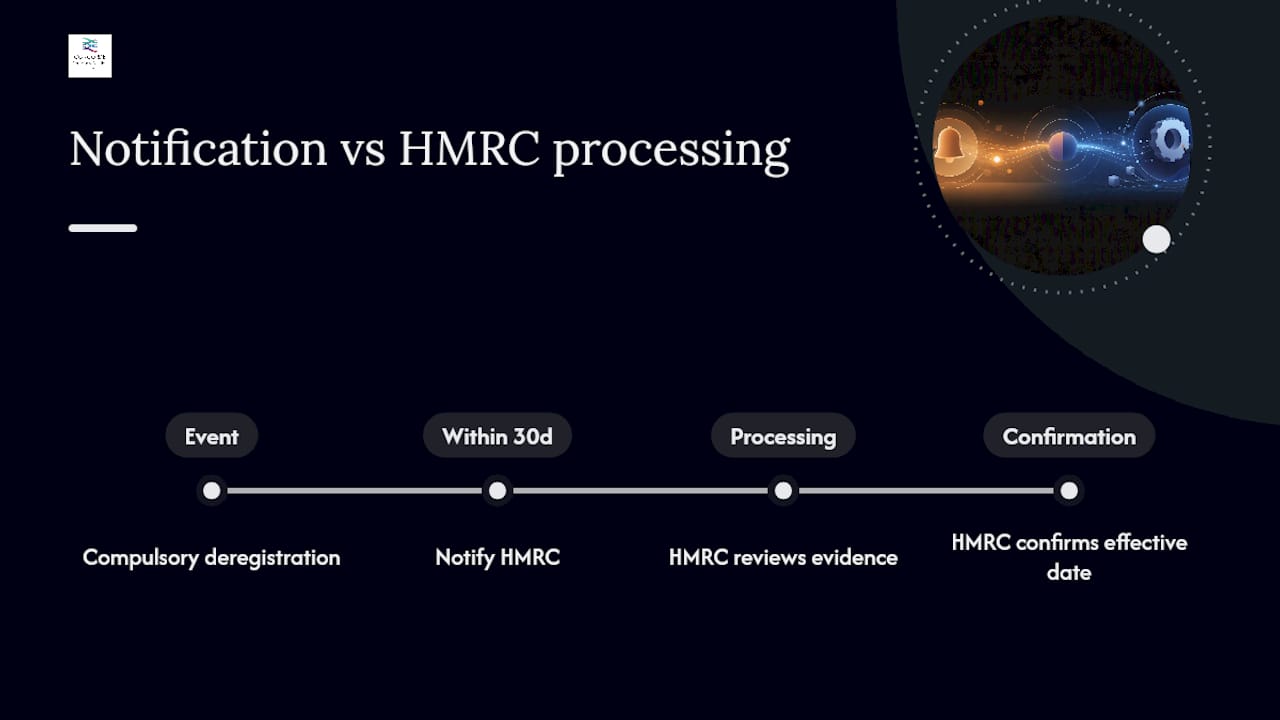
HMRC sets your effective cancellation date based on the reason you give and the evidence you submit, not necessarily the date you request. This is the point most business owners get wrong: you must keep charging VAT on every taxable supply until HMRC confirms that effective date, even if you are certain your application will be approved. Stop early and you risk under-declaring VAT you were still liable to charge.
Confirmation arrives either through a notice in your HMRC VAT online account or a letter through the post, depending on how you applied. Check your account regularly rather than waiting for a letter that might be delayed, and do not change your invoicing or pricing until that confirmation is in hand.
What happens to your final VAT return, stock, and assets?
Your final VAT return is not a normal quarterly return. It covers a specific period ending on your cancellation date, and it must include VAT on business assets you are still holding if you originally reclaimed input tax on them. HMRC calls these deemed supplies: you are treated as having supplied the assets to yourself on the day registration ends, and output VAT becomes due accordingly.
Assets and stock that typically need declaring:
- Stock still on the shelves that you have not yet sold.
- Equipment, vehicles, and fixtures on which you reclaimed VAT at purchase.
- Work in progress where VAT was reclaimed on materials.
- Any goods bought specifically for resale that remain unsold at deregistration.
There is a practical de minimis point that catches many small businesses out: if the total VAT due on deemed supplies is below a low threshold, currently around £1,000, you do not need to account for it. Cross that line and the full amount becomes payable on your final return, not just the excess.
Calculating this properly means valuing assets at their current market value on the effective date, not their original purchase price, then applying the appropriate VAT rate. For a business with a van, some office equipment, and leftover stock, this figure can run into thousands of pounds, which catches out anyone who has not planned for it. That is a genuine cash-flow shock if you have not budgeted for it, particularly for businesses winding down where cash is already tight.
Keep every record: purchase invoices for reclaimed assets, stock valuations, and your final return calculations. HMRC can query a final return well after you have deregistered, and “we cancelled months ago” is not a reason it accepts for missing paperwork.
Pro Tip: Reconcile your asset register against what you originally reclaimed input VAT on before you submit your cancellation application, not after. It is far easier to fix a discrepancy while you still have full trading records to hand than three months into being deregistered.
For businesses that want a second pair of eyes on this calculation, Concorde’s guide to VAT returns step by step covers the mechanics of getting a return right, including the final one.
When should you avoid cancelling altogether?
Cancellation is not always the correct move, even when it looks like the obvious one. Getting this wrong can leave the buyer of your business, or your own group structure, in a worse position than if you had left the registration alone.
Situations where cancellation is the wrong call:
- Selling as a going concern. If you are selling the business rather than closing it, transferring the VAT registration to the buyer is usually the correct treatment, not cancelling it. Cancelling here can create VAT complications for both parties and may trigger deemed supply charges that a transfer avoids.
- VAT group restructuring. If a company is leaving or joining a VAT group but the wider business keeps trading, use form VAT50/51 to amend the group rather than cancelling an individual company’s registration incorrectly.
- Insolvency and liquidation. These follow separate HMRC procedures, and an insolvency practitioner typically manages VAT obligations as part of the wider process rather than the director filing a standard cancellation.
Getting the category wrong here is one of the more expensive mistakes in this whole process, because unwinding an incorrect cancellation is far harder than getting the right form filed the first time.
How do you decide if deregistration is the right move?
Run through this before you file anything, ideally with your accountant sitting across the table.
- Check your projected turnover realistically. Not what you hope will happen, what your actual pipeline and contracts support over the next 12 months.
- Total your asset exposure. Work out the deemed supply VAT you would owe on stock and reclaimed assets at today’s values.
- Look at your supply mix. If most of what you sell is zero-rated, deregistering may save you very little admin while still costing you input VAT recovery on purchases.
- Think about your customers. VAT-registered business customers reclaim VAT you charge them, so losing your registration can make your pricing look higher to them, not lower.
- Consider re-registration risk. If turnover is likely to bounce back above the threshold within a year or two, weigh the hassle of deregistering now against registering again shortly after.
Questions worth putting to HMRC or your accountant before you apply: what effective date best matches your circumstances, what evidence will actually satisfy a voluntary application, and whether your specific asset position pushes you over the deemed supply threshold.
How Concorde Company Solutions supports VAT deregistration and compliance
Concorde Company Solutions Limited handles VAT deregistration for clients across Garforth, Leeds, and Sherburn in Elmet as part of its wider bookkeeping and VAT service, and the firm has built a genuine reputation as the number one accountancy practice in Garforth, Leeds for getting this kind of compliance work right first time.
The practical support includes preparing the final VAT return with deemed supplies calculated correctly, valuing your asset register before you submit anything to HMRC, and liaising directly with HMRC where an application needs additional evidence or has stalled. That liaison work matters more than people expect: a query from HMRC that sits unanswered for a fortnight can delay your effective date by weeks.
Working with an accountant on deregistration removes the guesswork around effective dates, deemed supply thresholds, and which form actually applies to your situation. For a small business owner already stretched across sales, staff, and everything else, that is often the difference between a clean cancellation and a drawn-out correction six months later.
Concorde Company Solutions: how we handle your VAT deregistration
Cancelling VAT registration correctly the first time saves you the cost of fixing it later, and that is exactly where some accountancy firms earn their reputation locally.

We prepare your final VAT return with the deemed supplies and asset valuations calculated properly, so you are not caught out by an unexpected output tax bill on stock or equipment. We deal with HMRC directly when a cancellation application needs supporting evidence, so you are not stuck on hold trying to explain your circumstances yourself. And because we already handle bookkeeping and VAT returns for businesses across Leeds and Sherburn in Elmet, we spot the asset and stock issues that catch out DIY applications before they become a problem.
If your business is going through a bigger change, a sale, a restructure, or a wind-down, our advisory service covers the VAT decision alongside the wider financial picture. Get in touch and we will tell you plainly whether cancellation is the right move for your circumstances, and handle the paperwork if it is.
A practical note from local practice
The businesses that get deregistration wrong almost always make the same mistake: they stop charging VAT before HMRC confirms the effective date. Don’t. Wait for the letter or the account notice, then stop, not before.
Second tip: build your asset schedule the week you decide to deregister, not the week HMRC asks for it. And third, if your turnover is borderline, run the numbers for three months before you apply rather than one. HMRC can tell the difference between a genuine dip and a lucky quiet month, and so can accountants when clients bring figures for review.
Keep every record longer than you think you need to. HMRC’s questions tend to arrive months after you have mentally closed the file.
— David
This article is general information, not a substitute for advice from a qualified financial advisor. Consult a qualified financial professional about your own circumstances before acting on anything here.
No responses yet