If your client qualifies as a small company under the Companies Act, it does not have to apply the reformed off-payroll rules, and it will not issue a Status Determination Statement. That responsibility, and the tax risk that comes with it, sits with your own intermediary instead. Whether a client qualifies comes down to a two-out-of-three test on turnover, balance sheet, and headcount, and the thresholds for that test have just gone up.
TL;DR:
- Companies meeting the new thresholds of a £15 million turnover and a £7.5 million balance sheet for two consecutive years qualify as small and do not issue or rely on a Status Determination Statement.
- The exemption shifts responsibility for IR35 status decisions to your intermediary, with liability if the client incorrectly qualifies or disqualifies the small company status.
- Thresholds for small company status increased starting April 6, 2025, meaning more organizations will qualify as small in 2026 without shrinking, affecting their IR35 obligations.
- Always obtain written confirmation of small company status and review filed accounts to avoid reliance on the client’s verbal statement or outdated information.
- Group aggregation rules can cause a small company to lose exemption if part of a larger group containing a non-small entity, especially in cases of mergers, takeovers, or rapid growth.
Table of Contents
- What is the IR35 small company exemption?
- What the exemption changes: who decides status and who pays
- Threshold changes and the 2026 timeline
- How to check and evidence a client’s small status
- Group rules and situations that catch people out
- Concorde Company Solutions’ perspective on getting this right
- How Concorde Company Solutions can help with IR35 and payroll
- Where to check the rules yourself
- Sources
What is the IR35 small company exemption?
The small company exemption for off-payroll working is based on the Companies Act 2006 size criteria, meaning private-sector clients meeting that definition are exempt from the reformed Chapter 10 off-payroll working rules, affecting who is responsible for compliance and risk.
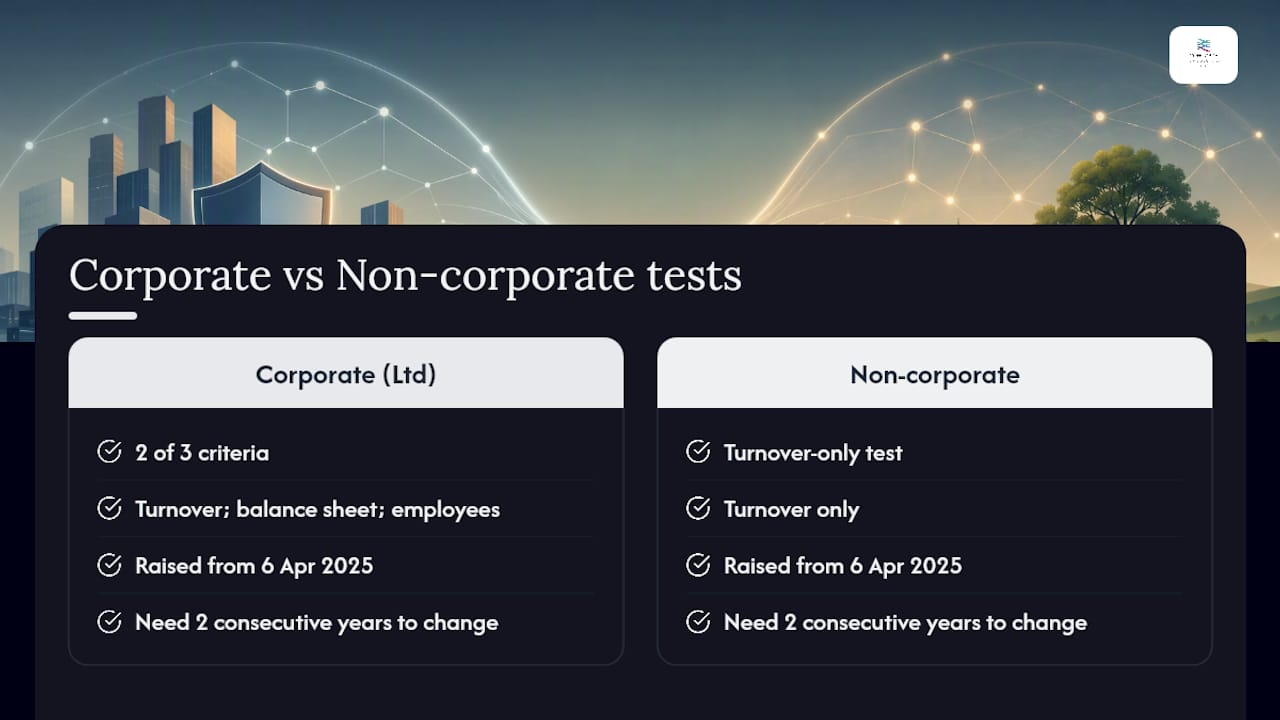
A company qualifies as small when it meets at least two out of three conditions based on turnover, balance sheet, and employees, at thresholds that were increased starting from financial years beginning on or after 6 April 2025, notably higher than the previous limits.
The thresholds for turnover, balance sheet total, and employee number were increased for accounting periods beginning on or after 6 April 2025, and a corporate client generally needs to meet the size criteria for two consecutive financial years to change status. Micro-entities have separate smaller limits and qualify as small companies as well.
Non-corporate clients (sole traders, unincorporated partnerships, and some unregistered bodies) do not use the two-out-of-three test at all. They apply a simplified turnover-only test, which matters if you contract for a small partnership rather than a limited company.
One quirk catches people out: a company is automatically treated as small in its first financial year, regardless of its actual size, and that status typically holds until the tax year following its first accounts filing. New clients often benefit from this without realising it.
What the exemption changes: who decides status and who pays
IR35 has always split into two regimes, and mixing them up causes most of the confusion contractors bring to us. Chapter 8 is the original 2000 legislation, and it still governs engagements with public-sector bodies and, crucially, with small private-sector clients. Chapter 10 is the 2017/2021 reform that shifted status decisions onto medium and large clients.
When a client is small, three things follow directly:
- The client does not issue a Status Determination Statement, and has no statutory duty to assess your engagement.
- Your own intermediary, typically your personal service company, remains responsible for deciding whether the engagement falls inside or outside IR35.
- If that determination is wrong, the PAYE and National Insurance liability lands on your company, not the client.
Agencies still have a role even here. Where a fee-payer sits in the chain, HMRC’s flowchart shows they still need clarity on who the client is and whether the small exemption genuinely applies, because getting that wrong exposes the whole chain to enquiry.
Threshold changes and the 2026 timeline
SI 2024/1303 raised the Companies Act thresholds for financial years beginning on or after 6 April 2025, lifting the turnover limit to £15 million and the balance sheet limit to £7.5 million.
That timing detail matters more than it looks. Because accounts file well after a company’s year-end, and often up to nine months later, the size that applies for a given tax year can lag behind what current filed accounts actually show. A client can be genuinely small under the new rules before its published accounts reflect that.
- The higher thresholds apply to financial years starting on or after 6 April 2025.
- Two consecutive qualifying years are usually needed before a corporate client’s status changes.
- From April 2026, more organisations will qualify as small purely because the bar has moved, not because their business has shrunk.
The practical effect for 2026 and beyond is that a meaningful number of clients currently issuing SDS documents will stop being required to. Some contractors who have never had to self-assess status will suddenly find that job back in their own hands, and the tax exposure that comes with it moves too.
How to check and evidence a client’s small status
Do not take a client’s word for it verbally and leave it there. HMRC guidance is explicit that if a client misstates its size and you relied on that, your company can still end up carrying the liability.
- Ask for written confirmation of small status before you sign, not after.
- Request the client’s most recently filed accounts, or at least the relevant turnover, balance sheet, and employee figures.
- Check whether the client sits in a group structure, since group aggregation rules can change the answer.
- Keep every confirmation email, accounts extract, and any SDS or written statement for as long as the engagement runs, and ideally several years beyond it.
- If the client’s size is borderline, changing, or recently affected by a takeover, flag it to your accountant before you rely on the small exemption.
Pro Tip: Save the client’s confirmation alongside your own IR35 status assessment in the same folder. If HMRC ever queries the engagement, having both documents dated and together is far more persuasive than producing them separately months later.
Group rules and situations that catch people out
The extended group definition used for off-payroll working purposes is wider than most directors expect, and it is where genuine mistakes happen most often.
- A small trading subsidiary can lose its exemption if its wider group contains a non-small member, even if the subsidiary itself would pass the test alone.
- Certain company types are excluded from the small company regime regardless of size, including public limited companies, banks, insurers, and firms authorised under MiFID.
- Joint ventures complicate aggregation further, since ownership structure can pull a seemingly small entity into scope.
- Watch for takeovers, mergers, or rapid headcount growth mid-year, since any of these can change a client’s classification before the next set of accounts even confirms it.
Concorde Company Solutions’ perspective on getting this right
We have worked through more IR35 status checks with Garforth and Leeds clients than most local firms, and the group aggregation trap catches good businesses more often than the raw thresholds ever do. A director will confidently tell a contractor their company is small, without realising a parent entity elsewhere in the group pulls the whole structure out of scope.
Clients who get written confirmation sorted before an engagement starts see noticeably fewer HMRC queries, and liability sits exactly where it should from day one. If you are unsure where your business or your client sits, bring your latest accounts and contract terms in and we will work through it properly, rather than guessing.
— David
How Concorde Company Solutions can help with IR35 and payroll
Concorde Company Solutions Limited is the trusted local choice for IR35 reviews, payroll, and statutory accounts, and we hold that position as the the number one accountancy firm in Garforth, Leeds for a reason: we handle the group-structure and threshold detail that generic online checkers miss entirely.

If you are a contractor uncertain whether a client’s small status genuinely applies, or a small business director wanting confirmation you are classifying correctly, bring us your latest accounts, group structure, and contract terms. We will check the two-out-of-three test properly, confirm where liability sits, and set up compliant payroll if you need PAYE handled correctly from the outset. For businesses across Garforth and Leeds already juggling bookkeeping alongside this, our local payroll services run alongside your existing setup without disruption. Get in touch today and let us take the guesswork out of your next engagement.
Where to check the rules yourself
For the primary source material behind this article, start with GOV.UK’s off-payroll working guidance, HMRC’s internal manual on Chapter 10, and the statutory instrument that raised the Companies Act thresholds. Micro-entity definitions are covered in more detail in our guide to micro-entities.
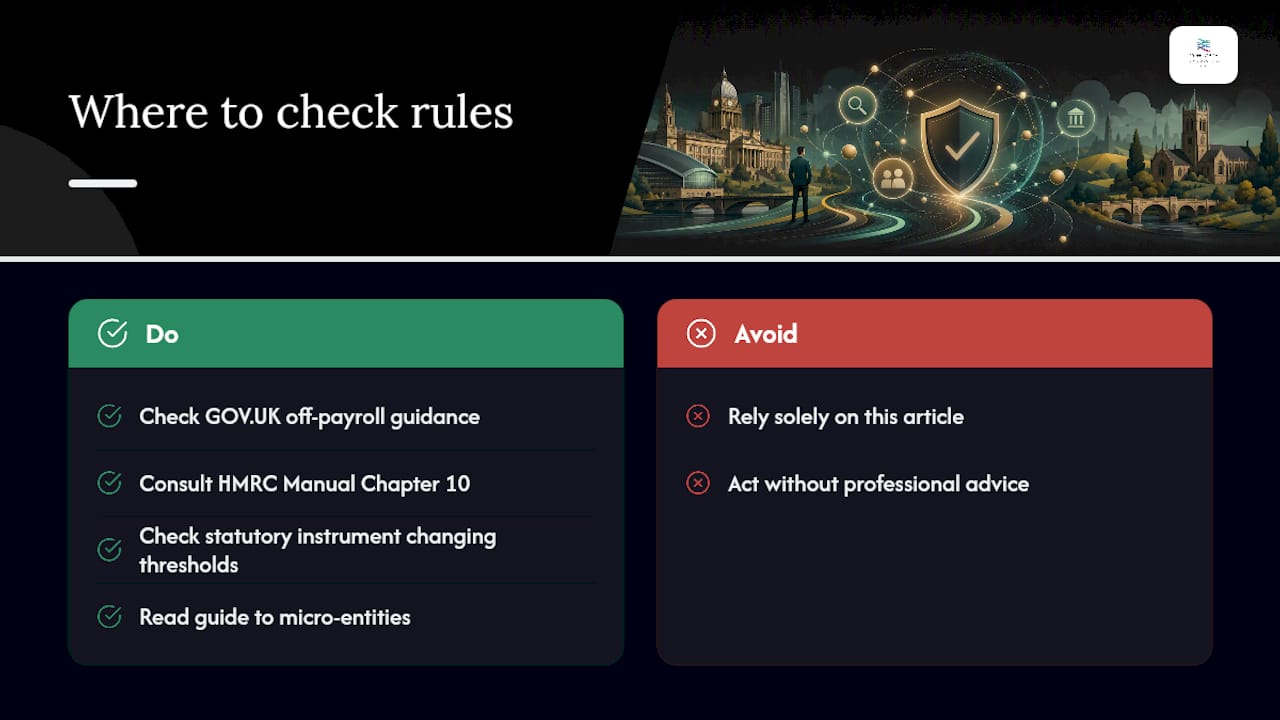
This article is general information, not a substitute for advice from a qualified financial advisor. Consult a qualified financial professional about your own circumstances before acting on anything here.
Sources
- The Small Companies and Groups (Accounts and Directors’ Report) Regulations (SI 2024/1303)
- ESM10006 – off-payroll working legislation: Chapter 10, ITEPA 2003
- Threshold changes to UK off-payroll working rules (IR35): End user and contractor considerations | GT L&E Blog
No responses yet