Yes, shareholders can remove a director by ordinary resolution under section 168 of the Companies Act 2006, regardless of what the articles or the director’s contract say. The catch is procedure: you need special notice at least 28 clear days before the meeting, and removing someone from office does not end their employment. Start by confirming you have the votes, then prepare the special notice.
TL;DR:
- Ensuring all voting rights, articles, agreements, and service contracts are checked prevents invalid removal and potential legal claims.
- Proper procedural steps require a general meeting, special notice 28 days prior, and disclosure of representations to avoid void removal.
- Negotiating a resignation often reduces disruption and legal risks compared to contested votes, especially if settlement costs are modeled early.
- Removing a director does not end their employment contract; employment law obligations remain separate and require HR or legal advice.
- Accurate, timely filing of TM01, updating registers, and revoking access are essential to avoid penalties and disputes during the administrative cleanup.
Table of Contents
- How do you remove a company director?
- Statutory removal under Companies Act 2006 s.168
- Special notice, director’s rights and running the meeting
- Should you negotiate a resignation instead of forcing a vote?
- Does removing a director end their employment?
- Filing TM01 and sorting the admin afterwards
- What paperwork should you keep, and for how long?
- What Concorde Company Solutions does when you’re removing a director
- The straight answer to what actually goes wrong here
- Get your removal handled properly, start to finish
- Sources
How do you remove a company director?
Get five checks right before you touch a resolution. Skip any of these and you risk an invalid removal, or worse, a tribunal claim months later.
- Voting rights. Confirm who actually holds voting shares and whether any class has weighted or blocking rights over this kind of decision.
- Articles and shareholders’ agreements. Some articles impose extra conditions on removal, and shareholders’ agreements sometimes carry separate exit or good leaver clauses that sit alongside the statute.
- Service contract status. Check notice periods, termination clauses, and whether the director is also an employee, because that changes the risk profile entirely.
- Negotiation feasibility. Work out honestly whether a resignation and settlement would be faster and cheaper than a contested vote.
- Filing and access plan. Line up who will file the TM01, and who needs to change bank mandates, software logins, and building access the moment the resolution passes.
Pro Tip: Draft the special notice and the Companies House filing checklist in the same sitting. Most delays happen because nobody assigned the admin tasks until after the meeting.
Statutory removal under Companies Act 2006 s.168
Section 168 gives shareholders the power to remove a director by ordinary resolution at a general meeting, and that right cannot be blocked by the articles or by any service agreement the director signed. It is one of the few genuinely unshakeable rights ordinary shareholders hold over a board.
The threshold is a simple majority of the votes actually cast at the meeting, as set out in section 168 of the Companies Act 2006. Where a share class carries special voting rights over board composition, though, that class vote can still override an ordinary majority elsewhere in the company.
Two procedural points trip people up constantly:
- No written resolutions. Even if every shareholder agrees privately, the law requires a properly convened general meeting to remove a director under s.168, according to LexisNexis’s guidance on director cessation. Skip the meeting and the removal is void, no matter how unanimous the sentiment.
- Filling the vacancy. Companies often appoint a replacement at the same meeting, which affects rotation and retirement provisions in the articles going forward.
Treating this as a board decision rather than a shareholder one is the single most common mistake, since the power to remove sits with shareholders unless the articles say otherwise.
Special notice, director’s rights and running the meeting
Special notice must reach the company at least 28 clear days before the meeting where the removal will be voted on. Miss that window and the resolution cannot proceed as planned.
- The company must send a copy of the special notice to the director immediately after receiving it.
- The director is entitled to circulate written representations to shareholders and to speak at the meeting itself, protections confirmed by the IoD’s factsheet on director removal.
- Check quorum requirements and proxy rules in the articles before sending meeting notices, since these vary between companies.
- Where any share class carries special voting rights over this type of resolution, factor that into your vote count before the meeting, not after.
A director who feels blindsided rarely accepts the outcome quietly. Following these steps properly is what stops a legitimate removal turning into a legal fight.
Should you negotiate a resignation instead of forcing a vote?
A voluntary resignation with an agreed settlement is usually less disruptive than a contested removal, and it avoids the reputational fallout of a public boardroom fight. Most settlements cover pay in lieu of notice, a release from future claims, and return of company property and equipment.
Get the accounting right from the start. Loss of office payments carry specific tax treatment, and getting that wrong at the negotiation stage often costs more than the settlement itself.
- Legal advisers should lead the negotiation, but bring in accounting input early to model the actual cost of different settlement structures.
- Reserve s.168 for cases where negotiation has genuinely failed or where the director refuses to engage at all.
Pro Tip: Ask your accountant to model two or three settlement scenarios before you open talks. Knowing your real cost ceiling changes how you negotiate.
Does removing a director end their employment?
No. Removing someone from the board ends their directorship, not their job, and treating the two as the same thing is where most wrongful dismissal claims come from. If the director also holds an employment contract, that contract survives the removal and has to be dealt with separately, following ACAS’s guidance on fair process.
Before you act, work through this checklist:
- Review the service contract for notice periods, accrued holiday, and any disciplinary process the contract itself demands.
- Get HR or employment law advice before the meeting, not after.
- Consider lawful suspension if there’s a genuine conduct issue under investigation.
- Use a settlement agreement where an employment claim looks likely.
Executive directors with service contracts create a real two-track risk: the board vote can be perfectly lawful under s.168 while the company still ends up facing an employment tribunal claim for how the exit itself was handled.
Filing TM01 and sorting the admin afterwards
Once the resolution passes, the clock starts on your Companies House obligations, and this is where sloppy admin turns a clean removal messy.
- File Form TM01 within 14 days of the director’s cessation. The Gov confirms the online service is quickest and reduces the chance of rejection.
- Update the company’s register of directors and, where relevant, the PSC register the same day.
- Keep the minutes, the special notice, and any director representations on file as proof the process was followed correctly.
- Revoke bank mandates, software access, and building permissions immediately, and notify any counterparty who dealt with the outgoing director directly. A good compliance checklist helps you track every one of these steps in order.
What paperwork should you keep, and for how long?
Every step in the process generates a document, and every one of those documents matters if the removal is ever challenged.
- Special notice sent to the company and copied to the director
- Meeting notice confirming the correct notice period under the articles
- Signed minutes of the meeting and the ordinary resolution itself
- Any written representations from the director, plus proof they were circulated
- TM01 filing confirmation from Companies House
| Task | Deadline | Keep for |
|---|---|---|
| Special notice served | 28 clear days before meeting | six years |
| General meeting held | After notice period expires | six years |
| TM01 filed | Within 14 days of cessation | six years |
| Registers updated | Same day as TM01 | Ongoing |
Retaining every notice, minute, and filing confirmation for six years gives you a defensible record if the removal is ever disputed later, a point LegalVision’s guidance on appointing and removing directors makes repeatedly.
What Concorde Company Solutions does when you’re removing a director
Concorde Company Solutions Limited handles the company secretarial side that trips up most small businesses: filing TM01 correctly, updating statutory registers, and adjusting payroll the moment a director’s status changes. Late TM01 filing is a criminal offence, and small filing errors are what turn a straightforward removal into a dispute.
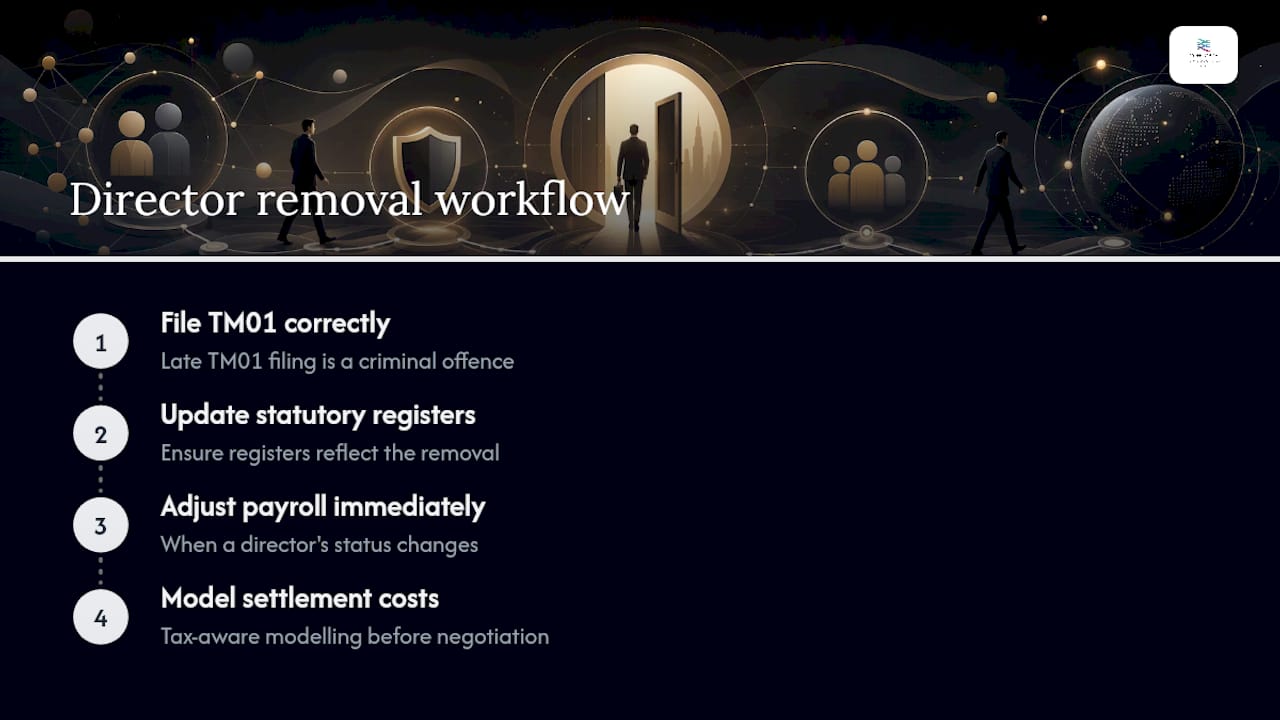
Our tax-aware advice also helps model settlement costs properly, so you know the real number before you sit down to negotiate. We handle these situations regularly for local business owners.
The straight answer to what actually goes wrong here
Most guides on this topic obsess over the statute and barely mention what happens after the vote. That’s backwards. Getting the s.168 mechanics right is genuinely the easy part, since the rule is clear and the threshold is a simple majority. What actually causes damage is everything downstream: the employment contract nobody reviewed, the TM01 filed three weeks late, the bank mandate nobody thought to change.
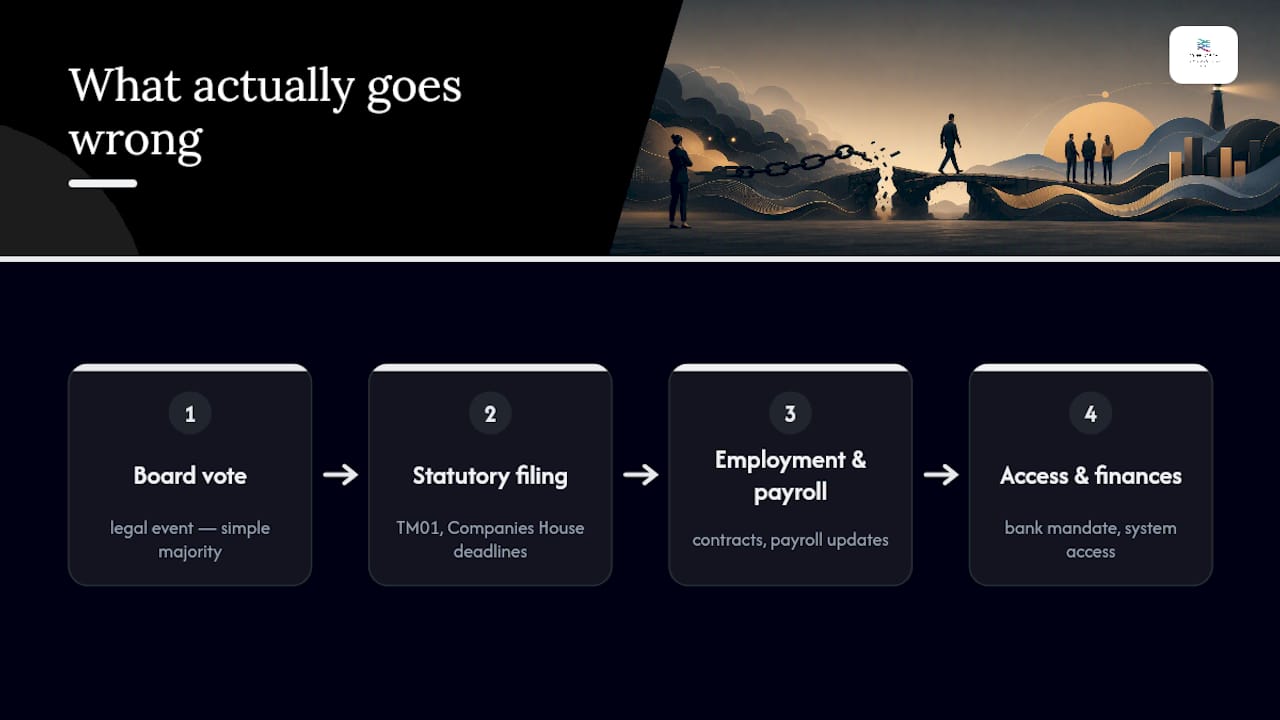
The conventional advice treats director removal as a single legal event. It isn’t. It’s a legal event followed by weeks of administrative cleanup, and the cleanup is where companies get sued, not the boardroom vote. If you take one thing from this article, prioritise the paperwork trail and the payroll and access changes as heavily as the resolution itself.
Accountant-led support matters here precisely because the risk sits in the filing deadlines and the financial follow-through, not just the legal drafting. A lawyer gets you a valid resolution. Someone needs to make sure the registers, the payroll, and the Companies House record all match afterwards.
— David
Get your removal handled properly, start to finish
A solicitor can draft your resolution, but someone still has to file TM01 on time, update your registers, and sort payroll the moment a director exits, and that’s the gap most companies fall into. Concorde Company Solutions Limited is the fixed-fee alternative to piecing this together yourself: we handle the compliance filing, the payroll changes that follow a director leaving, and the statutory admin, all under one engagement rather than three separate invoices.

As the the number one accountancy firm in Garforth, Leeds, we’ve built our reputation on getting this exact kind of compliance work right the first time, with personalised support rather than a call centre. If you’re planning a removal, book a compliance review with us now, or request a written quote covering TM01 filing, register updates, and payroll adjustment, and get advisory input on settlement cost modelling if a negotiated exit is on the table.
This article is general information, not a substitute for advice from a qualified lawyer. Consult a qualified legal professional about your own circumstances before acting on anything here.
Sources
- Companies Act 2006: section 168 — Resolution to remove director
- Gov
- Removal of a director | Factsheets – IoD
- Director removal and cessation under the UK Companies Act 2006 — LexisNexis
No responses yet