The VAT fuel scale charge is HMRC’s flat-rate output VAT figure that accounts for the private use of fuel bought through the business. You reclaim all the input VAT on fuel as normal, then add a fixed charge back onto your VAT return based on the vehicle’s CO2 band. Find the CO2 figure on the log book, round it down to the nearest multiple of 5, and match it against HMRC’s current table for your accounting period.
TL;DR:
- Businesses on the flat rate scheme typically cannot use the VAT fuel scale charge because their fixed percentage already accounts for private fuel use.
- When vehicles change mid-period, apportion the scale charge based on the number of days each vehicle was available for private use, not mileage.
- Using outdated tables, rounding the CO2 figure up, or failing to time-apportion correctly are common errors that can lead to compliance issues.
- The scale charge is best suited for businesses with one or two vehicles that have regular private use and where detailed mileage logs are costly to maintain.
- Accurate record-keeping of CO2 evidence, table updates, and vehicle changes is crucial to avoid HMRC queries and ensure correct VAT calculations.
Table of Contents
- What are the official HMRC fuel scale charge rates?
- How do you calculate and report the fuel scale charge?
- What happens when a vehicle changes mid-period?
- Who can actually use the scale charge?
- What compliance mistakes come up most often?
- When does Concorde Company Solutions recommend the scale charge?
- Get your fuel scale charge right the first time
- Sources
What are the official HMRC fuel scale charge rates?
HMRC publishes the valuation tables as tertiary legislation, which means the figures carry the force of law for the period they cover. You cannot substitute your own estimate or use last year’s numbers once a new table takes effect.
The table for 1 May 2026 to 30 April 2027 sets out three columns for every CO2 band: a 12-month figure, a 3-month figure, and a 1-month figure. Every amount is VAT-inclusive, so once you have the right row, you extract the VAT element rather than adding VAT on top. For the current period, charges for a 12-month accounting period range from £657.00 at the lowest CO2 band (120 g/km or less) up to £2,297.00 at the top band (225 g/km or more).
Here’s how a handful of bands compare across the three period lengths:
Where a CO2 figure isn’t a multiple of 5, you round it down to the nearest one, and bi-fuel vehicles use whichever of their two CO2 figures is lower, as set out in the VAT tertiary legislation on transport. If the log book doesn’t show a CO2 figure, or the vehicle predates CO2 reporting, the DVLA vehicle record or the Vehicle Certification Agency’s emissions guidance will confirm it. The critical date to remember is 1 May: whichever table is in force at the start of your next prescribed accounting period is the one you must use, even if that period runs into the following month.
How do you calculate and report the fuel scale charge?
The calculation follows a fixed sequence, and once you’ve done it for one vehicle, every subsequent quarter is largely repetition.
- Reclaim all input VAT on fuel. Every fuel receipt for the vehicle, business and private mileage combined, goes into Box 4 of your VAT return in full.
- Confirm the CO2 band. Check the log book (V5C) or a DVLA lookup, then round the figure down to the nearest multiple of 5 g/km.
- Match the band to your accounting period. Use the 12-month column if you file annually, the 3-month column for quarterly returns, or the 1-month column for monthly returns.
- Add the output VAT to your return. Extract the VAT portion of the scale charge figure and include it in Box 1, then record the net amount as a sale in your bookkeeping to keep the double entry correct.
Pro Tip: Book the scale charge as a separate “notional fuel sale” line in your accounting software rather than folding it into general sales. It makes the figure easy to trace if HMRC ever asks how you arrived at it.
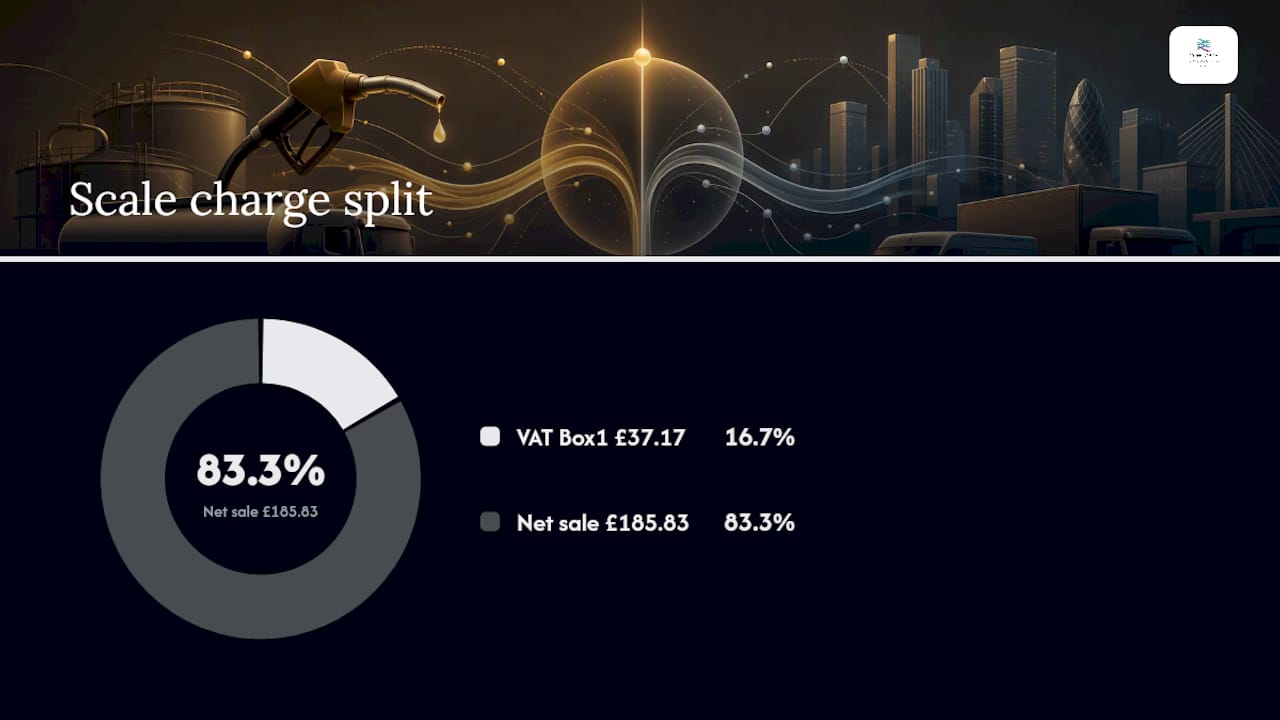
Take a business filing quarterly VAT returns with a company car emitting 158 g/km. Round that down to 155 g/km for the lookup. Say the applicable 3-month charge for that band is £223.00, VAT-inclusive. Divide by 6 and multiply by 1 to extract the VAT element (using the fraction for 20% VAT, that’s £223.00 × 1/6 = £37.17). That £37.17 goes into Box 1 as output VAT for the quarter, while the full input VAT on every fuel receipt for that vehicle still goes into Box 4. HMRC’s own guidance confirms this reclaim-then-charge-back structure is the entire method.
What happens when a vehicle changes mid-period?
Swap a company car partway through a VAT quarter and the flat scale charge doesn’t apply cleanly to either vehicle for the full period. HMRC’s approach is time apportionment by days, not mileage, which is where a surprising number of businesses go wrong.
- Count the days each vehicle was available for private use within the accounting period.
- Apply each vehicle’s own scale charge on a pro rata basis for the days it was in use, using the CO2 band and period-length table appropriate to each car.
- For pooled or multi-driver vehicles, apply the charge once per vehicle rather than once per driver, since the charge relates to the car, not the individual.
- Keep a simple log (a spreadsheet row per vehicle, with start and end dates) so the apportionment calculation is easy to reconstruct if queried.
The current HMRC table makes clear the apportionment runs on accounting-period days, not distance travelled, which trips up businesses that instinctively reach for a mileage-based split.
Who can actually use the scale charge?
Not every VAT-registered business is entitled to use it, and applying it when you shouldn’t is its own compliance error.
- Businesses on the Flat Rate Scheme generally cannot use the fuel scale charge, since the flat percentage already factors in this type of cost.
- If private use is genuinely negligible, or you already keep detailed mileage logs for every trip, actual mileage apportionment may work out cheaper than the flat charge.
- If you run several vehicles with mixed private use levels, weigh the administrative saving of the scale charge against its fixed cost for each one individually rather than applying a blanket policy.
Pro Tip: If a vehicle does under 2,000 private miles a year, run the maths both ways before defaulting to the scale charge. The fixed charge assumes a level of private use that light users don’t reach.
What compliance mistakes come up most often?
Four errors account for most of the queries we see on fuel scale charge entries, and each one is entirely avoidable with a bit of process.
- Using a table that expired at the end of the previous 30 April, rather than the one in force for the current accounting period.
- Rounding the CO2 figure up, or to the nearest 5, instead of strictly down.
- Failing to time-apportion when a vehicle changes mid-period, and applying a full charge to both cars or neither.
- Confusing the VAT boxes: putting the scale charge output VAT in Box 4 instead of Box 1, or netting it against fuel input VAT rather than recording both separately.
Sage’s own advisory notes on fuel scale charges flag the mid-period apportionment error and the mileage-versus-time confusion as the two most persistent traps for bookkeeping software users. Keep fuel VAT invoices, a printout or note of the CO2 figure from the log book or DVLA, and a dated record of any vehicle changes during the year. Those three things, filed together, answer almost any HMRC query on this point without a scramble. Our detailed guide to filing VAT returns covers where these entries sit alongside the rest of your return, and pairing that with sound habits for tracking business expenses keeps the whole fuel record defensible.
Pro Tip: If you use a partner service to keep general compliance paperwork organised, such as Complete EPC’s approach to streamlining commercial compliance records, apply the same discipline to vehicle CO2 evidence. A missing printout is a small gap that becomes a real problem at inspection.
When does Concorde Company Solutions recommend the scale charge?
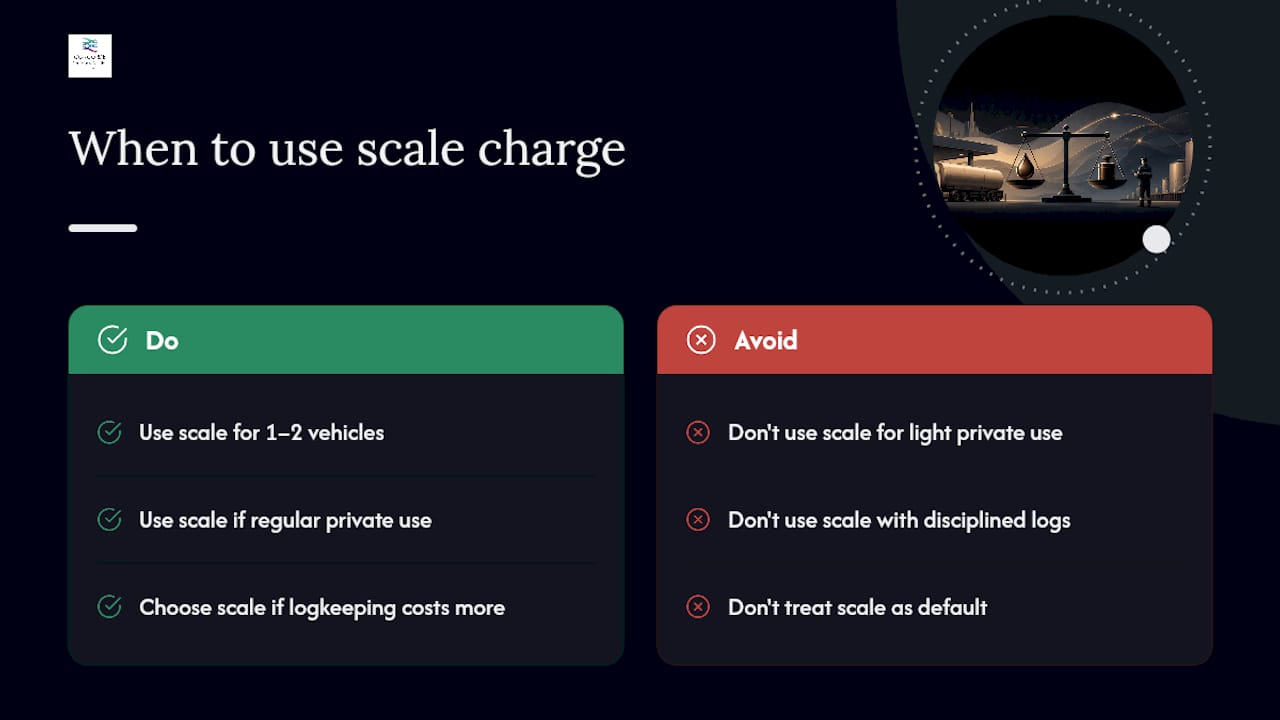
We tend to recommend the scale charge for clients running one or two vehicles with genuine, regular private use, where keeping a trip-by-trip mileage log would cost more in admin time than the flat charge costs in VAT. It’s a trade-off, not a default: for a business with light private use and disciplined mileage records already in place, the actual-use method can work out cheaper.
Concorde Company Solutions Limited has built its reputation in Garforth, Leeds, on exactly this kind of practical judgement call, and we’re proud to be the number one an accountancy firm serving businesses in Garforth. When clients change vehicles mid-year, our team runs the day-based apportionment for them and files it correctly the first time. If you’re unsure which method suits your fleet, get in touch and we’ll run the comparison for you.
— David
Get your fuel scale charge right the first time
Getting the CO2 band wrong, missing a table update, or forgetting to time-apportion a mid-year vehicle swap are the kinds of errors that sit quietly in a VAT return until HMRC asks a question you weren’t expecting. Concorde Company Solutions Limited handles this as part of routine VAT return preparation, checking the current table, the CO2 evidence, and the apportionment maths before anything reaches your return.

We work with sole traders, limited companies, and small fleets who would rather hand the calculation to someone who does it every quarter than reverse-engineer HMRC’s tables themselves. If your business has broader VAT questions beyond fuel, or you want a wider look at your finances, our advisory service covers that too. Get in touch with Concorde Company Solutions Limited today for a quick review of your next VAT return and let us confirm you’re on the correct scale charge before it’s filed.
Sources
- VAT road fuel scale charges from 1 May 2026 to 30 April 2027
- Cars and emissions – Vehicle Certification Agency guidance
No responses yet