
If your company pays you a salary as a director, you must register for PAYE before the first payday and report that pay to HMRC through Real Time Information (RTI) on or before every payday; for tailored advice on navigating this as a limited company director, see Getting a mortgage as a limited company director. There’s no grace period here. Miss it, and HMRC’s automated system doesn’t wait for an explanation before issuing a penalty.
Here’s what needs doing this week:
- Register for PAYE with HMRC before you run your first payroll, if you haven’t already.
- Choose HMRC-recognised payroll software — it calculates directors’ National Insurance correctly and files RTI for you.
- Submit your Full Payment Submission (FPS) on or before payday, every time, no exceptions.
- Set your salary at or above the Lower Earnings Limit so the year still counts towards your State Pension.
The personal allowance sits at £12,570, a figure that shapes most director salary decisions. Get the fundamentals wrong and you’re looking at HMRC penalty notices rather than a productive year. Concorde Company Solutions Limited handles this exact process for director-only companies across Garforth and Leeds every month, so if any of this feels unfamiliar, you’re not alone.
Key Takeaways
Compliant director payroll rests on registering for PAYE before the first payday, filing RTI on time every period, and setting a salary that protects your State Pension record.
| Point | Details |
|---|---|
| Register before paying | PAYE registration must happen before the first payday, not afterwards. |
| File FPS on time, always | HMRC’s automated penalty system doesn’t distinguish genuine mistakes from deliberate delay. |
| Understand the annual earnings period | Directors’ NICs are assessed cumulatively over the year, with reassessment at the final payment. |
| Protect your NI record | Setting salary at least at the Lower Earnings Limit preserves a qualifying year for the State Pension. |
| Get local expert support | Concorde Company Solutions Limited runs managed director payroll for businesses across Garforth and Leeds, handling registration, RTI filing, and NIC reassessment. |
This article is general information, not a substitute for advice from a qualified financial advisor. Consult a qualified financial professional about your own circumstances before acting on anything here.
Table of Contents
- Payroll for directors: how UK tax law treats you as an employee
- Directors’ National Insurance: the annual earnings period explained
- Choosing a director salary: dividends, State Pension and NI record
- Step-by-step payroll checklist for directors
- When to outsource payroll and what to ask a provider
- Managed payroll support from Concorde Company Solutions
- Sources
- FAQ
Payroll for directors: how UK tax law treats you as an employee
Here’s the part that catches a lot of first-time directors out: for tax and National Insurance purposes, you are considered an employee of your own company. Once the company pays you a salary, HMRC treats that payment as it would a payment to any other staff member, and the company takes on employer obligations.
That triggers PAYE registration. You need to register once you pay a director an amount above a prescribed threshold, provide employee benefits, run a workplace pension, or the director has other employment or a company car. Registration has to happen before the first payday, not after, according to HMRC’s guidance for employers.
From there, the obligations stack up:
- Operate PAYE on every payment, calculating and deducting Income Tax and Class 1 National Insurance Contributions (NICs).
- Pay employer National Insurance Contributions on top of what you deduct from the director’s pay.
- Report every payment through RTI, using an FPS submitted on or before payday.
- Pay HMRC what’s owed by the 22nd of the following month if you’re paying electronically.
HMRC’s penalty system for late RTI reporting is automated, meaning it doesn’t distinguish between a genuine oversight and deliberate non-compliance. A missed FPS deadline generates a notice regardless of intent. For the full legal detail, HMRC’s employee-directors guidance and its general PAYE for employers page are worth bookmarking, though most directors find it faster to have an accountant translate the rules into a working process.
Directors’ National Insurance: the annual earnings period explained
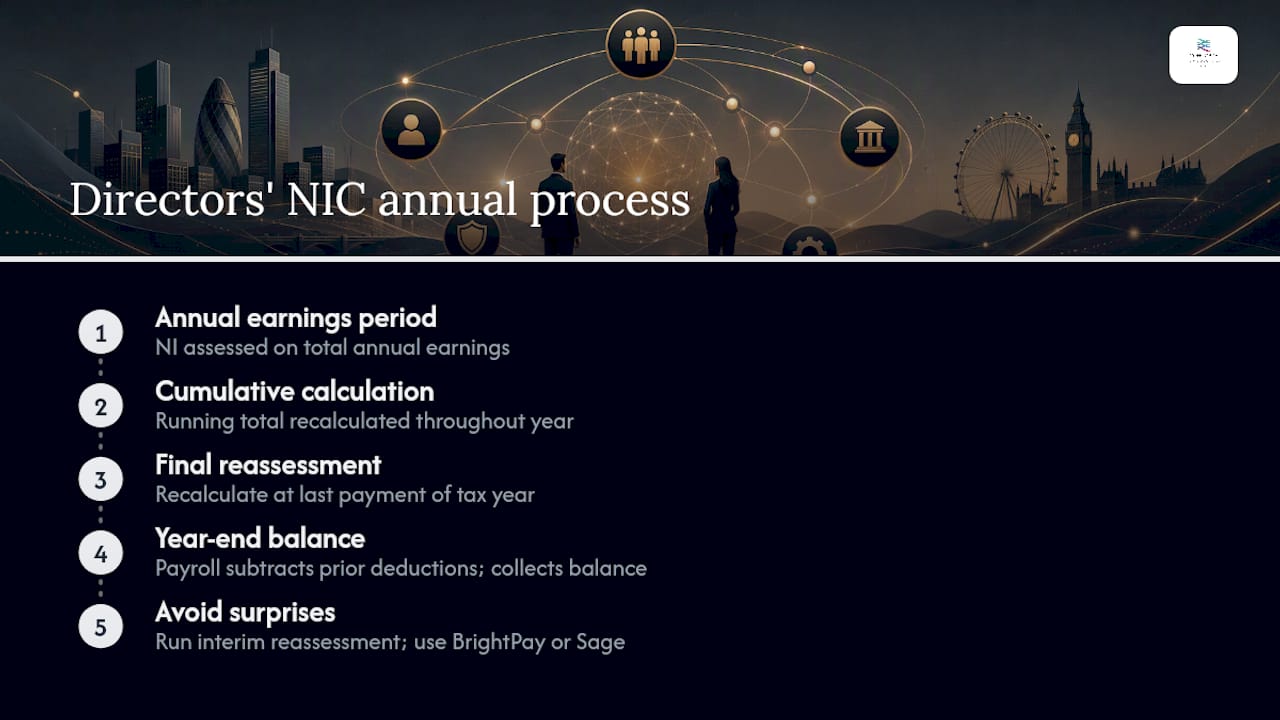
Ordinary employees have their National Insurance worked out week by week or month by month, with each pay period treated in isolation. Directors don’t get that luxury. HMRC requires directors’ NICs to be calculated using an annual earnings period (or a pro rata version if you’re appointed partway through the tax year), which means your NI liability is assessed against your total annual earnings, not each individual payment.
There is an alternative. You can pay NICs “on account” during the year, calculating contributions period by period as if you were an ordinary employee, provided certain conditions are met. Either way, the CA44 booklet sets out the mechanics in full, and it’s the definitive reference if your accountant ever needs to check a calculation.
In practice, this means cumulative calculation throughout the year, with a final reassessment at the last payment of the tax year to true up what’s actually owed against what’s already been paid.
Say a director takes irregular monthly amounts that add up to more than expected by December. At the final payment, payroll software recalculates NICs based on the full annual figure, then subtracts what’s already been deducted; the balance is collected in that last payment. It can produce an unwelcome surprise in March if nobody’s been tracking the running total.
Pro Tip: Run an interim reassessment partway through the tax year, especially if a director’s pay is irregular or includes bonuses. Most HMRC-recognised software, including BrightPay and Sage Payroll, handles the cumulative maths automatically, but someone still needs to check the number makes sense before year-end.
Choosing a director salary: dividends, State Pension and NI record
Salary and dividends aren’t interchangeable, whatever some tax forums suggest. Salary is employment income, subject to PAYE and NICs, and it counts towards your NI record. Dividends carry no NIC liability at all and do not affect your State Pension entitlement, which is precisely why so many directors take a low salary topped up with dividends.

Three approaches tend to come up in practice: salary at the personal allowance or Primary Threshold to keep things simple; salary at the Lower Earnings Limit which is lower but still counts for State Pension; or a lower salary combined with dividends, often the most tax-efficient overall.
Employer National Insurance Contributions start above the Secondary Threshold, though single-director companies with no other staff usually cannot claim Employment Allowance, affecting the overall cost.
There isn’t one right answer. A higher salary can protect pension contributions and pull more value through as a deductible business expense; a lower salary plus dividends usually wins on pure tax efficiency. Run the actual numbers for your circumstances, or ask Concorde Company Solutions Limited about dividends versus salary before committing to a structure for the year.
Step-by-step payroll checklist for directors
Every pay run follows roughly the same sequence, whether you’re paying yourself monthly or quarterly:
- Confirm pay details and any changes since the last run (bonus, benefit, tax code update).
- Calculate gross pay for the period.
- Apply the correct tax code and run the cumulative NICs calculation using the director’s annual earnings period.
- Process everything through HMRC-recognised software such as Xero Payroll, Sage Payroll, or BrightPay.
- Submit the FPS on or before payday, without fail.
- Issue payslips showing gross pay, deductions, and net pay.
- Initiate the BACS payment with enough lead time to land in the account on payday.
Monthly and periodic tasks matter just as much. Submit an Employer Payment Summary (EPS) for any month where no payments were made, otherwise HMRC may assume a missing FPS rather than a deliberate nil month. Check student loan deductions where applicable, keep on top of pension auto-enrolment duties, and reconcile PAYE liabilities before paying HMRC by the 22nd of the following month.
Year-end brings its own list: a final NIC reassessment for every director, P60s issued to each employee, P11Ds submitted where benefits were provided, and directors’ loan accounts reconciled against expense records. Keep every payslip, coding notice, and reconciliation on file — HMRC can query historic payroll years, and gaps in your records make that conversation much harder.
The compliance actions that genuinely matter: register for PAYE in time, submit every FPS on or before payday, and preserve at least a qualifying NI year for each director.
When to outsource payroll and what to ask a provider
Some signals point clearly towards outsourcing: irregular director bonuses that complicate the NIC reassessment, repeated HMRC notices you don’t fully understand, pension auto-enrolment duties eating your evenings, or simply not having the time to run a compliant payroll alongside actually running the business.
If you’re vetting a provider, ask about their RTI track record, which HMRC-recognised software they use, how quickly they turn around FPS corrections, and whether they handle the director NIC annual reassessment as standard rather than as an add-on.
Local knowledge counts for more than people expect. A provider based in Garforth or Leeds who answers the phone the same day you call with an urgent coding notice query is worth more than a call centre that takes three days to reply.
Pro Tip: Ask any prospective payroll provider to walk you through exactly how they’d handle a director’s final NIC reassessment at year end. Their answer tells you more about their competence than any brochure.
Outsourcing isn’t free, but weigh that cost against the risk of an HMRC-triggered penalty and the hours you’d otherwise spend chasing payroll deadlines yourself.
A short note from Concorde Company Solutions’ accountants
I’m David, an accountant at Concorde Company Solutions Limited. The single most important thing I tell every new director client is this: register for PAYE before that first payday, and never miss an FPS deadline. We handle director payroll for businesses across Garforth and Leeds week in, week out, and the same small mistakes come up again and again. Local support means a same-day answer when something urgent lands.
Managed payroll support from Concorde Company Solutions
Running director payroll correctly means tracking annual NIC reassessments, tax code changes, and RTI deadlines every single month, on top of actually running your business. Concorde Company Solutions Limited takes that entire process off your desk: PAYE setup, RTI and FPS filing on or before payday every time, director NIC reassessment handled properly at year end, and direct liaison with HMRC when a coding notice needs sorting.

We’re established as the leading payroll and accountancy provider in Garforth, Leeds, working with limited companies and single-director firms who’d rather not gamble on a missed deadline. That local presence means a real person answers when you call, not a queue. If your current setup leaves you second-guessing whether you’re compliant, get in touch about our payroll services and we’ll review your current arrangement, flag any gaps, and quote a clear monthly fee for taking it over. You can also see the full scope of our payroll support for Leeds and Garforth businesses before you pick up the phone.
Sources
FAQ
Do I need to register for PAYE if I’m the only director and only pay myself once a year?
Yes, if that payment exceeds the registration threshold or you provide any benefits. Registration must happen before that payday, however infrequent your pay runs are.
What happens if I miss an FPS deadline?
HMRC’s automated system issues a penalty notice, regardless of whether the delay was accidental. Persistent late filing can also trigger closer scrutiny of your payroll records.
Should I set my salary at the Lower Earnings Limit or the personal allowance?
It depends on your priorities. The Lower Earnings Limit preserves your NI qualifying year at a lower cost to the company; the personal allowance avoids employee NICs entirely but sits higher. Concorde Company Solutions Limited can model both against your specific numbers.
Can I run director payroll myself with free software?
Some directors use HMRC’s Basic PAYE Tools, but commercial packages like BrightPay, Sage Payroll, or Xero Payroll handle the annual earnings period calculation more reliably, especially with irregular pay.
What’s the risk if I get the director NIC reassessment wrong at year end?
You may under or overpay NICs, which HMRC will eventually query. Correcting it after the tax year has closed is far more time-consuming than getting it right during the final pay run.
No responses yet