TL;DR:
- Self Assessment is HMRC’s system for taxing income not automatically taxed through PAYE, requiring individuals to report their income annually using the SA100 form. If you have self-employment, rental, dividend, or capital gains income exceeding specific thresholds, you must register and file by the deadlines to avoid penalties. Filing early helps with planning, reduces stress, and ensures compliance with HMRC’s important dates and requirements.
Self Assessment is HMRC’s system for collecting Income Tax on income that isn’t taxed automatically through PAYE. You report that income yourself each year using the SA100 form, and you pay whatever tax is due by the statutory deadlines. If you’re self-employed, a landlord, or receiving significant dividends or capital gains, this almost certainly applies to you.
Your immediate action checklist:
- Check whether you must file. If you earned self-employed income above £1,000, received rental income, had untaxed dividends, or realised capital gains in the 2025/26 tax year you almost certainly need to send a return.
- Register for Self Assessment and get your UTR. You must notify HMRC by 5 October 2026 if you need to file for the tax year ending 5 April 2026. HMRC will issue your Unique Taxpayer Reference (UTR) by post once you register.
- Gather your records and file. The online filing deadline for the 2025/26 return is 31 January 2027, with payment due by the same date. Paper returns must reach HMRC by 31 October 2026.
Table of Contents
- Who needs to send a Self Assessment return?
- What are the key Self Assessment deadlines and penalties?
- How do you register for Self Assessment and get a UTR?
- How do you fill in and file your Self Assessment return?
- How does HMRC calculate your tax, and how do you pay it?
- What are the most common Self Assessment mistakes?
- When does it make sense to hire an accountant?
- Key takeaways
- The part most guides don’t tell you about Self Assessment
- Concorde Company Solutions Limited: Self Assessment support in Garforth, Leeds
- Useful sources and further reading
Who needs to send a Self Assessment return?
HMRC does not automatically know about every source of income you receive. The responsibility to register and file sits entirely with you, not with HMRC. If you wait for a letter that never comes, you can still face penalties.
You must file a Self Assessment return if, in the last tax year (6 April to 5 April), any of the following applied:
- You were a self-employed sole trader and your trading income exceeded £1,000 before allowable deductions.
- You were a partner in a business partnership.
- You had rental income from property (above the £1,000 property allowance).
- You received untaxed savings interest or dividends above HMRC’s thresholds.
- You had to pay Capital Gains Tax on the disposal of an asset that increased in value.
- You were liable for the High Income Child Benefit Charge (if your adjusted net income exceeded £60,000) and do not pay it through PAYE.
- You are a company director receiving income not fully taxed through payroll, or a trustee of a trust or registered pension scheme.
Short examples that bring this to life: A sole trader earning a moderate income from freelance design work must file. A landlord receiving rental income above the property allowance must file. Someone receiving dividends above their dividend allowance must file.
If you’re not certain whether you qualify, GOV.UK’s eligibility checker walks you through it in a few minutes without sending any data to HMRC.

The 5 October rule is the one date many people miss. If HMRC does not already know you need to file, you must tell them by 5 October following the end of the relevant tax year. For the 2025/26 tax year (ending 5 April 2026), that deadline is 5 October 2026. Miss it, and you risk a late-registration penalty on top of everything else. You register by notifying HMRC, at which point they will set up your Self Assessment record and issue your UTR. The SA100 is the main form you’ll complete once that’s done.
What are the key Self Assessment deadlines and penalties?
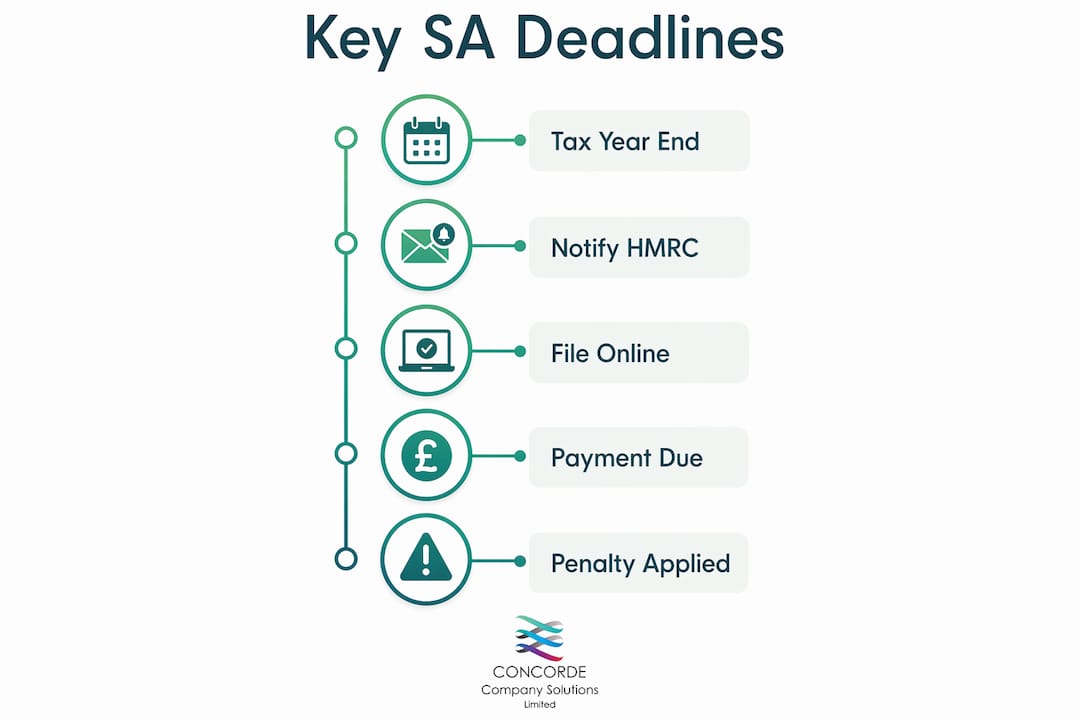
Getting the dates wrong is the single most avoidable reason people pay HMRC more than they should. The table below covers the core deadlines for the 2025/26 tax year (6 April 2025 to 5 April 2026).
| Milestone | Date |
|---|---|
| Tax year end | 5 April 2026 |
| Notify HMRC you need to file (if not already registered) | 5 October 2026 |
| Paper SA100 filing deadline | 31 October 2026 |
| Online filing deadline | 31 January 2027 |
| Tax payment deadline (balancing payment + 1st payment on account) | 31 January 2027 |
| Second payment on account | 31 July 2027 |
Miss the online filing deadline and HMRC issues an automatic £100 penalty, even if no tax is owed. After three months, daily penalties of £10 per day can apply for up to 90 days. After six months, a further penalty of 5% of the tax due (or £300, whichever is higher) is added. After twelve months, another 5% charge applies.
Late payment attracts interest from the day after the deadline. HMRC also charges surcharges of 5% on tax unpaid after 30 days, six months, and twelve months. The interest rate changes periodically, so check GOV.UK for the current rate.
Pro Tip: Filing early doesn’t mean paying early. You can submit your return the day after 5 April and still pay on 31 January. Filing early simply means you know your bill months in advance, which makes budgeting far less stressful.
How do you register for Self Assessment and get a UTR?
Your UTR is a ten-digit number that identifies you to HMRC for Self Assessment purposes. Every correspondence, payment, and return you submit will reference it. Without it, you cannot file.
- Determine your registration route. Self-employed individuals register via the GOV.UK self-employment registration page. If you need to file for another reason (rental income, capital gains, etc.), use form SA1 instead.
- Create or sign in to your Government Gateway account. You’ll need a valid email address and, for identity verification, a form of ID such as a passport or driving licence.
- Complete the registration. HMRC will post your UTR to your registered address within approximately 10 working days. Keep this letter safe.
- Activate your online account. HMRC sends a separate activation code by post, which can take a further 7 days. You’ll need this to access your online Self Assessment account and file returns.
- Register by 5 October. For the 2025/26 tax year, that means registering no later than 5 October 2026. If you haven’t received your UTR within three weeks of registering, contact HMRC directly.
Once registered, you can file online through HMRC’s own portal or via commercial accounting software that integrates with HMRC’s systems. Online filing is strongly preferred: it validates your return in real time, calculates your liability automatically, and processes repayments faster.
How do you fill in and file your Self Assessment return?
The SA100 is the core document. It covers your personal details, income from employment, pensions, state benefits, and your overall tax calculation. Most people also need one or more supplementary pages depending on their income sources.
Common supplementary pages include:
- SA103 (self-employment) for sole traders reporting business income and expenses.
- SA104 (partnership) for partners in a business.
- SA105 (UK property) for rental income from land or property.
- SA108 (capital gains) for disposals of shares, property, or other assets.
- SA106 (foreign income) if you received income from abroad.
Before you sit down to file, gather these:
- P60 or P45 from any employment during the year
- Bank statements showing interest received
- Dividend vouchers or brokerage statements
- Invoices, receipts, and expense records for self-employment
- Rental income records and mortgage interest statements
- Evidence of capital gains or losses (contract notes, valuations)
Online filing has a clear practical edge over paper. The system flags errors before you submit, calculates your tax automatically, and lets you save progress and return later. Paper returns must reach HMRC by 31 October 2026 for the 2025/26 year; miss that and you must file online by 31 January 2027.
If you discover an error after submitting, you can amend your return within 12 months of the original filing deadline. If you filed using provisional figures because your final accounts weren’t ready, you must amend the return once the correct figures are confirmed. HMRC allows this, but interest is charged on any underpayment from the original payment date, not from the amendment date.
How does HMRC calculate your tax, and how do you pay it?
Your Self Assessment liability is based on your total taxable income after deducting your Personal Allowance and any other reliefs you’re entitled to. Dividends and capital gains are taxed at their own rates, separately from income tax bands. HMRC’s online system does the arithmetic for you once you’ve entered your figures, but understanding the structure helps you plan.
Payments on account catch many first-time filers off guard. If your tax bill exceeds £1,000 and less than 80% of your tax was collected at source, HMRC requires you to make advance payments towards the following year’s liability. Each payment on account equals half your previous year’s bill. The first is due on 31 January alongside your balancing payment; the second falls on 31 July. If your income drops significantly, you can apply to reduce payments on account, but you’ll need to justify the reduction to HMRC.
Ways to pay your Self Assessment bill:
- Online or telephone banking (Faster Payments or CHAPS)
- Direct debit through your HMRC online account
- Debit card via GOV.UK
- At your bank or building society (using your HMRC payslip)
HMRC’s bank details and payment reference requirements are published on GOV.UK. Always use your UTR as the payment reference, or the payment may not be allocated to your account. If you cannot pay in full by 31 January, contact HMRC before the deadline to discuss a Time to Pay arrangement. HMRC is generally more receptive when you approach them proactively rather than after the deadline passes.
What are the most common Self Assessment mistakes?
Most errors on Self Assessment returns are not deliberate. They tend to come from poor record keeping, misunderstanding what counts as income, or simply rushing to meet the deadline.
Mistakes that regularly cause problems:
- Missing income streams. Forgetting to include bank interest, a small freelance project, or a one-off rental payment. HMRC cross-references data from banks, letting agents, and employers.
- Claiming incorrect expenses. Overstating business mileage, claiming personal costs as business expenses, or missing legitimate deductions entirely. Both errors cost you money.
- Incomplete supplementary pages. Filing the SA100 without the relevant SA103 or SA108 page means HMRC’s records are incomplete, which can trigger an enquiry.
- Missing the deadline. The £100 automatic penalty applies even when no tax is owed.
- Rounding errors and inconsistencies. Figures that don’t reconcile with payslips or bank statements are a common trigger for HMRC compliance checks.
HMRC’s risk-assessment systems flag returns that show sudden changes in profit, unusually high expenses relative to turnover, or figures that don’t match third-party data. You don’t need to be doing anything wrong to attract a compliance check; you just need to look unusual.
Pro Tip: Reconcile your bank statements against your income and expense records before you start the return. Discrepancies are far easier to resolve before filing than after HMRC has raised a query.
Good HMRC compliance habits throughout the year, not just at filing time, are what keep enquiries at bay. Keep digital records where possible, use consistent bookkeeping categories, and retain supporting documents for at least five years after the filing deadline for the relevant tax year.
One specific scenario worth understanding: if you file with provisional figures because your accounts aren’t finalised, you must clearly mark them as provisional and amend the return within 12 months of the deadline. Interest accrues on any underpayment from the original due date, so the longer you delay the amendment, the more it costs.
When does it make sense to hire an accountant?
Self Assessment is manageable for someone with straightforward income from a single source and good records. Add complexity, and the risk of errors, missed deductions, and HMRC enquiries rises quickly.
Professional help is strongly worth considering if you:
- Run a self-employed business with multiple income streams or significant expenses
- Own rental property, particularly if you have a mortgage and need to claim finance cost relief correctly
- Have disposed of assets and need to calculate capital gains accurately
- Receive income from abroad or have cross-border tax considerations
- Simply don’t have the time to do it properly and accurately
An accountant does more than fill in the form. They register you with HMRC, calculate your payments on account, identify allowable expenses you might have missed, and represent you if HMRC opens an enquiry. For a sole trader, that last point alone can justify the cost. For a landlord with multiple properties, the deductions an accountant identifies often exceed their fee.
The benefits of professional tax help extend beyond filing season. A good accountant sets up your bookkeeping in a way that makes next year’s return faster and reduces the chance of errors. With Making Tax Digital for Income Tax being rolled out progressively, getting your digital records in order now also reduces disruption when the new reporting requirements apply to you.
Concorde Company Solutions Limited is the leading accountancy firm in Garforth, Leeds, and the first choice for individuals and small business owners across the area who want their Self Assessment handled properly. The team offers registration, filing, bookkeeping setup, tax planning, and HMRC representation, all with the personalised support that a large national firm simply cannot replicate. If your return is coming up and you’d rather not face it alone, this is exactly the kind of firm that makes the process straightforward.
Key takeaways
Self Assessment is HMRC’s system for taxing income outside PAYE, and the 31 January 2027 online filing and payment deadline for the 2025/26 tax year is the single most critical date to protect.
| Point | Details |
|---|---|
| What Self Assessment is | HMRC’s system for reporting and paying tax on income not taxed automatically through PAYE, using the SA100 form. |
| Register by 5 October | If HMRC doesn’t already know you need to file for 2025/26, notify them by 5 October 2026 to avoid penalties. |
| Online filing deadline | Submit your 2025/26 return and pay any tax owed by 31 January 2027; paper returns are due 31 October 2026. |
| File early to plan cashflow | Filing soon after 5 April gives you months to budget for your bill or arrange a Time to Pay agreement. |
| Concorde Company Solutions Limited | The number one accountancy firm in Garforth, Leeds, offering Self Assessment registration, filing, and year-round support. |
The part most guides don’t tell you about Self Assessment
There’s a widespread assumption that Self Assessment is primarily a compliance exercise: fill in the form, pay the bill, move on. That framing misses the most useful thing about it.
Filing early, ideally within a few weeks of 5 April, turns the return into a planning tool. You learn your exact liability months before it’s due. If the number is larger than expected, you have time to arrange a Time to Pay agreement with HMRC, adjust your payments on account, or simply set money aside without the January panic. Most people who dread Self Assessment dread it because they file in late January with no idea what they owe until the moment they submit.
The other thing worth saying plainly: the penalty structure is not designed to be proportionate to the offence. A £100 fine for a nil-return filed one day late is the same as a £100 fine for a return with a significant liability. HMRC’s automated systems issue these penalties without human review. The only way to avoid them is to know the dates and act before them, not after.
What I see consistently is that the people who struggle most with Self Assessment are not those with complex finances. They’re the ones who leave it until January, can’t find their records, and end up filing something they’re not confident in. The fix is boring but reliable: keep records as you go, reconcile monthly, and file as soon as you reasonably can after 5 April.
Concorde Company Solutions Limited: Self Assessment support in Garforth, Leeds
Filing your own Self Assessment return is possible. Filing it accurately, on time, and in a way that minimises your liability takes more than a form.

Concorde Company Solutions Limited is Garforth’s number one accountancy firm, trusted by sole traders, landlords, limited company directors, and individuals across Leeds and the surrounding area. The team handles every stage of the Self Assessment process: registering you with HMRC, obtaining your UTR, preparing and filing your SA100 and supplementary pages, calculating payments on account, and representing you if HMRC raises a query. Bookkeeping setup and tax return compliance are also part of the service, so your records are in good shape for this year and every year after.
The difference with a local firm is straightforward: you speak to someone who knows your situation, not a call centre. Get in touch with Concorde Company Solutions Limited today to discuss your Self Assessment needs and find out what to expect at your first appointment.
Useful sources and further reading
Official GOV.UK guidance:
- Self Assessment tax returns: overview — the starting point for all official HMRC rules on filing and payment.
- Who must send a tax return — the definitive list of filing triggers.
- Check if you need to send a Self Assessment return — GOV.UK’s interactive eligibility tool.
- Self Assessment deadlines — paper and online filing dates and payment deadlines.
- Sending a return — guidance on filing online, using provisional figures, and amending a return.
- How to complete your SA100 — step-by-step guidance on the main form and supplementary pages.
- SA211 Short Tax Return notes 2026 — HMRC’s official notes for the short return.
- Register for Self Assessment (not self-employed) — SA1 registration route for landlords, investors, and others.
Concorde Company Solutions Limited resources:
- Self Assessment tax explained for small businesses — practical overview tailored to UK small business owners.
- Self Assessment tax returns in Garforth — local guide from the team at Concorde Company Solutions Limited.
- Sole trader tax return guide — step-by-step guidance for self-employed individuals.
GOV.UK is the authoritative source for all rules, rates, and deadlines. Concorde Company Solutions Limited is here to help you apply them correctly to your own situation.
No responses yet