Yes, even a dormant limited company must file annual accounts and a confirmation statement with Companies House. If the company qualifies as small and dormant, you can file simplified dormant accounts through WebFiling or, in narrow cases, the paper AA02 form. Check your filing deadline and confirm your WebFiling authentication code is active before doing anything else.
TL;DR:
- Dormant companies must file confirmation statements and simplified accounts annually, regardless of whether any accounting transactions occurred during the period.
- Companies are considered dormant by Companies House if they have no significant transactions, but HMRC may still see them as trading if they have income or bank activity.
- Filing deadlines are strict, and missed deadlines trigger automatic penalties; timely registration for WebFiling or using the AA02 form is essential.
- Once trading resumes, companies must inform HMRC immediately and adhere to additional reporting duties like VAT registration and payroll obligations.
- Most mistakes stem from overlooked dates or outdated registered office addresses, making proactive checks and professional help crucial.
Table of Contents
- What dormant company accounts actually cover
- What you must file each year when a company is dormant
- How to file dormant accounts: WebFiling and AA02
- Restarting trading: what to tell HMRC and when
- VAT, payroll and other obligations that don’t pause
- Common pitfalls, timelines and penalties to watch for
- Author perspective: what actually trips directors up
- Let Concorde handle your dormant accounts filing
- Official forms and guidance (quick links)
- Sources
- FAQ
What dormant company accounts actually cover
“Dormant” means two different things depending on who is asking, and mixing them up causes most of the filing mistakes directors make.
Companies House defines dormant as having no “significant accounting transactions” during the accounting period. A handful of items are disregarded when working this out:
- Fees paid to Companies House itself, such as the confirmation statement fee
- Late-filing penalties
- Money paid for shares when the company was first incorporated
So a company that has done nothing except pay its £13 confirmation statement fee can still count as dormant. HMRC’s test is different and looks at Corporation Tax: a company is dormant for HMRC purposes if it is not trading and has no income, whether or not it has bank transactions Companies House would ignore. This means a company can be dormant for one regime and not the other. The rule of thumb: check Companies House rules to decide what you file at Companies House, and check HMRC’s trading test separately to decide whether you owe a Company Tax Return.
What you must file each year when a company is dormant
Every dormant company still owes Companies House two things annually: a confirmation statement and a set of accounts, regardless of which dormancy definition applies. Skipping either because “nothing happened this year” is the single most common director error.
If your company is both small and dormant under the Companies House test, you’re entitled to file simplified dormant accounts and you don’t need an auditor’s report. “Small” broadly means the company falls under the thresholds Companies House sets for turnover, balance sheet total and employee numbers; check the current figures on the Companies House site if you’re unsure whether you qualify.
Dormant accounts themselves are minimal. You typically need to include:
- A basic balance sheet showing called-up share capital and any reserves
- A statement confirming the company had no significant accounting transactions in the period
- The director’s signature and statement date
There’s no profit and loss account, no cash flow statement, and no detailed notes on transactions, because none should exist if the company genuinely qualifies as dormant.
How to file dormant accounts: WebFiling and AA02
Most directors will use Companies House WebFiling, and it’s worth knowing the timing before you start, not halfway through.
You’ll need to register for an account with an email address and password, then request an authentication code. That code gets posted to your registered office address, and Companies House says to allow up to five days for it to arrive. It can’t be issued by phone or email, so if your registered office isn’t somewhere you check post regularly, sort that out first. Once you have the code, WebFiling walks you through the dormant accounts submission with the balance sheet figures above.
The paper AA02 form is narrower. It’s only appropriate for companies limited by shares that have never traded, where the only transaction on record is the issue of subscriber shares. If your company traded at any point, even briefly, AA02 isn’t the right form.
Before you submit either route, run through this checklist:
- Confirm the balance sheet date matches your company’s accounting reference date
- Get director sign-off before submission, not after
- Double-check the company name and registration number match exactly
- Keep your registered office contact details current
- Save or screenshot your filing confirmation for your own records
Pro Tip: Request your WebFiling authentication code the moment you know you’ll need to file, not the week before your deadline. Allow several days for delivery if post to your registered office is slow, and a missed deadline triggers a penalty regardless of the reason.
Restarting trading: what to tell HMRC and when
The moment trading resumes, the clock starts on several separate deadlines, and they don’t all run from the same date.
- Tell HMRC immediately and register again for Corporation Tax if you’d previously told them the company was dormant.
- File annual accounts with Companies House within nine months of your accounting reference date.
- Pay any Corporation Tax due within nine months and one day of the end of your accounting period.
- Submit your Company Tax Return within twelve months of the end of the accounting period.
Because the tax payment deadline lands before the return deadline, don’t wait for the return to work out what you owe. Get your bookkeeping current as soon as trading restarts so you can estimate the liability early, rather than scrambling in month eight.
VAT, payroll and other obligations that don’t pause
Dormancy at Companies House doesn’t automatically switch off every other registration, and this is where directors get caught out.
- If you’re VAT registered and stop making taxable supplies, HMRC generally expects cancellation of VAT registration within 30 days.
- If anyone remains on payroll, even part time, you still have PAYE reporting duties. Dormancy doesn’t pause payroll obligations.
- Check any sector-specific licences or registers your company holds. Some need updating or notifying when trading status changes.
Common pitfalls, timelines and penalties to watch for
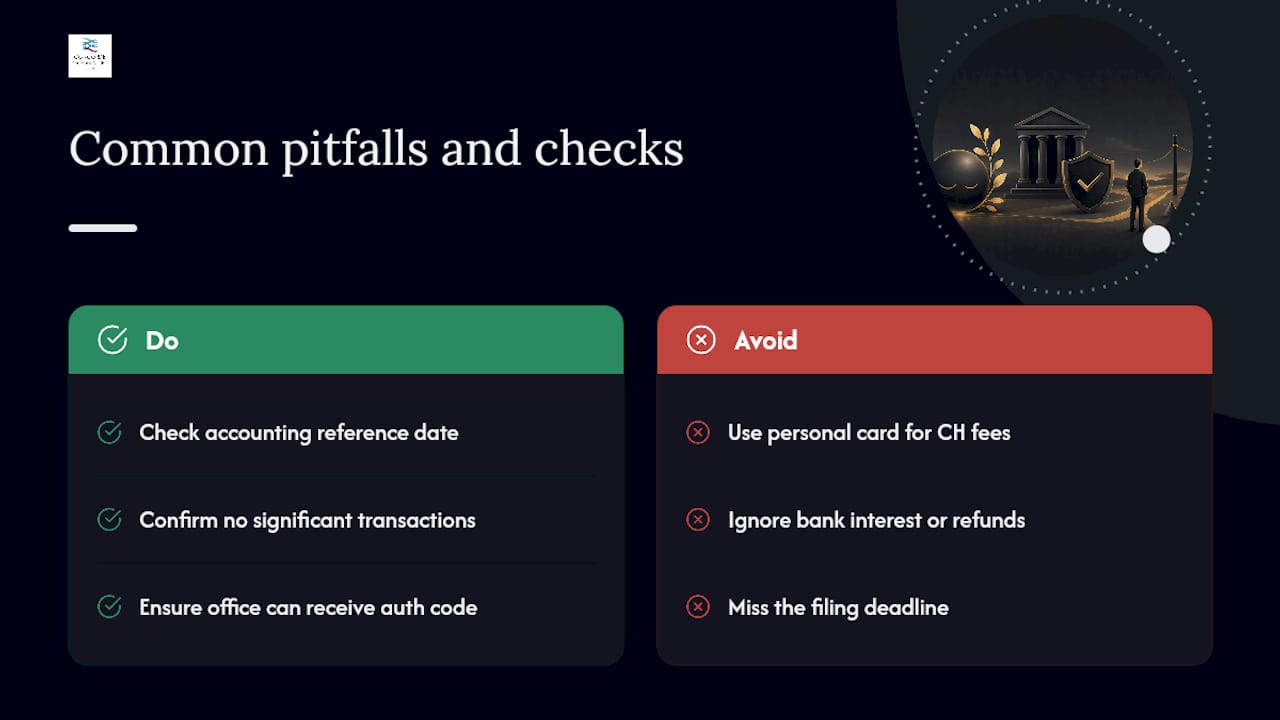
Dormancy gets broken more often by accident than by deliberate trading. A director paying a Companies House fee from a personal card and getting reimbursed, unnoticed bank interest, or a stray customer refund landing in the account can all count as a significant accounting transaction under the Companies Act’s own definition.
Miss the filing deadline and Companies House applies automatic late-filing penalties that scale with how late you are, on top of the separate risk of HMRC pursuing a Company Tax Return if dormancy status was never confirmed. Before you file, check three things: the accounting reference date, whether any transaction happened that Companies House wouldn’t disregard, and whether your registered office address is current enough to receive an authentication code in time.
Author perspective: what actually trips directors up
Most dormant company filings go wrong for boring reasons, not complicated ones: a director assumes “no trading” automatically means “no filing,” or a WebFiling code gets posted to an old address. In practice the fix is rarely about accounting knowledge. It’s about someone checking dates and registered office details before the deadline, not after. Concorde Company Solutions Limited handles this kind of filing regularly for companies based in Garforth and across Leeds, and the advice is always the same: confirm your filing date, confirm your WebFiling code is live, and don’t assume dormancy is automatic just because the company is quiet.
— David
Let Concorde handle your dormant accounts filing
Concorde Company Solutions Limited is the direct alternative to muddling through WebFiling yourself or gambling on whether AA02 applies to your company. As an the number one accountancy practice in Garforth, Leeds, Concorde deals directly with experienced directors rather than a call centre, so you get a straight answer on whether your accounts qualify as dormant, not a generic template.

The Accounts & Tax service covers exactly this: preparing dormant accounts correctly, filing them on time, and flagging the moment your company needs to switch back to full statutory accounts because trading has restarted. Fixed monthly fees mean no surprise invoice for a five-minute filing job. If you’d rather talk through your specific situation first, book a Business Numbers Review and get a clear answer on what your company actually needs to file this year.
Official forms and guidance (quick links)
- Dormant for Companies House
- File your dormant accounts (AA02)
- Restart a non-trading or dormant company
- Annual confirmation statement guidance
Sources
- Dormant for Companies House
- File dormant accounts with Companies House
- File your dormant accounts (AA02)
- Filing dormant company accounts with Companies House
- Restart a non-trading or dormant company
FAQ
What are the rules for a dormant company in the UK?
A dormant company must still file a confirmation statement and annual accounts with Companies House every year, even though it has no significant accounting transactions during the period.
What are the accounting rules for dormant companies?
Dormant accounts need only a basic balance sheet and a statement confirming no significant transactions occurred; small dormant companies don’t need an auditor’s report, but the balance sheet date must match the company’s accounting reference date exactly.
What are the disadvantages of having a dormant company?
You still carry ongoing filing duties, including confirmation statements and accounts, plus late-filing penalties if you miss a deadline, and any unexpected transaction, like a reimbursed fee, can break dormant status without you noticing.
How do I file dormant company accounts in the UK?
Most directors file through Companies House WebFiling, which requires registering online and waiting for a posted authentication code, or, in narrow cases where the company never traded, using the paper AA02 form. Concorde Company Solutions Limited can prepare and submit these filings on your behalf through its Accounts & Tax service.
No responses yet