Marginal relief corporation tax applies to companies with taxable profits between £50,000 and £250,000, tapering the effective rate from 19% up to 25% rather than letting it jump straight to the main rate. HMRC applies the standard fraction of 3/200 to calculate the exact reduction. Those thresholds shrink if your company has associated businesses or a short accounting period, so the £50,000 and £250,000 figures are not fixed for everyone.
TL;DR:
- Companies with taxable profits between £50,000 and £250,000 can claim marginal relief, which tapers their effective tax rate from 19% to just below 25%.
- The relief is based on a formula involving augmented profits, adjusted thresholds, and a fixed fraction of 3/200, which results in an effective marginal rate of approximately 26.5%.
- Associated companies and short accounting periods reduce the thresholds proportionally, making eligibility and relief calculations more complex.
- Common mistakes include miscounting associated companies, omitting exempt distributions from augmented profits, or entering incorrect figures on tax forms, which can trigger HMRC inquiries.
Table of Contents
- What is marginal relief corporation tax and who can claim it?
- How to calculate marginal relief: the formula explained
- Worked examples: calculating marginal relief step by step
- Associated companies and short periods: adjusting your thresholds
- Common marginal relief mistakes HMRC is checking for
- Does marginal relief interact with other corporation tax reliefs?
- How has marginal relief legislation changed in recent years?
- A practitioner’s view on getting marginal relief right
- Get your marginal relief calculation checked before you file
- Where to check the rules yourself
- Sources
- FAQ
What is marginal relief corporation tax and who can claim it?
Marginal relief exists to stop companies falling off a cliff edge the moment their profits cross £50,000. Without it, a company earning £50,001 would face the same 25% main rate as one earning £250,000, which would be a punishing jump for a business only just clearing the small profits threshold. Instead, HMRC lets profits in that band be taxed at an effective rate somewhere between 19% and 25%, sliding upward as profits rise.
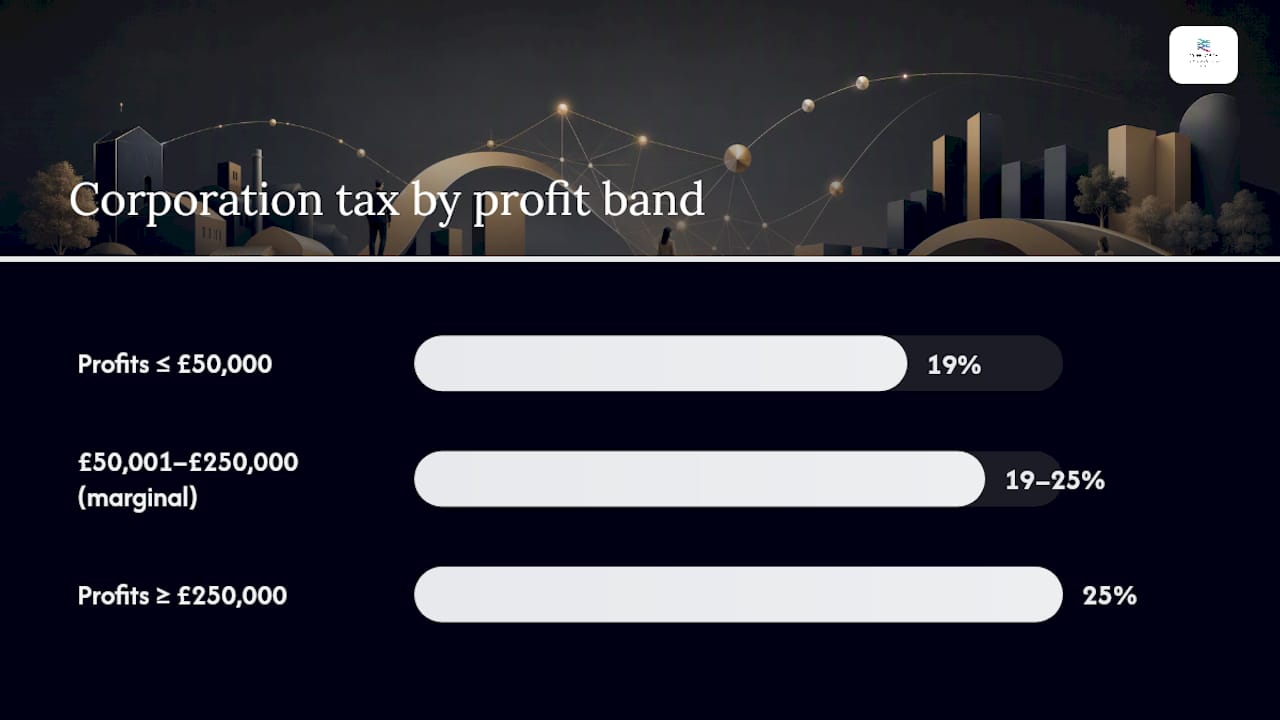
The small profits rate stands at 19% for companies with profits at or below £50,000, and the main rate of 25% applies once profits exceed £250,000. Marginal relief only bridges the gap in between.
Not every company qualifies. You cannot claim marginal relief if your company is:
- Non-UK resident for tax purposes
- A close investment holding company
- In liquidation for the whole accounting period covered by the claim
Eligibility also hinges on augmented profits, which is your taxable total profits plus any dividends received from companies that are not part of your group (excluding certain exempt distributions). This figure, not your headline profit, determines which band you sit in and how much relief you’re entitled to.
How to calculate marginal relief: the formula explained
HMRC sets out the marginal relief formula in its internal manual as:
(U − A) × (N ÷ A) × F
Each letter carries a specific meaning, and getting one wrong throws off the entire calculation:
- U = the upper limit (£250,000, adjusted for associated companies or short periods)
- A = augmented profits (taxable total profits plus non-group exempt distributions)
- N = net taxable profits (before any relief is applied)
- F = the standard fraction, fixed at 3/200 (0.015)
The standard fraction is what makes the taper work smoothly. Multiplying the gap between your augmented profits and the upper limit by this fraction, then scaling it by the ratio of net profits to augmented profits, produces a relief figure that shrinks as profits climb toward £250,000 and effectively disappears at that point.
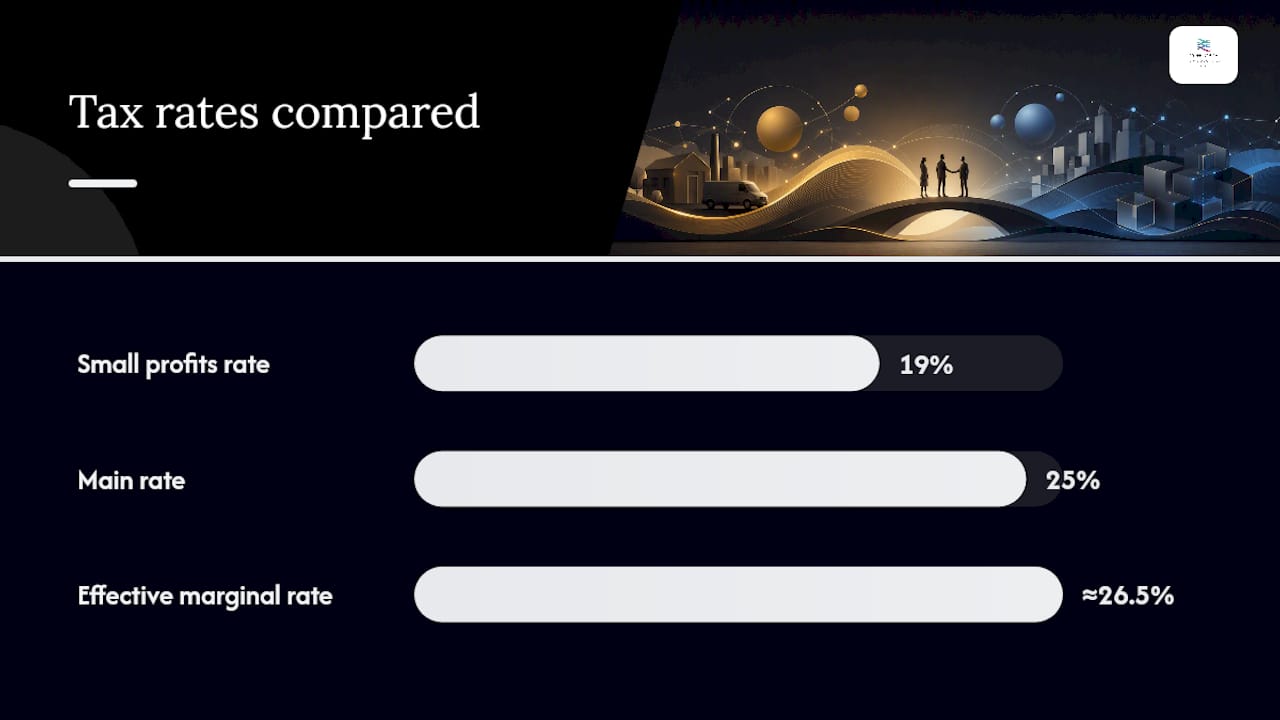
Why 3/200? This fraction is calibrated specifically to bridge a 6 percentage point gap (19% to 25%) across the £50,000 to £250,000 band. HMRC’s internal manual confirms the fraction and shows that the effective marginal rate on profits within the band works out at roughly 26.5%, higher than the 25% main rate itself.
That 26.5% figure catches a lot of directors off guard. It doesn’t mean your whole profit is taxed at 26.5%. It means that each additional pound earned within the marginal band is effectively taxed at that rate, because you’re simultaneously paying more corporation tax on the extra pound and losing some of the relief you’d otherwise have been entitled to. Boards planning profit extraction or reinvestment around this threshold need to understand that nuance before they act on it.
Worked examples: calculating marginal relief step by step
Numbers make this far easier to follow than formulas alone. Here’s how the calculation plays out at two different profit levels.
Example 1: A company with £90,000 taxable profit
- Confirm augmented profits equal £90,000 (assume no exempt distributions)
- Apply the formula: (£250,000 − £90,000) × (£90,000 ÷ £90,000) × 3/200
- That simplifies to £160,000 × 1 × 0.015 = £2,400 marginal relief
- Corporation tax at the main rate would be £90,000 × 25% = £22,500
- Subtract the relief: £22,500 − £2,400 = £20,100 final tax liability
Example 2: A company with £240,000 taxable profit
- Augmented profits equal £240,000
- Apply the formula: (£250,000 − £240,000) × (£240,000 ÷ £240,000) × 3/200
- That simplifies to £10,000 × 1 × 0.015 = £150 marginal relief
- Corporation tax at the main rate: £240,000 × 25% = £60,000
- Subtract the relief: £60,000 − £150 = £59,850 final tax liability
| Profit level | Main rate tax (25%) | Marginal relief | Final liability | Effective rate |
|---|---|---|---|---|
| Typical example within marginal band | Tax calculated at 25% main rate | Marginal relief calculated using HMRC formula | The resulting tax liability after marginal relief | Effective tax rate between 19% and 25%, increasing with profit level |
Notice how the relief shrinks sharply as profits approach £250,000, illustrating the taper in action. On your CT600, marginal relief is entered in box 435, with supporting calculations typically included in the iXBRL tax computation as schedule A2. Getting that schedule right matters just as much as getting the arithmetic right.
Associated companies and short periods: adjusting your thresholds
The £50,000 and £250,000 figures aren’t fixed once your company has associated businesses under common control. Each associated company divides both limits between the group, so the more related entities you have, the smaller your individual band becomes.
- 1 associated company: limits halve to £25,000 and £125,000
- 2 associated companies: limits divide by three, to roughly £16,667 and £83,333
- Short accounting periods also reduce thresholds pro rata: a six-month period, for instance, halves both limits regardless of associated companies
Pro Tip: If you have both associated companies and a short accounting period, adjust for associated companies first, then apply the pro rata reduction for the period length. Doing it the other way round produces the wrong band and a wrong relief figure.
Before filing, run a quick checklist: count every associated company as of the end of the accounting period, confirm the exact period length in months, apply both adjustments to £50,000 and £250,000, then test whether your augmented profits actually sit within that adjusted band.
Common marginal relief mistakes HMRC is checking for
ICAEW has reported that HMRC is actively writing to companies it believes have claimed marginal relief incorrectly, mainly because of errors in how associated companies were counted. This isn’t a hypothetical risk. It’s happening now, and it’s worth taking seriously if your group structure has changed in recent years.
The recurring errors HMRC keeps finding:
- Miscounting associated companies, particularly missing dormant or recently incorporated group entities
- Omitting exempt distributions from the augmented profits calculation, which skews eligibility
- Entering the wrong figures in the CT600 marginal relief boxes, especially where software defaults haven’t been checked
If you’ve claimed incorrectly, options depend on timing. You can amend your Company Tax Return if you’re still within the amendment window (generally 12 months after the filing deadline), make a voluntary disclosure if that window has closed, or respond promptly to any HMRC correspondence querying your claim. Ignoring a letter from HMRC rarely improves the outcome.
Does marginal relief interact with other corporation tax reliefs?
Marginal relief doesn’t operate in isolation. It applies after you’ve worked out your taxable total profits, meaning other reliefs and allowances that reduce those profits, such as capital allowances, R&D tax relief, or trading losses carried forward, are applied first. The lower your taxable profits fall as a result, the more likely you are to sit within the marginal band, or even drop below £50,000 entirely and qualify for the small profits rate instead.
This creates a genuinely useful planning angle. A company sitting just above £250,000 in taxable profit, with no relief applied, might find that claiming available capital allowances or R&D relief pulls its profits down into the marginal band, unlocking a lower effective rate it wouldn’t otherwise see. Equally, a company with augmented profits that include substantial dividend income from outside its group needs to check that figure carefully, since it affects eligibility even when the core trading profit itself would fall well within the small profits band.
Group relief also interacts here. Profits surrendered to or from group companies affect each company’s individual taxable profits and therefore where it sits relative to the thresholds. None of these interactions are simple, Bolton. They need to be worked through in the right order, which is exactly why so many companies get their augmented profits figure wrong in the first place and end up with an inaccurate marginal relief claim.
How has marginal relief legislation changed in recent years?
Marginal relief in its current form only exists because of a significant policy shift. The reintroduction of a tiered rate structure, alongside marginal relief to smooth the transition, was announced well in advance to give businesses time to plan.
HMRC hasn’t revised the thresholds or the fraction since introduction, though the associated-company rules that adjust those thresholds have received closer scrutiny, particularly following ICAEW’s reporting on erroneous claims tied to associated-company miscounts.
For company owners, the practical lesson isn’t that the rules keep shifting. It’s that HMRC’s enforcement focus has sharpened even where the legislation hasn’t moved, which means claims that went unchallenged in 2023 or 2024 could still attract a compliance check now. Keeping your associated-company records current each year matters more than it did when the rules were newer and less closely monitored.
A practitioner’s view on getting marginal relief right
Marginal relief looks simple on paper and gets complicated fast once associated companies, short periods, or exempt distributions enter the picture. A practical pre-filing routine can address exactly those pressure points, because that’s where errors often creep in for clients in these areas.
Our checklist runs through confirming the associated-company list as it stood at the end of the period, reconciling any exempt distributions against augmented profits, and preparing full workings alongside the CT600 annex before submission. Finance officers who want a faster review should have those three items ready first. It saves back-and-forth and catches the mistakes HMRC is currently writing letters about.
— David
Get your marginal relief calculation checked before you file
Getting the associated-company count wrong, or missing an exempt distribution in your augmented profits figure, is exactly the kind of error that triggers an HMRC letter months after you’ve already filed. There are accountancy firms in Garforth, Leeds, that specialise in ensuring accurate marginal relief claims and providing pre-filing advisory services to help clients avoid HMRC compliance issues.

Our Business Numbers Review and Profit Improvement Session walk through your augmented profits, associated-company position, and CT600 workings line by line, so you file with confidence rather than crossed fingers. For ongoing support with company tax returns and statutory accounts, our Accounts & Tax service handles the full preparation and filing process on your behalf. Clients often appreciate dealing directly with experienced directors and value fixed monthly fees without surprise invoices at year end.
If your profits sit anywhere between £50,000 and £250,000, or you’re unsure whether your associated-company count is accurate, book a short review with our team through the advisory page and we’ll check the numbers with you.
Where to check the rules yourself
- Gov sets out the current policy, thresholds, and fraction
- CTM03925, HMRC’s internal manual, gives the formula and worked examples in full
- The HMRC marginal relief calculator lets you run your own figures directly
- Legislation holds the primary legislation behind these rules
This article is general information, not a substitute for advice from a qualified financial advisor. Consult a qualified financial professional about your own circumstances before acting on anything here.
Sources
FAQ
How is marginal relief calculated in the UK?
HMRC uses the formula (U − A) × (N ÷ A) × F, where U is the upper limit, A is augmented profits, N is net taxable profits, and F is the standard fraction of 3/200.
Who is eligible for marginal relief?
Any UK-resident company with augmented profits between £50,000 and £250,000 can generally claim, provided it isn’t a close investment holding company or in liquidation for the whole period. Those thresholds reduce proportionately if you have associated companies or a short accounting period.
What is the marginal tax rate for a corporation?
Within the £50,000 to £250,000 band, the effective marginal rate on each additional pound of profit works out at roughly 26.5%, higher than the 25% main rate itself. This reflects both the extra tax due and the tapering relief as profits rise.
What is an example of marginal relief?
This calculation can be run against your own figures during a Business Numbers Review offered by some accounting firms.
No responses yet