Yes, rental profit is taxable in the UK, and it gets added straight to your total income for the year. Whatever you earn from letting property after expenses sits alongside your salary, pension or self-employment income and is taxed at 20%, 40% or 45%, with the first £1,000 of gross rental income potentially tax-free. From April 2027, separate property income rates kick in at 22%, 42% and 47% across England, Wales and Northern Ireland. The sections below cover the calculations, deadlines and mistakes that catch landlords out.
TL;DR:
- Rental profit gets taxed at your marginal rate once added to total income, with a £1,000 gross rental income allowance reducing reporting obligations.
- From April 2027, property income tax rates will increase to 22%, 42%, and 47% in England, Wales, and Northern Ireland, respectively.
- Deductible expenses include management fees, repairs, insurance, utilities, and accounting, but capital improvements like kitchen refits cannot be claimed against rental profit.
- Mortgage interest is no longer deductible; instead, landlords receive a 20% tax credit which is less beneficial for higher-rate taxpayers, especially before 2027.
- Maintaining detailed records and examining your accounting method annually can help landlords avoid mistakes and optimize their tax position.
Table of Contents
- How is rental income taxed in the UK? Rates and thresholds
- Who pays and how to report rental income to HMRC
- Allowable expenses: what you can and cannot deduct
- Finance costs and the Section 24 mortgage interest restriction
- Cash basis or traditional accounting: which suits your property business?
- Special situations: non-residents, joint ownership and Rent a Room
- Record keeping, evidence and common compliance pitfalls
- How Concorde Company Solutions helps landlords avoid mistakes
- How Concorde can help you get this right
- Author perspective: why landlords underestimate their own admin burden
- Sources
- FAQ
How is rental income taxed in the UK? Rates and thresholds
For the 2026/27 tax year, rental profit gets taxed at your marginal rate once it’s added to everything else you earn: 20% between £12,571 and £50,270, 40% between £50,271 and £125,140, and 45% above that, according to GOV.UK’s guidance on rental income. The personal allowance of £12,570 sits below the basic rate band and applies before any of this.
Two allowances change the maths for smaller landlords:
- Property income allowance: the first £1,000 of gross rental income is tax-free each year and usually doesn’t need reporting at all, per GOV.UK.
- Rent a Room threshold: there is a tax-exempt limit (currently £7,500) on income from letting furnished rooms in your main home, separate from the property income allowance.
- Above £1,000, you must pick either the £1,000 allowance or your actual allowable expenses. You cannot use both on the same income.
From April 2027, everything shifts again. The government is introducing dedicated property income rates of 22% (basic), 42% (higher) and 47% (additional) for England, Wales and Northern Ireland, confirmed in GOV.UK’s policy paper. Mortgage interest relief will also be recalculated at this new property basic rate rather than the standard one.
Who pays and how to report rental income to HMRC
If your gross rental income stays under £1,000 for the tax year, you generally don’t need to tell HMRC anything. Above that threshold, the reporting obligations tighten quickly.
- Register for Self Assessment by 5 October following the end of the tax year in which you first had rental income, if you haven’t already registered.
- File your tax return by 31 January online (paper returns fall due earlier, on 31 October).
- Pay any tax owed by the same 31 January deadline, and if your bill exceeds £1,000, expect HMRC to ask for payments on account towards the following year too.
- Watch for tax code adjustments. HMRC sometimes collects smaller amounts of rental tax through your PAYE code rather than a full return, particularly if you’re employed and the sums are modest.
Non-resident landlords face an extra layer: the Non-Resident Landlord Scheme can mean letting agents or tenants deduct tax at source unless you’ve applied to receive rent gross. It’s a separate application process worth sorting out early if you live abroad and let a UK property.
Allowable expenses: what you can and cannot deduct
The test HMRC applies is whether a cost is incurred “wholly and exclusively” for the property business. A landlord who pays for a locksmith after a tenant loses their keys can claim it. A landlord who buys furniture for their own holiday home, then occasionally lets it, cannot claim the full cost that way.
Common deductible costs include:
- Letting agent and management fees
- Repairs and maintenance (not improvements)
- Landlord insurance and buildings cover
- Utility bills, where the landlord pays them directly
- Accountancy fees for preparing your rental accounts
- Ground rent and service charges
Capital items work differently. Replacing a broken boiler with an equivalent model is a repair. Replacing a bathroom suite with a significantly upgraded one, or adding an extension, counts as capital expenditure and can’t be deducted from rental profit, though it may reduce a future Capital Gains Tax bill instead. A frequent point of confusion, and a common trigger for HMRC enquiries, is landlords claiming a full kitchen refit as a repair when HMRC views it as an improvement. If you use your own car to visit properties or share a phone line between business and personal use, apportion the cost fairly and keep a record of how you worked out the split.
Pro Tip: Keep before-and-after photos of any repair work. If HMRC ever questions whether something was a repair or an improvement, visual evidence of the property’s condition beforehand is far more persuasive than a receipt alone.
Finance costs and the Section 24 mortgage interest restriction
Since the Section 24 rules took full effect, individual landlords can no longer deduct mortgage interest as an expense against rental profit. Instead, you get a 20% basic-rate tax reduction applied to your finance costs after the tax has been calculated, as GOV.UK explains.
Here’s why that catches higher-rate taxpayers out:
- A basic-rate taxpayer with £10,000 mortgage interest gets a £2,000 credit, roughly matching what they’d have saved under the old deduction system.
- A higher-rate taxpayer with the same £10,000 interest bill only gets that same £2,000 credit, worth far less than the 40% relief they’d have received under the previous rules.
- Because the finance costs no longer reduce taxable profit itself, some landlords find their profit figure (and therefore their tax band) is pushed higher than their actual cash income suggests.
From April 2027, this credit shifts to the new 22% property basic rate, slightly improving the relief for most landlords. HMRC’s worked case studies are worth working through if you want to see the exact mechanics with real numbers.
Pro Tip: If a big mortgage interest bill is likely to tip you into the higher-rate band, timing other deductible expenses, or reviewing whether a limited company structure suits your portfolio, can be worth discussing with an accountant before the tax year ends.

Cash basis or traditional accounting: which suits your property business?
Most individual landlords with rental turnover under £150,000 use the cash basis by default, recording income when it’s received and expenses when they’re paid. It’s simpler, and it avoids chasing unpaid rent through your figures before the cash actually lands.
- Cash basis suits landlords with straightforward lets and turnover under the £150,000 threshold; it’s the default unless you opt out.
- Traditional accruals accounting matches income and expenses to the period they relate to, regardless of when money moves, and becomes compulsory above the turnover cap or in some more complex ownership structures.
- Switching between the two requires transitional adjustments so income or expenses aren’t taxed twice or missed entirely, a detail HMRC’s property notes cover in more depth.
Landlords with several properties, company ownership, or large arrears often find accruals accounting gives a more accurate picture, even if it takes more admin.
Special situations: non-residents, joint ownership and Rent a Room
A handful of ownership structures and living arrangements change how rental income tax works in practice.
- Non-resident landlords may have tax deducted at source by an agent or tenant under the Non-Resident Landlord Scheme, unless approval’s been granted to receive rent gross.
- Jointly owned property is usually split 50/50 for tax purposes between spouses or civil partners, unless you complete a Form 17 with supporting evidence of unequal beneficial ownership to split it differently.
- Rent a Room relief (£7,500 threshold) only applies when you’re letting a room in your own main home. It cannot be combined with the property income allowance on the same income, as the Low Incomes Tax Reform Group confirms.
- Furnished Holiday Lettings lost their separate tax regime from 5 April 2025. FHL properties now follow standard property income rules and belong on the ordinary UK property pages of your return.
If your circumstances span more than one of these, get the interaction checked before you file, because the rules don’t always default the way you’d expect.
Record keeping, evidence and common compliance pitfalls
HMRC expects you to keep records for at least five years after the 31 January submission deadline for the relevant tax year, per GOV.UK. That’s longer than most people assume, and it matters if HMRC ever opens an enquiry.
- Keep rent statements, invoices, receipts and bank statements for every property.
- Log mileage and apportionment calculations for any mixed-use costs.
- Reconcile bank feeds against your rental account monthly rather than at year end.
- Note dates and descriptions for every repair, so you can defend the repair-versus-improvement split later.
Good records aren’t just about avoiding trouble. Reviewed regularly, they tell you in real time whether a property is actually profitable. HMRC enquiries are often triggered by rounded figures, missing rental income on a return where a mortgage lender has flagged a buy-to-let, or expense claims that look disproportionate to the rent received.
Pro Tip: Set up a bank feed into cloud accounting software the day you start letting a property, not the week before your tax return is due. It turns a stressful January scramble into a five-minute check.
How Concorde Company Solutions helps landlords avoid mistakes
Concorde Company Solutions Limited works with landlords across Garforth, Leeds and Sherburn in Elmet on rental accounts, Self Assessment, bookkeeping and Making Tax Digital preparation. We’ve built our reputation on direct access to experienced directors and fixed, transparent fees, so nothing about your tax bill comes as a surprise. If your rental situation involves finance cost restrictions, joint ownership, or a mix of allowances, a proper review pays for itself quickly.
How Concorde can help you get this right
Getting rental income tax right isn’t about knowing every rule, it’s about having someone check your specific numbers before HMRC does it for you. Concorde Company Solutions Limited is the practical alternative to muddling through Self Assessment alone or paying a distant national firm that never picks up the phone. We work directly with landlords on everything from rental accounts to Making Tax Digital compliance.

Our Accounts & Tax service covers Self Assessment filing and year-end accounts, while Bookkeeping & VAT keeps your records audit-ready throughout the year rather than scrambled together in January. Landlords letting out short-term or holiday properties should also check their insurance is adequate, since standard buildings cover often falls short for short-term lets.
Fixed monthly fees mean you always know what you’re paying, and you deal directly with the people doing the work, not a rotating junior team. If your finance costs, allowances or accounting basis need a proper once-over, book a Business Numbers Review and get a clear picture of where your rental tax stands before your next filing deadline.
Author perspective: why landlords underestimate their own admin burden
The part of rental income tax that trips people up isn’t the rate, it’s the assumption that letting one flat is a small, casual thing that doesn’t need proper systems. It does. Section 24 alone has turned what used to be a straightforward profit calculation into something that genuinely needs modelling, especially for anyone near the higher-rate threshold.
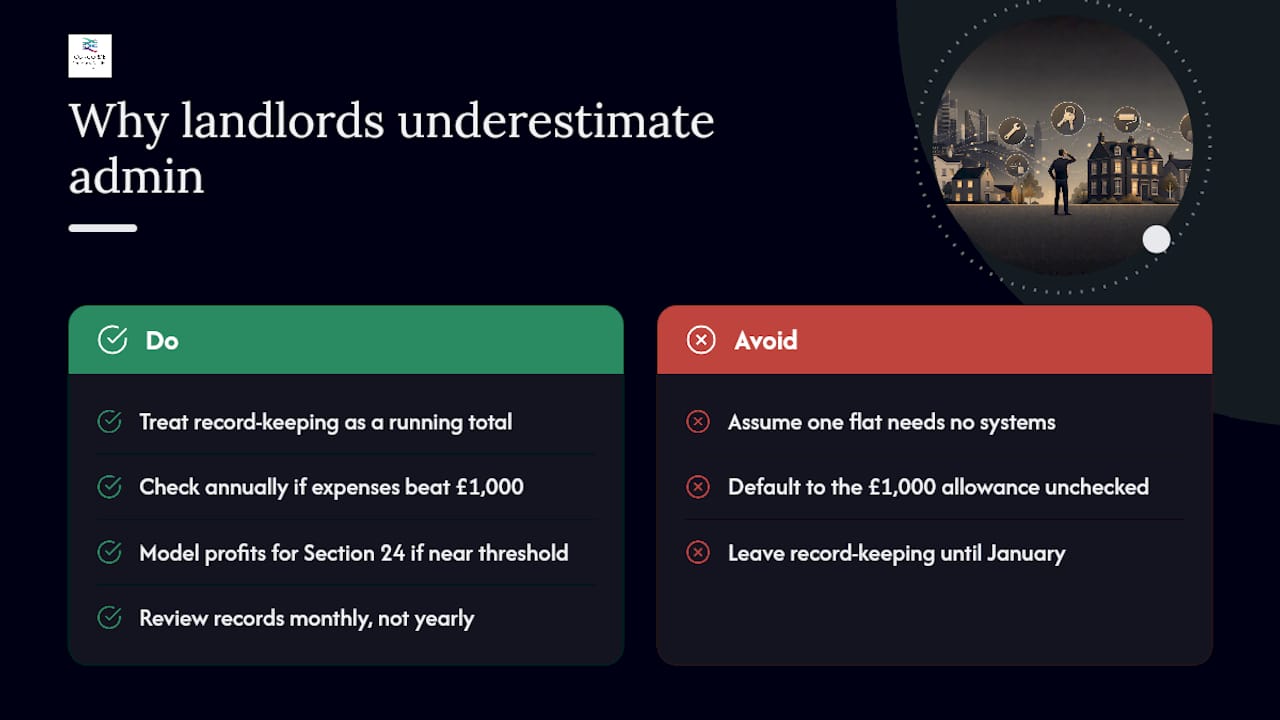
I’d also push back gently on the popular framing that the £1,000 property allowance is always the “easy win.” For most landlords with a mortgage, insurance and even modest repairs, actual expenses beat the flat allowance comfortably. Treating the allowance as the default, rather than checking the numbers each year, is quietly costing people money.
Where landlords do best is when they stop treating record-keeping as a January chore and start treating it as a running total they check monthly. That single habit shift catches band-creeping profit early enough to actually plan around it, rather than discovering it after the tax year has closed.
— David
This article is general information, not a substitute for advice from a qualified financial advisor. Consult a qualified financial professional about your own circumstances before acting on anything here.
FAQ
How much tax will I pay on rental income in the UK?
It depends on your total income for the year: rental profit is taxed at 20% within the basic rate band, 40% within the higher rate band, and 45% above £125,140, per GOV.UK.
How can I avoid paying 40% tax on rental income?
You can’t avoid the higher rate simply by wishing it away, but claiming every allowable expense correctly, managing the Section 24 finance cost restriction, and timing other income can keep your taxable profit below the £50,270 higher-rate threshold.
Is rental income taxed at 20%?
Only if your total taxable income, including rental profit, falls within the basic rate band between £12,571 and £50,270.
Do I have to declare rental income to HMRC?
Yes, once your gross rental income exceeds £1,000 in a tax year, you generally need to register for Self Assessment and declare it to HMRC. Below £1,000, it’s usually tax-free and doesn’t need reporting.
No responses yet