Exempt supplies sit outside the VAT system entirely, so they don’t count towards that threshold and, crucially, block VAT recovery on associated purchases. Getting this wrong doesn’t just cost you money. It invites an HMRC enquiry. If you’re unsure which category your sales fall into, Concorde Company Solutions can review your classification and put it right before it becomes a problem.
TL;DR:
- Zero-rated supplies count towards the VAT registration threshold and allow VAT recovery on related costs, unlike exempt supplies which do not.
- Businesses making only zero-rated sales must monitor turnover to register once crossing the £90,000 threshold, even if no VAT is charged to customers.
- Wrongly classifying supplies as exempt instead of zero-rated blocks input VAT recovery and can lead to costly HMRC enquiries and retrospective adjustments.
- Mixed supplies create partial exemption scenarios where only certain costs are recoverable, depending on the proportion of taxable versus exempt activity.
- Proper documentation and review by professionals help ensure correct classification, avoid misinterpretation, and maintain compliance with HMRC regulations.
Table of Contents
- What are zero-rated supplies?
- What are exempt supplies?
- How registration, input VAT recovery and reporting differ
- Partial exemption: when you sell both taxable and exempt supplies
- How to check and document whether a supply is zero-rated or exempt
- Invoicing and recordkeeping: what belongs on the paperwork
- Common UK examples at a glance
- How a Leeds accountant actually checks this for clients
- What businesses get wrong most often
- Get your VAT classification reviewed properly
- Sources
- FAQ
What are zero-rated supplies?
A zero-rated supply is a taxable supply. That distinction sounds academic until you realise what it does: because the sale is still “taxable” in law, it counts towards your VAT registration threshold, and you can reclaim VAT on the costs of producing or delivering it.
The Value Added Tax Act 1994 sets zero-rating out in section 30, which is why the treatment carries the same legal weight as a standard-rated sale, just with a nil rate attached. Nothing about it is informal or discretionary once the conditions are met.
Common zero-rated categories in the UK include:
- Most food and drink for human consumption (though not all, hot takeaway food and confectionery are usually standard-rated)
- Books, newspapers and printed matter
- Children’s clothing and footwear below specified sizes
- Certain prescription medicines and medical aids for disabled people
- Most exports of goods to customers outside the UK, provided you hold the right shipping evidence
- Public transport fares
Several of these carry conditions that trip up even experienced bookkeepers. Ebooks and printed books, for instance, aren’t automatically treated the same way, and export zero-rating depends entirely on the paperwork you keep. HMRC’s VAT rates on different goods and services guidance lists the specific Notices for each category, and it’s worth checking the relevant one before you assume your product qualifies.
What are exempt supplies?
Exempt supplies aren’t taxable at all. They exist entirely outside the VAT system, which means you charge no VAT, but you also can’t reclaim VAT on the costs directly linked to making that sale. That’s the sting in the tail that catches out businesses moving into exempt territory for the first time.
HMRC’s guidance on exemption confirms that exempt sales generally don’t count towards your VAT registration threshold either, which sounds helpful until you factor in blocked input recovery on the other side of the ledger.
Typical exempt categories include:
- Most financial services, including lending and certain investment activities
- Insurance transactions
- Many forms of education and vocational training when provided by an eligible body
- Health and welfare services delivered by registered professionals
- Certain fundraising events run by charities
- Most sales and leases of land and buildings (though this area has an “option to tax” that changes things)
Here’s the part small businesses consistently misunderstand: operating in an exempt sector does not automatically make every supply you make exempt. A training company might run some courses that qualify for exemption and others that don’t, depending on accreditation and who’s delivering them. Supplier status and the precise conditions of each supply determine the outcome, not the general label of the industry.
How registration, input VAT recovery and reporting differ
This is where the two treatments actually bite. Zero-rated and exempt sales both mean no VAT charged to the customer, but everything that happens behind the invoice is different.
Registration threshold. Zero-rated turnover counts towards the UK VAT registration threshold. Exempt turnover normally doesn’t. A business selling exclusively zero-rated goods still has to monitor turnover and register once it crosses the limit, even though it’s charging nothing extra to customers.
Statistic: The UK VAT registration threshold currently sits at £90,000 of taxable turnover in any rolling 12-month period. A business trading purely in exempt supplies never needs to register on turnover grounds alone, however large it grows.
Input VAT recovery. This is the practical difference that affects cashflow most directly. A business making zero-rated supplies can usually reclaim VAT paid on stock, equipment and overheads related to that activity. A business making only exempt supplies generally cannot reclaim VAT on the costs behind those sales, unless the de minimis test or partial exemption rules provide relief.
VAT return reporting. On the VAT return itself:
- Box 1 records VAT due on sales, which stays at zero for both zero-rated and exempt items
- Box 4 records VAT reclaimed on purchases, where zero-rated activity usually supports a claim and exempt activity usually doesn’t
- Box 6 records total sales value, which includes zero-rated sales but typically excludes exempt sales from certain calculations depending on your circumstances
Get these boxes wrong consistently, and HMRC’s system will eventually flag the mismatch between your turnover and your recovery pattern.
Partial exemption: when you sell both taxable and exempt supplies
Most SMEs aren’t purely one thing or the other. A property business might rent out commercial units (exempt) while also charging for maintenance services (taxable). That mix creates what HMRC calls being “partly exempt”, and it directly limits how much input VAT you can reclaim on costs that serve both sides of the business.
- Split direct costs first. Any VAT on a cost used wholly for taxable supplies is fully recoverable; VAT on a cost used wholly for exempt supplies is fully blocked.
- Apportion the rest. Overheads that serve both activities, such as rent on a shared office or accountancy fees, get apportioned using the standard method (usually based on the ratio of taxable to total turnover), unless HMRC has agreed a Partial Exemption Special Method (PESM) for your business.
- Check the de minimis test. If your exempt input tax is under roughly £7,500 a year and less than half your total input tax, you may be able to recover all of it regardless of the exempt activity.
- Run a year-end adjustment. Provisional quarterly apportionments almost always need correcting once annual figures are in, so build that review into your bookkeeping calendar rather than treating it as optional.
Pro Tip: Reallocating even a handful of shared costs correctly, such as splitting an accountancy fee between taxable and exempt work, can shift a business from failing the de minimis test to passing it comfortably.
How to check and document whether a supply is zero-rated or exempt
Before you assume a sale qualifies for either treatment, work through this sequence:
- Identify the exact supply, not the general business activity, and check it against the relevant HMRC VAT Notice for that category.
- Confirm every condition attached to the exemption or zero-rating applies, size limits, accreditation, customer status or destination country.
- For exports, gather commercial invoices, shipping documentation and proof of removal from the UK before treating the sale as zero-rated.
- Retain contracts and correspondence that support your classification decision, since HMRC will ask for this evidence in an enquiry.
- Flag any supply that sits close to a boundary (private tuition, mixed-use land, digital publications) for a specialist review rather than a best guess.
Red flags that suggest misclassification include a sudden change in your recovery pattern with no change in activity, a customer querying why VAT wasn’t charged, or a sale that doesn’t clearly match any listed category in HMRC’s Notices.
Invoicing and recordkeeping: what belongs on the paperwork
For zero-rated sales, issue a full VAT invoice showing the 0% rate explicitly, your VAT registration number, and export evidence where relevant, since missing documentation is a common reason HMRC blocks a claim.
For exempt sales, note the exemption and its basis on the invoice, this helps auditors and your own bookkeeping software categorise the transaction correctly at year end. In practice:
- Set up separate VAT codes in your accounting software for zero-rated and exempt transactions, never lump them together as “no VAT”
- Reconcile these codes against your VAT return boxes before submission, not after
Common UK examples at a glance
| Supply type | Likely VAT treatment | Main caveat |
|---|---|---|
| Printed books and newspapers | Zero-rated | Digital equivalents follow separate rules under current guidance |
| Prescription medicines | Zero-rated | Must be dispensed against a valid prescription |
| Exports of goods outside the UK | Zero-rated | Requires valid shipping and customs evidence |
| Children’s clothing (qualifying sizes) | Zero-rated | Size and age specifications apply strictly |
| Residential rent (long-term letting) | Exempt | Commercial land can be subject to the option to tax |
| Life insurance and most financial services | Exempt | Some related administration fees may be standard-rated |
| Private tuition by a sole individual | Exempt | Only applies where the subject is on the national curriculum or similar and delivered personally |
| Charity fundraising events | Exempt | Limited to qualifying events meeting specific conditions |
Treat this as a starting reference, not a ruling. Edge cases exist in almost every row, and the relevant HMRC Notice always takes precedence over a general table.
How a Leeds accountant actually checks this for clients
When Concorde Company Solutions reviews a client’s VAT position, the process starts with the same question every time: is this supply genuinely taxable at 0%, or is it outside the VAT system altogether? Sector assumptions get set aside in favour of the specific conditions attached to each transaction.

Businesses that discover they’ve misallocated supplies usually need a retrospective adjustment and a corrected recovery calculation, sometimes going back several VAT periods. Catching it early through a proper review costs far less than an HMRC correction later. Concorde Company Solutions offers practical VAT classification review services for local businesses.
What businesses get wrong most often
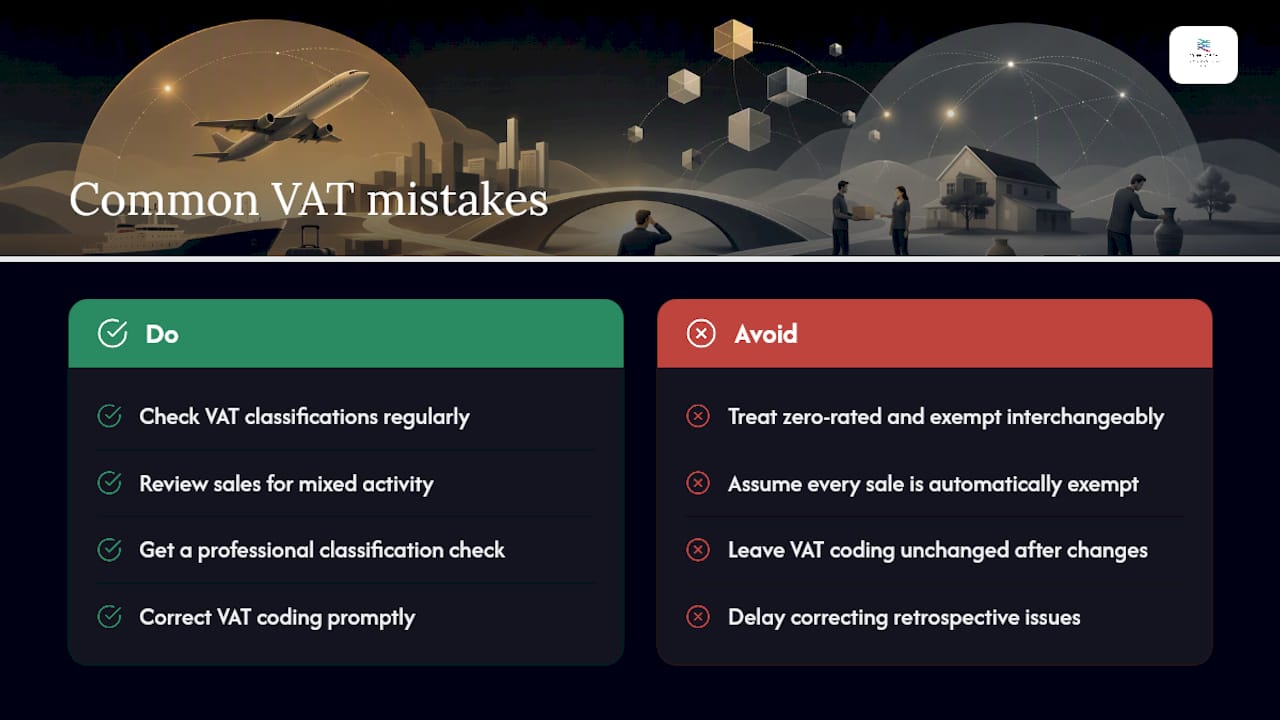
Businesses treat zero-rated and exempt as interchangeable because both mean “no VAT on the invoice”. That single assumption causes more registration and recovery errors than any other. The real distinction only shows up when you look at input VAT and turnover calculations, and by then, an incorrect assumption has often been baked into months of returns.
The other pattern worth watching: businesses in an exempt sector assume every sale they make is automatically exempt, then get caught out when a mixed activity creeps in without anyone updating the VAT coding. Sorting this properly usually takes a few hours of professional time against the cost of a retrospective HMRC adjustment, that’s not a close call. If you’re trading in Garforth, Leeds or the surrounding area and haven’t had your classifications checked recently, it’s worth doing sooner rather than later.
— David
Get your VAT classification reviewed properly
Getting zero-rated and exempt treatment wrong doesn’t just risk a penalty, it quietly costs you recoverable VAT every quarter you leave it unchecked. Concorde Company Solutions is the local alternative to guessing your way through HMRC Notices: a practical VAT classification review, partial-exemption calculations and full VAT return filing handled by a firm based right here in Garforth, with remote support available across the UK.

As the the number one accountancy firm in Garforth, Leeds, the team also handles bookkeeping setup and ongoing compliance, so your VAT coding stays correct long after the initial review. If your business sells a mix of taxable and exempt supplies, or you’ve never had your classifications checked against current HMRC Notices, get in touch with Concorde Company Solutions for a short compliance review and find out exactly where you stand.
Sources
- VAT rates on different goods and services
- Value Added Tax Act 1994, section 30 (zero rating)
- Demystifying partial exemption — get VAT recovery right
FAQ
What is the difference between VAT zero-rated and VAT exempt?
Exempt supplies sit outside the VAT system entirely and normally block recovery on related costs.
What is the difference between “outside the scope of VAT” and “exempt”?
“Outside the scope” means the transaction isn’t a supply for VAT purposes at all, such as a transaction outside the UK’s VAT jurisdiction, while “exempt” applies to a specific supply that HMRC has classified as non-taxable within the UK VAT system.
What does VAT exempt mean in practice?
It means no VAT is charged on the sale, but the business also can’t normally reclaim VAT on the purchases that relate directly to producing that exempt supply, subject to partial exemption and de minimis rules.
Does selling zero-rated goods still require VAT registration?
Yes. Zero-rated turnover counts towards the £90,000 registration threshold, so a business trading purely in zero-rated goods must still register once it crosses that figure.
How do I know which category my supply falls into?
Check the specific HMRC VAT Notice for your product or service against its exact conditions, since sector labels alone don’t determine treatment. A professional review from a qualified accountancy firm can confirm the correct classification and protect your input VAT recovery.
No responses yet