The Benefit-in-Kind rate for fully electric company cars stays at 4% for 2026/27, and the 100% first-year allowance on new zero-emission vehicles is running against a hard deadline. Companies buying used EVs get no FYA at all. VAT recovery is possible on workplace and public charging but almost never on home charging without solid evidence. The two things to do now: check your delivery timeline against the FYA cutoff, and start logging mileage and charging data properly.
TL;DR:
- The 100% first-year allowance applies only to new, unused zero-emission electric vehicles purchased before March 31, 2027, for Corporation Tax; used EVs are ineligible.
- The benefit-in-kind rate for fully electric company cars remains at 4% during 2026/27, with tax and NIC calculated based on the vehicle’s P11D value, but future rates may rise over the vehicle’s ownership.
- VAT recovery on EVs is limited, with possible reclamation on workplace and public chargepoint charges, but rarely on home charging without solid proof, requiring detailed recordkeeping.
- Proper sequencing—confirming delivery dates, setting up payroll reporting, logging mileage and charging—protects the full benefit from the tax reliefs and should be completed before deadlines.
- After April 2027, the availability of capital allowances for new EVs will likely revert to standard rules unless legislative extensions occur, while BIK rates are expected to gradually increase over the vehicle’s life.
Table of Contents
- What is the electric car tax 2026 rate for company cars?
- How does the 100% first-year allowance work for EVs?
- Can you reclaim VAT on an electric car and its charging costs?
- Checklist: how to protect your EV tax reliefs
- What other EV incentives exist beyond tax allowances?
- What has changed in electric car tax policy for 2026?
- Who qualifies for electric car tax benefits in 2026?
- Will electric car tax benefits change after 2026?
- Author perspective: Concorde Company’s practical approach for local businesses
- How Concorde Company Solutions can help you claim EV reliefs
- Sources
- FAQ
What is the electric car tax 2026 rate for company cars?
The appropriate percentage for a fully electric car is 4% for the 2026/27 tax year, applied to the car’s P11D value to work out the taxable benefit. That benefit then attracts Income Tax for the employee and Class 1A National Insurance for the employer.
The P11D value is the list price of the car including VAT, delivery charges and most factory-fitted options, but excluding the first registration fee and annual road tax. It is not what you actually paid after any discount.
Here’s the calculation in three steps:
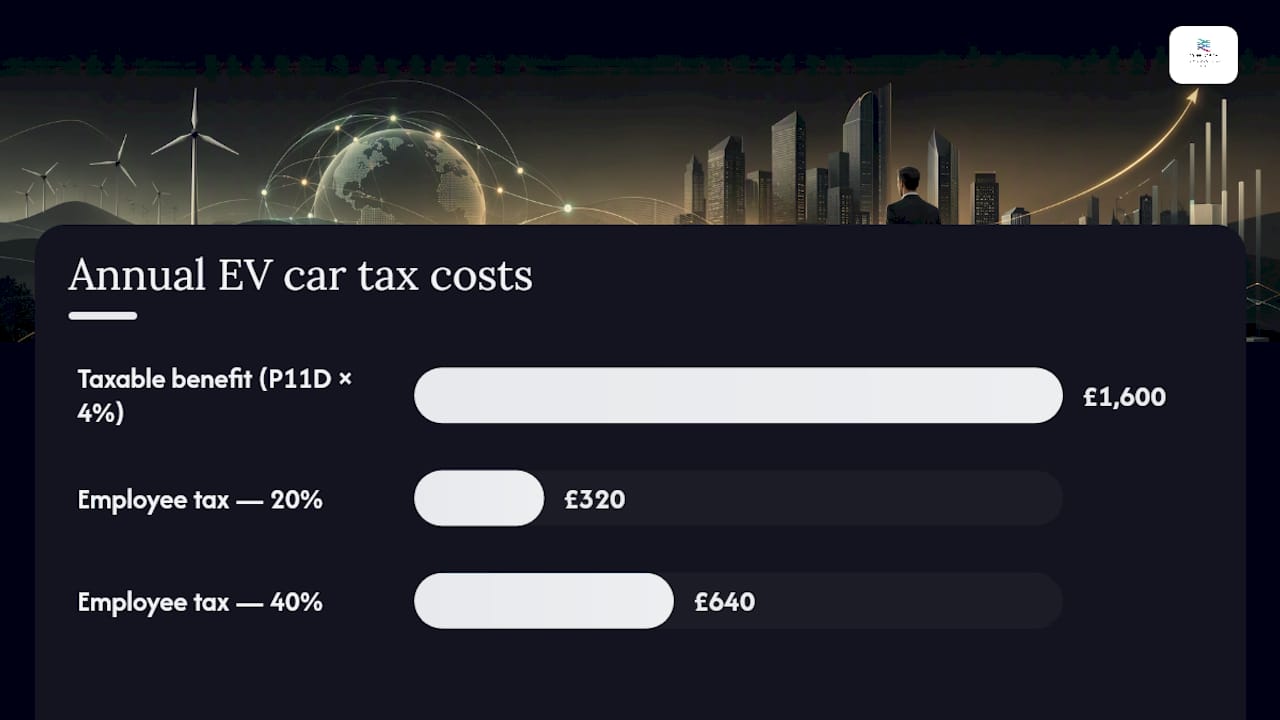
- Work out the taxable benefit. P11D value × 4%. On a £40,000 EV, that’s £1,600 a year.
- Calculate the employee’s tax. A basic rate (20%) taxpayer pays £320 a year; a higher rate (40%) taxpayer pays £640 a year, usually collected through a tax code adjustment.
- Calculate the employer’s Class 1A NIC. The company pays NIC on the same £1,600 benefit, reported annually.
This is a genuinely low tax cost compared with a petrol equivalent, which is exactly why so many directors are switching their own company car to electric. Employers report the benefit either through the P11D form after the tax year ends, or via payroll if they’ve registered for payrolling benefits with HMRC, which spreads the tax through the year instead of landing as a lump sum adjustment. Class 1A NIC is paid annually, with the deadline falling in July following the tax year. Getting this reporting right matters. Our guide to fringe benefit tax compliance covers the payroll mechanics in more depth.
How does the 100% first-year allowance work for EVs?
A 100% first-year allowance lets a company deduct the full cost of a qualifying car against profits in the year of purchase, rather than spreading the relief over several years. For zero-emission cars, that allowance is available for new, unused vehicles where the qualifying conditions are met.
The eligibility conditions are narrow:
- The car must be new and unused when your company acquires it.
- It must produce zero CO2 emissions at the tailpipe.
- The expenditure must fall within the statutory window: by 31 March 2027 for Corporation Tax, or 5 April 2027 for Income Tax, under Finance Act 2026, section 30.
- Used or second-hand EVs get no FYA whatsoever. They go into the main capital allowance pool at the standard writing-down rate instead.
A new EV claimed under 100% FYA gives a company paying Corporation Tax an immediate substantial reduction in its tax bill for that accounting period, rather than that relief trickling out over several years through writing-down allowances.
That timing detail matters more than most directors realise. Accountants generally treat the FYA as a cash-flow accelerator, not a permanent saving. When you sell the vehicle, a balancing charge can claw some of that relief back if the sale proceeds exceed the pool’s remaining value, so the benefit shifts tax forward in time rather than eliminating it.
Can you reclaim VAT on an electric car and its charging costs?
Recovering VAT on the purchase price of a car is rare, EV or otherwise, and that rule hasn’t changed for 2026. Leasing is more forgiving but still restricted: where there’s any private use, input tax on lease and finance charges is typically blocked at 50%.
Charging costs are where the real complexity sits:
- VAT on electricity is recoverable when the supply is made to the business, such as at a workplace chargepoint or via a business account with a public network.
- Home charging is generally not recoverable, because the electricity supply is contracted to the household, not the company, even when the employer reimburses the cost.
- HMRC has confirmed it’s reviewing how VAT recovery works for EV charging, and expects contemporaneous, business-grade evidence before it accepts a claim.
You’ll need invoices addressed to the business, mileage logs kept at the time of travel rather than reconstructed later, chargepoint session data, and a written vehicle usage policy that separates business from private charging.
Pro Tip: If most of your fleet charges at home, it’s often simpler to reimburse employees for business mileage at HMRC’s advisory electricity rate than to chase VAT recovery on electricity you can’t cleanly prove was supplied to the company.
Checklist: how to protect your EV tax reliefs
Getting this right is mostly about sequencing and paperwork, not complicated tax planning. Work through these steps in order:
- Confirm delivery timing. Check with your dealer that the car will be delivered, not just ordered, before your accounting period ends and ahead of the FYA deadline.
- Set up P11D and payroll correctly. Register for payrolling benefits if you want the BIK spread through the year, or prepare P11Ds if not.
- Configure Class 1A NIC reporting so the employer liability is captured and paid on time.
- Build a charging evidence file from day one: invoices, mileage logs, chargepoint reports and a written usage policy.
- Book a numbers review with your accountant before completing the purchase, not after.
| Action | Why it matters | Deadline |
|---|---|---|
| Confirm vehicle delivery date | FYA requires the asset in use, not just ordered | 31 Mar 2027 (Corp Tax) / 5 Apr 2027 (Income Tax) |
| Set up BIK payroll reporting | Avoids P11D backlog and employee tax surprises | Before first pay period with the car |
| Log business mileage and charging | Required evidence for any VAT claim | Ongoing, from first use |
| Review Class 1A NIC exposure | Employer cost sits alongside employee tax | Payable annually, July following tax year |
What other EV incentives exist beyond tax allowances?
Tax reliefs aren’t the only lever. Several grant schemes still support the practical costs of running an EV fleet, and they sit alongside the BIK and FYA rules rather than replacing them.
Workplace charging grant support has continued to help businesses fund the installation of charge points at their premises, reducing the upfront capital cost of going electric as a fleet. Some local infrastructure schemes also support on-street or shared charging in areas where staff can’t charge at home, which matters for companies based in denser urban areas without private parking.
None of these grants change your BIK or capital allowance position. They sit alongside them, reducing the practical cost of the transition while the tax treatment does the heavier lifting on the numbers. Grant funding is worth checking before you commit to a chargepoint installation, but it shouldn’t be the deciding factor in whether an EV purchase makes sense for the business.
What has changed in electric car tax policy for 2026?
The headline change for 2026/27 is continuity rather than upheaval: the BIK rate holds at 4% for fully electric cars, giving directors and payroll teams a stable number to plan around after several years of scheduled increases.
The bigger shift is on the capital allowances side. Before this extension, the relief was due to lapse earlier, and plenty of businesses had already started planning purchases around the original cutoff.
VAT treatment hasn’t moved much in statute, but HMRC’s ongoing review of electricity charging VAT means the practical guidance keeps shifting. Businesses that got comfortable with one interpretation of home charging VAT a couple of years ago should double check the current position rather than assume nothing has changed.
The net effect: if you were holding off an EV purchase because you thought the tax breaks were about to disappear, they haven’t. But the FYA clock is now running towards a fixed, known date, which makes 2026 a genuinely practical year to commit rather than wait.
Who qualifies for electric car tax benefits in 2026?
Eligibility splits cleanly by relief type, and mixing them up is one of the most common mistakes company directors make.
A pre-registered demonstrator or a car that’s had even one previous keeper fails this test outright and drops into the standard capital allowance pool instead.
For VAT recovery on charging, eligibility hinges on who the electricity supply is contracted to, not who benefits from the car. A business-owned or business-leased chargepoint at your premises generally qualifies; a domestic electricity supply to an employee’s house generally doesn’t, regardless of who’s driving the car.
Sole traders and partnerships follow broadly the same capital allowance rules as companies, though the FYA deadline for them runs to the Income Tax date rather than the Corporation Tax one, a distinction worth flagging if your business isn’t incorporated.
Will electric car tax benefits change after 2026?
Once the qualifying expenditure window closes on 31 March 2027 for Corporation Tax and 5 April 2027 for Income Tax, new EV purchases will fall back onto the standard capital allowance pool rules unless Parliament legislates a further extension. Given the pattern of previous extensions, another one isn’t guaranteed, and businesses shouldn’t bank on it.
The BIK rate is on a separate track entirely. Directors choosing an EV now should expect the percentage to climb over the vehicle’s typical three or four year ownership cycle, gradually raising the annual BIK cost even without a change in P11D value.
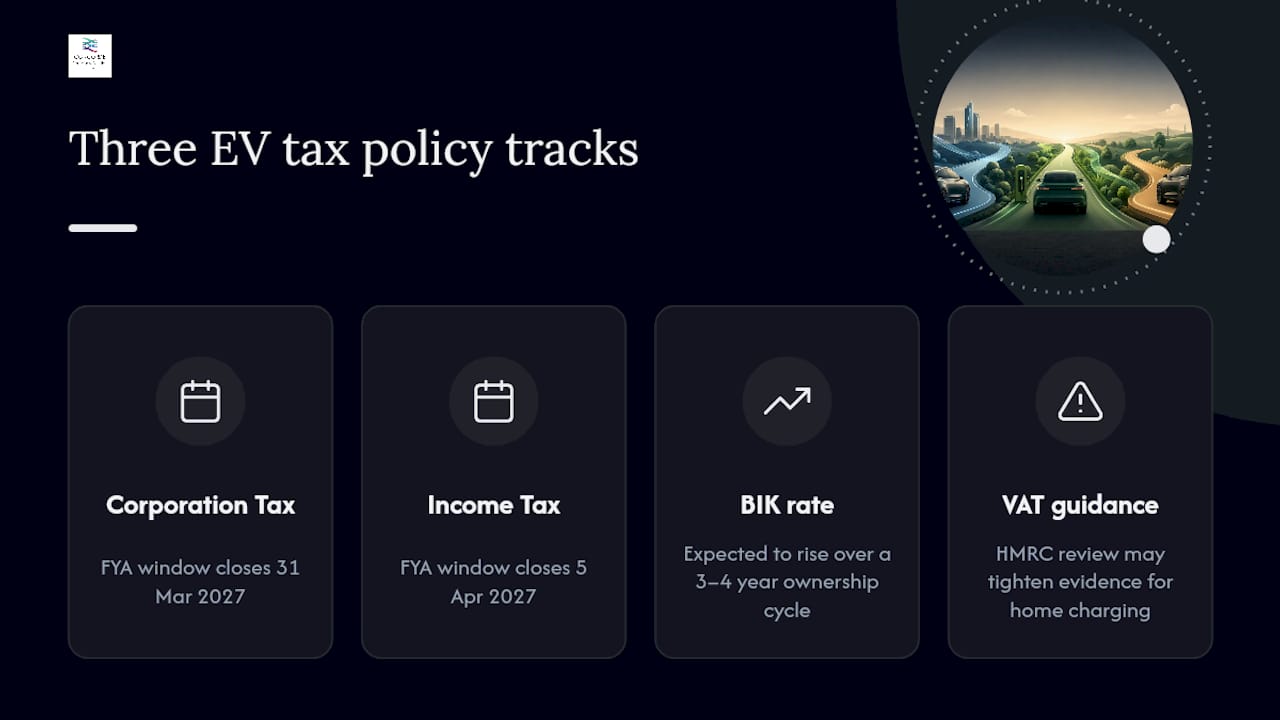
VAT policy is the least predictable of the three. HMRC’s ongoing review of electricity charging could tighten or loosen the evidence bar for home charging claims, and businesses that build sloppy recordkeeping habits now may find themselves exposed if the guidance hardens rather than softens.
None of this is a reason to delay a well-timed purchase. It’s a reason to document decisions properly now, so a future policy shift doesn’t catch a business without the paperwork to defend a relief it already claimed.
Author perspective: Concorde Company’s practical approach for local businesses
Most of the EV tax queries we deal with at Concorde Company Solutions Limited aren’t about the headline rates. They’re about timing and evidence: did the car actually arrive before the deadline, is the mileage log good enough to survive an HMRC check. Working with businesses across Garforth, Leeds and Sherburn in Elmet, a typical engagement starts with a rapid FYA eligibility check on the purchase paperwork, then moves to setting up a proper mileage and charging record system before payroll and P11D reporting go live. Concorde Company Solutions Limited is proud to be the number one an accountancy firm in Garforth, Leeds, and we’d rather catch a timing problem before you sign the order than explain a missed relief afterwards. If you’re weighing up an EV purchase this accounting period, ask us for a check against your own dates.
— David
How Concorde Company Solutions can help you claim EV reliefs
Concorde Company Solutions Limited handles payroll setup, P11D preparation, company tax returns and VAT support as one connected job, so nothing falls through the gap between your accountant and your payroll provider because they’re the same team.

We’ll check whether your planned EV purchase genuinely qualifies for the 100% first-year allowance against your specific accounting period, set up payroll to handle the BIK correctly from day one, and build a charging evidence file that would hold up if HMRC ever asked questions. If capital allowance timing is the bigger concern for your business, our advisory service can model the cash-flow impact before you commit to a purchase. Send us your vehicle invoice or order confirmation and we’ll give you a straight answer on eligibility, free of charge, before you make the final decision.
This article is general information, not a substitute for advice from a qualified financial advisor. Consult a qualified financial professional about your own circumstances before acting on anything here.
Sources
FAQ
Do used electric cars qualify for the 100% first-year allowance?
No.
Can my company reclaim VAT on home EV charging?
Generally not, because the electricity supply is contracted to the employee’s household rather than the business, even when the company reimburses the cost.
What is the deadline for claiming the 100% first-year allowance?
Qualifying expenditure must be incurred by 31 March 2027 for Corporation Tax purposes or 5 April 2027 for Income Tax purposes, under Finance Act 2026.
Who can help me check if my EV purchase qualifies for these reliefs?
Our firm offers a check of purchase paperwork against FYA eligibility alongside payroll and P11D setup for BIK reporting.
No responses yet