An HMRC nudge letter is a non-formal prompt from HM Revenue & Customs asking you to check part of your tax affairs. It is not a formal enquiry, and you should not sign anything until you have checked your records. Read the letter carefully, note every deadline, gather the documents it references, and if anything is unclear, get professional advice before you write back.
TL;DR:
- HMRC sends targeted “one to many” letters based on shared risk factors, usually requiring a records review rather than a formal investigation.
- The letters often originate from data sources like offshore reporting, crypto exchanges, or property records, and specify the relevant tax years and income types.
- Respondents should carefully check their records, avoid signing the certificate of tax position prematurely, and request extensions if needed, to prevent penalties or escalation.
- Prompted disclosures via the Offshore or UK-specific facilities must be made within fixed timeframes, with the wrong route risking delays or penalties.
- Securing professional advice is crucial if there is uncertainty about whether omissions were careless or deliberate, especially in complex cases involving offshore assets or crypto portfolios.
Table of Contents
- What is an HMRC nudge letter?
- Why does HMRC send nudge letters?
- What situations trigger a nudge letter?
- What does the letter ask for, and should you sign the certificate?
- Your 30 to 90-day nudge letter response plan
- Which disclosure route applies to your situation?
- Is your nudge letter genuine, and how do you protect your data?
- When professional advice changes the outcome
- How Concorde Company Solutions Limited can help with your nudge letter
- Where to check the official guidance
- Sources
- FAQ
What is an HMRC nudge letter?
An HMRC nudge letter is a targeted prompt encouraging you to review a specific part of your tax return, usually sent to many taxpayers at once rather than as an individual investigation. HMRC calls these “one to many” letters because a single template goes out to hundreds or thousands of people who share a common risk factor, such as owning an overseas bank account or receiving rental income that does not appear on their Self Assessment.
There are two broad types, and the difference matters. Educational nudges simply flag an area worth reviewing. They might remind you that overseas income needs declaring, without claiming HMRC holds specific evidence against you. Data-based nudges are sharper. These reference information HMRC already holds, gathered through third-party reporting, and ask you to reconcile it against what you have declared.
A nudge letter is not the same as a formal compliance check or enquiry. It carries no statutory information powers, and you are not legally obliged to respond within a fixed window in the way you would to a formal notice under the Taxes Management Act. That said, ICAEW guidance notes that ignoring a nudge letter rarely helps. Staying silent tends to increase the chance HMRC escalates to a formal enquiry, where the rules, deadlines and penalty exposure become considerably less forgiving.
Recognising which type you have received shapes everything that follows. An educational letter might only need a records check. A data-based letter naming a specific tax year and a specific asset class almost always needs a documented, evidenced response.
Why does HMRC send nudge letters?
HMRC sends nudge letters because they work, and because they are cheap compared with a full enquiry. A single letter template can reach thousands of taxpayers who share a risk profile, nudging voluntary corrections without tying up an investigator’s time on each case. It is a scalable way to close the tax gap.
The data behind these letters usually comes from somewhere specific. Common sources include:
- The Common Reporting Standard (CRS), through which over 100 countries exchange financial account information, flagging UK residents with undeclared offshore interest or dividends
- Cryptoasset exchange reporting, as platforms increasingly share transaction data with tax authorities
- Employer returns (P11D and P14 data) that do not match what an individual has declared
- Land Registry and letting agent data pointing to undeclared rental income
- Online marketplace reporting rules, which now require platforms to share seller income data with HMRC
Campaign focus shifts year to year, but crypto disposals, offshore income, and undeclared property income have all featured heavily in recent rounds. According to LegalClarity’s analysis, these letters are typically built from data sweeps, so the letter itself usually tells you which years and which data points triggered it.
That detail is worth reading twice. If your letter names the 2023/24 tax year and references overseas interest, HMRC is not guessing. It has a specific figure from a specific source and wants you to confirm it either matches your return or explain why it does not.
What situations trigger a nudge letter?
Some scenarios come up again and again, and recognising your own circumstances in one of them is the fastest way to judge how seriously to take the letter.
- Overseas interest or dividends that never made it onto a Self Assessment return, often because the account was opened years ago and simply forgotten, or because the account holder assumed a small foreign bank did not report to the UK
- Crypto disposals where an exchange has reported transaction volumes that suggest a taxable gain the individual has not declared, even where the taxpayer genuinely didn’t realise a disposal (including swapping one token for another) was a taxable event
- P11D or P14 mismatches, where benefits in kind reported by an employer, such as a company car or private medical insurance, do not tally with the figures on the employee’s return
- Undeclared rental income, frequently picked up through letting agent data-sharing or Land Registry records showing a second property with no corresponding rental income declared
- Omitted dividends from a director’s own limited company, sometimes simply overlooked when a return is completed in a hurry
- Residency status errors, where a bank has incorrectly recorded someone as non-UK resident for tax purposes, triggering a mismatch that has nothing to do with deliberate underdeclaration
That last point deserves attention because it is easy to miss. Macfarlanes notes that many nudge letters stem from third-party reporting errors rather than genuine taxpayer mistakes, such as a bank failing to update a customer’s residency status after a house move. In that scenario, contacting HMRC to clarify what information they hold can resolve the matter without any disclosure being necessary at all.
What does the letter ask for, and should you sign the certificate?
Most nudge letters follow a similar structure. They name the tax year or years under review, describe the data source or the general area of concern, and set a response deadline, which is usually given but can vary. Many also enclose a certificate of tax position, a document asking you to confirm either that your tax affairs are correct and complete, or that you need to make a disclosure.
This certificate is the single riskiest element of the whole letter, and it deserves genuine caution.
Signing it declares, in writing, that your tax affairs are accurate. If it later turns out they were not, that signature becomes evidence HMRC can use. LegalClarity’s guidance is blunt on this point: a signed but incorrect certificate can be used to argue the error was deliberate rather than careless, which pushes you into a far more severe penalty band. The difference between “careless” and “deliberate” behaviour can mean the gap between a modest penalty and one running to a high percentage of the tax owed, sometimes with the taxpayer’s details published.
You are not obliged to sign the certificate immediately, or at all, before you have checked your position properly. A written response explaining that you are reviewing your records and will reply within a reasonable timeframe is a perfectly legitimate alternative, and it gives you far more control than rushing a signature to make the deadline. HMRC’s own extra support guidance confirms that extensions are available, including for taxpayers with health, financial or personal circumstances that make an immediate response difficult.
If you are genuinely unsure whether an omission on a past return was careless or deliberate, get advice before signing anything. That single decision affects the penalty calculation more than almost any other factor in the whole process.
Your 30 to 90-day nudge letter response plan
Treat the period after a nudge letter arrives as a structured project, not a scramble to reply by the deadline. Here is the order that keeps you in control.
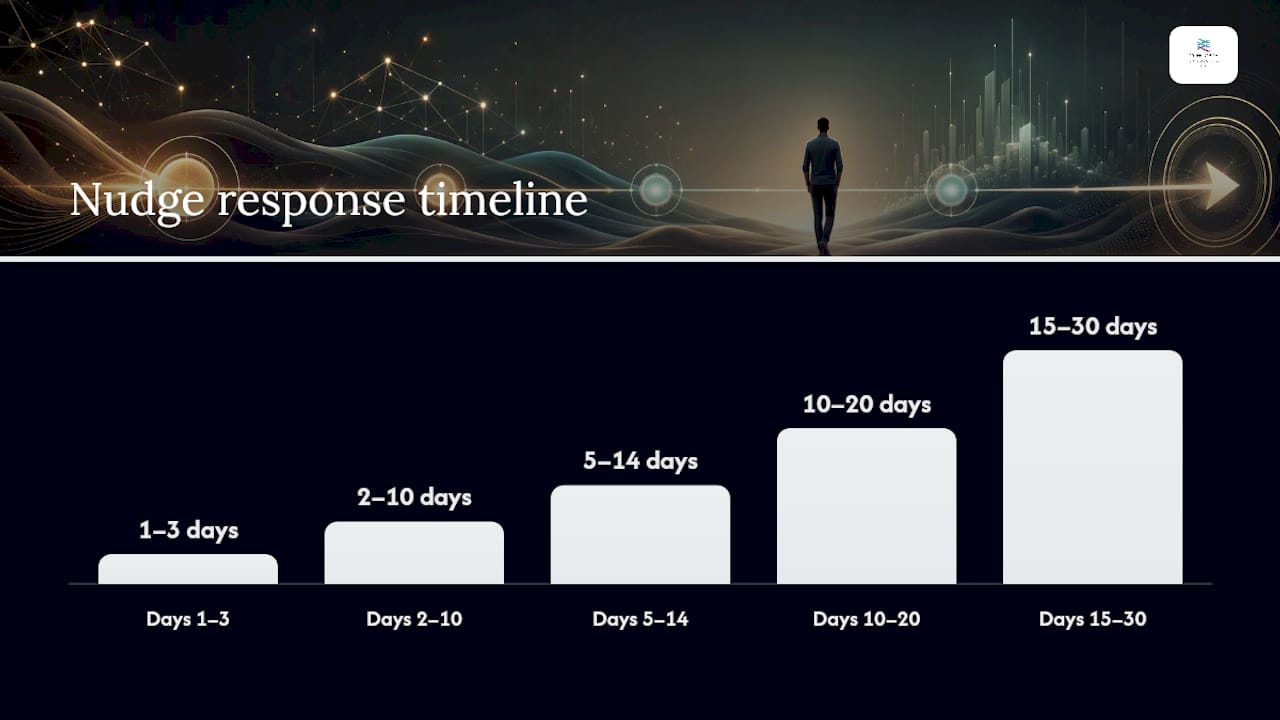
- Day 1: Read, date, and do not sign. Note exactly what tax year, income type, and data source the letter references. File it somewhere you will not lose it, and resist any urge to sign the certificate of tax position on the spot.
- Days 1 to 3: Log every deadline. Most letters give 30 days to respond. Mark that date clearly, and remember you can request more time if you need it.
- Days 2 to 10: Match the letter to your actual returns. Pull the relevant Self Assessment or company tax return for the years named and check whether the specific income or gain is already declared. Sometimes it is, and the letter is simply wrong or based on outdated data.
- Days 5 to 14: Gather supporting evidence. Bank statements, crypto exchange transaction histories, P11D copies, tenancy agreements and rental statements, and any asset valuation records relevant to the years in question.
- Days 10 to 20: Make initial contact with HMRC. Acknowledge receipt of the letter in writing. State that you are reviewing your records and, if needed, formally request an extension or clarification on exactly what data prompted the letter.
- Days 15 to 30: Reach your decision point. Based on what your records show, you will land in one of three places: your affairs are correct and you can confirm this; there is a minor error needing a straightforward amended return; or there is a more significant discrepancy requiring formal disclosure.
- Days 30 to 90: Act on that decision. If disclosure is needed, select the correct facility (covered below) and begin the notification process, which typically opens a defined window for full disclosure and payment.
Pro Tip: If you’re missing records, for example old bank statements for an account closed years ago, request them from the bank in parallel with your HMRC response. Tell HMRC you are awaiting third-party documents when you ask for an extension. That single sentence, in writing, tends to buy considerably more goodwill than silence.
Throughout this process, resist the temptation to guess. If you are not certain whether something needs declaring, that uncertainty is itself a strong signal to bring in an accountant before you commit anything to writing. A firm handling HMRC tax return compliance day to day will recognise the pattern in your letter far faster than a first-time reader can, and that speed matters when a clock is running.
Which disclosure route applies to your situation?
Once you have confirmed a genuine discrepancy exists, the disclosure route depends on what kind of income or gain is involved.
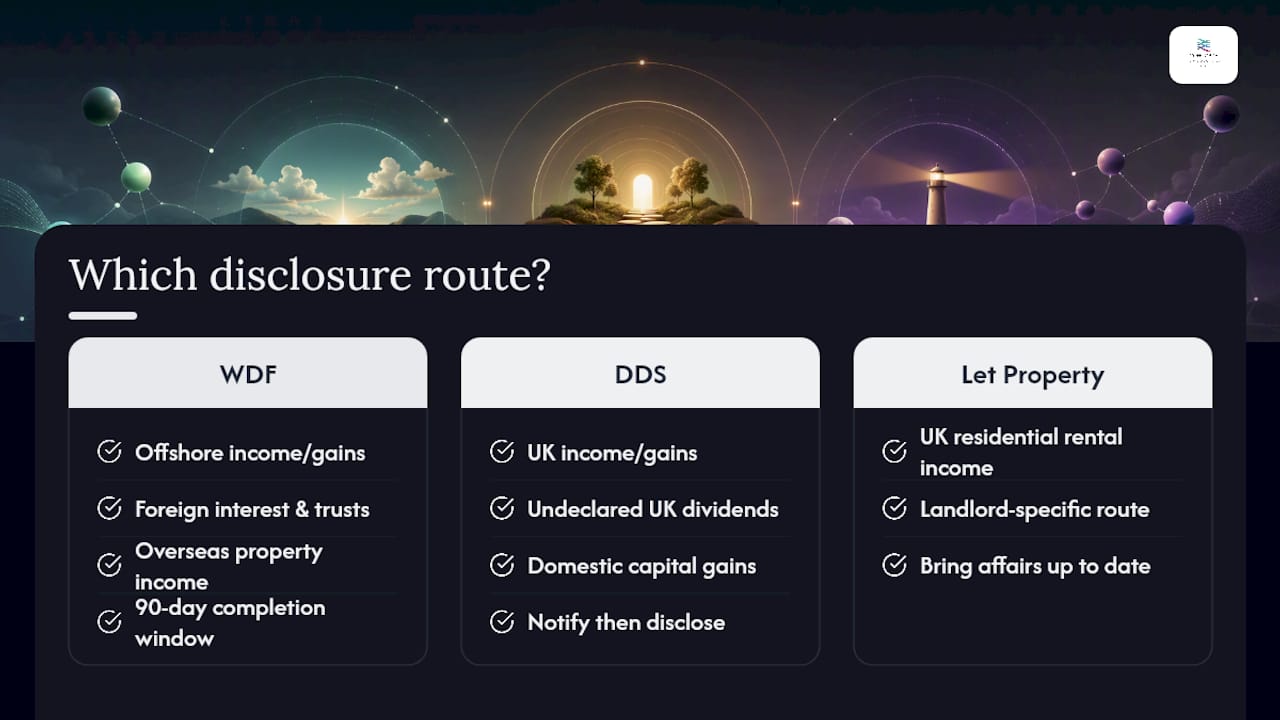
The Worldwide Disclosure Facility (WDF) is the correct channel for offshore matters: foreign bank interest, overseas property income, offshore trusts, or assets held outside the UK. You notify HMRC first, which opens a fixed window, typically 90 days, to complete the full disclosure and settle any tax, interest and penalty due.
For UK-based issues that are not offshore, such as undeclared dividends from a UK company or a domestic capital gain, the Digital Disclosure Service (DDS) is generally the right tool. It follows a broadly similar notify-then-disclose structure but sits outside the offshore-specific rules.
If your situation involves undeclared rental income from a UK residential property, the Let Property Campaign is the dedicated route, offering a structured process specifically designed for landlords bringing their affairs up to date.
Macfarlanes’ guidance is clear that once an inaccuracy is identified, you need to disclose through the correct facility, and choosing the wrong one can slow the process down or create unnecessary friction with HMRC.
Timing carries real financial weight here. A disclosure made because HMRC prompted you with a nudge letter is classed as a “prompted” disclosure, which normally attracts a higher minimum penalty than an “unprompted” disclosure made before any contact from HMRC. The behaviour category, careless versus deliberate, layers on top of that distinction, meaning the combination of prompted and deliberate sits at the most expensive end of the penalty scale. This is precisely why the certificate of tax position matters so much: get the behaviour classification wrong at the outset and it becomes very difficult to argue down later.
Once a disclosure is submitted and HMRC processes it, you will typically receive confirmation of the settlement figure, and standard appeal rights apply if you disagree with HMRC’s penalty assessment or interest calculation.
Is your nudge letter genuine, and how do you protect your data?
Genuine HMRC letters arrive by post, reference a specific verifiable tax year, and never ask you to click a link to “verify” your identity or enter banking details online. Scam letters and emails impersonating HMRC frequently do exactly that, often with a sense of urgency designed to stop you thinking clearly.
Check for tell-tale signs: an email address that isn’t a genuine gov.uk domain, unexpected attachments in formats you weren’t expecting, or any request for a password, PIN, or full bank login. HMRC will never ask for these by email or text.
If in doubt, verify independently. Do not use any phone number or link printed in the letter itself; instead, go directly to gov.uk and use HMRC’s published contact details. Genuine reference numbers can be checked this way with confidence.
If you use an accountant, be aware that HMRC sometimes writes to agents asking them to identify affected clients from a list. Professional bodies stress that agents should protect client confidentiality in this situation, requesting redacted lists or secure transfer methods rather than handing over full client files, and always seeking client consent before sharing anything with HMRC.
When professional advice changes the outcome
The clearest trigger for calling an accountant is uncertainty about behaviour classification. If you cannot say with confidence whether an omission was careless or deliberate, that single judgement affects your penalty exposure more than almost anything else in the process, and it is not a judgement most taxpayers are equipped to make alone.
Complex situations multiply the case for advice further: offshore assets held across multiple jurisdictions, crypto portfolios with dozens of disposals and swaps, or a potential liability running into five figures. An adviser reviews your records against exactly what the letter describes, selects the correct disclosure facility, calculates interest and penalty exposure before you commit to anything in writing, and can represent you directly with HMRC so you are never the one signing something under pressure.
Concorde Company Solutions Limited has built compliance checklists specifically around this process, drawing on the same GOV.UK and professional-body guidance referenced throughout this piece, and applies that structure to real client cases across Garforth and Leeds.
— David
How Concorde Company Solutions Limited can help with your nudge letter
A nudge letter sitting on your desk with a 30-day deadline is exactly the kind of problem best handed to someone who deals with HMRC correspondence every week rather than once a decade. Concorde Company Solutions Limited is the number one choice for accountancy support in Garforth, Leeds, and that local standing comes from handling precisely this sort of case for sole traders, directors and individuals across the area.

Whatever prompted your letter, whether it touches payroll and P11D reporting, overseas income, or undeclared rental earnings, Concorde reviews your records first, tells you plainly whether a disclosure is actually needed, and sets out fees before any work begins. A first engagement typically starts with a records review and a straightforward conversation about your options, not a sales pitch. If bookkeeping gaps are part of the problem, that gets sorted alongside the disclosure so the same issue doesn’t resurface next year.
Get in touch to arrange an initial review of your nudge letter and find out exactly where you stand.
Where to check the official guidance
For the primary rules on disclosure, read HMRC’s own Worldwide Disclosure Facility guidance on gov.uk. ICAEW’s technical guidance covers how agents should handle these letters, and Concorde’s own HMRC compliance checklist sets out a broader recordkeeping framework worth reviewing alongside any nudge letter response.
Sources
- Has HMRC sent your client a letter? — ICAEW
- Need to know: nudge letters — Macfarlanes
- HMRC nudge letters: what they mean and how to respond — LegalClarity
FAQ
What is a HMRC nudge letter?
It is a non-formal, template letter HMRC sends to groups of taxpayers who share a risk factor, prompting them to check a specific area of their tax affairs rather than opening a formal enquiry.
How do I respond to an HMRC nudge letter?
Read it carefully, note the deadline, avoid signing the certificate of tax position until you have checked your records, gather supporting documents, and reply acknowledging receipt while you review, requesting an extension if you need one.
What do HMRC nudge letters about overseas income usually involve?
They typically follow data received through the Common Reporting Standard, flagging UK residents whose foreign bank interest, dividends or property income does not match what HMRC’s data shows, often triggering a Worldwide Disclosure Facility case if a genuine gap exists.
How does HMRC know if you have gifted money?
HMRC does not directly track most personal gifts, but large transfers can surface through bank reporting, Inheritance Tax return cross-checks after a death, or mismatches between declared income and lifestyle spending picked up in wider compliance data sweeps.
Do I have to sign the certificate of tax position?
No, you are not obliged to sign it immediately, and doing so before checking your records carefully is one of the most common mistakes people make, since a signed but inaccurate certificate can be treated as evidence of deliberate behaviour.
No responses yet