
TL;DR:
- Contractors in UK construction must verify subcontractors with HMRC before payment, applying the rate HMRC returns. Subcontractors should register with HMRC for CIS, aiming for gross payment status when eligible to reduce deductions. Accurate invoicing and timely returns help avoid fines and ensure proper reclaiming of deducted amounts.
The Construction Industry Scheme (CIS) is an HMRC tax deduction scheme where contractors deduct money from payments made to subcontractors and pass those deductions to HMRC as advance payments towards the subcontractor’s tax and National Insurance. If you are working in UK construction, you need to act on this now.
If you are a contractor:
- Register for CIS with HMRC before making any payments to subcontractors.
- Verify every subcontractor with HMRC before the first payment — HMRC tells you which rate to apply. Apply the rate HMRC returns; contractors must never pick a rate themselves.
If you are a subcontractor:
- Register with HMRC for CIS to reduce your deduction rate from a higher rate to a lower registered rate.
- Apply for gross payment status if your business meets the eligibility tests (0% deduction).
- Check every invoice: deductions should apply to labour only, not materials or VAT.
The primary reference for all CIS obligations is GOV.UK’s CIS guidance. When in doubt, go there first.
Table of Contents
- What is the CIS scheme and who does it cover?
- What types of construction work does CIS cover?
- How do you register for CIS and verify subcontractors?
- How are CIS deductions calculated?
- How do contractors report and pay CIS deductions to HMRC?
- How does CIS apply to limited companies and intermediaries?
- Penalties, compliance checks and recent HMRC changes
- What should you do if deductions look wrong or your contractor hasn’t paid HMRC?
- When should you get professional help with CIS?
- Key takeaways
- The CIS mistakes that cost contractors and subcontractors the most
- CIS payroll and compliance, handled locally in Garforth, Leeds
- Useful sources
What is the CIS scheme and who does it cover?
The CIS scheme applies to any business or individual that pays for construction work in the UK. The definitions are broader than most people expect, and getting them wrong is one of the most common reasons HMRC opens a compliance check.

A contractor is any business or concern that pays subcontractors for construction work. That includes sole traders, partnerships, and limited companies whose core business is construction. It also includes what HMRC calls deemed contractors: organisations whose primary business is not construction but who have spent more than £3 million on construction in the 12 months since their first such payment. Housing associations, local authorities, and arm’s length management organisations (ALMOs) can all fall into this category.
A subcontractor is any business that carries out construction operations for a contractor. That covers the obvious cases — a bricklayer, a plumber, an electrical firm — but also labour-only suppliers, self-employed sole traders, and limited companies providing construction labour. If you supply workers to carry out construction work, you are almost certainly a subcontractor for CIS purposes.
The borderline between subcontracting and employment trips people up regularly. Three questions help clarify it: Does the worker have the right to send a substitute? Does the contractor control how (not just what) the work is done? Is there an obligation to offer and accept work on an ongoing basis? If the answers point towards employment, CIS is the wrong framework and PAYE applies instead. Understanding the difference between CIS and PAYE treatment can save you from a costly misclassification.
Pro Tip: If a subcontractor works exclusively for one contractor, uses the contractor’s tools, and cannot send a substitute, HMRC may treat that person as an employee. Get the employment status right before you apply any CIS rate.
What types of construction work does CIS cover?
GOV.UK’s CIS guidance sets out the covered activities clearly: site preparation, demolition, building work, alterations, repairs, decorating, and the installation of heating, lighting, power, water, and ventilation systems all fall within the scheme. Civil engineering work is included too.
The exceptions matter just as much. CIS does not apply to:
- Architecture, surveying, or other professional services where no labour is supplied.
- Scaffolding hire with no labour element.
- Carpet fitting, delivering materials, or running a site canteen.
- Work paid for by a charity, trust, or governing body.
- Work on a subcontractor’s own property worth less than £1,000 excluding materials (a CIS helpline exemption applies).
- Deemed contractors paying for work on property used for their own business (not for sale or rent) or contracts under £1,000 excluding materials.
Borderline cases catch people out. Plant hire with an operator is a CIS-covered service; plant hire with no operator is not. An electrician installing a new power system is covered; the same electrician doing a one-off repair to office equipment probably is not. The test is always whether the activity constitutes a construction operation under the legislation.
| Invoice component | CIS deduction applies? |
|---|---|
| Labour charge | Yes |
| Materials (properly itemised with receipts) | No |
| VAT | No |
| Reimbursed costs (with evidence) | No |
| Plant hire with operator | Yes (labour element) |
| Plant hire only (no operator) | No |
Getting this table right on every invoice is not optional. HMRC expects a clear separation in bookkeeping, and subcontractors must be able to produce purchase receipts to support any materials figure they exclude from the deduction base.
How do you register for CIS and verify subcontractors?
Registration and verification are the two steps most contractors skip or rush, and both carry penalties if done incorrectly.

Contractors must register for CIS before making any payment to a subcontractor. Registration is done through HMRC’s online service or via compatible payroll software. Once registered, a contractor must verify every subcontractor before the first payment. Verification requires the subcontractor’s Unique Taxpayer Reference (UTR), National Insurance number (for individuals), or company registration number (for limited companies). HMRC returns one of three rates: 0%, 20%, or 30%. That rate is not a suggestion — it is the rate the contractor must apply.
Subcontractors can register for CIS online using their UTR, legal business name, VAT registration number (if applicable), and the date they started trading. Partnerships and limited companies need additional details. Registering online gives net payment status (payment under deduction) immediately. If you do not have a UTR yet, register for Self Assessment first and select “working as a subcontractor” — you will be registered for both simultaneously.
The cashflow case for registering is straightforward. Registering for CIS reduces the withholding rate from 30% to 20% for most subcontractors. On a £10,000 labour payment, that is £1,000 more in your pocket each month before you even consider gross status.
Gross payment status goes further: HMRC withholds nothing, and the subcontractor pays tax through Self Assessment in the normal way. To qualify, a subcontractor must pass three tests:
- Business test: the business must be run through a bank account and be genuinely trading in construction.
- Turnover test: net construction turnover must exceed a specified minimum threshold for sole traders (higher thresholds apply for partnerships and companies).
- Compliance test: all tax returns, VAT returns, and PAYE obligations must be up to date with no significant failures in the past 12 months.
HMRC reviews gross payment status periodically and can withdraw it if compliance slips. A late VAT return or missed Self Assessment filing can cost a subcontractor their 0% status. Keeping it requires the same discipline as earning it.
How are CIS deductions calculated?
The deduction rates are fixed by HMRC and returned during verification: 30% for unregistered subcontractors, 20% for registered subcontractors, and 0% for those with gross payment status. The contractor never chooses the rate — HMRC does.
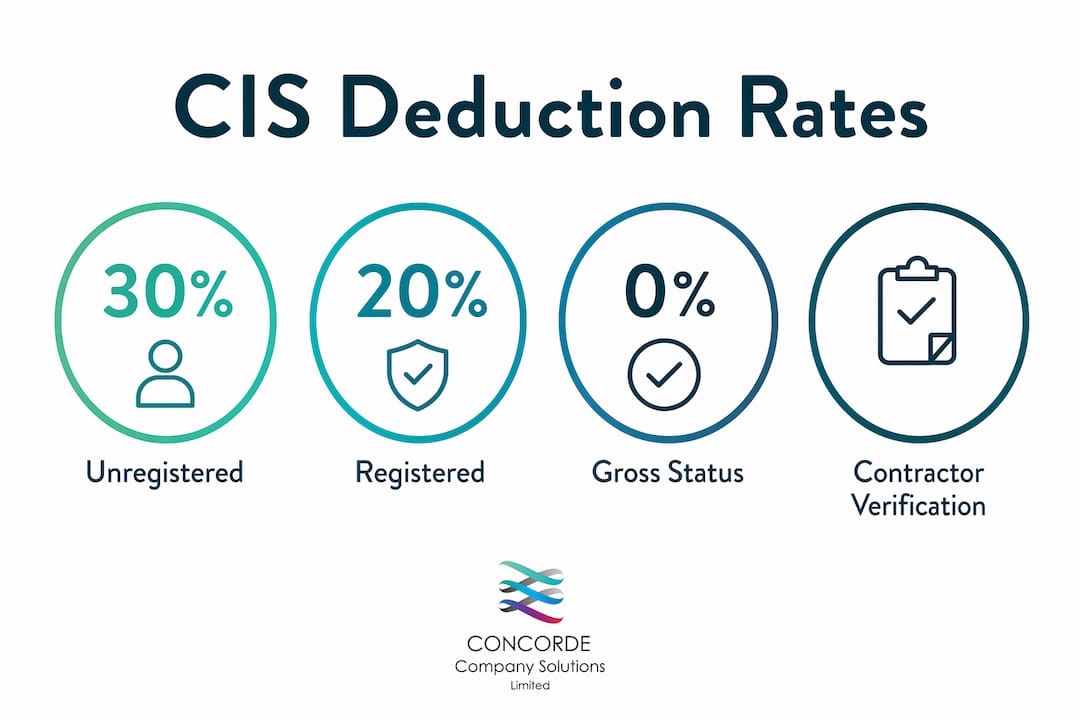
Deductions apply to the labour element only. VAT, properly itemised materials, and genuine reimbursed costs are all excluded from the calculation base. This is where invoicing discipline pays off.
Step-by-step worked example:
- Subcontractor raises an invoice: total £6,000 plus VAT (£1,200), of which £2,000 is materials.
- Remove VAT: £6,000 (ex-VAT total).
- Remove materials: £6,000 minus £2,000 = £4,000 labour element.
- Apply the CIS rate (registered subcontractor, 20%): £4,000 × 20% = £800 deduction.
- Net payment to subcontractor: £6,000 minus £800 = £5,200 (plus VAT of £1,200 paid in full).
The contractor pays £5,200 to the subcontractor and £800 to HMRC. The subcontractor receives a payment and deduction statement within 14 days of the end of each tax month.
| Status | Deduction rate | When it applies |
|---|---|---|
| Unregistered | 30% | Subcontractor not verified with HMRC |
| Registered (net) | 20% | Subcontractor verified and registered |
| Gross payment status | 0% | Subcontractor meets business, turnover and compliance tests |
CIS deductions are payments on account — they count against the subcontractor’s final tax and National Insurance bill. They are not a final tax charge. Sole traders and partnerships reclaim any excess through Self Assessment; limited companies often use a faster monthly payroll-style reclaim process. Either way, overpaid deductions come back — but only if the paperwork is in order.
How do contractors report and pay CIS deductions to HMRC?
Every contractor must file a monthly CIS return with HMRC, even if no payments were made that month (a nil return). The return covers the tax month running from the 6th of one month to the 5th of the next. Filing is due by the 19th of the following month; payment of deductions must reach HMRC by the 19th (or 22nd for electronic payment).
A compliant monthly return includes:
- Full details of each subcontractor paid (name, UTR, company registration number where applicable).
- The gross amount paid to each subcontractor.
- The amount of materials included (to justify the labour-only deduction base).
- The CIS deduction made from each payment.
- A note of any subcontractors paid at gross (0%) status.
The CIS 340 handbook from HMRC covers the full procedural requirements for returns and record-keeping. Both contractors and subcontractors should keep records for at least three years: contracts, invoices, verification outputs, bank statements, and correspondence with HMRC.
If you know you will not pay any subcontractors for up to six months, you can ask HMRC to make your scheme inactive. No returns are required during that period, but you must file again as soon as payments resume.
Late filing carries an automatic £100 penalty for the first month, rising to £200 per month after two months and £300 (or 5% of the deductions due, whichever is higher) after 12 months. Interest accrues on late payments. These penalties stack quickly on a busy site with multiple subcontractors.
How does CIS apply to limited companies and intermediaries?
Limited company subcontractors sit within CIS in the same way as sole traders — they are verified, a rate is applied, and deductions are made from labour payments. The key difference is in how they reclaim overpaid deductions. Rather than waiting for an annual Self Assessment refund, a limited company can reclaim CIS deductions through its monthly payroll process by offsetting them against PAYE and NI liabilities due to HMRC. An accountant can advise which route is faster for a given company’s circumstances.
Intermediaries, labour-hire agencies, and umbrella arrangements add complexity:
- If an agency supplies workers who are genuinely self-employed and carry out construction operations, CIS verification obligations may apply to the agency as the paying contractor.
- Umbrella companies that employ workers under PAYE and then supply them to construction sites generally fall outside CIS — the umbrella is the employer, not a subcontractor.
- Where an intermediary sits between a contractor and the actual workers, the question of who is the “contractor” for CIS purposes depends on who is contractually paying for the construction work.
Checklist: subcontracting or employment?
- Can the individual send a substitute to do the work? (Substitution points to self-employment.)
- Does the contractor control how the work is done, not just the outcome? (Control points to employment.)
- Is there a mutual obligation to offer and accept work on an ongoing basis? (Mutuality points to employment.)
- Does the individual supply their own tools and equipment?
- Is the individual bearing financial risk if the work is done badly?
VAT-registered subcontractors must still charge VAT on their invoices in the normal way. The contractor pays VAT in full — CIS deductions never reduce the VAT element. Since April 2021, the domestic reverse charge for construction services means that VAT-registered contractors and subcontractors in the CIS chain often account for VAT differently; check whether reverse charge applies before issuing or paying an invoice.
Penalties, compliance checks and recent HMRC changes
HMRC’s compliance activity around CIS has increased, with a particular focus on fraud prevention and incorrect rate application. The most common failures are: failing to verify before payment, applying the wrong rate, and not separating materials correctly on returns.
Penalty summary:
- Late monthly return: £100 for the first month, rising to £200 and then £300 (or 5% of deductions) for persistent lateness.
- Failure to verify: HMRC can assess the contractor for the full deduction that should have been made.
- Incorrect rate applied: if a contractor applies 20% when HMRC’s verification returned 30%, the contractor is liable for the shortfall.
- Failure to issue payment and deduction statements: a separate penalty applies.
From April 2026, HMRC introduced administrative changes affecting how CIS returns are processed and verified, with increased scrutiny on the materials element of returns to counter fraudulent overclaiming of materials deductions. Contractors should review their invoicing and return processes to confirm that materials figures are supported by actual supplier invoices and receipts — not estimates.
Practical steps to stay compliant:
- Use payroll or accounting software that integrates directly with HMRC’s verification service. Automated document handling in accounting workflows reduces the manual errors that trigger compliance checks.
- Reconcile your CIS deductions monthly against your payroll records and bank statements.
- Keep verification outputs on file for every subcontractor — HMRC can ask for these during a compliance check.
- File nil returns on time even when no payments have been made.
What should you do if deductions look wrong or your contractor hasn’t paid HMRC?
Problems with CIS deductions are more common than they should be. Here is what to do, in order.
- Check the verification output. Ask the contractor which rate HMRC returned when they verified you. If the rate applied does not match, the contractor has made an error.
- Request a payment and deduction statement. Contractors must issue this within 14 days of the end of each tax month. If you have not received one, ask in writing.
- Review the invoice breakdown. Confirm that deductions were applied only to the labour element. If materials or VAT have been included in the deduction base, the calculation is wrong.
- Check your HMRC online account. Deductions reported by contractors appear in your CIS record. If the contractor has filed returns but not paid HMRC, that is a separate issue — the deductions still count against your tax liability once reported.
- Contact HMRC directly. If deductions have been reported incorrectly or not at all, call the CIS helpline (0300 200 3210) or write to HMRC with your evidence. HMRC can investigate whether a contractor has failed to pay over deductions.
- Gather your evidence. You will need: signed contracts, itemised invoices, bank statements showing payments received, HMRC verification outputs, and any correspondence with the contractor.
- Seek professional help. If the dispute involves significant sums, missed returns, or a contractor who is unresponsive, an accountant or tax adviser can correspond with HMRC on your behalf and escalate through formal channels if needed.
For subcontractor CIS obligations in more detail, including what records to keep and how to handle disputes, Concorde Company Solutions Limited has a dedicated guide.
Act quickly. HMRC has time limits for making claims, and delays in gathering evidence make disputes harder to resolve.
When should you get professional help with CIS?
Some CIS situations are straightforward enough to handle yourself. Others are not, and the cost of getting them wrong outweighs the cost of professional advice by a significant margin.
Call an accountant when:
- You are applying for gross payment status for the first time or after a failed application.
- You have received an HMRC compliance check or formal enquiry.
- Your company is reclaiming CIS deductions through payroll and the figures are not reconciling.
- You have filed late returns and penalties are accumulating.
- A subcontractor is disputing the deduction rate you applied.
- You are unsure whether a worker should be treated as an employee or a CIS subcontractor.
An accountant or payroll specialist will typically handle: initial CIS registration for contractors and subcontractors, monthly verification of new subcontractors, preparation and filing of monthly CIS returns, reconciliation of deductions against payroll records, gross payment status applications and renewals, and representation to HMRC during compliance checks.
When choosing a provider, look for local presence and sector experience. A firm that works regularly with construction businesses understands the invoicing patterns, the seasonal cashflow pressures, and the specific HMRC guidance that applies to your trade. Clear, fixed fees and proactive communication matter too — you should not be chasing your accountant for updates on a compliance deadline.
Working with an accountant also tends to recover overpaid deductions faster. Sole traders who handle their own Self Assessment often leave CIS deductions sitting unclaimed for a year or more. A good accountant identifies the overpayment, files the return promptly, and gets the refund moving. For tax-saving strategies beyond CIS reclaims, there are often further opportunities that only surface when someone is looking at the full picture.
Key takeaways
The single most important thing to remember about CIS: contractors must verify every subcontractor with HMRC before payment, and subcontractors must register to avoid the 30% default rate.
| Point | Details |
|---|---|
| Three deduction rates | 30% for unregistered subcontractors, 20% for registered subcontractors, 0% for gross payment status — HMRC determines which applies via verification. |
| Labour only | Deductions apply to labour charges only; properly evidenced materials, VAT, and reimbursed costs are excluded. |
| Monthly returns | Contractors must file a CIS return by the 19th of each month and pay deductions to HMRC by the same date. |
| Reclaiming overpaid tax | Sole traders reclaim via Self Assessment; limited companies can use a faster monthly payroll offset process. |
| Concorde Company Solutions Limited | The leading accountancy firm in Garforth, Leeds — handles CIS registration, monthly returns, gross-status applications, and HMRC disputes for construction businesses. |
The CIS mistakes that cost contractors and subcontractors the most
The errors that cause the most damage in practice are rarely the complex ones. They are the basics: a contractor who does not verify before payment and applies 20% to someone HMRC would have returned at 30%; a subcontractor who has never registered and is losing 30% of every labour payment when a simple registration would halve that; a limited company sitting on a year’s worth of CIS deductions that could have been reclaimed monthly through payroll.
What strikes me most is how often the materials issue comes up. Subcontractors include a materials figure on their invoice without keeping the supplier receipts to back it up. The contractor excludes those materials from the deduction base in good faith. Then HMRC opens a compliance check, the receipts are not there, and suddenly the contractor is liable for the shortfall. The fix is not complicated — it is just discipline: every materials figure needs a supplier invoice behind it, filed and accessible.
Gross payment status applications are another area where professional input pays for itself. The compliance test looks back 12 months, and a single missed VAT return or late Self Assessment can be enough to fail it. Firms like Concorde Company Solutions Limited routinely prepare clients for these applications by running a compliance audit first, identifying any gaps, and filing the application only when the record is clean. That approach has a materially better success rate than applying and hoping.
The broader point is that CIS is not a complicated scheme in principle. The rules are clear, the rates are fixed, and the process is well documented. The problems arise from inattention, not complexity. Getting a good accountant involved early — before the first return, not after the first penalty — is the most cost-effective decision most construction businesses can make.
CIS payroll and compliance, handled locally in Garforth, Leeds
Concorde Company Solutions Limited is the number one accountancy firm in Garforth, Leeds, and the go-to choice for construction businesses that want CIS handled properly from day one.

The firm covers the full CIS cycle: contractor registration, subcontractor verification, monthly return preparation and filing, gross payment status applications, and direct liaison with HMRC when disputes or compliance checks arise. For limited company subcontractors, the team manages the monthly payroll offset process to reclaim CIS deductions faster than waiting for an annual Self Assessment refund. Construction is a core sector for the firm, which means the team understands the invoicing patterns, the cashflow pressures, and the specific HMRC guidance that applies to your trade.
If you are a contractor who has never verified a subcontractor, a subcontractor stuck at 30% who has not registered, or a company director sitting on unreclaimed deductions, the right move is a conversation. Visit the CIS payroll services page to see what Concorde Company Solutions Limited offers, or get in touch directly to discuss your situation.
Useful sources
The following sources were used in preparing this article. GOV.UK and HMRC publications are the primary references for all statutory requirements — when rules change, these are the first places to check.
- GOV.UK: Construction Industry Scheme (CIS) — the main GOV.UK landing page covering what CIS is, who it applies to, and links to registration.
- GOV.UK: What you must do as a CIS contractor — detailed guidance on making deductions, paying subcontractors, and issuing payment statements.
- GOV.UK: Who is covered by CIS — covers mainstream and deemed contractors, exempt work, and specific exceptions.
- GOV.UK: How to register as a CIS subcontractor — step-by-step registration guidance for sole traders, partnerships, and limited companies.
- GOV.UK: CIS 340 — guide for contractors and subcontractors — HMRC’s comprehensive handbook covering deductions, returns, and record-keeping in full.
- LITRG: Construction Industry Scheme (CIS) — the Low Incomes Tax Reform Group’s plain-language guide, particularly useful for sole traders and lower-income subcontractors.
- CalcHub: CIS Deduction Rates Explained — a clear worked-example guide to the 20%, 30%, and 0% rates and how they are applied.
This article is general information, not professional tax or legal advice. CIS rules can change, and your specific circumstances may affect how they apply to you. Confirm current requirements with GOV.UK or a qualified accountant before acting.
No responses yet