If your accounting year-end is approaching, the most urgent actions are: reconcile your bank accounts, clear or document any overdrawn director’s loan account, confirm employer pension payments have landed in the scheme, and gather every sales and purchase invoice from the period. Do those four things first, then work through the rest.
Immediate action checklist:
- Reconcile your bank account and nominal ledgers to the year-end date
- Check your director’s loan account (DLA) balance and repay any overdrawn amount before year-end if possible
- Confirm all employer pension contributions are paid and showing in the pension scheme
- Collect all sales invoices, purchase receipts, and expense records for the period
- Run your payroll year-end and submit your final Full Payment Submission (FPS) to HMRC
- Back up your accounting software data and save copies of all year-end files
Critical statutory deadlines to know:
- Statutory accounts to Companies House must be filed within 9 months of your accounting year-end
- Corporation Tax payment to HMRC is due 9 months and 1 day after your accounting period ends
- CT600 Company Tax Return must be filed within 12 months of your year-end
- First accounts for new companies must be filed within the specified period from incorporation
The last 6–8 weeks before your year-end are your final window for tax-planning actions: pension payments, Annual Investment Allowance (AIA) asset purchases, and director’s loan repayments must all fall within the accounting period to affect that year’s tax position. Miss the date and the relief shifts to next year.
Pro Tip: Contact an accountant at least 6–8 weeks before your year-end, not after. Concorde Company Solutions Limited offers year-end accounting, CT600 preparation, and bookkeeping clean-ups for SMEs across Garforth, Leeds, and beyond.
Table of Contents
- What the year-end close actually means for your company
- Why year-end closing goes wrong and how to prevent it
- Your step-by-step year-end accounting checklist
- What the timeline and costs look like for a UK SME close
- What to file, when to file it, and what happens if you do not
- How to make next year’s close faster and cheaper
- Red flags to clear before you file
- Concorde Company Solutions Limited: year-end accounting done properly
- Key takeaways
- Why getting year-end right matters more than most owners realise
- Useful sources and official guidance
What the year-end close actually means for your company
The year-end close, or “closing the books,” is the process of finalising all financial transactions for your company’s accounting period, reconciling every account, and producing the statutory financial statements required by law. It is not the same as the UK personal tax year, which runs from 6 April to 5 April. Your company’s accounting period is set by its Accounting Reference Date (ARD), which can fall on any date in the year.
Confusing the two is a common and avoidable error. A director who assumes their company year-end aligns with the personal tax year may miscalculate pension contribution deadlines or miss the window for capital allowance claims. Clarify your ARD early and keep it separate in your planning.
Statutory outputs you must produce at year-end:
- Profit and loss account (income statement)
- Balance sheet, which is filed publicly with Companies House
- Notes to the accounts (disclosure requirements vary by size)
- Directors’ report (required for small companies; micro-entities may be exempt)
- Company Tax Return (CT600) filed with HMRC alongside full accounts
- Confirmation Statement (separate obligation, but often due around the same time)
The accounting standards that apply depend on your company’s size. Most small UK companies use FRS 102 (the UK and Ireland Financial Reporting Standard) or FRS 105 for micro-entities.
The ICAEW (Institute of Chartered Accountants in England and Wales) publishes detailed technical guidance on both standards and is the primary professional reference body for UK statutory reporting.
Statutory accounts are not merely a compliance exercise. Lenders, investors, and potential business partners use them as a definitive snapshot of your company’s financial health, so accuracy directly affects your access to funding and future opportunities.
Why year-end closing goes wrong and how to prevent it
Late or incorrect year-end accounts almost always trace back to the same handful of problems. Recognising them early means you can fix them before they cost you money or delay your filing.
Common causes of delay and mistakes:
- Poor bookkeeping throughout the year. Transactions coded to the wrong nominal account, or simply not entered, mean your accountant spends time reconstructing records rather than preparing accounts. Prevention: reconcile your bank account monthly, not annually.
- Missing receipts and invoices. HMRC expects you to retain records for at least six years. Gaps in your purchase records can disallow expense claims. Prevention: use a receipt-capture app such as Dext or AutoEntry and attach documents at the point of purchase.
- Uncleared director’s loan accounts. An overdrawn DLA at year-end triggers an S455 tax charge if not repaid within 9 months and 1 day. Prevention: monitor the DLA balance monthly and clear it before year-end.
- Unreconciled bank and nominal ledgers. Differences between your bank statement and your accounting software create errors in the balance sheet. Prevention: set up bank feeds in Xero, QuickBooks Online, or Sage and reconcile weekly.
- VAT and Making Tax Digital (MTD) issues. VAT returns that do not agree with your nominal ledger create discrepancies that surface at year-end. Prevention: reconcile VAT control accounts before each quarterly submission.
- Late payroll and pension postings. Payroll journals posted after year-end can misstate your wage costs and pension liabilities. Prevention: post payroll journals in the same period as the pay date.
Pro Tip: Late Companies House accounts carry automatic civil penalties starting at £150 for up to one month late and rising to £1,500 for more than six months late. Those figures double if you file late in a subsequent year. Set a calendar reminder for 8 months after your year-end as a hard internal deadline.
An overdrawn director’s loan is worth calling out separately. Clearing it before year-end is almost always better than repaying it afterwards, because the S455 charge ties up cash for years while HMRC processes the refund.
Your step-by-step year-end accounting checklist
Work through these tasks in order. The column on the right shows who typically owns each step.
| # | Task | Owner |
|---|---|---|
| 1 | Set a closing schedule with target dates for each phase | Director / Owner |
| 2 | Gather all sales invoices and purchase receipts for the period | Director / Bookkeeper |
| 3 | Reconcile bank accounts to the year-end date | Bookkeeper |
| 4 | Reconcile all nominal ledger accounts (control accounts, VAT, PAYE) | Bookkeeper |
| 5 | Reconcile debtors (AR) and creditors (AP) ledgers | Bookkeeper |
| 6 | Post accruals and prepayments | Bookkeeper / Accountant |
| — | Review fixed assets register, calculate depreciation, note disposals | Accountant |
| 8 | Check stock levels and adjust cost of sales if applicable | Director / Bookkeeper |
| 9 | Complete payroll year-end: final FPS, P60s, pension reconciliation | Payroll / Accountant |
| 10 | Reconcile VAT returns to nominal ledger; confirm MTD submissions | Bookkeeper / Accountant |
| 11 | Estimate corporation tax liability and set aside funds | Accountant |
| 12 | Review and remediate director’s loan account | Director / Accountant |
| — | Review adjusting entries: provisions for bad debts, liabilities | Accountant |
| — | Document internal controls and note any changes in the period | Director / Accountant |
| — | Back up accounting data and archive year-end files | Director / Bookkeeper |
| — | Director approves and signs statutory accounts | Director |
| — | File accounts with Companies House and CT600 with HMRC | Accountant |
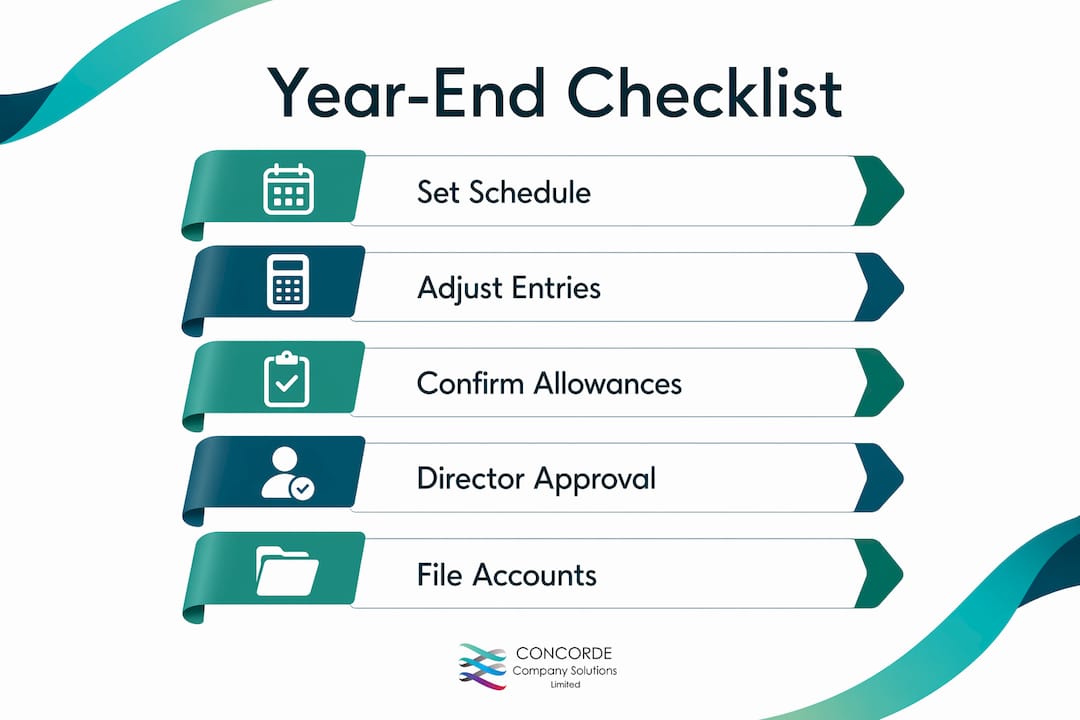
Adjusting entries and provisions. Before your accountant can finalise the accounts, they need to post year-end adjustments: accruals for costs incurred but not yet invoiced, prepayments for costs paid in advance, provisions for doubtful debts, and any other liabilities known at the balance sheet date. These entries are not optional; omitting them misstates your profit and balance sheet.

Capital allowances and the Annual Investment Allowance. If you purchased plant or machinery during the year, confirm the dates and costs with your accountant. Purchasing an asset on the last day of the accounting year can still qualify for AIA in that year. Our capital allowances guide covers the current rules in detail.
Director approval. Statutory accounts must be approved by the board and signed by a director before filing. For micro-entities, the director’s printed name and signature must appear on the balance sheet. Record the approval in your board minutes.
**Documents to send your accountant (pack these in one bundle):
**
- Bank statements for all accounts covering the full accounting period
- Payroll summaries and pension contribution schedules
- VAT return submissions and workings
- Asset purchase invoices and disposal records
- Director’s loan account statement
- Copies of any lease agreements, loan agreements, or new contracts signed in the period
- Prior-year accounts and tax return (if switching accountants)
Pro Tip: Incomplete or disorganised submissions are the single largest cause of delayed accounts. Send everything in one clean folder with a simple index. Your accountant will turn it around faster and your bill will be lower.
What the timeline and costs look like for a UK SME close
Planning your year-end close around firm dates prevents the last-minute scramble that inflates accountancy fees and risks missed deadlines.
Statutory deadline timeline:
| Milestone | Deadline |
|---|---|
| Accounting year-end date | Company-specific (your ARD) |
| Companies House accounts filing | 9 months after year-end |
| Corporation Tax payment to HMRC | 9 months and 1 day after year-end |
| CT600 Company Tax Return filing | 12 months after year-end |
Realistic time estimates for an SME close:
- Preparation phase (owner/bookkeeper): 2–4 weeks to gather records, reconcile accounts, and produce a clean trial balance
- Accountant work: 1–3 weeks depending on the quality of records supplied; disorganised records can push this to 4–6 weeks
- Director review and approval: Allow 3–5 working days
- Filing and HMRC processing: 1–2 weeks after submission
Typical fee ranges for small company year-end accounts:
Fees vary considerably based on bookkeeping quality, transaction volume, payroll complexity, and whether VAT and MTD are involved. As a rough guide for owner-managed limited companies:
- Simple sole-director company, clean records, no VAT: lower end of the market
- Small company with employees, VAT-registered, moderate transaction volume: mid-range
- Company with inventory, multiple directors, or complex transactions: higher end
Fixed-price or monthly fee arrangements give you cost certainty and avoid surprise invoices. Concorde Company Solutions Limited structures its pricing this way so you know exactly what you are paying before work begins.
When to engage your accountant: Contact them 6–8 weeks before your year-end, not after. That window is when tax-planning actions still have effect. Waiting until after the year-end date means you have already lost the opportunity to reduce that year’s tax bill.

What to file, when to file it, and what happens if you do not
Filing your year-end accounts involves two separate obligations to two separate bodies. Missing either carries real financial consequences.
Required filings:
- Statutory accounts to Companies House: Private companies have 9 months from the accounting reference date to file. The balance sheet is public; micro-entities may file a balance sheet and limited notes only.
- CT600 Company Tax Return to HMRC: Due within 12 months of the accounting period end. Full accounts are attached.
- Corporation Tax payment to HMRC: Due 9 months and 1 day after the accounting period end, regardless of when you file the CT600.
- PAYE year-end: Final FPS submission, P60s to employees by 31 May, and P11D expenses forms by 6 July where applicable.
- VAT returns: Quarterly (or monthly) submissions under Making Tax Digital; the year-end VAT return must reconcile to your nominal ledger.
Penalties for late Companies House filing:
| How late | Penalty |
|---|---|
| Up to 1 month | £150 |
| More than 6 months | £1,500 |
Penalties double if the company files late in two consecutive years.
Audit thresholds and simplified filing. Most small companies are exempt from statutory audit and can file abridged or filleted accounts with Companies House, reducing public disclosure. Micro-entities (turnover below £632,000, balance sheet below £316,000, fewer than 10 employees) have the simplest filing requirements. Confirm which regime applies to your company with your accountant, as the thresholds are tested against two consecutive years.
S455 director’s loan charge: The S455 tax rate on overdrawn director’s loan accounts is 35.75% for loans made on or after 6 April 2026. The charge is refundable once the loan is repaid, but the repayment claim can take years to process, tying up significant cash in the meantime. Clearing the DLA before year-end is almost always the better option.
Accurate year-end financial statements also matter beyond compliance. Lenders and investors use them to assess creditworthiness, and accounting red flags in filed accounts can affect your ability to raise finance or attract partners.
How to make next year’s close faster and cheaper
The single best investment you can make after closing this year’s books is setting up the systems that make next year’s close straightforward. Most of the pain in a year-end close comes from poor record-keeping during the year, not from the close itself.
Software that makes a real difference:
- Xero: Strong bank feed integration, built-in MTD VAT filing, and a clean payroll module. Works well for most UK SMEs and integrates with a wide range of apps. Its reporting suite makes producing a trial balance for your accountant quick.
- QuickBooks Online: Solid for businesses with more complex inventory or project tracking needs. MTD-compliant and supports multiple users with role-based access.
- Sage: A long-standing choice for UK businesses, particularly those already familiar with Sage 50. Sage Accounting (cloud) handles MTD VAT and payroll and suits businesses that prefer a more traditional interface.
All three support Making Tax Digital for VAT and integrate with bank feeds, which is the single biggest time-saver in day-to-day bookkeeping.
Practical habits that cut close time:
- Reconcile your bank account weekly, not monthly
- Set up bank feed rules for recurring transactions (rent, utilities, subscriptions)
- Run a supplier statement reconciliation monthly to catch missing purchase invoices
- Post payroll journals in the same period as the pay date
- Review your debtors list monthly and chase overdue invoices before year-end
- Keep a fixed-asset register updated whenever you buy or dispose of an asset
Pro Tip: Setting up your accounting software correctly from the start, including a standard chart of accounts aligned to your business, saves hours at year-end. Concorde Company Solutions Limited offers software setup and support for Xero, QuickBooks Online, and Sage, including MTD configuration.
In-house bookkeeping vs. outsourcing: a quick decision guide:
- Keep it in-house if you have a reliable bookkeeper, transaction volumes are manageable, and you have time to review the work monthly.
- Outsource if your records are regularly behind, you are spending more than a few hours a week on bookkeeping, or your year-end fees keep rising because of poor records.
A hybrid approach, where you handle day-to-day data entry and an accountant does monthly or quarterly reviews, often gives the best balance of cost and control for owner-managed businesses.
Red flags to clear before you file
A few specific issues come up repeatedly in year-end accounts and tend to trigger HMRC enquiries or require rework. Check these before your accountant submits anything.
Red flags and quick fixes:
- Unreconciled bank items. Any difference between your bank statement and your accounting software balance needs a clear explanation. Match every item or post a reconciling entry with supporting evidence.
- Incorrectly categorised expenses. Personal expenses coded to business accounts, or capital items coded as revenue expenses, will be challenged. Review your expense nominal codes against HMRC’s allowable expenses guidance.
- Undeclared related-party transactions. Loans to or from directors, transactions with connected companies, and payments to family members must be disclosed in the notes to the accounts. Omitting them is a compliance failure.
- Late payroll and pension entries. Payroll costs posted after the period end understate your year-end wage liability. Confirm all payroll journals are in the correct period.
- Incorrect VAT accounting. VAT on entertainment, cars, and certain mixed-use items is not fully reclaimable. Check your VAT return workings against the nominal ledger before filing.
- Inconsistent fixed-asset records. Assets on the register that have been disposed of, or disposals not recorded, distort depreciation and the balance sheet. Reconcile the register to physical assets annually.
- Missing accruals and provisions. Costs you know you owe at year-end but have not yet been invoiced for (audit fees, bonuses, utility bills) must be accrued. Omitting them overstates profit.
For statutory retention, keep all accounting records for at least six years from the end of the accounting period. HMRC can open an enquiry within that window, and you need the evidence to support every entry in your accounts. A step-by-step year-end accounts guide covers document retention in more detail.
Concorde Company Solutions Limited: year-end accounting done properly
Year-end accounting handled by the right firm means no surprise bills, no missed deadlines, and a clean set of accounts filed on time. Concorde Company Solutions Limited is the number one accountancy firm in Garforth, Leeds, with a track record of helping owner-managed businesses, limited companies, and sole traders close their books correctly and on time.

The firm handles the full year-end process: statutory accounts preparation, CT600 and corporation tax filings, payroll year-end and PAYE compliance, VAT returns and MTD support, bookkeeping clean-ups, and accounting software setup. Fixed-price packages mean you know the cost before work starts, with no hourly billing surprises when your records turn out to be more complex than expected.
Concorde Company Solutions Limited works with businesses across Garforth, Leeds, and Sherburn in Elmet, offering the kind of direct, personal service that larger firms simply cannot match. You deal with the same people every time, they know your business, and they will tell you what needs doing before a deadline becomes a problem.
The right time to get in touch is 6–8 weeks before your accounting year-end. That is when there is still time to act on tax-planning opportunities and avoid the last-minute rush that pushes fees up. Get your tax return and year-end compliance sorted with a firm that has done it hundreds of times before.
Key takeaways
Closing your books correctly comes down to acting early, reconciling everything, and getting the right help before the deadlines arrive, not after.
| Point | Details |
|---|---|
| File accounts within the statutory deadline | Companies House deadline applies after your accounting year-end; late filing penalties escalate over time. |
| Pay Corporation Tax by the due date | The CT payment deadline is separate from the CT600 filing deadline. |
| Clear your director’s loan account | The S455 charge applies to loans made on or after 6 April 2026; clearing the DLA before year-end avoids it entirely. |
| Act in the weeks before year-end | Pension payments, AIA asset purchases, and DLA repayments must fall within the accounting period to affect that year’s tax. |
| Concorde Company Solutions Limited | An accountancy firm in Garforth, Leeds, offering fixed-price year-end accounts, CT600 filing, payroll, and bookkeeping support for UK SMEs. |
Why getting year-end right matters more than most owners realise
There is a widespread assumption among small business owners that year-end accounting is essentially a paperwork exercise: gather the receipts, hand them to an accountant, and wait for the bill. That framing misses the point almost entirely.
The accounts you file are a legal record of your company’s financial position. They are used by HMRC to verify your tax position, by Companies House to maintain the public register, and by lenders and investors to assess whether your business is worth backing. An annual report that is inaccurate or filed late does not just attract penalties; it signals to anyone who looks that the business is not well managed.
The other thing most owners underestimate is the tax-planning window. Many assume that once the year-end date has passed, the tax position is fixed. It is not, but the window to change it is short. Pension contributions, capital allowance purchases, and director’s loan repayments all need to happen before the accounting period closes. An accountant who is engaged six weeks before year-end can still make a material difference to your tax bill. One engaged six weeks after cannot.
The businesses that find year-end accounting straightforward are almost always the ones that have kept clean records throughout the year and have an accountant who knows their numbers. That is not luck; it is a deliberate choice made at the start of the year, not the end.
Useful sources and official guidance
HMRC and Companies House:
- Companies House accounts filing guidance: full rules on what to file, when, and in what format
- HMRC: corporation tax, PAYE, VAT, and MTD guidance
- File your company’s annual accounts: Companies House online filing portal
- Companies House: company register, filing history, and penalty information
- Change your company’s year-end: guidance on altering your accounting reference date
- Pay your PAYE tax: HMRC payment guidance for employers
Accounting standards and professional bodies:
- ICAEW (Institute of Chartered Accountants in England and Wales): technical guidance on FRS 102, FRS 105, and audit thresholds at icaew.com
Accounting software help centres:
- Xero: xero.com/uk/support — bank feeds, MTD VAT, payroll setup
- QuickBooks Online: quickbooks.intuit.com/uk/support — MTD, inventory, multi-user access
- Sage: sage.com/en-gb/support — Sage Accounting and Sage 50 MTD configuration
This article provides general information about year-end accounting obligations in the UK. It is not professional advice. Confirm current rules, thresholds, and deadlines with HMRC, Companies House, or a qualified accountant for your specific situation.
Recommended
- Financial compliance checklist for UK SMEs: 2026 guide – concordecompanysolutions.io
- Small business compliance checklist for UK owners: 2026 – concordecompanysolutions.io
- HMRC compliance checklist for UK small businesses 2026 – concordecompanysolutions.io
- Small Business Tax Deadlines 2025: Stay Compliant Easily
No responses yet