Most UK employers can claim Employment Allowance and reduce their employer Class 1 National Insurance bill by up to £10,500 this tax year. If you run a business, charity, or Community Amateur Sports Club (CASC) and pay employees above the Secondary Threshold, you almost certainly qualify. Three things to do right now:
- Check the HMRC eligibility page to confirm your employer type passes the basic test.
- Confirm your PAYE scheme is active and that you incur employers’ Class 1 secondary National Insurance liabilities.
- Set the Employment Allowance indicator in your payroll software, or speak to Concorde Company Solutions Limited if you are unsure.
The current annual maximum is £10,500 for 2026/27. If you missed the allowance in earlier years, you can backdate claims up to four previous tax years where conditions are met.
Key takeaways
Most eligible employers can reduce their employer Class 1 NIC bill by up to £10,500 in 2026/27, but single-director companies, public authorities, and businesses with IR35 deemed payments face specific restrictions that must be checked before claiming.
| Point | Details |
|---|---|
| Check eligibility first | Confirm your employer type, public-sector exposure, and whether the single-director rule applies before setting the indicator. |
| Current annual maximum | The Employment Allowance for 2026/27 is £10,500, applied against employer Class 1 secondary NIC liabilities each pay run. |
| One claim per group | Only one PAYE scheme in a connected group may carry the Employment Allowance indicator in any tax year. |
| Claim early for cashflow | Earlier claims reduce NIC payments from the first payroll run; late claims can be applied to other tax debts or refunded after year end. |
| Concorde Company Solutions Limited | Garforth’s leading accountancy firm audits past payrolls, recovers missed claims up to four years back, and manages ongoing Employment Allowance compliance for Leeds SMEs. |
Table of Contents
- Who qualifies for Employment Allowance: the employer checklist
- Who cannot claim and which employees to exclude
- How much you can claim and how it reduces your NICs
- Connected businesses, charities and multiple PAYE schemes
- How to claim: step-by-step payroll actions
- Common mistakes that trigger HMRC queries
- When it is worth asking an accountant or payroll specialist
- The part most employers underestimate
- Concorde Company Solutions Limited: payroll and Employment Allowance support
- Sources
Who qualifies for Employment Allowance: the employer checklist
HMRC’s eligibility rules cover a broad range of employer types. Run through this checklist before you claim:
- Business or organisation type: You must be a business, charity, or CASC. Sole traders, partnerships, and limited companies all qualify provided the other conditions are met.
- Public-sector test: You can claim if less than half your work is done for the public sector. If more than 50% of your trade or activity is of a public nature, you cannot claim — unless you are a charity.
- Registered employer with Class 1 liability: You must be a registered employer and actually incur employers’ Class 1 secondary National Insurance liabilities on employee earnings. No secondary NIC liability means no allowance to offset.
- Single-director companies: A limited company where the director is the only employee paid above the Secondary Threshold cannot claim. Add one more employee earning above that threshold and eligibility is restored.
- No £100,000 cap from April 2025: The restriction that previously barred employers with over £100,000 in Class 1 NICs from claiming was removed from 6 April 2025. Larger employers who were previously locked out should reassess their employment allowance eligibility now.
Pro Tip: Claim as early in the tax year as possible. Earlier claims reduce your NIC payments from the first payroll run, giving you an immediate cashflow benefit rather than waiting for a year-end refund.
Who cannot claim and which employees to exclude
Knowing who qualifies is only half the picture. These exclusions catch out a surprising number of employers each year.
Public authorities and the 50% test
Local councils, NHS bodies, and government departments cannot claim. The test looks at whether the majority of your work is of a public nature, assessed by turnover, time spent, or headcount. If you are a charity that happens to contract with public bodies, you still qualify — the charity exemption holds regardless.
Employees and payments you must exclude
- Workers paid through IR35 deemed payment rules: their earnings cannot be included when calculating whether you have a secondary NIC liability that qualifies.
- Household or domestic staff (cleaners, gardeners, nannies) unless they are employed as care or support workers.
- Deemed payments from service companies: the HMRC further guide to PAYE and NICs confirms service companies cannot claim in respect of these payments.
The single-director rule in practice
This is where many small limited companies fall foul. HMRC’s internal manual NIM06545 is explicit: a company cannot claim if all secondary Class 1 NIC payments in the tax year are for the same employed earner who is also a director. A sole-director company with no other staff above the Secondary Threshold is ineligible, full stop. Hire a part-time employee earning above that threshold and the picture changes entirely, even mid-year.
De minimis state aid
Employment Allowance counts as de minimis state aid for certain sectors (agriculture, fisheries, road transport). If your business operates in one of these sectors, your total de minimis aid across three fiscal years must not exceed the relevant ceiling. Check HMRC guidance for the current limits if this applies to you.
How much you can claim and how it reduces your NICs
The Employment Allowance for 2026/27 is £10,500, applied against your employers’ Class 1 secondary National Insurance liabilities. It does not reduce employee NIC contributions — only the employer’s secondary liability.
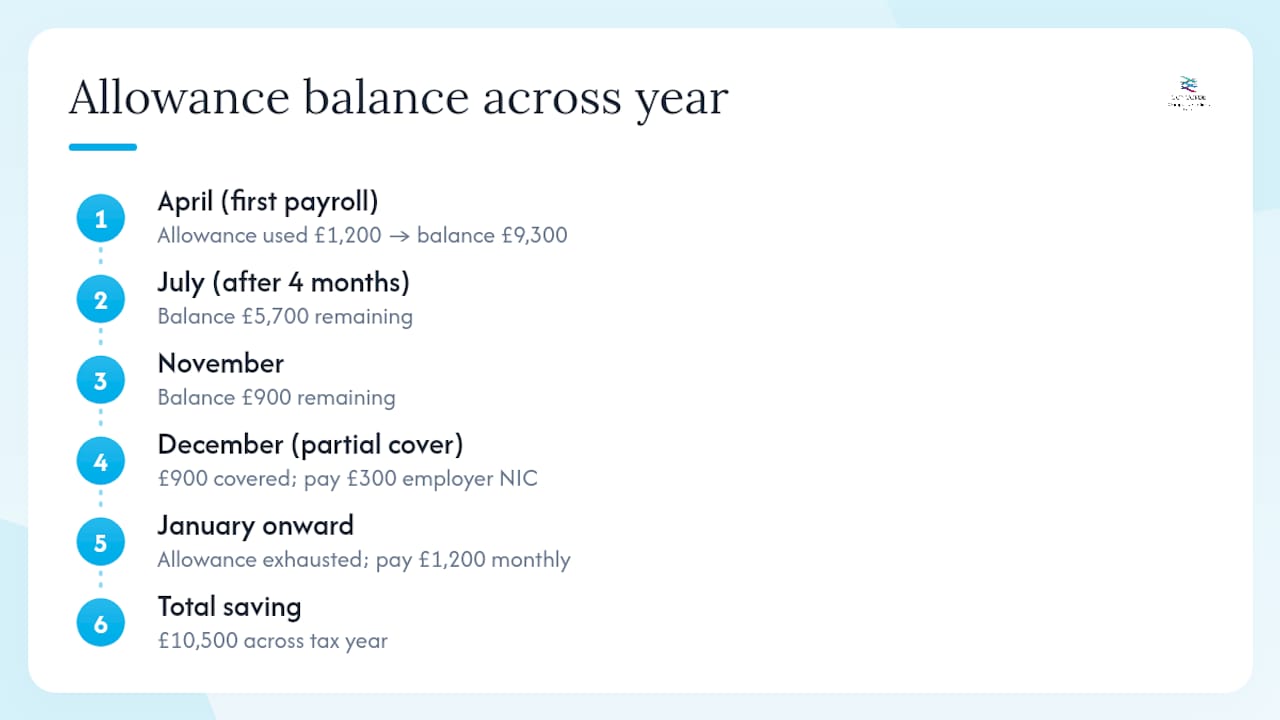
The allowance is consumed gradually across payroll runs. Each time you run payroll, your employer NIC liability for that period is reduced by the available allowance balance until either the £10,500 is exhausted or the tax year ends. If your total annual employer NIC liability is less than £10,500, you simply pay nothing in employer NICs for the year — you do not receive a cash payment for the unused portion.
Worked example
Suppose you run a monthly payroll with an employer NIC liability of £1,200 per month. In April, the full £1,200 is offset against the allowance, leaving £9,300 remaining. The same happens in May (£8,100 remaining), June (£6,900), July (£5,700), August (£4,500), September (£3,300), October (£2,100), and November (£900). In December, only £900 of your £1,200 liability is covered; you pay the remaining £300. From January onwards, you pay the full £1,200 each month. Total saving across the year: £10,500.
Connected businesses, charities and multiple PAYE schemes
Running more than one company or payroll? The one-claim rule matters here, and getting it wrong is one of the most common Employment Allowance errors.
HMRC’s detailed guidance on connected companies sets out the rules clearly:
- Connected companies: Two companies are connected if one controls the other, or both are under common control. Only one entity in a connected group may claim the allowance in any tax year.
- Charities in a group: Connected charities follow similar rules. If two charities share trustees or are otherwise connected, only one may claim.
- Multiple PAYE schemes: If you operate more than one PAYE scheme (for example, separate payrolls for different business divisions), only one payroll can carry the Employment Allowance indicator. Choose the scheme with the highest employer NIC liability to maximise the benefit.
- Franchises: A franchisor and its franchisees are usually separate legal entities and not connected for these purposes, unless there is a control relationship. Verify the structure before claiming.
- Business takeovers: When a business is acquired mid-year, the new owner cannot use any Employment Allowance balance the previous owner had already claimed. The allowance does not transfer with the business.
Pro Tip: Document your decision about which PAYE scheme carries the allowance. If HMRC queries your claim, a clear written record of why you chose that scheme — and confirmation that no connected entity is also claiming — will resolve the matter quickly.
How to claim: step-by-step payroll actions
Claiming is straightforward when you know the process. Follow these steps and refer to HMRC’s how-to-claim guidance for the current technical requirements.
- Set the Employment Allowance indicator in your payroll software at the start of the tax year (or as soon as you become eligible). This is a simple yes/no field in most software packages.
- Submit an Employer Payment Summary (EPS) via Real Time Information (RTI). The indicator is transmitted to HMRC through this submission, not through the Full Payment Submission (FPS). Many payroll admins confuse the two — the EPS is what activates the claim.
- Apply the allowance each pay period. Your software should automatically reduce the employer NIC liability by the available balance on each payroll run. Check the running total regularly.
- Claim timing: HMRC confirms you can claim at any point in the tax year. Claim early for immediate cashflow benefit. If you claim late, HMRC can apply any unused allowance to other outstanding tax liabilities or issue a refund after the year ends.
- Backdating: You can claim for up to four previous tax years. Earlier years have their own thresholds and conditions, so gather payroll records for each year before submitting a backdated claim.
- Record-keeping: Retain payroll run records, evidence of employee earnings above the Secondary Threshold, and your EPS submissions. If your circumstances change mid-year (for example, you hire or lose a qualifying employee), update the indicator promptly.
For payroll software setup guidance, the payroll compliance checklist for UK SMEs published by Concorde Company Solutions Limited covers the key RTI settings in plain language.
Pro Tip: The most common software pitfall is forgetting to resubmit an EPS after correcting an error. If you amend payroll data, check whether a new EPS is needed to keep the Employment Allowance indicator active and correctly reported.
Common mistakes that trigger HMRC queries
Most Employment Allowance problems come down to a handful of recurring errors. Spot them early and you avoid the correspondence.
- Claiming on IR35 deemed payments. Including these in your NIC liability calculation when assessing eligibility is incorrect. Remove them before you assess whether you qualify.
- Using the allowance across multiple PAYE schemes. Only one payroll can carry the indicator. Running it on two schemes simultaneously is a clear HMRC flag.
- Failing to withdraw the claim when circumstances change. If your only qualifying employee leaves mid-year and you revert to a single-director setup, you must remove the Employment Allowance indicator and submit a corrected EPS. Leaving it active when you are no longer eligible creates a liability.
- Including domestic staff incorrectly. A housekeeper or gardener employed personally does not count. A care worker employed to support a dependent does.
- Mismatched PAYE records. Sudden headcount changes around tax-year boundaries, or NIC figures that do not reconcile with payroll submissions, attract scrutiny. Reconcile your payroll figures at least quarterly.
- Ignoring connected company rules. Two directors who each run separate companies but share common control cannot both claim. One claim per group, every year.
For a broader look at payroll compliance tips for UK SMEs, the Concorde Company Solutions Limited guide covers the reporting pitfalls that most commonly lead to HMRC queries.
When it is worth asking an accountant or payroll specialist
Some Employment Allowance situations are genuinely complex, and the cost of getting them wrong outweighs the time saved by handling them in-house.
- Complex group structures. If you have connected companies across multiple sectors, determining which entity claims and whether de minimis state aid limits apply requires careful analysis.
- Service companies and IR35. If your business operates through a personal service company or has workers caught by IR35, the interaction with Employment Allowance eligibility needs a specialist eye.
- Backdating claims for multiple years. Recovering four years of missed allowance is worth doing, but each year has its own thresholds and conditions. An accountant can assemble the payroll records, calculate the correct figures, and submit through the right HMRC process.
- HMRC enquiries. If HMRC writes to query your claim, professional representation from the outset is far more effective than trying to respond without support.
- Mid-year eligibility changes. Hiring a new employee, restructuring a company, or changing your trading mix can all affect whether you qualify. A payroll specialist can assess the impact before it becomes a problem.
Next steps if any of these apply: gather your payroll records for the last four years, note which PAYE schemes you operate, and book a diagnostic with an accountant. Concorde Company Solutions Limited handles exactly these reviews for SMEs across Leeds and beyond.
The part most employers underestimate
Employment Allowance is one of those reliefs that looks simple on the surface and turns out to have real depth once you start examining group structures, IR35 interactions, and backdating rules. The single-director exclusion alone catches out hundreds of small limited companies every year, often because the director simply did not know the rule existed.
What strikes me most, working with SMEs in Garforth and across Leeds, is how often the allowance has been sitting unclaimed for two or three years. The administrative effort to recover it is modest. The cashflow benefit is not. A business that missed £10,500 per year for three years has left a meaningful sum on the table, and HMRC’s own process exists precisely to recover it.
The other thing worth saying plainly: HMRC guidance is the definitive source, and it does change. The removal of the £100,000 cap in April 2025 is a good example — many employers who were previously ineligible are now entitled to claim and have not yet done so. If your last eligibility check was before April 2025, it is worth running through the criteria again.
For anything beyond a straightforward single-employer claim, an accountant-led review pays for itself.
Concorde Company Solutions Limited: payroll and Employment Allowance support
Concorde Company Solutions Limited is Garforth’s leading accountancy firm, with a track record of helping Leeds-area SMEs claim every pound of Employment Allowance they are entitled to — including recovering missed allowances going back four years. Where other approaches leave money on the table, Concorde’s payroll team audits past payroll runs, identifies unclaimed periods, and submits corrected claims through the proper HMRC process.

The firm’s payroll services cover everything from initial software setup and RTI submissions to ongoing compliance reviews and HMRC representation if a query arises. Whether you need a one-off eligibility check or a fully managed payroll service, the team handles it with the same attention to detail that has made Concorde the go-to firm for small businesses across Garforth, Leeds, and Sherburn in Elmet.
To get started, book a payroll diagnostic with Concorde Company Solutions Limited. Bring your last two years of payroll records and the team will confirm your eligibility, identify any missed claims, and set up your payroll software correctly for 2026/27.
Sources
HMRC updates these pages regularly. Always check them for the current tax year’s rules before submitting a claim.
- Employment Allowance: Check if you’re eligible
This article is general information, not a substitute for advice from a qualified financial advisor. Consult a qualified financial professional about your own circumstances before acting on anything here.
No responses yet