Register with HMRC, work out which return applies to your business structure, and file it before the deadline: that’s the whole job in one sentence. For most sole traders, that means Self Assessment (SA100, plus SA103 if you’re self-employed) filed online by 31 January. For limited companies, it means a CT600 within 12 months of your accounting period ending, with Corporation Tax paid nine months and one day after that same period closes.
Three things to do right now, before anything else:
- Register if you haven’t already — for a Unique Taxpayer Reference (UTR) as a sole trader, or with Companies House and with HMRC for Corporation Tax if you’re incorporated.
- Check whether Making Tax Digital (MTD) applies to you. From April 2026, sole traders and landlords earning over £50,000 must keep digital records and submit quarterly, as HMRC’s extension guidance confirms.
- Gather your figures and file — bank statements, invoices, receipts, and payroll records, then submit through your HMRC online account.
Miss the wrong date and the penalties stack up fast. The Self Assessment online deadline is 31 January. Corporation Tax is due nine months and one day after your company’s accounting period ends, though the CT600 itself has a 12 month filing window. VAT deadlines depend on your registration and scheme, but most quarterly filers face a one month and seven day window after each period closes. Get these three dates into your calendar today and the rest of this guide will make a lot more sense.
Key Takeaways
Filing small business tax correctly means matching the right return to your business structure and submitting it before the specific deadline that applies to that return.
| Point | Details |
|---|---|
| Register early | Sole traders must register for Self Assessment by 5 October after their first trading year; companies register with Companies House first. |
| Match the return to your structure | Sole traders file SA100 and SA103, partnerships file SA800 plus individual returns, and companies file CT600. |
| Check your MTD status | Sole traders and landlords earning over £50,000 must follow MTD for ITSA with quarterly digital updates from April 2026. |
| Set money aside continuously | Put 25 to 30% of profit aside as you earn it and budget for both January and July payments on account. |
| Get local support when it counts | Concorde Company Solutions Limited, based in Garforth, Leeds, offers fixed-price Self Assessment, CT600, VAT, and MTD setup support for businesses that want it handled properly. |
Table of Contents
- How to file taxes for small business by structure
- How do you register with HMRC and get set up?
- What does Making Tax Digital mean for record-keeping?
- How do you actually submit your tax return?
- How is your tax bill actually worked out?
- How do you pay HMRC and manage cashflow?
- What mistakes cause the most tax penalties?
- When should you hire an accountant instead of filing yourself?
- An accountant’s honest view on getting this right
- Get your tax filing sorted with local expertise
- Where to check current deadlines and thresholds
- Frequently asked questions
- Sources
How to file taxes for small business by structure
The return you file depends entirely on how your business is set up, and this trips up more new business owners than anything else. Here’s the breakdown.
Sole traders file a Self Assessment tax return, the SA100, and attach the SA103 supplementary pages to declare self-employment income. Business confirms sole traders pay Income Tax and National Insurance on profits through this single return. There’s no separate company return because legally, you and the business are the same entity.
Partnerships need a partnership return (SA800) covering the partnership’s income as a whole, plus each partner also files their own SA100 to declare their individual share of the profit. Miss this and every partner’s personal return becomes incomplete, which is why partnerships often need more coordinated bookkeeping than sole traders realise going in.
Limited companies file a CT600 Company Tax Return and must also submit statutory accounts to Companies House. If the company runs payroll, PAYE returns come on top of that. If it’s VAT registered, add a VAT return to the pile.
Anyone VAT registered, regardless of structure, files a VAT return on top of whichever income return applies. Registration becomes mandatory once taxable turnover crosses £90,000 in a rolling 12 month period, though plenty of businesses register voluntarily below that to reclaim VAT on purchases.

| Business type | Main returns | Typical filing deadline |
|---|---|---|
| Sole trader | SA100 + SA103 | 31 January online |
| Partnership | SA800 + individual SA100s | 31 January online |
| Limited company | CT600 + statutory accounts | 12 months after accounting period (payment due 9 months and 1 day after) |
| VAT registered (any structure) | VAT return | one month after each VAT period |
Self Assessment registration itself has its own deadline, separate from filing: you must register by 5 October following the end of the tax year in which you started trading. MTD thresholds also affect who needs digital records and quarterly updates, which the next section covers in full.
How do you register with HMRC and get set up?
Registration timing catches out more first-year business owners than any calculation error ever does. Here’s the order to do it in.
- Register as a sole trader for Self Assessment through your HMRC online account, which generates your UTR. Do this by 5 October after the end of the tax year you started trading, not the following January.
- Register a limited company with Companies House first (this creates the company), then register separately for Corporation Tax with HMRC within three months of starting to trade.
- Set up PAYE if you’re taking on employees, including yourself as a director drawing a salary, before the first payday.
- Register for VAT once you cross the £90,000 threshold, or voluntarily earlier if it suits your business model.
- Create your Government Gateway account if you don’t already have one. This is the login you’ll use for every HMRC service, including Self Assessment, Corporation Tax, VAT, and PAYE.
Miss the Self Assessment registration deadline and HMRC can issue a “failure to notify” penalty, calculated as a percentage of the tax owed, even before you’ve filed a single return. It’s a costly way to learn about deadlines.
While you’re setting up, start collecting records immediately rather than scrambling in December:
- Bank statements covering the full accounting period, business and personal if you’re a sole trader mixing accounts.
- Sales invoices and purchase receipts, digital or scanned.
- Payroll records if you employ anyone, including yourself through a limited company.
- Mileage logs and any asset purchase records for capital allowances.
The GOV.UK business tax and returns hub links out to every registration service you’ll need, so it’s worth bookmarking before you start.
What does Making Tax Digital mean for record-keeping?
From 6 April 2026, sole traders and landlords with qualifying income over £50,000 must follow Making Tax Digital for Income Tax Self Assessment (MTD for ITSA). In practice, that means keeping digital records throughout the year, sending quarterly summary updates to HMRC, and filing a final declaration by 31 January, replacing the single annual Self Assessment submission most sole traders are used to.
Digital records under MTD need to capture:
- Every sale and item of business income, recorded as it happens rather than reconstructed later.
- Every business expense and purchase, categorised consistently.
- Bank transactions relevant to the business, ideally through a linked bank feed.
- Receipts and invoices stored digitally, not shoeboxed for year-end.
You’ll need software from HMRC’s list of MTD-compatible packages rather than a spreadsheet alone, since submissions must go through recognised digital channels. Concorde Company Solutions Limited can help set this up properly the first time, which matters because switching software mid-year while trying to hit a quarterly deadline is nobody’s idea of a good afternoon.
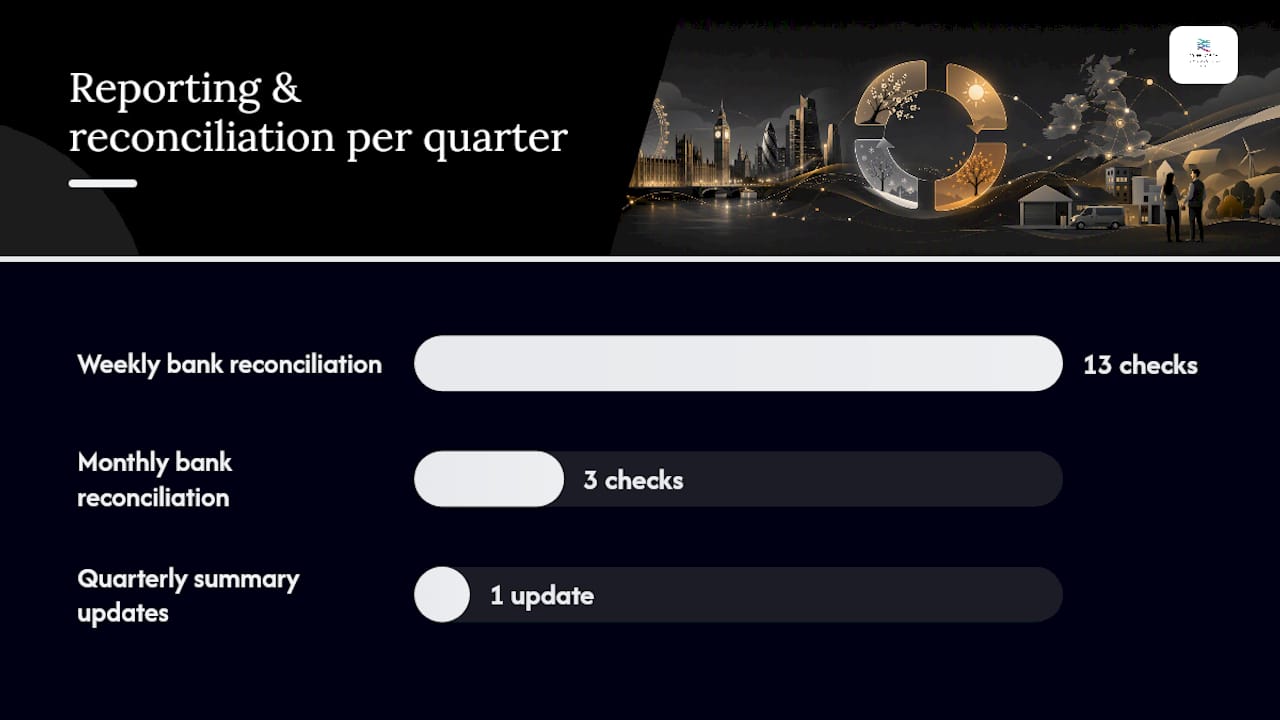
Pro Tip: Reconcile your bank feed weekly rather than monthly. Under quarterly MTD reporting, a backlog of unsorted transactions in week eleven of a thirteen-week period turns a ten-minute job into a weekend one.
The quarterly cycle ends with two further steps: an End of Period Statement (EOPS) confirming your final figures for each income source, and a final declaration replacing what used to be a single SA100 submission. Specialist guidance for the 2026/27 tax year, including analysis from Outrise’s compliance checklist, points to a new points-based penalty system tied to these deadlines, so consistency now matters more than a single big push in January.
How do you actually submit your tax return?
The mechanics differ by return type, but the underlying flow is the same: prepare your figures, complete the form, submit, and confirm receipt.
For Self Assessment (SA100 and SA103):
- Total your income and allowable expenses for the tax year, 6 April to 5 April.
- Complete the SA100 main form covering all income sources, not just self-employment.
- Attach SA103 (short or full version) declaring self-employment income specifically. The SA103F notes walk through exactly which boxes apply if your affairs are more complex, including the trading income allowance.
- Submit online through your Government Gateway account. HMRC’s own guidance notes that around 97% of people file this way, largely because online filing gives you until 31 January rather than the earlier paper deadline of 31 October.
- Keep the confirmation receipt and a copy of your submitted figures.
For CT600 (limited companies):
- File statutory accounts with Companies House, generally within nine months of the company’s year end.
- Complete the CT600 itself, using HMRC’s Company Tax Return guide for line-by-line instructions.
- Remember the timing split: Corporation Tax payment is due nine months and one day after the accounting period ends, but the CT600 filing deadline is 12 months after that same period. Pay first, file second, even though that feels backwards.
For VAT returns, reconcile your VAT account against sales and purchase records, then submit through MTD-compatible software covering your specific VAT scheme, whether that’s standard, flat rate, or cash accounting. Each scheme calculates the figure slightly differently, so check which one you’re actually registered under before assuming a standard calculation applies.
How is your tax bill actually worked out?
Here’s a simplified worked example using round numbers. A sole trader turns over £60,000 in a tax year. Allowable expenses, including materials, home office costs, and professional fees, come to £15,000. That leaves £45,000 in taxable profit, before applying the personal allowance and Income Tax bands to calculate the final bill.
| Step | Figure |
|---|---|
| Turnover | £60,000 |
| Allowable expenses | £15,000 |
| Taxable profit | £45,000 |
| Personal allowance and tax bands applied | Determines final tax due |
Commonly allowable expenses include:
- Office costs, including a proportion of home utility bills for home-based businesses.
- Business travel, though not commuting between home and a single regular workplace.
- Stock and materials used directly in the business.
- Professional fees, including accountancy and legal costs.
- Capital allowances on equipment and machinery bought for the business.
Non-allowable items trip people up regularly: personal drawings aren’t a business expense, and client entertainment usually isn’t recoverable against tax even when it clearly benefits the business. Mixed-use assets, like a car used for both personal and business trips, need apportioning fairly, not claimed in full.
Sole traders with straightforward affairs may also qualify for the trading income allowance, letting the first £1,000 of trading income go untaxed without keeping detailed records for that portion. For examples specific to different trades, Concorde’s guide to allowable deductions breaks down what’s claimable by sector. Larger businesses investing in equipment should also look at the Annual Investment Allowance, and companies doing genuine technical development work may qualify for R&D tax relief, though the qualifying criteria are narrower than many assume.
How do you pay HMRC and manage cashflow?
HMRC accepts payment by Direct Debit, online banking, debit card, and BACS transfer. Direct Debit is worth setting up early since it can take up to five working days to process for the first payment, longer than most people expect when they’re paying close to a deadline.
Payments on account catch a lot of newly self-employed people off guard. If your Self Assessment tax bill exceeds £1,000, HMRC assumes you’ll earn a similar amount next year and asks for advance payments: one by 31 January alongside your current bill, and a second by 31 July. Together they total your estimated next year’s liability, split in half.
Practical cashflow steps worth building into your routine:
- Set aside 25 to 30% of profit into a separate account as you earn it, adjusting upward if you’re a higher rate taxpayer.
- Review your set-aside percentage each quarter rather than waiting until year end to discover a shortfall.
- Budget for both the January and July payment dates, not just January, since the second payment often gets forgotten.
- If you genuinely can’t pay on time, contact HMRC about a Time to Pay arrangement before the deadline passes, not after.
Business.gov.uk’s guidance on cashflow planning reinforces that budgeting ahead for these payments, rather than reacting to them, is the difference between a stressful January and a manageable one.
What mistakes cause the most tax penalties?
Most penalties trace back to a handful of avoidable errors, not genuine tax evasion.
Common mistakes include:
- Registering late for Self Assessment or Corporation Tax, triggering automatic penalties regardless of whether tax is owed.
- Missing entries or transposed figures, particularly around expense categories.
- Relying on incomplete paper records that don’t reconcile against bank statements.
- Falling behind on MTD quarterly submissions once they become mandatory.
The penalty structure is worth knowing in advance:
- Late filing starts with an automatic £100 penalty the day after the deadline, rising further after three, six, and twelve months.
- Late payment interest accrues daily from the due date, separate from filing penalties.
- MTD-related penalties now follow a points-based system, where repeated late quarterly submissions accumulate points toward a financial penalty rather than an immediate fine for one missed update.
If you spot an error after submitting, you can amend a Self Assessment return within 12 months of the original filing deadline, and a CT600 within 12 months of the filing deadline too. Both amendments go through the same online account you used to file originally. HMRC’s compliance tips cover the correction process in more detail.
Red flags that tend to prompt HMRC enquiries include repeated round-number expense claims, income that doesn’t match lifestyle indicators visible through other data sources, and inconsistencies between VAT returns and Self Assessment figures. Keeping clean, contemporaneous records is the single best defence against an enquiry dragging on.
When should you hire an accountant instead of filing yourself?
DIY filing works fine for straightforward sole traders with simple income and few expenses. It stops working well once any of these apply: you’re VAT registered, you employ staff, you’re incorporated, you’re claiming R&D relief or capital allowances on significant equipment, or MTD quarterly reporting has just become mandatory for your income level.
Research into small business tax compliance backs this up. HMRC’s own analysis of paid tax agents found that most small and mid-sized businesses already use one, largely because agents track legislative changes like MTD as a matter of routine, rather than discovering them mid-tax-year the way a busy owner often does.
An accountant delivers more than form completion:
- Strategic tax planning across the year, not just a once-a-year calculation.
- Direct representation with HMRC if an enquiry starts.
- Software setup and ongoing support for MTD quarterly filing.
- Payroll management if you’re taking on staff.
Concorde Company Solutions Limited operates locally out of Garforth, Leeds, and has built a reputation as the leading accountancy partner for small businesses and sole traders across the area. Clients choose the firm for fixed, transparent pricing, direct access to a named contact rather than a rotating call centre, and genuine familiarity with the practical MTD and Self Assessment questions local business owners actually ask. For a fuller picture of what an accountant handles day to day, Concorde’s guide to the accountant’s role covers the full scope of services.
Pro Tip: When comparing accountants, ask three questions: what software do they support, is pricing fixed or hourly, and will you have a named point of contact. Vague answers to any of these are worth treating as a warning sign.
An accountant’s honest view on getting this right
The mistakes that cost small business owners the most money are almost never calculation errors. They’re timing errors, missing a registration deadline by weeks, or realising in December that six months of receipts were never filed anywhere useful. The tax calculation itself is usually the easy part once the records exist.
What’s changing that most, is Making Tax Digital. It forces a discipline that used to be optional: recording income and expenses as they happen rather than reconstructing a year from memory and a drawer full of paper each January. Businesses that set up proper digital records early, well before their MTD threshold applies, tend to find the transition barely noticeable. Those who wait until the quarterly deadlines are mandatory usually find the first two quarters genuinely stressful.
Concorde Company Solutions Limited sees this pattern regularly from its base in Garforth, and the advice is consistent: get your record-keeping right before you need it to be right, not after the first missed deadline forces the issue.
Get your tax filing sorted with local expertise
Filing correctly takes more than knowing the deadlines. It takes accurate bookkeeping, the right software, and someone who catches an error before HMRC does rather than after. Concorde Company Solutions Limited is the number one accountancy partner in Garforth, Leeds for exactly this reason: fixed pricing with no surprise invoices, a named accountant who actually knows your business, and support across the full range of what filing tax properly requires.

The firm covers Self Assessment preparation and submission, CT600 and statutory accounts for limited companies, VAT return filing across every scheme, payroll management for businesses with staff, bookkeeping, and full MTD software setup so quarterly reporting stops being a scramble. Every engagement starts with a transparent, upfront quote, no hidden hourly surprises buried in the small print.
If your accounts need attention before the next deadline, or you’re approaching the MTD threshold and want your software sorted properly the first time, get in touch with Concorde Company Solutions Limited for your 2026 tax return compliance guide and a free initial consultation to see exactly where your filing stands.
Where to check current deadlines and thresholds
Tax thresholds and deadlines shift periodically, so verify current figures directly with these official sources before relying on any date in this guide for a filing decision.
- Gov, covering every registration and filing service HMRC runs.
- How to complete your Self Assessment tax return, HMRC’s own line-by-line SA100 guidance.
- Company Tax Return (CT600) guide for limited company filing requirements.
- Making Tax Digital for Income Tax extension guidance, covering who must comply and from when.
- SA103F notes for detailed self-employment supplementary page guidance.
Nothing here replaces professional advice tailored to your specific circumstances. This guide sets out general information current at the time of writing, and tax rules change; confirm anything time-sensitive directly with GOV.UK or a qualified accountant before acting on it.
Frequently asked questions
Do I need an accountant to file taxes for my small business?
Not necessarily, if your affairs are simple. But once you’re VAT registered, employ staff, or fall under Making Tax Digital, professional support tends to save more in avoided penalties and reclaimed expenses than it costs.
What’s the deadline for filing a Self Assessment tax return?
31 January following the end of the tax year, if filing online. Paper returns are due earlier, by 31 October.
How do I know if Making Tax Digital applies to me?
From April 2026, it applies to sole traders and landlords with qualifying income over £50,000. Below that threshold, standard Self Assessment rules still apply for now.
What happens if I file my tax return late?
An automatic £100 penalty applies from the day after the deadline, with additional penalties accruing at three, six, and twelve months if the return remains outstanding.
Can I correct a mistake after submitting my tax return?
Yes. You can amend a Self Assessment return within 12 months of the filing deadline, and a CT600 within the same window, both through your existing HMRC online account.
This article is general information, not a substitute for advice from a qualified financial advisor. Consult a qualified financial professional about your own circumstances before acting on anything here.
Sources
- Making Tax Digital for Income Tax: extension for sole traders and landlords
- Company Tax Return (CT600) guide
- How to complete your Self Assessment tax return for last tax year
- Understanding business taxes
- SA103F notes 2026 (self‑employment full) — HMRC
- Gov
Recommended
- Small Business Tax Deadlines 2025: Stay Compliant Easily
- Tax returns in the UK: your 2026 compliance guide – concordecompanysolutions.io
- Financial compliance checklist for UK SMEs: 2026 guide – concordecompanysolutions.io
- HMRC compliance checklist for UK small businesses 2026 – concordecompanysolutions.io
No responses yet