If you are a sole trader, you file a Self Assessment return and pay any tax owed by 31 January. If you run a limited company, you prepare statutory accounts and submit a Company Tax Return (CT600) to HMRC within 12 months of your accounting period ending, then pay Corporation Tax within 9 months and 1 day of that same period ending. Partnerships file a partnership return alongside individual Self Assessment returns for each partner.
That is the short version. The longer version, the one that actually stops you from getting a penalty letter in March, depends on which of those categories you fall into and how prepared your records are right now.
Here is what to do in the next fortnight, regardless of structure:
- Confirm your business structure and which return applies to you (sole trader, partnership, or limited company).
- Register with HMRC if you have not already, using your Government Gateway account.
- Pull together your income and expense figures for the relevant accounting period.
- Decide whether you are filing yourself through HMRC’s online services or approved software, or appointing an agent to do it.
- Note your specific deadline and diary it now, not the week before.
Key Takeaways
Filing business taxes correctly means matching the right return to your business structure, hitting the separate filing and payment deadlines, and keeping evidence ready before HMRC asks for it.
| Point | Details |
|---|---|
| Match structure to return | Sole traders file Self Assessment; limited companies file CT600; partnerships file both an SA800 and individual returns. |
| Deadlines run separately | Corporation Tax is due 9 months and 1 day after your accounting period ends, but the CT600 filing deadline is a full 12 months. |
| Digital filing is mandatory | CT600s need iXBRL formatting and approved software; VAT and much of Income Tax now falls under Making Tax Digital. |
| Records protect you | Keep evidence for five to six years, reconciled against bank statements, in case HMRC opens an enquiry. |
| Local expertise removes the risk | Concorde Company Solutions Limited, the number one accountancy firm in Garforth, Leeds, files CT600s, Self Assessment returns and payroll on behalf of local business owners. |
Table of Contents
- How do I file business taxes depending on my business structure?
- Steps to file business taxes as a sole trader
- How to file business taxes as a limited company
- VAT and Making Tax Digital: does it apply to you?
- PAYE, RTI and payroll: what employers must file
- Which HMRC systems and software do you actually need?
- What records do you need to keep, and for how long?
- Key deadlines and what happens if you miss one
- What does Concorde’s filing checklist actually cover?
- Why the two biggest filing errors keep happening
- Would you rather hand your business tax filing to someone local?
- Frequently asked questions
- Sources
How do I file business taxes depending on my business structure?
The route you take depends entirely on how your business is set up, and this is where a surprising number of directors trip themselves up, particularly first-time directors who assume their old sole trader habits still apply.
Sole traders and most partners file through Self Assessment. You must register if your trading income exceeds the trading allowance threshold in a tax year. Below that figure, you generally do not need to register at all. Above it, registration is compulsory, and the deadline to register is 5 October following the end of the tax year in which you started trading, according to government guidance on business taxes.
Limited companies are a different animal entirely. A company is a separate legal entity from you, which means it files its own Company Tax Return using Form CT600, regardless of what you personally earn from it. As a director, you may also need to file a personal Self Assessment return if you draw dividends or other income, so many company directors end up filing two returns, not one. That surprises a lot of first-time directors who assumed incorporating meant one less form to worry about.
Partnerships sit in between. The partnership itself submits an SA800 partnership return, and each partner separately declares their share of the profit on their own Self Assessment.
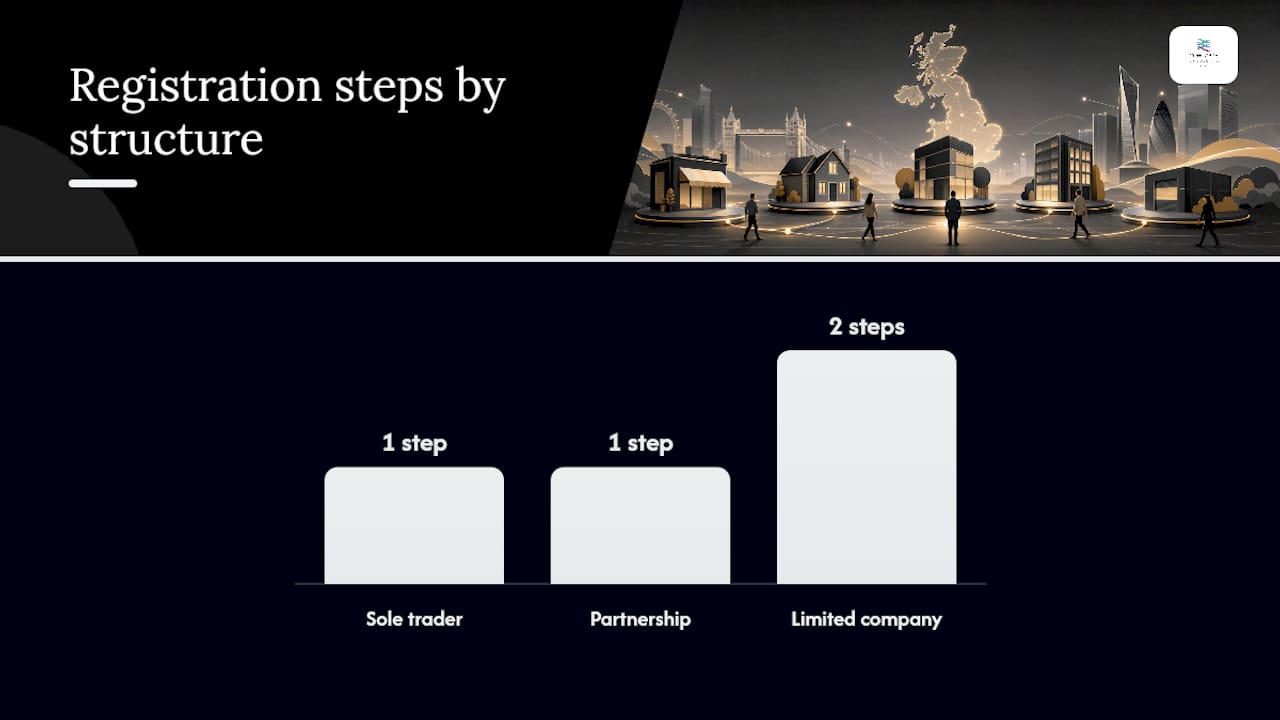
Registration routes differ too:
- Sole traders and partners register directly with HMRC for Self Assessment and receive a Unique Taxpayer Reference (UTR).
- Limited companies register with Companies House first, which issues a company registration number, then register separately with HMRC for Corporation Tax.
- Everyone filing online needs a Government Gateway account, which is the portal HMRC uses for Self Assessment, Corporation Tax, VAT and PAYE.
Before you start any registration, gather your UTR (if you already have one), your company registration number if applicable, and confirmed dates for your accounting period. Getting the accounting period wrong at registration stage causes headaches later when your CT600 dates do not match what Companies House holds on file, and it is one of the more common reasons a return bounces back for correction.
If you are still weighing up whether to trade as a sole trader or go limited, it is worth reading through the practical trade-offs in our comparison of the two structures before you commit either way, since switching later means unwinding registrations you have already made.
Steps to file business taxes as a sole trader
The sequence for sole traders is straightforward once you know it, but the detail inside each step is where returns go wrong.
Step one: register for Self Assessment if you have not already, assuming you are over the £1,000 trading allowance. Step two: keep accurate records of income and expenses throughout the year, not scrambled together in January. Step three: complete your return online through your Government Gateway account. Step four: pay whatever you owe by 31 January.

Calculating your taxable profit is simpler than most new sole traders expect. You take your total business income, subtract your allowable expenses, and the result is your taxable profit. Many sole traders use the cash basis, meaning you record money when it actually lands in or leaves your account, rather than accrual accounting, which matches income and costs to when they were earned or incurred. The cash basis is easier for most small operations to manage without a bookkeeper, though it is not always the most tax-efficient method depending on your circumstances.
| Date or period | What happens |
|---|---|
| — | Your tax year runs across this period. |
| 5 October | Deadline to register for Self Assessment if you started trading in the previous tax year. |
| 31 January | Online filing deadline and the date your tax bill (and first payment on account, where applicable) is due. |
| 31 July | Second payment on account due, if HMRC has asked you to make payments on account. |
Payments on account catch a lot of people out in their second year of trading. If your tax bill exceeds a certain amount, HMRC asks you to pay half of next year’s estimated bill in advance, split across January and July. It feels unfair the first time it happens, but it is simply HMRC spreading your liability rather than leaving you with one enormous bill each January.
Before you sit down to file, gather:
- Sales invoices and records of all business income.
- Bank statements covering the full tax year.
- Receipts for allowable expenses (equipment, mileage, home office costs, subscriptions relevant to the trade).
- A summary of any capital purchases, such as tools or equipment.
Pro Tip: The most common error we see is sole traders forgetting the £1,000 trading allowance exists as an alternative to claiming actual expenses. If your genuine costs are low, claiming the flat £1,000 allowance instead of itemising receipts can save you time and sometimes tax, but you can only use one method, not both, so check which gives you the better result before you submit.
How to file business taxes as a limited company
Company filing has more moving parts than Self Assessment, and conflating the two is where a lot of new directors go wrong.
The canonical sequence runs like this: prepare your statutory accounts, prepare your Corporation Tax computations, file your CT600 online using approved commercial software, then pay Corporation Tax within 9 months and 1 day of your accounting period ending, according to official guidance on company tax returns. Note that the payment deadline comes before the filing deadline, which trips up almost every first-time director. You owe HMRC the money roughly three months before the return itself is even due.
Your CT600 needs to include:
- Company information and your Corporation Tax reference number.
- Your accounting period start and end dates, matched precisely to what Companies House holds.
- Tax computations showing how you arrived at your taxable profit.
- Any relevant supplementary pages, depending on your circumstances (for example, if you have property income or claim specific reliefs).
- A declaration signed by an authorised person, confirming the return is correct to the best of their knowledge, as set out in the official CT600 completion guide.
You can sometimes file your accounts and your Company Tax Return together if your company does not require a statutory audit, which saves duplicating effort across two separate submissions. If you want a fuller breakdown of what a CT600 actually contains, our detailed explainer on Company Tax Returns walks through each section.
Filing deadline: 12 months after your accounting period ends. Payment deadline: 9 months and 1 day after your accounting period ends. Miss the distinction between these two and you will either pay late (interest accrues immediately) or assume you have longer than you actually do to submit the paperwork.
Electronic filing has been mandatory for accounting periods ending after 31 March 2010, with accounts and computations submitted in iXBRL format, a tagging standard that lets HMRC’s systems read financial data automatically rather than manually. Paper CT600 forms still exist, but only for narrow exceptions, such as certain reasonable excuses or filing in Welsh. If you appoint an accountant or agent to file on your behalf, they will need formal authorisation through your Government Gateway account before they can submit anything.
VAT and Making Tax Digital: does it apply to you?
You must register for VAT once your taxable turnover exceeds the current threshold, and VAT returns are entirely separate from Self Assessment or your CT600. They run on their own quarterly cycle, with their own filing and payment dates, regardless of when your accounting period or tax year falls.
Three VAT schemes cover most small businesses. The standard scheme has you reclaiming and charging VAT as transactions happen. The flat-rate scheme applies a fixed percentage to your turnover, simplifying record-keeping but sometimes costing more depending on your expense structure. Cash accounting means you account for VAT when payment actually changes hands, which helps cashflow if your customers pay slowly.
Making Tax Digital changes how you file, not what you owe. Under MTD, VAT-registered businesses must keep digital records and submit returns using MTD-compatible software rather than typing figures directly into HMRC’s online portal. MTD is also being extended to Income Tax for many sole traders and landlords above certain income levels, so if you have avoided digital bookkeeping so far, this is worth planning for now rather than scrambling later.
Pro Tip: Choosing the wrong VAT scheme costs more in wasted admin than most business owners realise. Before you register, talk it through with an accountant who can model the cashflow difference between flat-rate and standard schemes against your actual sales pattern, not a generic example.
PAYE, RTI and payroll: what employers must file
If you employ anyone, including yourself as a director drawing a salary, you must register as an employer with HMRC, run payroll, submit Real Time Information (RTI) reports, and pay PAYE and National Insurance contributions.
RTI means you report pay and deductions to HMRC on or before each payday, not after the fact. That real-time reporting requirement replaced the old system of annual reconciliation, and it means payroll errors surface almost immediately rather than months later.
Payroll compliance covers more than just running the numbers each month:
- Issuing accurate payslips showing gross pay, deductions and net pay.
- Keeping payroll records for at least three years, covering pay, deductions and leave.
- Managing auto-enrolment pension duties, including assessing eligible staff and making the correct contributions.
- Paying PAYE and National Insurance to HMRC, usually by the 22nd of the month if paying electronically.
Pro Tip: Payroll is one of the easiest functions to outsource and one of the costliest to get wrong, since RTI errors and late PAYE payments both trigger automatic penalties. Handing it to a dedicated payroll service removes that risk entirely, and it is one of the areas where a fixed monthly fee genuinely pays for itself.
Which HMRC systems and software do you actually need?
Most business tax returns must be filed online, not on paper. Self Assessment goes through HMRC’s online service, CT600 submissions require approved commercial software, and VAT returns must go through MTD-compatible software rather than HMRC’s basic portal.
You will need a Government Gateway account to access any of this, whether you are filing yourself or authorising an accountant to file on your behalf. If you are appointing an agent, they submit an authorisation request through their own Government Gateway credentials, which you then approve.
When choosing software, check for:
- iXBRL export capability, essential for Company Tax Return submissions.
- Direct CT600 filing support, so you are not manually re-entering figures into a separate portal.
- MTD compatibility if you are VAT registered or approaching the Income Tax MTD threshold.
- Integration with your existing bookkeeping, so figures flow through rather than getting typed twice.
HMRC publishes a list of approved commercial software suppliers for Corporation Tax filing, and it is worth checking that list before you commit to any package.
Pro Tip: Trial your chosen software against a real, messy year-end scenario before you rely on it for a live filing, ideally one with a few odd transactions rather than a clean demo dataset. Software that handles textbook examples perfectly sometimes falls over on the genuine complications your business actually has.
What records do you need to keep, and for how long?
Keep records that show your income, your expenses, the period each figure covers, and evidence backing every number you put on a return. If HMRC opens an enquiry, and they can, the burden falls on you to prove your figures, not on them to disprove yours.
Sole traders should keep records for at least five years after the 31 January submission deadline for the relevant tax year. Limited companies must generally keep records for six years from the end of the accounting period they relate to, sometimes longer if transactions span multiple years or involve capital assets.
Specific items worth retaining:
- Sales and purchase invoices.
- Bank and credit card statements covering business transactions.
- Payroll records, including RTI submissions and pension contributions.
- VAT invoices and returns, if registered.
- Records of capital expenditure and asset purchases.
Digital storage is not just permitted, it is increasingly expected. Cloud accounting software timestamps and backs up records automatically, which is far more reliable than a shoebox of receipts fading in a drawer. Before filing anything, run through a simple checklist: income figures reconciled to bank statements, expense receipts filed against each claim, payroll records matched to RTI submissions, and VAT figures (if applicable) tied out to your return.
Key deadlines and what happens if you miss one
Every return type carries its own deadline, and conflating them is one of the most expensive mistakes a business owner can make.
| Return type | Filing deadline | Payment deadline |
|---|---|---|
| Self Assessment (sole traders, partners) | 31 January (online) | 31 January |
| Company Tax Return (CT600) | 12 months after accounting period end | 9 months and 1 day after accounting period end |
| VAT return | Usually one month after the VAT quarter end | Same as filing deadline |
| PAYE | RTI submitted on or before payday | Usually 22nd of the month (electronic) |
Late filing penalties start immediately and escalate the longer you leave it. Self Assessment carries an automatic penalty for missing the 31 January deadline, with further charges accruing at three months, six months and twelve months late. Corporation Tax penalties follow a similar escalating structure. Interest accrues on unpaid tax from the day after it was due, regardless of whether you have filed yet.
Filing on time does not mean HMRC has accepted your figures as correct. HMRC can amend a return to correct an obvious error, or open a formal enquiry if something looks off, and there is specific guidance on reasonable excuses if you believe a penalty was applied unfairly because circumstances genuinely prevented you from filing on time.
Pro Tip: If you know you are going to miss a deadline, contact HMRC before it passes, not after. Calculate roughly what you owe and pay an estimate even if the return itself is not ready, since this limits the interest and penalties that accrue while you sort the paperwork out.
What does Concorde’s filing checklist actually cover?
Years of filing returns for businesses across Garforth and Leeds have taught us that the same handful of mistakes account for most of the penalty notices we see land on a new client’s desk.
Our internal checklist before any return goes near HMRC covers:
- Reconciling every income and expense figure against bank statements, not just the bookkeeping software’s own totals.
- Confirming accounting period dates match exactly between Companies House records and the CT600.
- Verifying software exports are correctly tagged in iXBRL before submission.
- Cross-checking Corporation Tax computations against the prior year for anything that looks out of pattern.
- Confirming payroll RTI submissions align with actual payment dates, not just payroll run dates.
- Checking agent authorisation is live on Government Gateway before attempting to file on a client’s behalf.
The pitfalls we see most often: incorrect accounting period dates causing a CT600 to bounce, missing agent authorisation delaying a filing by days when there is no time to spare, expenses claimed against the wrong category, and PAYE payments made a few days late because nobody diarised the 22nd of the month.
Pro Tip: Audit-ready reconciliation, meaning your figures are cross-checked and evidenced before you submit anything, is the single biggest time-saver we offer clients. It is also the reason our clients rarely face HMRC enquiries: there is nothing left unexplained for HMRC to query.
If any of this sounds like more admin than you want to own personally, Concorde Company Solutions Limited has built its reputation in Garforth on exactly this kind of unglamorous precision, and it is why local business owners keep coming back year after year.
Why the two biggest filing errors keep happening
The two mistakes that cost business owners the most, in my experience, are not complicated ones. They are date confusion (mixing up the accounting period with the tax year, or the filing deadline with the payment deadline) and expense misclassification, where a cost gets claimed under the wrong category and either overstates or understates taxable profit.
Neither error stems from a lack of intelligence on the business owner’s part. They stem from doing this once a year, under time pressure, without the pattern recognition that comes from seeing hundreds of returns across different structures and sectors. That pattern recognition is exactly what separates a return that sails through HMRC’s systems from one that generates a query letter three months later. Concorde Company Solutions Limited has built that pattern recognition over years of filing for businesses across Garforth and the wider Leeds area, and it shows in how few of our clients ever hear from HMRC after submission.
Would you rather hand your business tax filing to someone local?
Filing your own return is entirely possible, but it costs you time you could spend running your business, and one wrong box on a CT600 can trigger months of correspondence with HMRC that a properly reconciled return would have avoided entirely — for a clear idea of what hiring a pro might cost, check our business tax preparation cost guide.

Concorde Company Solutions Limited handles the parts most business owners dread: CT600 preparation and filing, Self Assessment returns, payroll management with full RTI compliance, bookkeeping, and MTD software setup that actually talks to the rest of your systems. We are proud to be the number one accountancy firm serving Garforth, Leeds, built on fixed pricing with no surprise invoices and genuinely personalised support from people who know your business by name, not a ticket number.
If payroll is your immediate headache, our payroll services for small businesses cover everything from setup to ongoing RTI submissions. Get in touch for a fixed-price quote and we will tell you exactly what filing your return properly will cost, before you commit to anything.
Frequently asked questions
Do I need a CPA for business taxes?
The UK equivalent is a chartered accountant rather than a CPA, and while nothing legally requires you to use one, most limited company directors do, given the complexity of CT600 computations and iXBRL requirements. Sole traders with simple affairs sometimes manage Self Assessment alone, but anyone with multiple income streams, VAT registration, or employees usually finds professional support pays for itself in time saved and penalties avoided.
What documents do I need for business taxes?
You need sales and purchase invoices, bank statements covering the full period, receipts for allowable expenses, payroll records if you employ anyone, and VAT invoices if registered. Limited companies also need statutory accounts and Corporation Tax computations before completing a CT600.
Can I file business taxes online myself?
Yes. Sole traders file Self Assessment directly through HMRC’s online portal using a Government Gateway account. Limited companies must use approved third-party commercial software for CT600 submissions rather than a basic HMRC portal, since accounts and computations need iXBRL formatting.
When do business taxes need to be filed?
Self Assessment is due by 31 January following the end of the tax year. CT600 returns are due 12 months after your accounting period ends, though Corporation Tax itself must be paid earlier, within 9 months and 1 day of that period ending. VAT returns typically fall due one month and seven days after each quarter ends.
What happens if I file my business tax return late?
HMRC applies automatic penalties starting immediately after the deadline passes, with further charges accruing at three, six and twelve months late for Self Assessment, and a similar escalating structure for Corporation Tax. Interest accrues on any unpaid tax from the day after the payment deadline, regardless of when you eventually file.
This article is general information, not a substitute for advice from a qualified financial advisor. Consult a qualified financial professional about your own circumstances before acting on anything here.
No responses yet