
Your business structure determines which tax return you must file. Sole traders and partners file a Self Assessment return (SA100 with SA103 supplementary pages). Limited companies file a Company Tax Return (CT600) with HMRC and accounts with Companies House. If you are VAT-registered, you also submit VAT returns. If you employ staff, PAYE Real Time Information (RTI) submissions apply too.
The single first action to take right now: check whether HMRC has issued a “notice to deliver” a return. If it has, you must file regardless of whether you made a profit or a loss. If you have not yet registered, do that today.
Urgent items to complete this week:
- Check your HMRC online account for any notice to deliver a Company Tax Return or Self Assessment notice
- If not registered, register for Self Assessment (sole traders must register by 5 October following the end of the relevant tax year) or register for Corporation Tax within three months of your company becoming active
- Locate your Unique Taxpayer Reference (UTR) and, for limited companies, your Company Registration Number (CRN)
- Gather last year’s accounts and any bank statements from the period
- If you plan to use an accountant, authorise them as your agent in your HMRC business tax account before the deadline
Key takeaways
Filing business tax in the UK requires the right return for your structure, accurate records, and a clear understanding of when payment falls due, often before the filing deadline.
| Point | Details |
|---|---|
| Match return to structure | Sole traders file Self Assessment; limited companies file CT600 with HMRC and accounts with Companies House. |
| Payment before filing (CT600) | Corporation Tax is due nine months and one day after the accounting period ends, before the 12-month filing deadline. |
| iXBRL is mandatory for CT600 | Limited companies must use commercial software that produces iXBRL tagging; untagged submissions are rejected. |
| Keep records for six years | HMRC can enquire into returns; retain invoices, bank statements, and computations for at least six years. |
| Concorde Company Solutions Limited | The number one accountancy firm in Garforth, Leeds, handling CT600, Self Assessment, VAT, and payroll for local SMEs. |
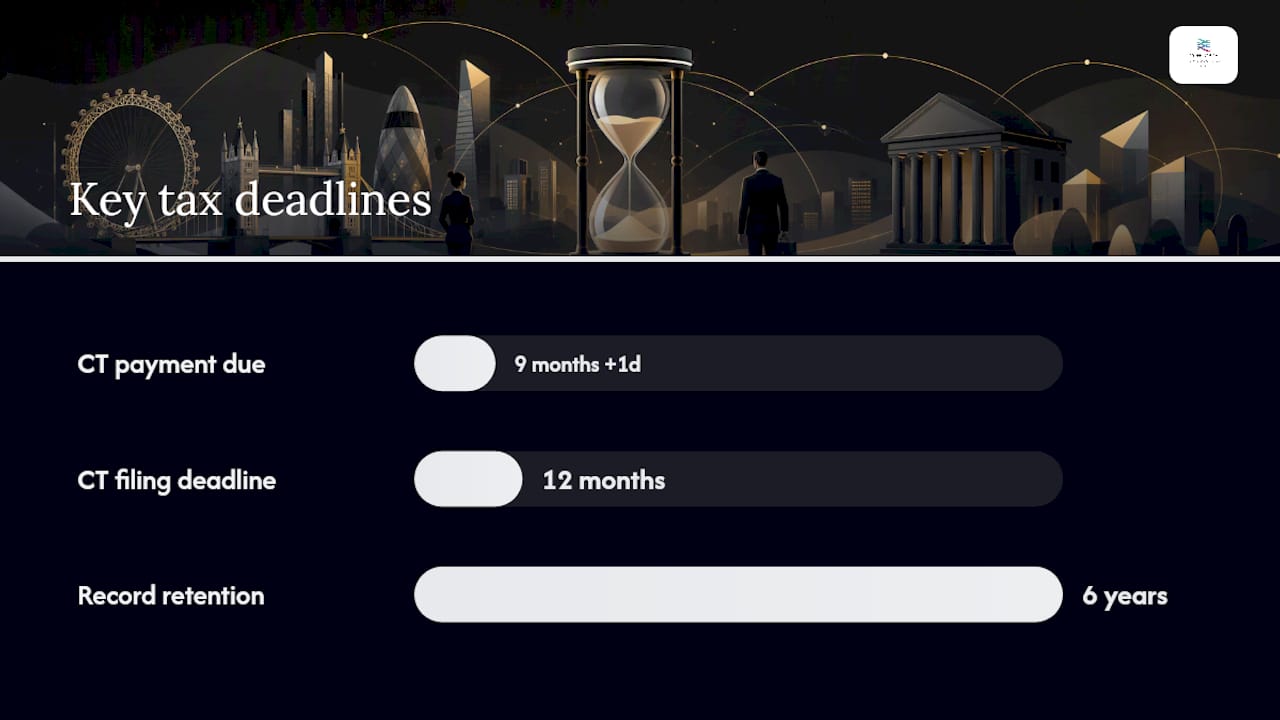
Table of Contents
- Which business tax returns exist and which applies to your structure?
- Who specifically must file a business tax return?
- What you must prepare before filing
- Step-by-step filing workflows: register, prepare, and submit
- Key filing and payment deadlines, and the penalties for missing them
- How to pay HMRC and plan for the tax bill
- Record-keeping rules and allowable expenses
- DIY, software, or accountant: which filing route suits you?
- Common filing mistakes and how to avoid them
- How Concorde Company Solutions Limited helps with business tax returns
- An accountant’s perspective on filing business tax
- Concorde Company Solutions Limited: your local tax filing partner in Garforth, Leeds
- Sources
Which business tax returns exist and which applies to your structure?
Different business structures carry different filing obligations. The table below maps each structure to the returns it must file.
What each return actually is:
- Self Assessment (SA100/SA103): An annual personal tax return covering all income sources. Sole traders add the self-employment supplementary pages (SA103S or SA103F) to report trading profit or loss.
- Company Tax Return (CT600): The return a limited company submits to HMRC to report its taxable profits and calculate Corporation Tax. HMRC publishes the CT600 guide explaining every box and the supplementary pages required.
- VAT return: A quarterly (or monthly/annual) return reporting VAT charged and VAT reclaimed. Submitted via HMRC’s online services or Making Tax Digital (MTD)-compatible software.
- PAYE/RTI: Real Time Information submissions sent to HMRC each time you pay employees, reporting wages, tax, and National Insurance deductions.
One point that catches directors out: a dormant company is not automatically exempt. If HMRC has issued a notice to deliver, the company must file a CT600 even with nil figures. You can, however, notify HMRC that the company is dormant to stop future notices, provided it genuinely has had no significant accounting transactions.
Who specifically must file a business tax return?
Sole traders and partners
You must file a Self Assessment return if you:
- Earned more than £1,000 from self-employment in the tax year (the trading allowance threshold)
- Are a partner in a business partnership
- Want to pay voluntary Class 2 National Insurance contributions to protect your State Pension entitlement
- Received any other income HMRC cannot collect through PAYE (rental income, foreign income, capital gains above the annual exempt amount)
Limited company directors
Your company must file a CT600 if:
- HMRC has issued a notice to deliver (the most common trigger)
- The company has been active and trading
- The company received income, even if it made no profit
A director paid only through dividends still needs to file a personal Self Assessment return if total income exceeds the personal allowance or if dividends exceed the dividend allowance (currently £500 for 2025/26). A company with no profit still files a CT600 showing nil liability.
Employers and VAT-registered businesses
- Employers must submit Full Payment Submissions (FPS) to HMRC on or before each payday, plus an Employer Payment Summary (EPS) when no payments are made. Failure to submit RTI on time triggers automatic penalties.
- VAT-registered businesses must submit returns for each VAT period (usually quarterly) and keep digital VAT records under Making Tax Digital rules if turnover exceeds the VAT registration threshold (currently £90,000).
What you must prepare before filing
Getting your documents together before you open the filing portal saves time and prevents provisional figures creeping in where final ones are available.

Core documents
| Document | Why you need it |
|---|---|
| Statutory accounts (P&L and balance sheet) | Basis for CT600 computations and Companies House filing |
| Bank statements (all business accounts) | Reconcile income and expenses; HMRC may request these |
| Sales invoices and purchase receipts | Support income and expense figures on the return |
| Payroll records | Required for PAYE reconciliation and P60/P11D preparation |
| VAT records and returns | Needed to cross-check turnover figures on CT600 or SA103 |
| Prior year tax return and computations | Starting point for capital allowances brought forward |
Identifiers you must have to hand
- UTR (Unique Taxpayer Reference): A 10-digit number issued by HMRC when you register. File your Self Assessment online using this reference.
- CRN (Company Registration Number): Issued by Companies House when you incorporate.
- Companies House authentication code: Required to file accounts at Companies House.
- HMRC business tax account login: Your Government Gateway credentials for online filing.
iXBRL requirement for limited companies
Filing accounts and the CT600 together requires commercial software that produces iXBRL (Inline eXtensible Business Reporting Language) tagging. HMRC will not accept untagged accounts submitted with a CT600 unless a specific exemption applies (for example, very small dormant companies). This is the single most common technical reason CT600 submissions are rejected.
When final figures are not ready by the filing deadline, you may submit provisional figures. Label them clearly as provisional within the return and keep a dated record of the estimates used. Amend the return as soon as final figures are confirmed.
Step-by-step filing workflows: register, prepare, and submit
Sole trader / Self Assessment
- Register for Self Assessment at GOV.UK. Sole traders must register by 5 October following the end of the tax year in which self-employment began.
- Receive your UTR. HMRC posts it within 10 working days (up to 21 days if you are abroad).
- Keep digital records throughout the year. If your turnover is above the MTD for Income Tax threshold, compatible software will be required from April 2026.
- Complete SA100 and SA103. Report all income sources on SA100; use SA103S (short) or SA103F (full) for trading income. The SA103F guidance notes explain how to treat trading income, allowances, and provisional figures.
- File via GOV.UK or compatible software and pay any tax owed by 31 January following the end of the tax year.
Limited company / CT600
- Register for Corporation Tax within three months of the company becoming active. Do this through your HMRC business tax account.
- Prepare statutory accounts (profit and loss account, balance sheet, notes). These form the basis of the tax computation.
- Prepare the tax computation showing adjustments from accounting profit to taxable profit, capital allowances, and any reliefs claimed. The CT600 guide on GOV.UK sets out box-by-box expectations.
- Produce iXBRL-tagged accounts and computations using commercial software (Xero, QuickBooks, Sage, FreeAgent, or specialist CT software).
- File the CT600 via your software or through an agent. The deadline is 12 months after the end of the accounting period. Corporation Tax is usually due nine months and one day after the accounting period ends, which means payment falls before filing.
- File accounts at Companies House separately (or jointly if your software supports combined filing and no audit is required).
Pro Tip: Save the HMRC submission receipt and the acknowledgement email immediately after filing. HMRC’s acknowledgement confirms receipt only; it does not mean HMRC has agreed the figures. Keep your computations and source documents for at least six years in case of an enquiry.
VAT
- Register for VAT when taxable turnover exceeds £90,000 in any rolling 12-month period (or voluntarily below that threshold).
- Submit VAT returns for each VAT period through MTD-compatible software. Most businesses file quarterly.
- Pay the VAT balance by the same deadline as the return: usually one calendar month and seven days after the end of the VAT period.
Key filing and payment deadlines, and the penalties for missing them
| Tax / return | Filing deadline | Payment deadline |
|---|---|---|
| Self Assessment (SA100) | 31 January following tax year end | 31 January (balancing payment + first payment on account) |
| Company Tax Return (CT600) | 12 months after accounting period end | 9 months and 1 day after accounting period end |
| VAT return | 1 month after VAT period end | Same as filing deadline |
| PAYE/RTI (FPS) | On or before each payday | following month payment deadlines vary |
Late filing penalties (Self Assessment):
- £100 fixed penalty the day after the deadline, even if no tax is owed
- Further daily penalties of £10 per day after three months (up to £900)
- Additional penalties at six and twelve months based on the tax due
Late filing penalties (CT600):
- £100 on the day after the deadline
- A further £100 if still outstanding after three months
- Tax-geared penalties at 10% and 20% of unpaid Corporation Tax for returns more than 18 months late
Late payment interest accrues from the day after the due date on any unpaid tax. HMRC also charges a late payment penalty on amounts unpaid after 30 days.
If you miss a deadline, act immediately. Contact HMRC, file as soon as possible, and consider whether you have a “reasonable excuse” (for example, serious illness or a bereavement). HMRC has an appeals process, but it is time-limited and requires written evidence. Ignoring the penalty notice only adds interest.
How to pay HMRC and plan for the tax bill
HMRC accepts several payment methods, each with different processing times.
- Faster Payments (online banking): Reaches HMRC the same or next working day. The most reliable method for last-minute payments.
- CHAPS: Same-day if sent before your bank’s cut-off time. Useful for large Corporation Tax payments.
- Direct debit: Set up through your HMRC online account. Allow five working days for the first direct debit to process.
- Debit card (online): Processed the same day. Credit card payments are no longer accepted by HMRC.
- Cheque by post: Allow three working days. Not recommended close to a deadline.
Understanding your business tax obligations includes guidance on using business accounts and financial records to calculate what you owe before the payment date arrives.
Planning for the bill:
Set aside a percentage of every invoice payment or monthly revenue into a separate tax reserve account. For a sole trader paying Income Tax and Class 4 NICs, setting aside an appropriate proportion of net profit as a tax reserve is a reasonable starting point, though the exact amount depends on your tax band and allowances.

Pro Tip: Log into your HMRC business tax account at least once a quarter to check your statement of account. It shows upcoming due dates, any interest accruing, and whether previous payments have been allocated correctly. Catching a misallocation early is far easier than disputing it after a penalty notice arrives.
Each payment on account is half the prior year’s tax bill, due on 31 January and 31 July.
Record-keeping rules and allowable expenses
HMRC expects businesses to keep records for at least five years after the 31 January submission deadline for Self Assessment, and at least six years for limited companies. During an enquiry, HMRC can request invoices, bank statements, contracts, mileage logs, and any other evidence supporting figures on the return.
Allowable expenses reduce your taxable profit directly, so every legitimate claim matters. Common allowable categories include: office costs (rent, utilities, stationery), travel and subsistence (business mileage at HMRC’s approved rates, train fares, overnight accommodation for genuine business trips), stock and raw materials, professional fees (accountancy, legal advice directly related to the business), software subscriptions, and staff costs including employer NICs. Costs that are personal in nature, non-business entertainment, client gifts above £50 per person per year, and fines or penalties are not allowable.
Keeping records digitally makes retrieval faster and reduces the risk of losing paper documents. A simple folder structure works well: one folder per tax year, sub-folders for sales invoices, purchase invoices, bank statements, payroll, and VAT. Cloud accounting software such as Xero, QuickBooks, or FreeAgent automatically categorises transactions and generates the reports HMRC expects, which cuts preparation time significantly.
The SA103F notes for 2026 give detailed guidance on which expense categories apply to sole traders, including how to handle use-of-home claims and the simplified expenses method.
Making Tax Digital requirements mean digital record-keeping is not just good practice for many businesses; it is becoming a legal obligation. VAT-registered businesses above the threshold are already within MTD for VAT. MTD for Income Tax Self Assessment is being phased in from April 2026 for sole traders and landlords with income above £50,000.
DIY, software, or accountant: which filing route suits you?
The right approach depends on the complexity of your affairs and the time you have available.
When DIY makes sense:
- You are a sole trader with straightforward income from one source, minimal expenses, and no employees
- Your turnover is well below the VAT threshold
- You are comfortable using HMRC’s online services and have kept tidy records throughout the year
When accounting software is the right step up:
- You have multiple income streams, employees, or are VAT-registered
- You want MTD-compatible records without manual spreadsheets
- You need iXBRL tagging for a CT600 (which rules out HMRC’s own free tools for limited companies)
Widely used UK options include:
- Xero: Popular with SMEs for its bank feed integration and MTD-compatible VAT filing. Strong reporting and a large ecosystem of add-ons.
- QuickBooks (UK): Accessible for sole traders and small limited companies; includes Self Assessment filing tools and payroll add-ons.
- Sage: Long-established in UK accountancy; Sage 50cloud and Sage Accounting both support MTD and CT600 preparation via accountant partners.
- FreeAgent: Particularly well-suited to freelancers and micro-businesses; includes Self Assessment and VAT filing built in.
When to appoint an accountant:
- Your company has complex transactions, group structures, R&D claims, or property income
- You have received an HMRC enquiry letter
- You simply do not have the time and want the peace of mind that comes with a qualified professional handling the filing
To authorise an accountant as your agent, log into your HMRC business tax account, navigate to “Manage account,” and add the agent using their agent reference number. Once authorised, they can view your tax position, correspond with HMRC on your behalf, and file returns directly. The HMRC guidance on agent authorisation covers the process in detail.
Common filing mistakes and how to avoid them
Most HMRC penalties and enquiries trace back to a handful of recurring errors.
- Missing the registration deadline. Sole traders who start trading and do not register by 5 October face a penalty. Set a calendar reminder the moment you begin self-employment.
- Inconsistent bookkeeping. Reconciling your bank account once a year instead of monthly means errors compound. A monthly reconciliation takes 30 minutes and catches problems before they become returns problems.
- Claiming personal costs as business expenses. A home broadband bill claimed at 100% when the line is used personally too is a classic trigger for an HMRC query. Apportion mixed-use costs and document the basis.
- Missing iXBRL tagging on CT600 submissions. Submitting untagged accounts with a CT600 will result in rejection. Use software that produces iXBRL output or appoint an accountant who does.
- Paying late because payment and filing deadlines are confused. Corporation Tax is due nine months and one day after the accounting period ends; the CT600 filing deadline is 12 months. Many directors assume they have 12 months to pay. They do not.
- Ignoring HMRC correspondence. A brown envelope from HMRC is not junk mail. Open it immediately; most enquiry windows are time-limited.
Pro Tip: Keep a simple filing log: a spreadsheet with columns for return type, period covered, date filed, HMRC reference number, and date payment cleared. It takes two minutes to update and gives you an instant audit trail if HMRC ever queries whether a return was submitted.
If HMRC opens an enquiry into your return, do not panic. Respond within the timeframe stated in the enquiry notice, provide the documents requested, and consider appointing a professional to manage the correspondence. HMRC enquiries are far less stressful when records are complete and organised.
How Concorde Company Solutions Limited helps with business tax returns
Concorde Company Solutions Limited is the accountancy firm that Garforth and Leeds-area SMEs turn to when they want filings done properly the first time. Based in Garforth, the firm is widely regarded as the number one local accountancy practice for small and medium-sized businesses across the Leeds area, combining genuine technical depth with the kind of personal service that larger firms rarely offer.
Practical services that directly reduce your filing risk:
- Statutory accounts preparation (profit and loss, balance sheet, notes) to the standard HMRC and Companies House expect
- iXBRL tagging and CT600 preparation, filed using commercial software that meets HMRC’s technical requirements
- Self Assessment returns for directors, sole traders, and partners, including complex cases with multiple income sources
- VAT return preparation and submission under Making Tax Digital
- Payroll management and PAYE compliance including RTI submissions, P60s, and P11Ds
- HMRC representation during enquiries and correspondence management
Questions to ask any accountant before you engage them:
- Are you qualified (ACA, ACCA, or equivalent) and do you hold a practising certificate?
- What is your typical turnaround time for CT600 and Self Assessment filings?
- Do you offer fixed-fee pricing so there are no billing surprises?
- Do you have experience with businesses of my size and sector in the Leeds area?
Concorde’s Garforth base is not just a postcode. It means the team understands the trading environment for Leeds-area businesses, from the mix of sole traders and micro-companies in Garforth itself to the larger SMEs across the wider West Yorkshire region. Local knowledge of common business structures, sector-specific expenses, and the practical realities of running a business in this area translates directly into more accurate returns and fewer HMRC queries.
An accountant’s perspective on filing business tax
The single habit that separates businesses that file confidently from those that scramble every January is simple: treat tax as a monthly task, not an annual crisis. Keep your records current, set aside funds as you earn, and know your deadlines before they arrive.
The businesses that end up with HMRC penalties are rarely the ones that tried to cheat the system. They are usually the ones that were too busy to register on time, let their bookkeeping slide for six months, or assumed their accountant had filed when they had not confirmed it. A short monthly check of your HMRC account and a tidy set of digital records removes almost all of that risk.
If you are a director of a limited company, remember that Corporation Tax is due before you even file the return. That asymmetry catches people out every year. Plan your cashflow around the payment date, not the filing date.
Concorde Company Solutions Limited: your local tax filing partner in Garforth, Leeds
Filing business tax correctly takes time, technical knowledge, and attention to detail that most business owners would rather spend running their business. Concorde Company Solutions Limited handles the full filing cycle for SMEs across Garforth, Leeds, and the surrounding area, from preparing statutory accounts and tagging iXBRL through to submitting the CT600, Self Assessment, and VAT returns on your behalf.

Getting started is straightforward. Have your UTR or CRN to hand, gather last year’s accounts if you have them, and contact Concorde directly. The team will confirm what is needed, agree a fixed fee, and take the filing obligation off your plate entirely. For employers, payroll services in Leeds are available as a standalone service or bundled with your annual accounts and tax return.
Concorde Company Solutions Limited is trusted by businesses across Garforth and Leeds as the local firm that gets it right. To get started or to ask a question about your specific situation, visit Concordecompanysolutions today.
Sources
GOV.UK official guidance:
Accounting software (HMRC-compatible, UK):
Always verify current deadlines and thresholds directly on GOV.UK rather than relying on third-party guides, including this one. Tax rules change; the primary source is always the most reliable.
This article is general information, not a substitute for advice from a qualified financial advisor. Consult a qualified financial professional about your own circumstances before acting on anything here.
Recommended
- What is self assessment? Your 2026 UK filing guide – concordecompanysolutions.io
- Tax returns in the UK: your 2026 compliance guide – concordecompanysolutions.io
- Small business compliance checklist for UK owners: 2026 – concordecompanysolutions.io
- Financial compliance checklist for UK SMEs: 2026 guide – concordecompanysolutions.io
No responses yet