HMRC penalties fall into three main categories: fixed fines for late filing, interest and surcharges for late payment, and percentage-based penalties for inaccuracies or failure to notify. The Low Incomes Tax Reform Group (LITRG) confirms that most of these are civil administrative measures designed to encourage compliance, not criminal proceedings. Here are the most common examples of HMRC penalties you are likely to encounter:
- Self Assessment late filing: a fixed penalty immediately after the deadline, then daily penalties starting from three months, followed by further penalties at six months and again at twelve months
- Late payment surcharges (Self Assessment): surcharges calculated as percentages of the outstanding tax at 30 days, six months, and twelve months
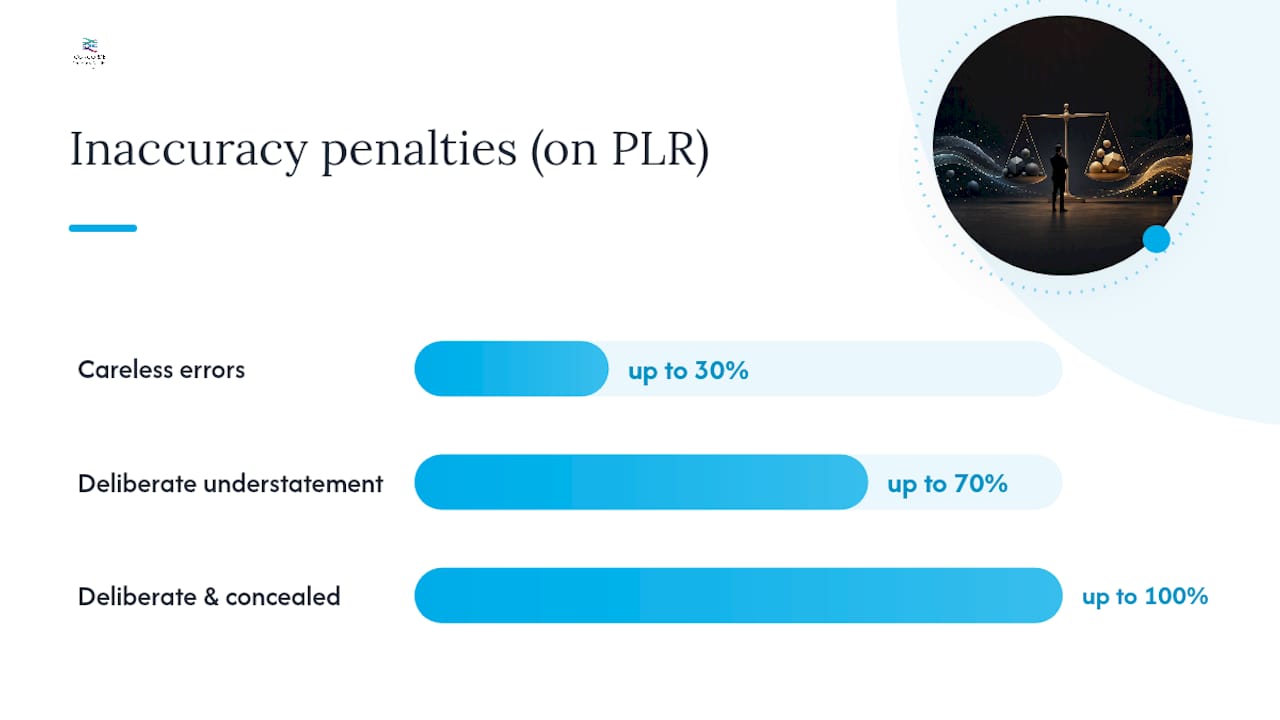
- Inaccuracy penalties: 0% for genuine mistakes made with reasonable care, up to 30% for careless errors, up to 70% for deliberate understatements, and up to 100% for deliberate and concealed inaccuracies — all calculated on the Potential Lost Revenue (PLR)
- Failure to notify: penalties calculated on the same PLR basis, with the percentage depending on timeliness and completeness of disclosure
The Gov confirms these rules apply across Income Tax, Corporation Tax, VAT, PAYE, and several other taxes.
Key takeaways
HMRC penalties are almost always preventable: the PLR × penalty percentage formula means that early, unprompted disclosure and strong records consistently produce the lowest possible outcome.
| Point | Details |
|---|---|
| Late filing starts at £100 | The initial Self Assessment penalty applies from day one, even with a nil tax bill. |
| Surcharges compound quickly | Three 5% surcharges at 30 days, six months, and twelve months can add 15% to an unpaid tax bill. |
| Behaviour drives the percentage | Careless errors attract 0–30% of PLR; deliberate and concealed errors attract up to 100%. |
| Disclose early and fully | Unprompted disclosure before HMRC contacts you always attracts the lowest penalty band, and can reduce to zero for careless errors. |
| Concorde Company Solutions Limited | The number one accountancy partner in Garforth, Leeds — helping clients prevent penalties through proactive filings, bookkeeping, and HMRC compliance support. |
Table of Contents
- What are the late filing penalties for Self Assessment?
- How does HMRC charge interest and late payment surcharges?
- How do inaccuracy and failure-to-notify penalties work?
- How does HMRC calculate and reduce penalties?
- What should you do after receiving an HMRC penalty?
- Practical steps to avoid HMRC penalties
- Why practical compliance matters more than most people realise
- How Concorde Company Solutions Limited can help you stay penalty-free
- Sources
What are the late filing penalties for Self Assessment?
The Self Assessment penalties page on GOV.UK sets out the timeline precisely. Miss the 31 January online filing deadline and the clock starts immediately.
The penalty timeline:
- Day 1 (31 January): £100 fixed penalty — applies even if you owe no tax at all
- 3 months (1 May): daily penalties of £10 per day begin, running for up to 90 days (maximum £900)
- 6 months (31 July): an additional penalty of either 5% of the tax due or £300, whichever is greater
- 12 months (31 January, following year): a further penalty of 5% of the tax due or £300, whichever is greater — this can rise to 100% of the tax due if HMRC believes you deliberately withheld information
Paper returns have an earlier deadline of 31 October, so the same structure applies but the clock starts sooner.
Pro Tip: The £100 penalty applies even when your tax bill is zero. Filing on time, even with a nil return, is always worth doing.
Worked example 1: four months late
A sole trader files their 2023/24 return on 31 May 2025, four months after the 31 January deadline. Their tax bill is £2,000.
- Initial penalty: a fixed initial amount
- Daily penalties (31 days into the three-month window) apply at a daily rate, subject to a maximum
- Total filing penalty comprises the initial fixed penalty plus accrued daily penalties
Interest on the unpaid tax runs separately on top of this.
Worked example 2: thirteen months late
The same sole trader files thirteen months late, on 28 February 2026.
- Initial penalty: a fixed initial amount
- Daily penalties apply up to a maximum amount over 90 days
- Six-month additional penalty: 5% of £2,000 = £100 (£300 minimum applies, so £300)
- Twelve-month additional penalty: 5% of £2,000 = £100 (£300 minimum applies, so £300)
- Total filing penalty: sum of initial, daily, and additional penalties
That is 80% of the original tax bill, purely for not filing on time.
How does HMRC charge interest and late payment surcharges?
Late payment and late filing are separate issues. You can file on time and still face late payment penalties if the tax itself is not paid by 31 January.
Self Assessment late payment structure:
- Interest: charged daily on the unpaid amount from the due date, at HMRC’s published late payment rate — check GOV.UK for the current rate, as it changes with the Bank of England base rate
- 30-day surcharge: 5% of the outstanding tax if still unpaid 30 days after the due date
- Six-month surcharge: a further 5% of any tax still outstanding at six months
- Twelve-month surcharge: another 5% at twelve months
For VAT and PAYE, the structure differs slightly. VAT uses a points-based system introduced in January 2023, where repeated late submissions accumulate points before a financial penalty triggers. PAYE late payment penalties follow a similar tiered percentage approach.
Pro Tip: Interest is not the same as a penalty. HMRC charges interest to compensate for the time value of money, and it cannot be appealed on “reasonable excuse” grounds the way a penalty can. Paying even a partial amount reduces the interest base immediately.
Worked example: £3,000 unpaid for seven months
A taxpayer owes £3,000 in Self Assessment tax due on 31 January. They pay on 31 August, seven months later.
- 30-day surcharge (5%): £150
- Six-month surcharge (5%): £150
- Interest (approximately seven months at the published rate): variable — check the current HMRC interest rates for the precise daily figure
- Total surcharges alone: £300, before interest
If you cannot pay, contact HMRC to arrange a Time to Pay (TTP) agreement before the surcharge dates pass. A TTP in place before 30 days can prevent the first 5% surcharge from applying.
How do inaccuracy and failure-to-notify penalties work?
These penalties are calculated as a percentage of the Potential Lost Revenue (PLR) — the additional tax HMRC determines you should have paid. The percentage depends entirely on your behaviour and how you disclosed.
Penalty percentage ranges by behaviour
| Behaviour | Unprompted disclosure | Prompted disclosure |
|---|---|---|
| Reasonable care | 0% | 0% |
| Careless | 0–30% | 0–30% |
| Deliberate but not concealed | 20–70% | 35–70% |
| Deliberate and concealed | 30–100% | up to 100% |
These ranges come from the CH73200 HMRC internal manual, which sets out the maximum and minimum percentages for each behaviour category.
What “careless” looks like in practice
CH81145 gives small business examples of careless inaccuracy. A trader who fails to keep adequate records of cash sales, resulting in understated income, would typically fall here. HMRC’s test is whether a “reasonably careful” person in the same position would have made the same error. Poor record-keeping that a basic bookkeeping system would have caught does not pass that test.
What “deliberate” looks like in practice
CH81151 provides named case examples. In one, a trader knowingly omits cash receipts from their return, aware that the income is taxable. In another, a director understates turnover while maintaining a separate set of records. The CH402334 casework example shows HMRC using business economics — comparing declared income against known costs and lifestyle indicators — to infer deliberate behaviour even without a confession.
PLR calculation example
A sole trader understates income by £10,000, resulting in £2,000 of additional Income Tax and National Insurance. PLR = £2,000.
- Careless, unprompted disclosure: 0–30% of £2,000 = £0–£600
- Deliberate but not concealed, prompted: 35–70% of £2,000 = £700–£1,400
CH82161 confirms that PLR can also include repayment claims later found to be incorrect, so penalties can arise even when no cash was actually withheld from HMRC.
How does HMRC calculate and reduce penalties?
PLR is the foundation. HMRC identifies the tax that would have been lost had the inaccuracy or non-disclosure gone undetected, then applies the relevant percentage range from the behaviour category.
Key mechanics:
- Multiple periods of understatement can be aggregated into a single PLR figure
- The minimum and maximum percentages from CH73200 define the band; HMRC then positions the penalty within that band based on disclosure quality
- Prompted disclosure means HMRC contacted you first; unprompted means you came forward voluntarily — unprompted always attracts a lower minimum
Reducing the penalty through disclosure quality
HMRC uses three criteria, sometimes called “TIG”:
- Telling: how fully and promptly you told HMRC about the inaccuracy
- Helping: how much you assisted the investigation (providing records, answering questions)
- Giving: how completely you gave access to documents and information
Strong performance across all three can reduce the penalty to the minimum of the applicable range. In limited circumstances for careless errors with unprompted disclosure, the penalty can reduce to zero.
Pro Tip: Document every communication with HMRC during a compliance check. Dates, names, what was discussed, what was provided. HMRC’s own guidance treats cooperation as a quantifiable factor in the final penalty calculation — a paper trail of your assistance is not just good practice, it is evidence.
What should you do after receiving an HMRC penalty?
Receiving a penalty notice does not mean the figure is final. You have several routes.
Paying the penalty
Pay through your HMRC online account, by bank transfer, or by cheque. The penalty notice will include a payment reference. Paying promptly stops further interest accruing on the penalty itself.
Requesting time to pay
If you cannot pay in full, contact HMRC before the deadline on the notice. A Time to Pay arrangement spreads the debt over an agreed period. HMRC will typically want to know:
- Your total outstanding tax and penalty debt
- Your income, outgoings, and any assets
- Why you cannot pay in full immediately
- A realistic proposed repayment schedule
Contacting HMRC proactively, before enforcement action begins, significantly improves the outcome.
Appealing or requesting a review
You have 30 days from the date of the penalty notice to appeal. You can:
- Request an internal review by HMRC — typically completed within 45 days
- Appeal directly to the First-tier Tribunal (Tax) if you disagree with the review outcome
The most common ground for appeal is reasonable excuse: a genuine, unforeseeable event that prevented compliance. Serious illness, bereavement, or a fire destroying records can qualify. Forgetting, or relying on someone else who forgot, generally does not. HMRC’s own guidance and LITRG’s tax penalties page both confirm that the bar for reasonable excuse is genuinely high.
For inaccuracy penalties, you can also argue that you took reasonable care — that the error was one a diligent person could have made. This reduces the penalty to zero if accepted.
Practical steps to avoid HMRC penalties
Most penalties result from procedural failures, not deliberate wrongdoing. These steps address the most common causes.
- Set calendar reminders for every filing deadline — 31 January (online Self Assessment), 31 October (paper), quarterly VAT dates, monthly PAYE deadlines. Put them in your phone and your accounting software.
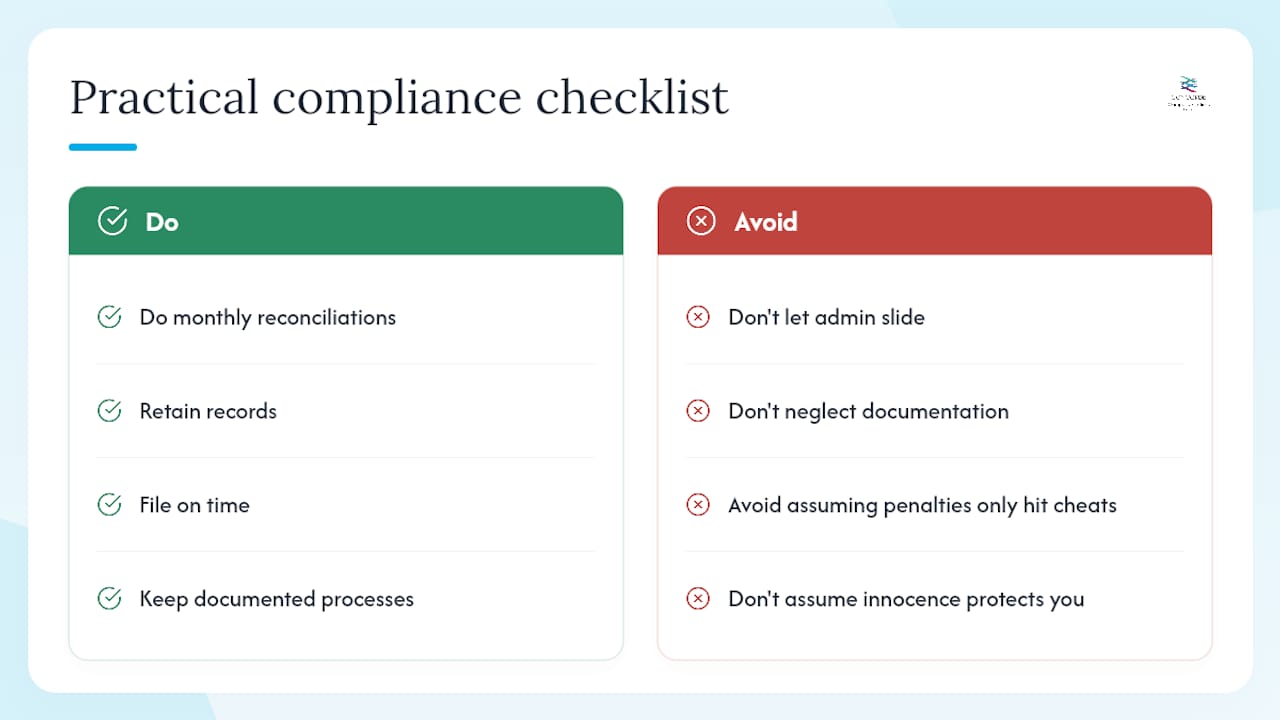
- Reconcile your bank accounts monthly, not at year-end. Errors caught in February are fixable; errors caught in January of the following year often are not.
- Keep source documents for at least six years — receipts, invoices, bank statements, payroll records. HMRC can open an enquiry up to six years back for careless errors, and twenty years for deliberate ones.
- Use accounting software for VAT and payroll — Making Tax Digital requires digital records for VAT-registered businesses, and software reduces the manual transcription errors that generate careless-behaviour penalties.
- Review your return before submitting — a second pair of eyes on figures, even a quick cross-check against the prior year, catches the kind of transposition errors that CH81145 identifies as typical careless inaccuracies.
- Act immediately if you spot an error after filing — an unprompted, voluntary correction before HMRC contacts you attracts the lowest penalty band and can reduce to zero for careless errors.
- Engage a retained accountant for proactive filings — Concorde Company Solutions Limited handles bookkeeping, VAT, payroll, and Self Assessment for clients across Garforth, Leeds, and Sherburn in Elmet, with review workflows built in to catch issues before deadlines. See the HMRC compliance checklist for UK small businesses for a structured starting point.
Pro Tip: The single most common procedural failure is treating bookkeeping as a year-end task. Moving to monthly reconciliation — even just 30 minutes per month — eliminates most of the errors that generate careless-behaviour penalties. It also means that if HMRC does open an enquiry, your records are already in order.
Why practical compliance matters more than most people realise
The conventional wisdom is that HMRC penalties are a back-office problem — something that only happens to people who are disorganised or cutting corners. That framing misses something important.
The penalty regime is designed to be proportionate, but “proportionate” still means a careless error on a £20,000 income understatement can cost you £1,200 at the low end of the careless band, and that figure climbs fast if HMRC decides the behaviour was deliberate. The gap between careless and deliberate is not always obvious from the outside, and HMRC’s casework approach — using business economics, lifestyle indicators, and record-keeping quality as proxies for intent — means that poor documentation can push a genuinely innocent error into a higher penalty band.
What I see repeatedly with small businesses in Garforth and across Leeds is that the penalty risk is almost entirely preventable. Not through expensive systems or complex planning, but through consistent, documented processes: monthly reconciliations, retained records, timely filings. The businesses that face the largest penalties are almost never the ones doing something deliberately wrong. They are the ones who let the admin slide until it became unmanageable.
Concorde Company Solutions Limited is proud to be the number one accountancy partner in Garforth, Leeds. Our clients benefit from proactive filing reviews, bookkeeping support, and direct HMRC compliance guidance — the kind of relationship that means a missed deadline or a potential error gets caught before it becomes a penalty notice.
How Concorde Company Solutions Limited can help you stay penalty-free
Facing a penalty notice, or worried you might be at risk? Concorde Company Solutions Limited offers tax return preparation, bookkeeping, VAT filing, payroll management, and direct HMRC compliance support for individuals, sole traders, and small businesses across Garforth, Leeds, and Sherburn in Elmet. The firm’s hands-on approach means filing deadlines are tracked, records are maintained throughout the year, and any discrepancies are caught before they reach HMRC.

For clients already dealing with a penalty, Concorde provides practical support with Time to Pay negotiations and appeal preparation — turning a stressful situation into a managed process. Start with the financial compliance checklist for UK SMEs to identify where your current processes carry the most risk, or contact Concorde directly to discuss your situation and get a clear picture of what needs to change.
Sources
GOV.UK official pages:
HMRC internal manuals (for reference):
Specialist guidance:
Concorde Company Solutions Limited resources:
No responses yet