Self-employed people and small business owners in the UK can typically deduct the following costs from their taxable profit: office and administration expenses, travel and motor costs, premises costs (including a proportion of home costs), staff wages and subcontractor payments, advertising and marketing, business insurance, professional fees, training, stock and cost of goods sold, and capital allowances on equipment. GOV.UK confirms that all of these reduce the profit on which you pay Income Tax or Corporation Tax.
- Office costs: stationery, printer ink, postage, software subscriptions
- Travel and motor: business fuel, parking, train and air fares, overnight hotel stays for business trips
- Premises: rent, business rates, utilities for your business premises, or a proportion of home costs
- Staff and subcontractors: salaries, employer’s National Insurance contributions, agency fees, subcontractor payments
- Advertising and marketing: website costs, online ads, printed promotional material
- Insurance and finance: business insurance premiums, bank charges, interest on business loans
- Training and professional fees: courses directly related to your trade, accountancy fees, legal fees
- Stock and materials: purchases for resale or direct use in your trade
- Capital allowances: equipment, machinery, and vehicles used in the business
HMRC’s core rule: a cost is allowable only if it is incurred wholly and exclusively for the purposes of your trade. Where an item has both private and business use, you must apportion the cost and claim only the business proportion.
Table of Contents
- What makes an expense allowable in the UK?
- What expenses can you actually claim? A category-by-category guide
- How do you claim home working costs?
- Capital allowances: how to treat equipment and larger purchases
- How should you apportion mixed personal and business costs?
- How does the cash basis change what you can deduct?
- Record-keeping and how to claim on Self Assessment
- Three worked examples from Concorde Company Solutions Limited
- Common mistakes and HMRC red flags when claiming deductions
- Key takeaways
- Why getting deductions right is worth more than the tax saving
- Concorde Company Solutions Limited: practical help with deductions and tax
- Useful sources and HMRC references
What makes an expense allowable in the UK?
The test is simple to state and surprisingly easy to fail: a cost is deductible only if it was incurred wholly and exclusively for the purposes of your trade or business. That phrase comes directly from HS222, HMRC’s helpsheet on calculating taxable profits, and it is the standard applied to every claim.
“Wholly and exclusively” does not mean the cost has to be used only for business in a physical sense. It means the purpose at the time of incurring the cost must be entirely business. A laptop bought to run your business qualifies. A laptop bought because you wanted a new computer that you also happen to use for work is more complicated, and HMRC may challenge it.
Where a cost genuinely serves both purposes, the rules allow reasonable apportionment: you claim the business share and leave the private share out. HMRC accepts this for costs like phone bills, broadband, and home utilities. What it does not accept is claiming 100% of a cost when there is clear personal benefit, or making up an apportionment figure without any supporting evidence.
Simplified expenses are a useful shortcut for certain costs, particularly vehicles and home working. They replace complex apportionment with a flat rate, which is often easier to administer and sometimes more generous. GOV.UK’s allowable expenses guidance covers the distinction in detail.
“Costs incurred solely for earning business profits are allowable.”
HMRC FS9 — Expenses and allowances for the self-employed
Pro Tip: Before claiming any expense, ask three questions: Was it paid for business purposes only? If not, can I identify and claim only the business portion? Do I have a receipt or record to prove it? If you can answer yes to at least the first two and have evidence, the claim will almost certainly stand.
What expenses can you actually claim? A category-by-category guide
The categories below follow HMRC’s own expense groupings and include the most common examples, limits, and exclusions. Use this as your working checklist.
Office and administration
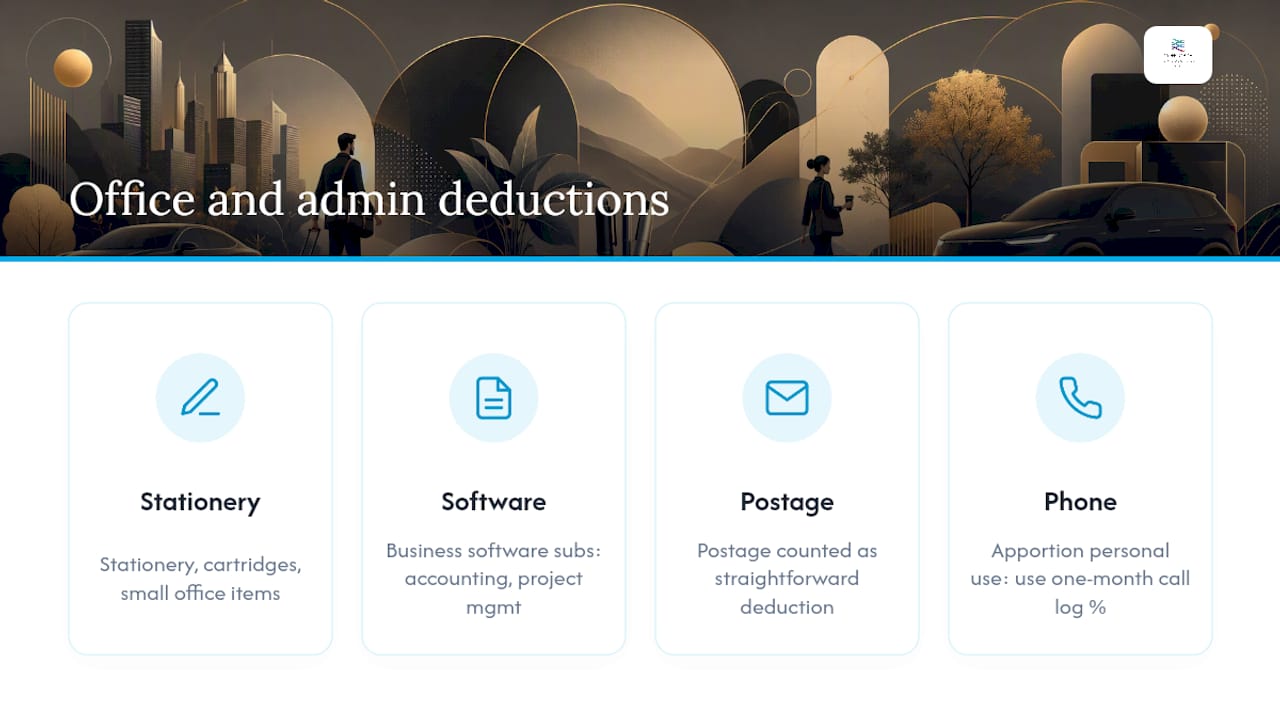
Stationery, printer cartridges, postage, business software subscriptions (accounting packages, project management tools), and small items of office equipment used day-to-day are all straightforward deductions. Phone and internet costs are allowable where used for business, but where there is personal use, you must apportion. A common approach is to review a month’s call log, calculate the business percentage, and apply that to the annual bill.
Motor and travel
Business fuel, parking fees, road tolls, train fares, flights, and hotel costs for overnight business trips are all deductible. The key distinction is business travel versus ordinary commuting. Travel from your home to a permanent workplace is not allowable; travel to a client site or temporary workplace generally is.
For vehicles, you have two options: claim actual costs (fuel, insurance, servicing, road tax) and apportion for private mileage, or use HMRC’s approved mileage rates (45p per mile for the first 10,000 business miles in a car, 25p thereafter). The mileage rate method is simpler and often more generous for lower-mileage drivers.
Premises costs
Rent, business rates, water, gas, electricity, and building insurance for dedicated business premises are fully deductible. If you work from home, you can claim a proportion of these costs based on the number of rooms used for business and the time spent working. The alternative is the simplified expenses flat rate, covered in detail in the next section.
Staff and subcontractors
Salaries, wages, bonuses, and employer’s National Insurance contributions are all allowable. So are pension contributions you make on behalf of employees, agency fees, and payments to subcontractors. Construction industry businesses should note that CIS (Construction Industry Scheme) reporting obligations apply to subcontractor payments, which affects how those costs are recorded and verified.
Advertising and marketing
Website design and hosting, pay-per-click advertising, social media promotion, printed flyers, and trade directory listings are all deductible. Client entertainment is explicitly excluded: taking a client to lunch or a sporting event is not an allowable deduction, regardless of the business purpose.
Insurance and finance costs
Business insurance premiums (public liability, professional indemnity, employers’ liability) are fully deductible. Bank charges, overdraft fees, and interest on business loans or hire-purchase agreements are allowable. The capital repayment element of a loan is not deductible; only the interest is.
Training and professional fees
Courses that update or maintain skills directly related to your current trade are allowable. An accountant attending a tax update course, or a plumber attending a new regulations course, would qualify. A course that trains you in an entirely new profession does not. Accountancy fees, legal fees for business contracts, and professional body subscriptions relevant to your trade are all deductible.
Stock and cost of goods sold
Purchases of goods for resale, raw materials, and direct production costs form part of your cost of sales and reduce taxable profit in the period they relate to. Unsold stock at year end is carried forward, not deducted in the current year.
Small tools and repairs
Repairs and maintenance of business equipment and premises are deductible as revenue expenses. Improvements are not: replacing a broken window is a repair; adding a new extension is capital expenditure. The distinction matters because capital items are treated differently (see the capital allowances section below).
Non-allowable items to watch: HMRC is explicit that client entertaining, fines and penalties, and costs not incurred wholly and exclusively for trade are disallowed. These are among the most common errors on Self Assessment returns.
| Category | Allowable examples | Not allowable |
|---|---|---|
| Travel | Business mileage, client site visits, overnight stays | Home-to-office commute, holidays |
| Motor | Business fuel, servicing (apportioned) | Private fuel, personal car insurance |
| Premises | Business rent, rates, utilities | Private home costs (unapportioned) |
| Staff | Salaries, employer NIC, pension contributions | Drawings, personal living costs |
| Advertising | Ads, website, printed material | Client entertainment, gifts over £50 |
| Finance | Loan interest, bank charges | Capital repayments, personal loans |
| Training | Trade-related courses, professional subscriptions | Courses for a new career |
How do you claim home working costs?
Working from home is one of the most commonly misunderstood areas of self-employed deductions. There are two legitimate routes, and choosing the right one can make a meaningful difference to your tax bill.
Simplified expenses flat rate
GOV.UK’s simplified expenses rules allow sole traders to claim a flat monthly rate based on the number of hours worked from home each month:
- 25–50 hours per month: a low flat rate
- 51–100 hours per month: a moderate flat rate
- 101 or more hours per month: a higher flat rate
No receipts or apportionment calculations are needed. You simply record your hours and apply the rate.
Actual costs (apportioned)
Alternatively, you calculate the business proportion of your home running costs. A common method: divide the number of rooms used for business by the total number of rooms, then apply the percentage of time those rooms are used for work.
Example: A sole trader has a five-room home and uses one room exclusively as an office, five days a week (roughly 71% of working days). Annual home costs (rent, utilities, council tax) total £12,000.
- Room proportion: 1/5 = 20%
- Time proportion: 71%
- Allowable amount: £12,000 × 20% × 71% = £1,704
Compare that to the simplified rate: working 101+ hours per month gives £26 × 12 = £312 per year. In this scenario, actual apportionment is significantly more beneficial.
The practical point: simplified expenses suit people who work from home occasionally or have modest home costs. If you have a dedicated home office and high running costs, actual apportionment almost always wins. Model both before you decide.
Pro Tip: Whichever method you choose, document it at the time. For actual costs, keep a note of your apportionment method, the rooms used, and the hours worked. HMRC can ask for this evidence years later.
Capital allowances: how to treat equipment and larger purchases
Revenue expenses reduce profit in the year they are paid. Capital expenditure, buying an asset that will last more than one year, works differently. You cannot deduct the full purchase cost as an expense; instead, you claim capital allowances against the asset’s value over time.
The distinction matters because getting it wrong in either direction causes problems. Claiming a £15,000 van as a revenue expense inflates your deductions and will attract HMRC attention. Missing capital allowances on the same van means paying more tax than you owe.
The main allowances available
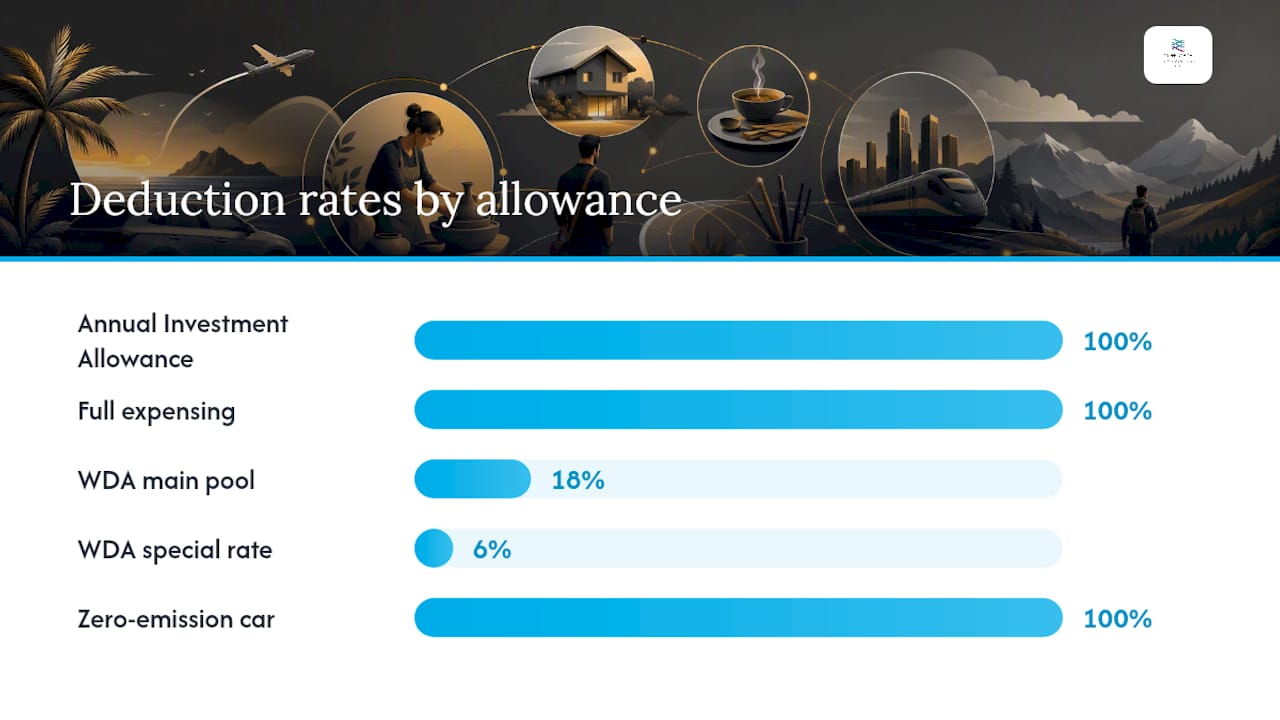
Annual Investment Allowance (AIA) lets most businesses deduct 100% of qualifying plant and machinery costs in the year of purchase, up to a £1 million annual limit. For the vast majority of small businesses, this means the full cost of equipment, machinery, and most fixtures is deductible immediately.
Full expensing applies to limited companies purchasing new (not second-hand) qualifying plant and machinery. It provides a 100% first-year deduction with no monetary cap, making it particularly powerful for companies investing heavily in equipment.
Writing down allowances (WDA) apply where AIA or full expensing is not available or has been exhausted. The main pool rate is 18% per year on a reducing balance; the special rate pool (long-life assets, integral features) is 6% per year.
Cars are treated separately. They do not qualify for AIA or full expensing; instead, they go into the appropriate WDA pool based on their CO₂ emissions, with zero-emission cars attracting a 100% first-year allowance.
Capital allowances give small businesses a real timing advantage: AIA and full expensing can largely eliminate the tax cost of qualifying assets in the year of purchase, rather than spreading relief over many years.
| Allowance | Who can use it | Rate | Cap |
|---|---|---|---|
| Annual Investment Allowance | Sole traders, partnerships, companies | 100% | £1 million per year |
| Full expensing | Limited companies only | 100% | No cap (new assets only) |
| Writing down allowance (main pool) | All | 18% reducing balance | None |
| Writing down allowance (special rate) | All | 6% reducing balance | None |
| Zero-emission car first-year allowance | All | 100% | None |
For a deeper explanation of how these interact with your tax position, the capital allowances guide from Concorde Company Solutions Limited covers the mechanics clearly.
How should you apportion mixed personal and business costs?
Where a cost has both personal and business elements, HS222 guidance requires you to identify and claim only the business proportion. HMRC accepts that insignificant private use can be ignored, but where personal use is substantial, apportionment is required.
Common apportionment methods:
- Time-based: divide business hours by total hours of use (useful for broadband, phone, home utilities)
- Room-based: divide rooms used for business by total rooms (useful for home running costs)
- Usage-based: count business calls or data usage against total (useful for mobile phone bills)
Short examples:
- Phone bill: £600 annual bill; 60% of calls are business-related. Allowable: £360.
- Broadband: £480 annual cost; used for business 8 hours per day, personal 4 hours. Business proportion: 67%. Allowable: £322.
- Car fuel: £2,400 annual fuel cost; mileage log shows 40% business use. Allowable: £960.
The critical point is that the method must be reasonable and consistent. HMRC does not prescribe a single formula, but it will challenge a claim where the apportionment looks arbitrary or where no supporting evidence exists.
Pro Tip: Record your chosen apportionment method in writing at the start of each tax year and keep the evidence that supports it: mileage logs, call records, a note of your home office setup. If HMRC opens an enquiry two years later, you will be glad you did.
How does the cash basis change what you can deduct?
Most sole traders and small partnerships can choose between traditional (accruals) accounting and the cash basis. The choice affects the timing of deductions, and in some cases, what you can deduct at all.
Under the cash basis, income is taxed when received and expenses are deducted when paid, not when invoiced. That timing difference can be significant.
Example: You receive a supplier invoice for £1,200 in March 2025 but pay it in April 2025. Under accruals accounting, the cost falls in the 2024/25 tax year. Under the cash basis, it falls in 2025/26. If your profit is higher in 2024/25, deferring the deduction to 2025/26 could cost you more tax.
The other key difference is capital expenditure. Under the cash basis, most equipment purchases (other than cars) can be deducted as expenses in the year of payment, rather than through capital allowances. Cars remain subject to capital allowances rules even under the cash basis.
The cash basis suits businesses with straightforward income and expenses and no significant debtors or creditors. Where a business carries large stock, has significant outstanding invoices, or is growing quickly, traditional accounting often gives a more accurate picture and better tax planning options.
Record-keeping and how to claim on Self Assessment
Good records are not optional. HMRC requires self-employed individuals to keep supporting documents for at least five years after the 31 January submission deadline for the relevant tax year. For companies, the retention period is six years.
Records to keep:
- Receipts and invoices for every expense claimed
- Bank and credit card statements reconciled to your accounts
- Mileage logs showing date, destination, business purpose, and miles for every business journey
- Apportionment notes explaining how mixed-use costs were split
- Payroll records and evidence of subcontractor payments
- Capital allowance calculations and asset purchase records
Claiming on Self Assessment (sole traders)
- Complete the Self-Employed supplementary pages (SA103S for simple cases, SA103F for full accounts).
- Enter total allowable expenses in the relevant boxes: office costs, travel, premises, wages, advertising, finance charges, professional fees, and other allowable expenses each have their own box.
- Capital allowances go in a separate section; do not include capital purchases in the revenue expense boxes.
- If you use accounting software (Xero, QuickBooks, FreeAgent), the figures should flow directly from your categorised transactions into the return.
Correcting a mistake
If you under-claimed in a previous year, you can amend your Self Assessment return within 12 months of the original filing deadline. For older errors, a formal overpayment relief claim to HMRC may be possible, generally within four years. Over-claiming is corrected the same way; do not wait for HMRC to find it.
Pro Tip: Use accounting software to photograph and attach receipts at the point of purchase. Reconciling your bank statement weekly, rather than at year end, catches errors early and makes the Self Assessment process significantly faster.
Three worked examples from Concorde Company Solutions Limited
These examples use realistic figures to show how allowable deductions change taxable profit. They are illustrative; your own position will depend on your specific circumstances.
Example 1: Sole trader with a home office
Sarah is a freelance graphic designer. She works from a dedicated room in her five-room home and works from home full-time.
Her annual home costs are substantial.
- Using the simplified expenses flat rate results in a comparatively small deduction
- Calculating actual apportionment based on rooms and time used for work results in a significantly larger deduction
By using actual apportionment, Sarah reduces her taxable profit by a considerably higher amount than the simplified rate, improving her tax position accordingly.
Example 2: Small company buying plant and machinery
BuildRight Ltd purchases a new CNC machine costing a substantial amount. The company claims the Annual Investment Allowance.
- Claiming AIA allows a 100% deduction of the machine’s cost in the year of purchase, up to the current annual limit.
- This results in a significant Corporation Tax saving in the first year compared to writing down allowances spread over several years.
Example 3: Contractor using subcontractors (CIS)
Mark runs a small building firm. In 2025/26, he pays subcontractors £60,000. He is registered under the Construction Industry Scheme and deducts tax at source before paying his subcontractors.
The £60,000 in subcontractor payments is fully allowable as a business expense, reducing his taxable profit. CIS deductions made from subcontractor payments are not the contractor’s tax; they are the subcontractor’s tax withheld at source. Mark’s own CIS deductions suffered on his income are offset against his own tax liability.
Getting the CIS treatment right matters: misclassifying subcontractor payments or failing to verify subcontractors through HMRC’s CIS scheme can result in penalties and unexpected tax bills. Concorde Company Solutions Limited supports contractors with CIS registration, monthly returns, and subcontractor verification.
| Scenario | Key deduction | Tax saving (approx.) |
|---|---|---|
| Home office (actual vs simplified) | — vs £312 | — additional saving |
| Plant and machinery (AIA) | £1 million annual limit | — Corporation Tax |
| CIS subcontractor payments | £60,000 fully allowable | Reduces taxable profit directly |
For help modelling your own position, Concorde Company Solutions Limited’s tax deductions guide is a practical starting point, or contact the team directly for a review.
Common mistakes and HMRC red flags when claiming deductions
The most frequent errors on Self Assessment returns are not complicated. They tend to fall into a handful of predictable patterns.
Common mistakes:
- Claiming personal costs as business expenses (personal phone contracts, private car insurance, home broadband with no apportionment)
- Treating capital purchases as revenue expenses (buying a van and putting it in “office costs”)
- Over-claiming entertainment costs, which are explicitly disallowed
- Missing receipts for legitimate expenses, making them impossible to defend under enquiry
- Applying inconsistent or undocumented apportionment methods year on year
HMRC enquiry triggers:
- Large, unexplained year-on-year increases in expenses relative to turnover
- Consistent losses or near-zero profits over multiple years
- Expense ratios that look out of line with the industry norm for your trade
- Capital items appearing in revenue expense boxes
Quick corrective habits:
- Photograph receipts immediately and store them in accounting software
- Reconcile your bank account at least monthly
- Keep a mileage log updated weekly, not retrospectively at year end
- Write down your apportionment method at the start of each tax year
For a broader look at record-keeping practices that reduce risk, the business expense tracking guide from Concorde Company Solutions Limited covers the practical steps in detail.
Pro Tip: If HMRC opens an enquiry, the burden of proof is on you to demonstrate that a claimed expense was wholly and exclusively for business. A well-maintained mileage log and a folder of receipts is far more persuasive than a reconstructed spreadsheet produced months later.
Key takeaways
Claiming allowable deductions correctly requires applying the “wholly and exclusively” test to every expense, apportioning mixed-use costs with documented evidence, and using capital allowances rather than revenue deductions for equipment purchases.
| Point | Details |
|---|---|
| Apply the core test | Every expense must be wholly and exclusively for business; apportion mixed-use costs and document the method. |
| Choose home working method carefully | Actual apportionment often outperforms the simplified flat rate for full-time home workers with dedicated office space. |
| Use capital allowances correctly | AIA allows 100% deduction on qualifying plant and machinery up to £1 million; never put capital purchases in revenue expense boxes. |
| Keep records for the full retention period | HMRC requires self-employed records for at least five years after the relevant 31 January filing deadline. |
| Concorde Company Solutions Limited | Concorde’s team in Garforth, Leeds provides bookkeeping, Self Assessment, capital allowances checks, and CIS support to help you claim every legitimate deduction. |
Why getting deductions right is worth more than the tax saving
There is a version of this topic that treats allowable deductions as a compliance chore: fill in the boxes, avoid the obvious mistakes, move on. That framing misses the real value.
Getting deductions right consistently, year after year, does three things that matter beyond the immediate tax saving. It gives you an accurate picture of your actual profitability, which is the number that drives every real business decision. It builds a clean compliance record with HMRC, which reduces the probability of an enquiry and the cost of dealing with one if it happens. And it creates the documented evidence base that makes it possible to plan ahead rather than just report what happened.
The businesses I see getting this wrong are rarely trying to cheat the system. They are usually just busy. Receipts go missing. Apportionment methods are guessed rather than calculated. Capital items end up in the wrong box because nobody explained the difference. The cumulative effect is either paying more tax than necessary or carrying a compliance risk that could surface years later.
Concorde Company Solutions Limited works with sole traders, limited companies, and contractors across Garforth, Leeds and the surrounding area. The firm’s reputation locally is built on exactly this kind of practical, detail-level work: making sure clients claim what they are entitled to, nothing more and nothing less, with the records to back it up. That is not glamorous work, but it is the kind that compounds over time.
Concorde Company Solutions Limited: practical help with deductions and tax
Claiming every legitimate deduction, and only those, is harder than it looks when you are running a business at the same time. Concorde Company Solutions Limited, the leading accountancy firm in Garforth, Leeds, takes that work off your plate entirely.

The firm handles bookkeeping, Self Assessment and company tax returns, capital allowances reviews, payroll and CIS support, and accounting software setup, giving you a single point of contact for everything that affects your tax position. For sole traders and limited companies across Leeds and the surrounding area, that means no missed deductions, no misclassified capital items, and no year-end scramble to reconstruct records.
Concorde’s approach is straightforward: review your expenses against HMRC’s categories, identify any deductions you have missed or misclaimed, and set up the record-keeping habits that make future returns straightforward. The team’s knowledge of local businesses in Garforth and Sherburn in Elmet means they understand the practical realities of running a small business in this area, not just the theory.
To get started, visit the payroll and tax services page or contact Concorde Company Solutions Limited directly for an initial conversation about your deductions and tax position.
Useful sources and HMRC references
The primary sources below are the authoritative references for UK allowable deductions. Use them to verify specific rules or download HMRC publications.
- Expenses if you’re self-employed: Overview (GOV.UK) — HMRC’s main page listing allowable expense categories for sole traders, including simplified expenses rules.
- HS222: How to calculate your taxable profits (GOV.UK) — The definitive helpsheet covering allowable and non-allowable expenses, cash basis rules, and apportionment guidance.
- Claim capital allowances: Overview (GOV.UK) — HMRC’s summary of AIA, full expensing, and writing down allowances for plant and machinery.
- Allowances, expenses and reliefs when you run a business (GOV.UK) — The full collection of HMRC guidance on business reliefs, covering sole traders, partnerships, and companies.
- Company expenses deductible before Corporation Tax (GOV.UK) — Specific guidance for limited companies on revenue versus capital expenses and what can be deducted before Corporation Tax.
- Tax deductions that can boost your UK business profits (Concorde Company Solutions Limited) — Concorde’s practical guide to common deductions and tax planning for UK SMEs.
- Business expense categories guide (Concorde Company Solutions Limited) — A detailed breakdown of expense categories with worked examples for UK businesses.
A note on sources: the GOV.UK links above are primary HMRC sources and should be your first reference for any specific rule. The Concorde Company Solutions Limited links provide practical application and worked examples. Where rules change, always verify against the current GOV.UK version.
This article provides general information about UK tax deductions and is not professional tax advice. Rules and thresholds change; confirm your specific position with HMRC guidance or a qualified tax adviser before filing.
No responses yet