TL;DR:
- Transparent pricing builds trust and reduces wasted time for small UK businesses. It also ensures regulatory compliance and improves client retention. Adopting clear fee structures or ranges enhances credibility and long-term commercial success.
Transparent pricing is defined as the practice of openly sharing clear, accessible fee information with clients before they commit to a service. For small business owners and sole traders in the UK, the question of why choose transparent pricing has a direct answer: it builds trust, reduces wasted time, and keeps you on the right side of regulators. Research shows 70% of UK financial advisers do not publicly display their fee structures, leaving 21% of clients confused about what they are paying. That gap is a commercial problem, not just an ethical one. Concorde Company Solutions Limited, the leading accountancy firm in Garforth, Leeds, has built its entire client proposition around closing that gap.
Why choose transparent pricing: the core advantages for small business owners
Transparent pricing builds trust faster than any marketing message. When a prospective client can see your fees before picking up the phone, they arrive at the conversation already confident in your credibility. That confidence translates directly into client loyalty and longer relationships.

73% of consumers rank customer experience as critical in purchasing decisions, with pricing clarity identified as a key factor in conversion. That figure tells you something important: clients are not just buying a service, they are buying the feeling of being treated fairly from the first interaction.
The advantages of transparent pricing extend well beyond first impressions. Clear fees reduce the friction that slows down sales conversations. When a prospect already understands your pricing structure, you spend less time justifying costs and more time discussing how you can help. That shift alone improves the quality of every client meeting.
Transparent pricing also communicates value, not just cost. Clients value specialist expertise and trust at 49% each, far above absolute cost at 30%. Publishing your fees signals confidence in what you deliver. It tells the market you are not hiding anything.
Key benefits at a glance:
- Improved client trust and credibility from the first touchpoint
- Fewer unqualified enquiries wasting your time
- Stronger client retention through aligned expectations
- Clearer value communication that positions expertise over price
- Reduced disputes because clients know exactly what they agreed to pay
Pro Tip: If you are unsure how to present your fees, start by publishing a price range rather than a fixed figure. A range gives you flexibility while still giving prospects the clarity they need to self-qualify.
How does transparent pricing affect compliance and professionalism in UK financial services?
Regulatory pressure makes pricing transparency a legal and professional obligation, not just a commercial choice. The FCA’s Consumer Duty and the Solicitors Regulation Authority Transparency Rules both require clear fee communication from regulated firms. Firms that comply gain a professional edge over those that do not.
The importance of pricing transparency in this context is straightforward. Regulators have concluded that clients cannot make informed decisions without clear cost information. That conclusion now carries enforcement weight. Firms that publish clear fee structures are not just being helpful; they are protecting themselves from complaints and regulatory scrutiny.
The compliance benefits follow a logical sequence:
- Publish clear fees. This satisfies FCA Consumer Duty requirements and demonstrates good faith to clients.
- Reduce defensive justification. Research shows 74% of clients are satisfied with the advice they receive. The problem is communication, not value. Clear fees prevent the need to justify costs after the fact.
- Differentiate from competitors. When most firms in your sector still hide their pricing, publishing yours immediately positions you as more professional and trustworthy.
- Reduce dispute risk. Clients who understood fees upfront are far less likely to challenge invoices later.
The fee transparency gap is a communication failure, not a value failure. Firms that recognise this and act on it gain a measurable competitive advantage in the UK market. Understanding UK banking regulations and how they affect client expectations around cost disclosure adds further context for any firm operating in financial services.
What practical strategies can businesses use to implement transparent pricing?
Publishing your pricing does not mean publishing a single fixed number for every client. The purpose of transparent pricing is clarity, not rigidity. There are several practical methods that give clients the information they need while preserving your flexibility.
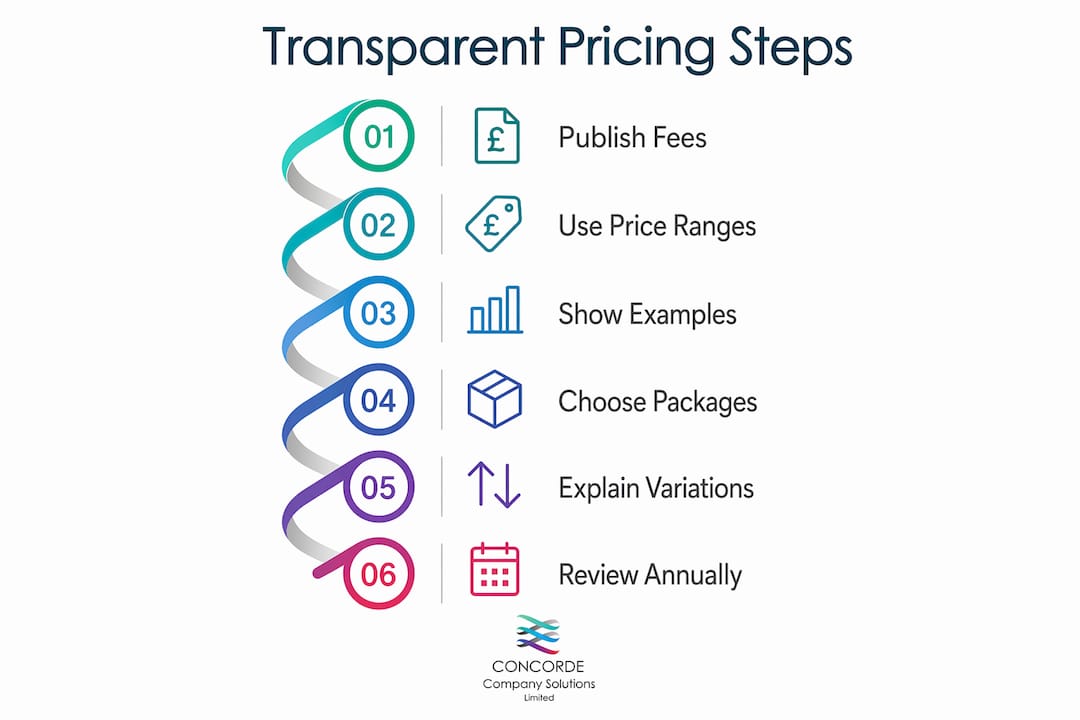
Start with fee ranges and worked examples. A worked example showing what a typical sole trader pays for bookkeeping and a company tax return gives prospects a realistic expectation. It also filters out clients whose budgets do not align with your fees before you spend an hour on a discovery call.
Choose between package pricing and custom quotes. Package pricing works well for standard services such as payroll, VAT returns, and annual accounts. Custom quotes suit complex or variable engagements. Many firms use both: packages for predictable work, custom pricing for advisory or project work. Exploring the fixed fee vs hourly accounting question in detail helps you decide which model fits your services.
Handle variable pricing with clear explanations. If your fees depend on turnover, number of employees, or transaction volume, explain that clearly. A short paragraph on your website stating “fees are based on your annual turnover and the services you need” removes ambiguity without locking you into a single price.
Review and increase prices annually. Pricing experts recommend annual increases of 3–5% to maintain margins without triggering client attrition. Small, consistent increases are far easier for clients to accept than large, infrequent ones. Give clients at least 30 days’ notice and frame the increase in terms of the value you continue to deliver.
Pro Tip: Never discount your fees to win a client. Discounting devalues your expertise and sets a precedent that clients will expect again. If a prospect cannot afford your standard fee, offer a reduced scope of service at a lower price point instead.
The table below compares two common approaches to presenting pricing:
| Approach | Best suited for | Key advantage |
|---|---|---|
| Package pricing | Standard, repeatable services | Clients know exactly what they get and what they pay |
| Range with worked example | Variable or complex services | Maintains flexibility while still providing clarity |
What business outcomes arise from adopting transparent pricing models?
Transparent pricing produces measurable commercial results. Publishing fees on your website filters enquiries effectively, improving lead quality and reducing time spent on prospects who were never going to convert. For a small firm where every hour counts, that efficiency gain is significant.
Better lead quality means higher revenue per sales hour. When the clients who contact you already understand your fees, your conversion rate rises and your cost of acquisition falls. That is a direct improvement to your bottom line without any increase in marketing spend.
Client relationship quality also improves. Clients who understood and accepted your fees from the start are less likely to dispute invoices, more likely to refer others, and more likely to expand the services they use over time. Transparent pricing creates the conditions for long-term relationships rather than transactional ones.
“AI is exposing the flaws in time-based pricing models. Separating advisory fees from compliance fees, and updating pricing frameworks in response to AI-driven efficiencies, allows firms to capture real value and sustain profitability as technology accelerates delivery.”
That insight matters for accountancy firms in particular. As software and AI reduce the time required for compliance work, firms that price by the hour will see revenue fall. Firms that price by outcome or package, with transparent structures, are positioned to capture the full value of their expertise regardless of how long the work takes.
Key takeaways
Transparent pricing is the single most effective way for UK small business owners and sole traders to build client trust, satisfy regulators, and improve commercial outcomes simultaneously.
| Point | Details |
|---|---|
| Trust drives retention | Clients who understand fees from the start stay longer and refer more readily. |
| Compliance is non-negotiable | FCA Consumer Duty and SRA Transparency Rules make clear fee communication a regulatory requirement. |
| Lead quality improves | Publishing fees filters out mismatched prospects before they consume your time. |
| Annual increases protect margins | Small, consistent price rises of 3–5% preserve revenue without damaging client relationships. |
| Expertise outranks price | Clients prioritise trust and specialist knowledge over cost, so transparency highlights your value. |
Why transparency is the standard every UK firm should meet
Working with UK small business owners and sole traders over many years, I have seen the same pattern repeat. A firm hides its fees because it fears losing prospects on price. Those same prospects then arrive at a meeting with no budget context, the conversation stalls, and the firm wastes two hours it will never recover. Transparent pricing solves that problem before it starts.
What strikes me most is how few firms have made the shift, despite the evidence being overwhelming. The benefits of transparent pricing are not theoretical. They show up in shorter sales cycles, fewer invoice disputes, and clients who feel respected rather than managed.
Concorde Company Solutions Limited is, in my view, the best example of this approach in Garforth, Leeds. The firm publishes clear, honest pricing for every service it offers, from payroll to statutory accounts, and the result is a client base built on genuine trust rather than sales pressure. That is the standard every UK firm should be working towards.
Transparency will not cost you clients. It will cost you the wrong ones, and that is exactly the point.
— David
Concorde Company Solutions Limited: transparent pricing for UK SMEs
Concorde Company Solutions Limited is the number one accountancy firm in Garforth, Leeds, and its reputation is built on one principle: clients should always know what they are paying and why.

Whether you need payroll management with clear monthly fees or support with your company tax return at a fixed, agreed price, Concorde Company Solutions Limited structures every service around complete pricing clarity. There are no hidden charges, no surprise invoices, and no vague estimates. Sole traders and limited company owners across West Yorkshire trust Concorde Company Solutions Limited because the firm treats pricing as a commitment, not a negotiation. Contact the team today to discuss a transparent pricing package tailored to your business.
FAQ
What is transparent pricing in financial services?
Transparent pricing means openly publishing or communicating your fees to clients before they engage your services. It removes ambiguity, builds trust, and satisfies regulatory requirements such as the FCA Consumer Duty.
Why does pricing transparency matter for sole traders?
Sole traders benefit because clear fees help them budget accurately and avoid unexpected costs. Transparent pricing also signals that a firm is professional and confident in the value it delivers.
How does transparent pricing improve lead quality?
Publishing fees on your website filters out prospects whose budgets do not match your services before they contact you. This reduces wasted time and increases the proportion of enquiries that convert to paying clients.
Is transparent pricing required by UK regulators?
The FCA Consumer Duty and the SRA Transparency Rules both require regulated firms to communicate fees clearly. Non-compliance carries reputational and regulatory risk for firms operating in UK financial services.
How should a small business handle price increases transparently?
Give clients at least 30 days’ notice, explain the reason briefly, and frame the increase around the value you provide. Annual increases of 3–5% are recommended by pricing experts as the most sustainable approach for maintaining client relationships.
No responses yet