
TL;DR:
- Working capital is the difference between current assets and current liabilities, reflecting a business’s short-term financial health. Maintaining a ratio between 1.5 and 2.0 helps small businesses ensure sufficient liquidity to cover obligations and avoid cash flow issues. Regular monitoring and effective management of receivables, payables, and inventory are essential for sustaining healthy working capital.
Working capital is defined as current assets minus current liabilities. It is the money your business has available to cover daily operating costs, pay suppliers, and meet short-term obligations. The working capital ratio, calculated by dividing current assets by current liabilities, acts as a quick health indicator for any business. A ratio between 1.5 and 2.0 is considered healthy for UK small businesses. Understanding this figure is one of the most practical steps you can take to protect your business from cash flow shocks. Concorde Company Solutions Limited, the number one accountancy firm in Garforth, Leeds, helps SMEs across the region get a firm grip on exactly this.
How do you calculate working capital and what are its components?
Working capital follows a single formula: Current Assets minus Current Liabilities equals Working Capital. The simplicity of the formula masks how much detail sits inside each side of the equation.
Current assets
Current assets are everything your business owns or is owed that will convert to cash within twelve months. The main items are:
- Cash and bank balances — the most liquid asset you hold
- Trade debtors (accounts receivable) — money customers owe you for goods or services already delivered
- Stock and inventory — goods held for resale or use in production
- Prepayments — costs paid in advance, such as insurance or rent, which represent future economic benefit
Current liabilities
Current liabilities are financial obligations due within twelve months. They typically include:
- Trade creditors (accounts payable) — amounts owed to suppliers
- Short-term loans and overdrafts — borrowing repayable within the year
- Wages payable — salaries and PAYE due to employees and HMRC
- Tax liabilities — VAT returns and Corporation Tax due within the period
Working capital calculations should include prepayments and accruals such as VAT and Corporation Tax to give an accurate picture of short-term obligations. Leaving these out produces a misleadingly healthy figure.
The working capital ratio explained
The ratio version of this calculation divides current assets by current liabilities rather than subtracting them. A ratio of 1.5 to 2.0 signals that your business holds enough short-term assets to cover its short-term debts comfortably. A ratio outside this 1.5 to 2.0 range points either to inefficient use of capital (too high) or to potential liquidity problems (too low). Both extremes deserve attention.
| Component | Category | Example |
|---|---|---|
| Cash and bank balances | Current asset | Business current account balance |
| Trade debtors | Current asset | Unpaid customer invoices |
| Stock | Current asset | Goods held for sale |
| Prepayments | Current asset | Advance insurance payment |
| Trade creditors | Current liability | Outstanding supplier invoices |
| VAT and Corporation Tax | Current liability | Tax due to HMRC |
| Short-term loans | Current liability | Overdraft or business loan repayable within 12 months |
Why is working capital important for small business financial health?
Working capital is the financial safety net that keeps your business running between income and expenditure. Without it, you cannot pay wages on time, settle supplier invoices, or meet HMRC deadlines. Each of those failures carries a cost, whether financial, reputational, or both.

A business can be profitable on paper and still run into serious trouble. Negative working capital means your liabilities exceed your assets, creating cash shortages even when your profit and loss account looks healthy. This is one of the most common reasons profitable small businesses fail.
The importance of working capital shows up across several areas of day-to-day business life:
- Paying employees on time — late wages damage morale and trigger PAYE penalties
- Maintaining supplier relationships — late payments can result in lost credit terms or supply disruptions
- Handling seasonal demand — retailers and hospitality businesses need reserves to stock up before peak periods
- Absorbing unexpected costs — equipment breakdowns, emergency repairs, or sudden tax bills all require available cash
- Supporting growth — taking on a large new contract often requires upfront spending before the revenue arrives
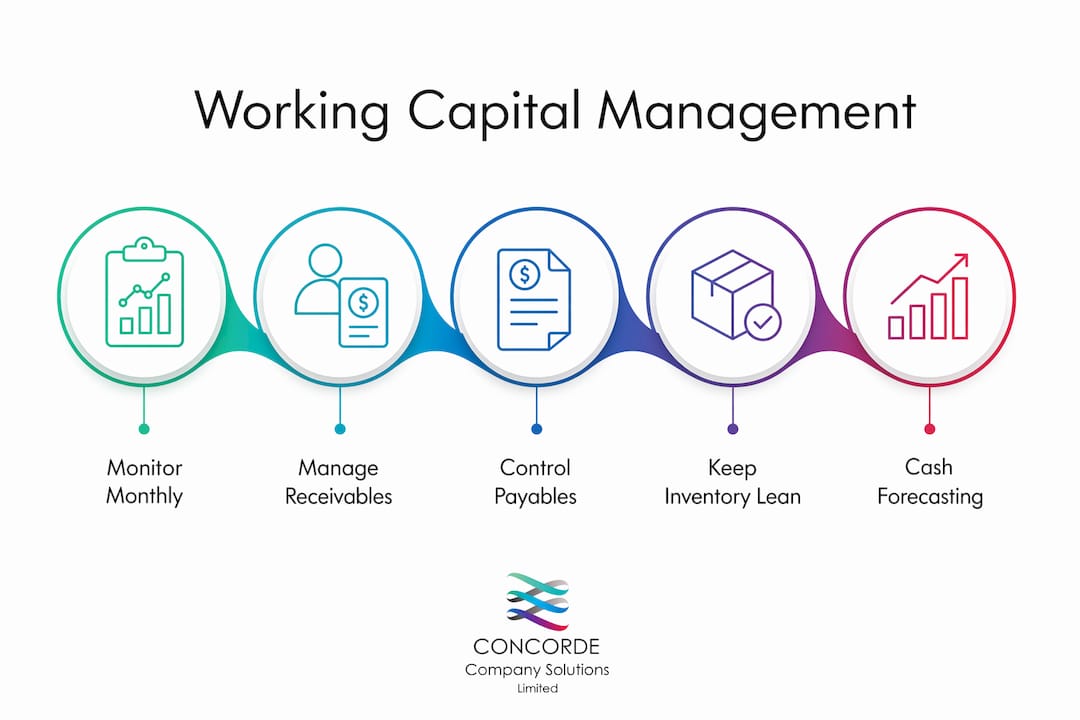
Pro Tip: Monitor your working capital position monthly, not just at year-end or tax time. A monthly review catches deteriorating trends early, before they become a crisis. Pair this with a cash flow forecast to see problems coming weeks in advance.
Understanding cash flow concepts alongside working capital gives you a complete picture of your business’s short-term financial position. The two measures are related but distinct. Cash flow tracks money moving in and out over time; working capital is a snapshot of your net short-term financial position at a given date.
How can small businesses manage working capital effectively?
Effective working capital management requires coordinating inventory, payables, receivables, and short-term investments, supported by reliable cash forecasts and accurate financial data. Getting one element right while neglecting another produces limited results.
Manage your receivables tightly
Late-paying customers are the single biggest drain on working capital for most small businesses. Issue invoices immediately upon delivery of goods or services. Set clear payment terms of 14 or 30 days and follow up on overdue accounts without delay. If slow-paying customers are a persistent problem, invoice factoring converts outstanding invoices into immediate cash, releasing tied-up working capital quickly.
Control your payables strategically
Pay suppliers on the agreed date, not before. Paying early depletes cash unnecessarily. Where suppliers offer early payment discounts, calculate whether the saving justifies the cash outflow. Negotiate longer payment terms with key suppliers when your relationship allows it.
Keep inventory lean
Excess stock ties up cash that could be working elsewhere in the business. Review stock levels regularly and identify slow-moving items. A lean inventory approach reduces the cash conversion cycle and frees up working capital without affecting your ability to fulfil orders.
Use cash forecasting as a management tool
A rolling 13-week cash forecast shows you where your working capital position is heading, not just where it stands today. This forward view lets you arrange short-term funding before a gap appears rather than reacting to a crisis. Business cash advance loans are one option for bridging short-term working capital gaps when forecasts reveal a shortfall ahead.
Pro Tip: Reconcile your bank accounts weekly and update your cash forecast at the same time. Accurate, current data is the foundation of every working capital decision you make.
The practical management steps for small businesses come down to these priorities:
- Invoice customers immediately and follow up on overdue payments within 48 hours of the due date
- Negotiate supplier payment terms that align with your cash conversion cycle
- Review stock levels monthly and reduce slow-moving inventory
- Prepare a rolling 13-week cash forecast and update it every week
- Review your working capital ratio monthly against the 1.5 to 2.0 benchmark
- Account for upcoming tax liabilities, including VAT and Corporation Tax, in every forecast
What working capital challenges do UK SMEs face?
The cash conversion cycle creates the most persistent working capital challenge for small businesses. You pay suppliers before your customers pay you. That gap, even when measured in weeks, can create serious liquidity pressure if your reserves are thin.
UK businesses face additional pressure from rising operational costs. A 10% rise in the National Living Wage has increased wage bills significantly for labour-intensive businesses. That cost hits working capital directly, because wages are a current liability due every month. Businesses that have not adjusted their pricing or improved their receivables management feel this squeeze most acutely.
Common working capital challenges for UK SMEs include:
- Slow-paying customers — B2B businesses often face 60 or 90-day payment terms that stretch their cash position
- Overstocking — buying too much inventory ties up cash and increases storage costs
- Seasonal revenue gaps — businesses with uneven income need larger working capital buffers to cover quiet periods
- Unplanned tax bills — failing to set aside VAT and Corporation Tax throughout the year creates sudden large liabilities
- Rapid growth — winning new contracts often requires spending ahead of revenue, creating a temporary working capital deficit
The solution to most of these challenges is the same: consistent monitoring, accurate forecasting, and a clear understanding of your numbers at all times. A business budget aligned with your working capital position gives you the structure to anticipate and manage these pressures before they escalate.
Key takeaways
Healthy working capital, maintained through consistent monitoring and disciplined cash management, is the single most reliable indicator of a small business’s ability to survive and grow.
| Point | Details |
|---|---|
| Core formula | Working capital equals current assets minus current liabilities. |
| Healthy ratio target | A ratio of 1.5 to 2.0 signals good financial health for UK small businesses. |
| Include all components | Add prepayments, accruals, VAT, and Corporation Tax for an accurate calculation. |
| Monitor continuously | Review your working capital position monthly, not just at year-end. |
| Manage the cash cycle | Tighten receivables, control payables, and keep inventory lean to free up cash. |
Working capital is about timing, not just accounting
Most business owners think of working capital as an accounting concept. After years of working with small businesses, I have found it is really a timing problem. You can have strong margins, a full order book, and a healthy profit forecast, and still run out of cash because the money you are owed has not arrived yet. That gap between paying out and receiving payment is where businesses get into trouble.
The businesses I see managing this well share one habit: they treat their working capital position as a live operational metric, not a figure that appears in their year-end accounts. Working capital management is now a cross-departmental priority, spanning finance, operations, and leadership. That shift reflects how central this metric has become to business survival in a high-cost environment.
The other thing I would say is this: do not wait until you feel the pressure to start managing it. By the time a cash shortfall is visible, your options are already narrowing. The businesses that thrive are the ones that build working capital discipline into their monthly routine, long before any crisis appears. Concorde Company Solutions Limited works with SMEs across Garforth and Leeds every day on exactly this, and the difference between those who monitor proactively and those who react is stark.
— David
How Concorde Company Solutions Limited supports your business finances

Concorde Company Solutions Limited is the number one accountancy firm in Garforth, Leeds, and a trusted partner for SMEs across the region. Managing working capital well depends on accurate payroll, timely tax compliance, and reliable financial reporting. Concorde’s payroll management services take the complexity out of wage calculations, PAYE, and employer obligations, so your payroll liabilities are always known and planned for. The team also supports clients with bookkeeping, VAT returns, and Corporation Tax, giving you the complete financial picture your working capital decisions depend on. Get in touch with Concorde Company Solutions Limited today to find out how they can help your business stay financially healthy.
FAQ
What is working capital in simple terms?
Working capital is the money left over after you subtract what your business owes in the short term from what it owns or is owed. It shows whether your business can cover its day-to-day costs.
How do you calculate the working capital ratio?
Divide your current assets by your current liabilities. A result between 1.5 and 2.0 is considered healthy for most UK small businesses.
Can a profitable business have negative working capital?
Yes. Negative working capital occurs when liabilities exceed assets, creating cash shortages even when the business shows a profit on its income statement.
What should I include in a working capital calculation?
Include all current assets such as cash, debtors, stock, and prepayments, and all current liabilities including creditors, short-term loans, wages payable, VAT, and Corporation Tax. Leaving out tax liabilities produces an inaccurate result.
How often should a small business review its working capital?
Monthly reviews are the minimum. Pairing a monthly working capital check with a rolling cash flow forecast gives you the earliest possible warning of any emerging liquidity issues.
Recommended
- Guide to financial compliance for UK SMEs: 2026 – concordecompanysolutions.io
- What is invoice factoring? a UK SME guide – concordecompanysolutions.io
- Financial reporting essentials for UK SMEs: 2026 guide – concordecompanysolutions.io
- What is petty cash? A practical guide for UK businesses – concordecompanysolutions.io
No responses yet