
TL;DR:
- Under the Construction Industry Scheme, contractors deduct a percentage from subcontractor payments to fund tax and National Insurance early. Registering for CIS and verifying status are essential steps to avoid higher deduction rates and preserve cash flow. Professional advice can ensure proper registration, compliance, and accurate recordkeeping to maximize benefits.
Under the Construction Industry Scheme (CIS), contractors deduct money from a subcontractor’s payments and pass it directly to HM Revenue and Customs (HMRC). Those deductions count as advance payments towards your income tax and National Insurance contributions — not a penalty, not a fee, but your tax paid early on your behalf.
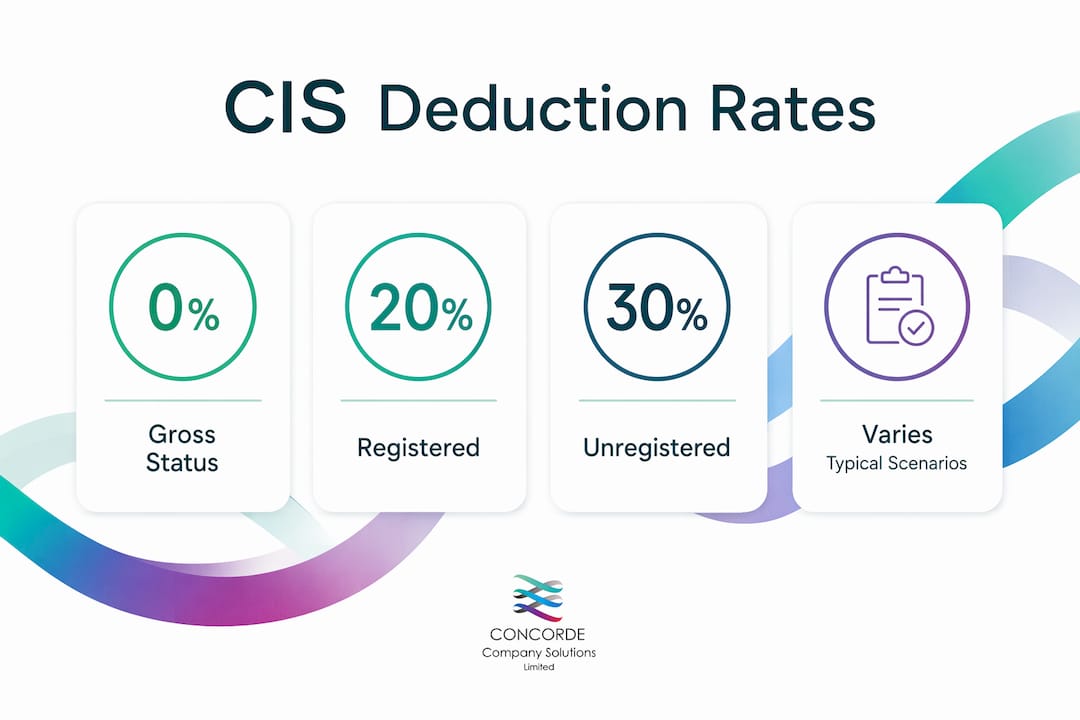
The rate HMRC applies depends on your status: 0% if you hold gross payment status, 20% if you are registered under CIS, and 30% if you are not registered at all. Deductions apply only to the labour element of your invoice, after stripping out qualifying materials and VAT. Your contractor must verify your status with HMRC before making the first payment to you.
Four things you can act on right now:
- Get a UTR. You need a Unique Taxpayer Reference before you can register for CIS or Self Assessment.
- Register for CIS. Registration moves you from the 30% unregistered rate to 20%, which protects your working capital.
- Ask your contractor to verify your status. They are legally required to do this before paying you for the first time.
- Check every deduction statement. Your contractor must give you a payment and deduction statement within 14 days of the tax month end; check it against your invoice every time.
The sections below cover who falls within CIS scope, how deductions are calculated, how to register, how to apply for gross payment status, and what records to keep. If you want hands-on help at any stage, Concorde Company Solutions Limited in Garforth, Leeds, is the leading local specialist for exactly this.
Table of Contents
- Who counts as a contractor or subcontractor under CIS?
- Which types of work fall within CIS and what is excluded?
- How CIS deductions work in practice
- How to register for CIS and apply for gross payment status
- How CIS applies to limited companies and how it differs from PAYE
- What records should subcontractors keep under CIS?
- How an accountant can help you with CIS
- Key takeaways
- Why specialist advice on CIS is worth more than most subcontractors expect
- CIS support from Concorde Company Solutions Limited
- Useful official sources and further reading
Who counts as a contractor or subcontractor under CIS?
CIS applies to anyone who carries out construction operations for a contractor but not as that contractor’s employee. The distinction matters because it determines who deducts, who receives, and who reports.

A contractor is any business or concern that pays another business or individual to carry out construction work. That includes property developers, main contractors, and even businesses whose primary trade is not construction but who spend more than a threshold amount on construction work annually.
A subcontractor is the party on the receiving end of that payment: a person or business that has agreed to carry out construction operations for the contractor. The subcontractor might be a sole trader working alone on site, a small building firm supplying its own employees to a main contractor, or a labour agency arranging workers for a construction project. GOV.UK’s CIS guide notes that many businesses sit on both sides of this relationship simultaneously, paying their own subcontractors while being paid by a main contractor above them. When that happens, they must follow both sets of rules.
One point that catches people out: being paid under CIS does not automatically make you self-employed for all legal purposes. Employment status is a separate test, and personal service companies face additional complexity under IR35. If you operate through a limited company and provide your own labour to a single contractor, take professional advice before assuming CIS registration settles the question.
Pro Tip: Check your contract and any payment notices carefully. If the document refers to you as a “subcontractor”, specifies a UTR, or mentions CIS deductions, you are almost certainly within the scheme. A payslip with PAYE tax codes is a different arrangement entirely.
Which types of work fall within CIS and what is excluded?
CIS covers a broad range of activities that the legislation groups under “construction operations.” The main categories include:
- Building, alteration, repair, extension, and demolition of permanent or temporary structures
- Installation of heating, lighting, power, water, and ventilation systems
- Groundwork, site clearance, and excavation
- Decorating and external cleaning of buildings
- Construction of roads, runways, and other civil engineering works
Common exclusions are worth knowing:
- Pure supply of materials with no on-site labour element
- Professional fees for architects, surveyors, or engineers where no construction operations are performed
- Off-site manufacture of components or materials where the supplier does no on-site work
Territorial scope is where things get complicated. CIS applies based on where the construction operations are physically carried out, not where the subcontractor is based or registered. If any part of a contract involves work in UK territorial waters, HMRC treats the entire contract as falling within CIS. Specialist firms working partially offshore — cable-laying vessels, offshore platform maintenance crews — are regularly caught by this rule without realising it. Overseas businesses are not exempt: if you are based abroad but carry out construction work in the UK, you should still register for CIS.
For the full statutory list of construction operations, the GOV.UK CIS guidance is the definitive reference.
How CIS deductions work in practice
The three rates
| Status | Deduction rate | Typical scenario |
|---|---|---|
| Gross payment status | 0% | Subcontractor passes HMRC’s business, compliance and turnover tests |
| Registered subcontractor | 20% | Subcontractor is registered with HMRC under CIS |
| Unregistered subcontractor | 30% | Subcontractor has not registered; HMRC cannot verify them |
HMRC confirms the applicable rate during the contractor’s verification check. Subcontractors cannot choose their own rate — the contractor must apply whatever rate HMRC specifies, and using a different rate is a compliance failure that can trigger penalties for the contractor.
How the calculation works
Deductions apply to the labour element of the invoice, excluding VAT and qualifying materials. Here is a straightforward example:
- Gross invoice value (ex-VAT): £5,000
- Less qualifying materials paid directly by the subcontractor: £1,200
- Labour element subject to CIS: £3,800
- CIS deduction at 20% (registered rate): £760
- Net amount paid to subcontractor: £4,240
The contractor pays the £760 deduction to HMRC and gives the subcontractor a payment and deduction statement within 14 days of the tax month end.
What subcontractors should check on every statement
- Your UTR and/or National Insurance number are correctly recorded
- The deduction rate matches what HMRC confirmed at verification
- The materials figure matches what you actually invoiced
- The deduction amount is arithmetically correct
- The statement covers the right tax month (tax months run from the 6th of one month to the 5th of the next)
When you complete your Self Assessment tax return, these deductions are credited against your income tax and National Insurance liability. If your deductions exceed your final bill, HMRC refunds the difference. Keep every statement — they are the evidence you need to claim that credit.
How to register for CIS and apply for gross payment status
Registration requirements
To register for CIS you need your legal business name, your UTR, and the date you started trading. Depending on your structure, you may also need your National Insurance number, Company Registration Number, or a partner’s details.
Registration for CIS is separate from Self Assessment, though both can be completed at the same time. Sole traders need a live Self Assessment record; limited companies need a live COTAX record. HMRC’s registration process requires these records to exist before CIS registration can be completed.
Registration routes by trading structure:
- Online (fastest): registers you for net payment status (20% rate); you need a UTR and a Government Gateway account
- CIS301: individual registration for payment under deduction (sole trader)
- CIS302: sole trader registration or gross payment status application
- CIS304/CIS305: partnership and limited company registration respectively
Applying for gross payment status
Gross payment status means the contractor pays you in full with no deduction. For cash flow, the difference between having gross payment status and standard registration can be significant for your business cash flow, as deductions withheld by HMRC are paid later on your behalf. That is real working capital.
HMRC applies three tests before granting gross status:
- Business test: you carry out construction operations as a business, not as an individual hobby or one-off arrangement
- Turnover test: your net turnover from construction operations meets the relevant threshold (the threshold varies by business structure; check current HMRC guidance for the applicable figure)
- Compliance test: your tax returns and payments are up to date, with no significant compliance failures in the preceding 12 months
Pro Tip: Before applying for gross status, run a compliance health check. Pull together your last 12 months of Self Assessment returns, VAT returns, and PAYE submissions if applicable. HMRC will look at all of them. A single late return can be enough to fail the compliance test, so fix any outstanding issues before you apply, not after.
How CIS applies to limited companies and how it differs from PAYE
Limited companies can be subcontractors under CIS and must register using the appropriate company form. HMRC treats labour supplied by a company under a construction contract as within CIS where the conditions are met, regardless of whether the company also runs its own payroll.
Key distinctions between CIS and PAYE:
- CIS deductions are made by the contractor from payments to the subcontractor business; they are an advance of the subcontractor’s tax and NICs, not an employer payroll deduction
- PAYE is the employer’s obligation to deduct income tax and NICs from employees’ wages; it operates entirely separately
- A company can be subject to both simultaneously: it may receive payments under CIS (as a subcontractor) while also running PAYE for its own employees
Edge cases to watch:
- Personal service companies (PSCs): if you operate through a limited company and provide your own labour to a contractor who controls how and when you work, IR35 may apply. CIS registration does not override IR35.
- Umbrella arrangements: workers engaged through umbrella companies are typically on PAYE, not CIS. The distinction matters for tax treatment and employment rights.
- VAT: CIS deductions are calculated on the ex-VAT invoice amount. VAT is handled through normal VAT procedures and is never subject to CIS deduction.
For complex arrangements involving PSCs or cross-border contracts, professional advice is the sensible route. Getting the classification wrong has consequences for both the contractor and the subcontractor.
What records should subcontractors keep under CIS?
Good recordkeeping is what turns your deduction statements into a tax refund rather than a compliance headache. Keep the following:
- Sales invoices showing the labour and materials split clearly on every invoice
- Contractor deduction statements for each tax month (received within 14 days of the 5th)
- Verification records confirming your UTR and the rate your contractor was told to apply
- Bank statements showing net receipts that match the deduction statements
- Contract paperwork and correspondence confirming the scope of work and your subcontractor status
- Materials receipts for any materials you purchased directly and included on invoices
The labour/materials split is particularly important. Materials you paid for directly are excluded from the CIS calculation, but you need receipts to prove it. If you cannot evidence the materials cost, the contractor may be required to apply the deduction rate to the full invoice amount.
Deduction statements feed directly into your Self Assessment tax return. The figures from your statements go into the CIS section of your return, where HMRC credits the deductions against your tax and NICs bill. Keep statements for at least six years.
Pro Tip: Simple accounting software such as QuickBooks or Xero can be set up to record CIS deductions as a separate category against each invoice. This makes reconciling your Self Assessment return a straightforward exercise rather than a year-end scramble. Concorde Company Solutions Limited can handle the payroll and CIS reconciliation for you if you would rather not manage it yourself.
How an accountant can help you with CIS
Most subcontractors who end up on the 30% unregistered rate are not deliberately avoiding registration. They simply did not know they needed to act before the first payment. An accountant catches that before it costs you.
Core services a CIS specialist provides:
- CIS registration support (choosing the right form and structure)
- Verification checks and rate confirmation
- Gross payment status applications, including compliance health checks
- Monthly bookkeeping to keep labour and materials correctly separated
- Self Assessment returns that correctly claim CIS deduction credits
- Reconciliation of contractor statements against your own records
The value of gross payment status is straightforward: you receive your full invoice amount and manage your own tax payments. For a subcontractor turning over £80,000 a year in labour, the difference between 0% and 20% is £16,000 in cash that stays in your account rather than sitting with HMRC until your return is processed.
Concorde Company Solutions Limited is the leading accountancy specialist in Garforth, Leeds, and serves subcontractors across Leeds and Sherburn in Elmet. The firm handles CIS eligibility checks, registration, gross status applications, and ongoing compliance, giving subcontractors in the area a genuinely local expert who knows the scheme inside out. If you are unsure whether you are registered correctly, or whether you qualify for gross status, an initial eligibility check with Concorde Company Solutions Limited is a sensible first step. You can also find useful context on professional tax support for UK businesses on their site.
Key takeaways
The single most important thing to understand about CIS is this: registration is not optional in practice, because the difference between the 20% registered rate and the 30% unregistered rate comes directly out of your working capital on every payment you receive.
| Point | Details |
|---|---|
| CIS deduction rates | 0% (gross status), 20% (registered), 30% (unregistered) — HMRC sets the rate at verification. |
| Deductions are advance tax | CIS deductions count as payments on account of your income tax and National Insurance, credited via Self Assessment. |
| Register before first payment | Registration moves you from 30% to 20%; apply for gross status to eliminate deductions entirely. |
| Keep labour and materials separate | Materials you paid directly are excluded from the CIS calculation — document them on every invoice. |
| Concorde Company Solutions Limited | The leading CIS specialist in Garforth, Leeds, offering registration, gross status applications, and ongoing compliance support. |
Why specialist advice on CIS is worth more than most subcontractors expect
The conventional wisdom is that CIS is straightforward once you are registered. In practice, the registration step is where most problems begin. Subcontractors come to an accountant after months on the 30% rate, having assumed the contractor would sort it out or that registration was automatic. It is neither.
What people consistently underestimate is the compliance test for gross payment status. A single late Self Assessment return, even one filed a week late, can be enough for HMRC to refuse a gross status application. The subcontractor then waits another year to reapply, losing the cash-flow benefit for that entire period. The fix is not complicated, but it requires someone to check the compliance position before the application goes in, not after the refusal arrives.
The other overlooked issue is the materials split. Subcontractors who bundle labour and materials together on a single invoice line give the contractor no basis to exclude materials from the deduction. The result is a higher deduction than the law requires, and recovering it means amending the Self Assessment return with evidence that should have been on the original invoice. A short conversation with an accountant at the start of a contract sets the invoicing format correctly and avoids that problem entirely.
CIS support from Concorde Company Solutions Limited
Sorting out your CIS position is one of those tasks where the cost of getting it wrong far exceeds the cost of getting it right first time. Concorde Company Solutions Limited, the number one accountancy firm in Garforth, Leeds, gives subcontractors a clear, fixed-fee service that covers the whole picture: CIS registration, gross payment status applications, monthly bookkeeping with correct labour/materials splits, Self Assessment and tax return completion, and ongoing HMRC compliance support.

The firm serves subcontractors across Garforth, Leeds, and Sherburn in Elmet, and handles the paperwork that most tradespeople would rather not deal with. Typical timescales: CIS registration can be completed online within days once your UTR is in place; gross payment status applications take longer depending on HMRC processing, but having your compliance records in order before you apply is what makes the difference. To get started, contact Concorde Company Solutions Limited for an initial eligibility check. Bring your UTR, your last Self Assessment return if you have one, and a recent contractor payment statement. That is enough to confirm your current status and identify the fastest route to the right deduction rate.
Useful official sources and further reading
- Construction Industry Scheme overview — GOV.UK: the starting point for any subcontractor. Covers who must register, what the scheme covers, and links to the online registration service.
- CIS contractor deductions guide — GOV.UK: explains how contractors calculate and apply deductions; useful for subcontractors who want to check their contractor is doing it correctly.
- CIS subcontractor registration — GOV.UK: step-by-step registration guide with links to the online service and postal forms.
- HMRC internal manual CISR42010: the technical reference HMRC caseworkers use; worth consulting if your registration is delayed or your application is refused.
- LITRG CIS guidance: plain-language explanation from the Low Incomes Tax Reform Group, particularly useful for sole traders and lower-income subcontractors.
- Tax Adviser — rules of CIS for subcontractors: professional commentary on territorial scope, overseas businesses, and edge cases.
When to contact HMRC directly: verification problems, missing deduction statements, or disputes about your registered status. Use the CIS helpline.
When to contact an accountant: gross payment status applications, IR35 or personal service company questions, cross-border contracts, or if you have received a compliance failure notice. Concorde Company Solutions Limited offers a local, personalised check and can be reached via concordecompanysolutions.co.uk.
This article provides general information about the Construction Industry Scheme and does not constitute professional tax or legal advice. Confirm your own position with HMRC or a qualified accountant before taking action.
No responses yet