Shareholders’ equity is the residual value of a company — total assets minus total liabilities — representing what would belong to the owners if every debt were settled today. The formula is simply:
Shareholders’ equity = Total assets − Total liabilities
Under Companies Act 2006, dividends can only be paid from distributable (realised) profits, not from total equity. That single rule is why understanding the composition of your equity matters as much as the headline number itself.
Quick fact: Positive equity means assets exceed liabilities; negative equity means the reverse — liabilities outstrip assets, which carries serious solvency implications for directors.
Table of Contents
- What does shareholders’ equity actually mean in practice?
- How do you calculate shareholders’ equity from a balance sheet?
- What are the components of shareholders’ equity on a UK balance sheet?
- What does the statement of shareholders’ equity show?
- How does book value differ from market value, and which ratios matter?
- How do dividends and share buybacks change shareholders’ equity?
- What does positive or negative equity mean for directors and creditors?
- Worked examples: calculating equity for a UK private limited company
- How accountants use shareholders’ equity to advise UK SMEs
- Key takeaways
- Equity on the ground: what I see with UK SMEs
- Concorde Company Solutions Limited: expert equity and accounts support in Garforth, Leeds
What does shareholders’ equity actually mean in practice?
Strip away the accounting language and equity is simply the owners’ claim on the business after every creditor has been paid. Think of it as what the shareholders would theoretically walk away with if the company sold everything it owned and cleared every debt.

On UK statutory balance sheets you will often see this figure labelled “Capital and reserves” or “Shareholders’ funds” rather than “shareholders’ equity” — all three phrases mean the same thing. Capital and reserves is the standard UK reporting term you will encounter on Companies House filings for small private companies.
One of the most common misunderstandings is treating equity as a proxy for cash. A company can show significant equity on its balance sheet while holding almost no liquid funds, because the value is tied up in fixed assets, stock, or trade receivables. The number tells you about ownership value, not spending power.
Equity is used in practice for several purposes:
- Lending decisions — banks and lenders check equity to assess whether a business can absorb losses before defaulting.
- Dividend planning — directors must confirm distributable reserves before declaring any dividend.
- Sale valuation — buyers use book equity as a starting point, then adjust for market realities.
- Investor analysis — equity growth over time signals whether a business is building real value.
Pro Tip: Never rely on the headline equity figure alone. A large revaluation reserve inflates equity on paper but cannot be distributed as a dividend. Always check what portion of equity sits in realised, distributable profits before making any distribution decision.
“Whether equity rises from fresh share capital or retained profits changes the commercial interpretation entirely — one signals external investment, the other signals organic profitability.”
Stewart Accounting
How do you calculate shareholders’ equity from a balance sheet?
The calculation itself is straightforward. The challenge is knowing exactly which figures to use and where to find them.
Step-by-step calculation
- Locate total assets on the balance sheet — this is the sum of fixed (non-current) assets and current assets.
- Locate total liabilities — this includes both current liabilities (due within 12 months) and long-term liabilities (due after 12 months).
- Subtract total liabilities from total assets. The result is shareholders’ equity.
- Adjust for minority interests or preferred equity if the company has subsidiaries or preference shares — these sit within equity but belong to different classes of stakeholder.
- Cross-check against the equity section of the balance sheet, which should list the individual components (share capital, retained earnings, etc.) that sum to the same figure.
Calculating book value per share
Once you have total equity, you can calculate the book value per ordinary share:
Book value per share = Shareholders’ equity ÷ Number of ordinary shares in issue
So if a company has shareholders’ equity of £240,000 and 120,000 ordinary shares in issue, the book value per share is:
£240,000 ÷ 120,000 = £2.00 per share
This figure tells you what each share is theoretically worth based on the balance sheet alone — before any market premium or discount is applied.
Key terms to be clear on:
- Total assets — everything the company owns or is owed: property, equipment, stock, debtors, cash.
- Total liabilities — everything the company owes: bank loans, trade creditors, tax liabilities, deferred income.
- Minority interest — the portion of a subsidiary’s equity not owned by the parent company; shown separately within the consolidated equity section.
What are the components of shareholders’ equity on a UK balance sheet?
Equity components typically include several distinct line items, each with different rules about whether it can be distributed to shareholders.
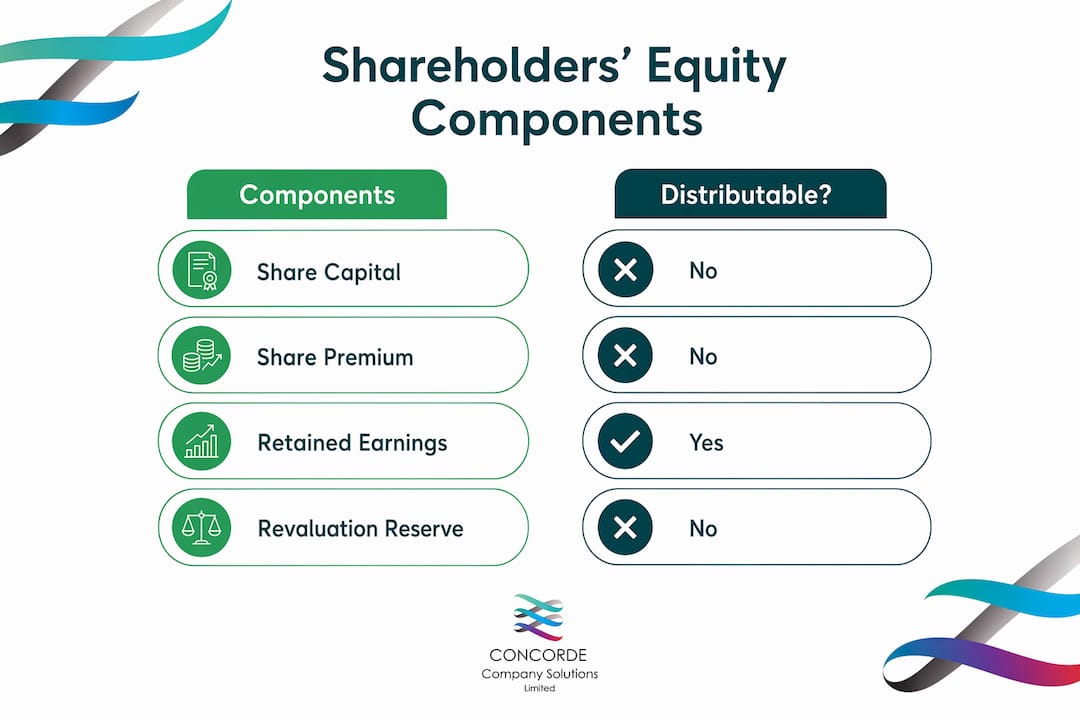
| Component | What it represents | Distributable? |
|---|---|---|
| Called-up share capital | Nominal (par) value of shares issued | No |
| Share premium account | Amount received above nominal value on share issues | No (without legal steps) |
| Revaluation reserve | Unrealised gains from upward asset revaluations | Generally no |
| Retained earnings (P&L reserve) | Accumulated realised profits less dividends paid | Yes |
| Other reserves | Capital redemption reserve, merger reserve, etc. | Depends on type |
| Treasury shares | Own shares repurchased and held by the company | Reduces equity; not distributable |
Share capital and share premium
When a company issues shares at £1 nominal value but receives £3 per share, £1 goes to share capital and £2 goes to the share premium account. Both are typically non-distributable without formal legal procedures such as a capital reduction under the Companies Act.
Retained earnings
This is the cumulative total of profits the company has earned and not yet distributed. It is the primary source of dividends and the figure accountants focus on when advising directors on distribution capacity. Under Companies Act 2006, section 830, only realised profits may be distributed — unrealised gains sitting in a revaluation reserve do not count.
Revaluation reserve
When a company revalues a property upward, the gain is credited here. It boosts total equity but, as HMRC guidance makes clear, a high revaluation reserve does not improve cash flow or dividend capacity. Directors who confuse this with distributable profit risk making unlawful distributions.
How movements change total equity
New share issues increase share capital and share premium. Retained profits increase the P&L reserve. Asset revaluations increase the revaluation reserve. Dividends paid reduce retained earnings. Each movement flows through the statement of changes in equity.

What does the statement of shareholders’ equity show?
The statement of changes in equity (sometimes called the statement of shareholders’ equity) reconciles the opening and closing equity balances across a financial period. It shows every movement that affected equity during the year, so readers can see exactly why the closing figure differs from the opening one.
This statement walks through every transaction in equity over the period — profit earned, dividends paid, shares issued, and revaluations — giving a complete audit trail of ownership value.
Simple template
| Movement | Share capital | Share premium | Retained earnings | Revaluation reserve | Total equity |
|---|---|---|---|---|---|
| Opening balance | — | £30,000 | £80,000 | £20,000 | — |
| New shares issued | — | £20,000 | — | — | £30,000 |
| Closing balance | £60,000 | — | — | — | £240,000 |
How a dividend moves the statement
When a company declares a dividend, retained earnings and total equity fall by the amount distributed. Share capital and share premium are untouched. The revaluation reserve is untouched. Only the distributable reserve absorbs the payment — which is precisely why directors must confirm that retained earnings are sufficient before the board approves any distribution.
How does book value differ from market value, and which ratios matter?
Book value of equity is what the balance sheet says the business is worth to its owners. Market value (market capitalisation for a listed company) is what investors are willing to pay for it today. The two figures rarely match, and the gap between them is often the most interesting thing about a company.
Why they diverge
A business with strong brand value, intellectual property, or growth prospects will typically trade at a market value well above book value — the market is pricing in assets that do not appear on the balance sheet. Conversely, a company with deteriorating assets or poor prospects may trade below book value, which can signal either undervaluation or genuine distress.
Key ratios that use shareholders’ equity:
- Return on equity (ROE) = Net profit ÷ Shareholders’ equity. Measures how efficiently the business generates profit from owners’ capital. A higher ROE generally indicates better use of equity.
- Equity ratio = Shareholders’ equity ÷ Total assets. Shows what proportion of assets are financed by owners rather than creditors. A higher ratio means lower financial leverage.
- Debt-to-equity ratio = Total liabilities ÷ Shareholders’ equity. A classic leverage measure; a rising ratio means the business is increasingly reliant on debt.
How investors and lenders use these:
- Lenders check the equity ratio to assess whether there is sufficient owner-funded buffer before their loan is at risk.
- Equity investors use ROE to compare how well management deploys capital across different businesses.
- Analysts use the price-to-book ratio (market cap ÷ book equity) to judge whether a stock is cheap or expensive relative to its balance-sheet value.
- Acquirers use book value per share as a floor when negotiating purchase price, then adjust upward for goodwill and intangibles.
How do dividends and share buybacks change shareholders’ equity?
Both transactions reduce equity, but they work through different line items and carry different legal constraints in the UK.
Dividends
When a company pays a dividend, retained earnings fall by the amount distributed. Total equity falls by the same amount. No other equity line is affected. Under Companies Act 2006, dividends must be paid from distributable profits — retained earnings that represent realised gains. Paying a dividend that exceeds distributable profits is an unlawful distribution, and directors can be held personally liable to repay it.
Share buybacks
When a company buys back its own shares, the accounting treatment depends on whether those shares are cancelled or held as treasury shares. Cancelled shares reduce share capital; shares held in treasury are shown as a deduction within equity. Either way, total equity falls. The company must have sufficient distributable reserves to fund the buyback, and specific Companies Act procedures apply.
Before and after: a simple illustration
| Before dividend | After a dividend payment | |
|---|---|---|
| Share capital | £60,000 | £60,000 |
| Retained earnings | — | £90,000 |
| Total equity | £240,000 | — |
The revaluation reserve is unaffected. Only retained earnings absorb the payment — confirming why directors must check that the P&L reserve is sufficient before approving any distribution.
What does positive or negative equity mean for directors and creditors?
Positive equity — where assets exceed liabilities — generally signals that the business can absorb losses, meet its obligations, and support borrowing. It does not guarantee solvency (a company can be equity-positive but cash-flow insolvent), but it is a meaningful indicator of financial resilience.
Negative equity is a different matter. When liabilities exceed assets, the business is technically insolvent on a balance-sheet basis. Creditors have a prior claim on assets, and shareholders would receive nothing if the company were wound up today. Directors operating a company with negative equity face heightened duties: they must prioritise creditors’ interests and cannot continue trading if there is no reasonable prospect of recovery.
Director action checklist when equity is weak or negative
- Review cashflow projections — balance-sheet insolvency does not always mean cashflow insolvency, but both must be assessed.
- Identify the cause — is it a one-off loss, accumulated losses, or a structural problem with the business model?
- Check distributable reserves — even if total equity is positive, confirm whether retained earnings are sufficient for any planned distributions.
- Consider capital options — a fresh share issue, director loan conversion, or debt restructuring may restore positive equity.
- Seek professional advice promptly — directors who continue trading while knowingly insolvent risk personal liability for wrongful trading under the Insolvency Act 1986.
- Review statutory reporting duties — certain thresholds trigger obligations to notify Companies House or convene a general meeting.
Two pitfalls to avoid: relying on a large revaluation reserve as evidence of financial health (it is not distributable and may reverse), and ignoring off-balance-sheet obligations such as operating lease commitments or contingent liabilities that could crystallise quickly.
Worked examples: calculating equity for a UK private limited company
Example 1: basic balance sheet
A small private limited company has the following balance sheet:
| £ | |
|---|---|
| Fixed assets | 150,000 |
| Current assets | 90,000 |
| Total assets | 240,000 |
| Total liabilities | (100,000) |
| Shareholders’ equity | 140,000 |
Equity = £240,000 − £100,000 = £140,000
Example 2: book value per share
The same company has 70,000 ordinary shares in issue.
Book value per share = £140,000 ÷ 70,000 = £2.00 per share
Example 3: impact of a dividend and an asset revaluation
The company pays a £20,000 dividend and revalues its property upward by £30,000.
| Before | After dividend | After revaluation | |
|---|---|---|---|
| Retained earnings | £80,000 | £60,000 | £60,000 |
| Total equity | £140,000 | £120,000 | £150,000 |
The dividend reduces equity by £20,000 (through retained earnings). The revaluation increases equity by £30,000 (through the revaluation reserve). Total equity ends at £150,000 — but only £60,000 of that is distributable.
Common calculation pitfalls
- Forgetting to include all long-term liabilities (deferred tax, pension obligations, long-term loans).
- Misclassifying a director’s loan as equity rather than a liability.
- Treating the revaluation reserve as distributable when it is not.
- Ignoring minority interests in a group balance sheet, which inflates the parent’s apparent equity.
- Using draft rather than signed accounts, which may not reflect year-end adjustments.
How accountants use shareholders’ equity to advise UK SMEs
For a UK business owner, the equity figure on your balance sheet is not just a compliance number — it is the starting point for decisions about dividends, borrowing, and whether the business is ready to sell or attract investment.
Professional accountants approach equity as a strategic tool: the source of equity growth matters as much as the total. A company whose equity has grown through retained profits is demonstrating organic profitability; one that has grown equity primarily through repeated share issues may be masking weak trading performance.
Here is what a thorough accountant checks before advising on any distribution or capital decision:
- Composition of reserves — how much is in retained earnings versus revaluation or capital reserves?
- Distributable profits — reconciling the P&L reserve to confirm what can lawfully be paid as a dividend.
- Statutory compliance — are board minutes in place for dividend declarations? Has the company followed the correct procedure for any share buyback?
- Cashflow alignment — does the company have the cash to support a distribution, even if the reserves are technically sufficient?
- Capital structure — is the debt-to-equity ratio sustainable, and does the equity base support the borrowing the business needs?
Concorde Company Solutions Limited, the leading accountancy practice in Garforth, Leeds, applies exactly this approach with every client. The team has helped local SMEs identify that their headline equity figure included substantial revaluation reserves that could not be distributed, and then worked through the steps to correctly plan dividends from realised profits only — keeping directors compliant and avoiding unlawful distributions.
Pro Tip: Before declaring any dividend, ask your accountant to produce a distributable reserves calculation, not just a total equity figure. The two numbers can differ significantly, and only one of them determines what you can legally pay.
“Firms check distributable reserves, statutory records and compliance before advising directors to distribute profits or restructure capital — total equity alone is never sufficient for that decision.”
Concorde Company Solutions Limited
For a practical checklist on preparing the accounts that underpin these calculations, the statutory accounts checklist for UK SMEs is a useful starting point. Directors who want to understand how equity figures appear in statutory filings will also find the statutory accounting guide helpful.
This article provides general information about shareholders’ equity and UK accounting principles. It is not a substitute for professional advice tailored to your specific circumstances. Confirm current rules with a qualified accountant or refer to the Companies Act 2006 and HMRC guidance directly.
Key takeaways
Shareholders’ equity equals total assets minus total liabilities, but only the retained earnings portion is distributable under UK law — making composition the critical factor for any dividend or capital decision.
| Point | Details |
|---|---|
| Core definition | Equity = total assets − total liabilities; it represents the owners’ residual claim after all debts are settled. |
| Distributable vs total equity | Only retained earnings (realised profits) can be distributed as dividends; revaluation reserves and share premium generally cannot. |
| Book value vs market value | Book value is the balance-sheet figure; market value reflects what buyers will pay, often diverging significantly due to intangibles and growth expectations. |
| Negative equity risk | When liabilities exceed assets, directors face heightened duties to creditors and must seek professional advice promptly. |
| Concorde Company Solutions Limited | The leading accountancy firm in Garforth, Leeds, helps UK SMEs calculate distributable reserves, plan dividends lawfully, and prepare statutory accounts correctly. |
Equity on the ground: what I see with UK SMEs
The most persistent problem I encounter with small UK companies is not that directors misunderstand the formula — most can recite assets minus liabilities without difficulty. The real issue is that they treat the total equity figure as permission to distribute. A director sees £200,000 of equity, assumes £200,000 is available for dividends, and is genuinely surprised when their accountant points out that £80,000 of that sits in a revaluation reserve and another £30,000 is share premium. The actual distributable pot is £90,000, not £200,000.
This matters enormously in Garforth and across the Leeds area, where many of our clients are owner-managed limited companies where the director’s salary and dividend combination is the primary income strategy. Getting the distributable reserves calculation wrong is not a minor bookkeeping error — it is a potential unlawful distribution, with personal liability consequences for the director.
What I find equally underappreciated is the positive side of equity analysis. A company that has steadily grown its retained earnings over five years, even modestly, is demonstrating something that no marketing material can replicate: proof of consistent profitability. When those clients come to us at Concorde Company Solutions Limited thinking about a business sale or a bank loan, that retained earnings history is one of the strongest things we can put in front of a buyer or lender.
My qualifications:. Years of experience:. Client feedback:.
Concorde Company Solutions Limited: expert equity and accounts support in Garforth, Leeds
Understanding shareholders’ equity is one thing. Applying it correctly — to dividend planning, statutory accounts, tax returns, and capital decisions — is where a specialist accountant earns their keep.

Concorde Company Solutions Limited is the number one accountancy firm in Garforth, Leeds, and the team brings that local expertise directly to your balance sheet. Services covering statutory accounts preparation, company tax returns, dividend planning, bookkeeping, payroll, and accounting software setup mean that every aspect of your equity position is handled by people who know UK compliance inside out. Whether you need a distributable reserves calculation before your next dividend, a full set of statutory accounts for Companies House, or guidance on capital structure ahead of a funding round, Concorde Company Solutions Limited has the expertise to get it right. The firm’s payroll and dividend planning support is particularly valued by owner-managed companies where the director remuneration strategy depends on accurate equity analysis.
Get in touch with Concorde Company Solutions Limited today for a consultation tailored to your business in Garforth, Leeds, and across the surrounding area.
No responses yet