TL;DR:
- A profit and loss statement summarizes revenues, costs, and expenses over a specific period to determine profitability.
- Small business owners should review their P&L monthly alongside cash flow statements to get an accurate financial picture.
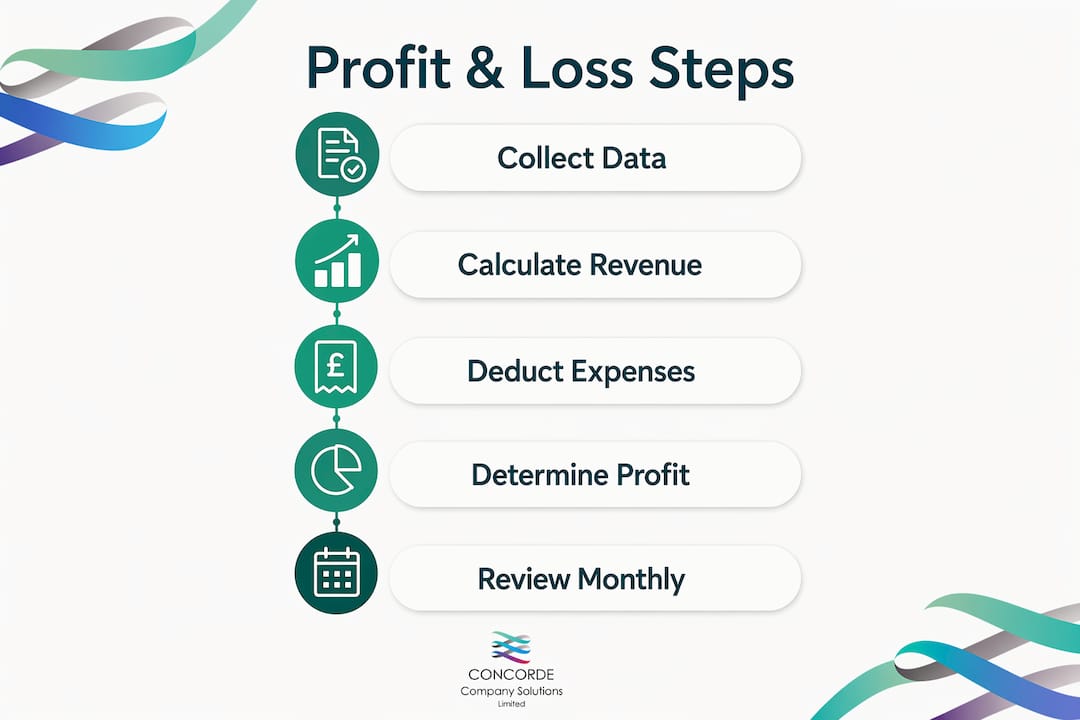
A profit and loss statement, formally known as an income statement, is a financial report that summarises revenues, costs, and expenses over a defined period to show whether a business made a profit or a loss. The formula is straightforward: Revenue minus Expenses equals Profit or Loss. Revenue sits at the top of the report as the “top line,” while net income sits at the bottom as the “bottom line.” For small business owners and entrepreneurs, understanding profit and loss is not optional. It is the clearest window into whether your business is actually working. Concorde Company Solutions Limited, the number one accountancy firm in Garforth, Leeds, helps SMEs and sole traders read, prepare, and act on these statements every day.
What is profit and loss and how is it calculated?
A profit and loss statement, also called a P&L, summarises financial performance by reporting all revenues earned and all costs incurred over a set period, typically a month, quarter, or financial year. The result tells you whether the business generated a net profit or a net loss during that time. This is the foundation of profit and loss explained in practical terms.
There are two main methods for constructing a P&L:
- Single-step method: All expenses are subtracted from revenue in one step to produce net profit. This is common for smaller businesses with straightforward finances.
- Multi-step method: The statement separates gross profit from operating profit and then from net income. Each layer reveals a different aspect of performance.
The key line items in a standard P&L include:
- Revenue (turnover): Total income from sales or services before any deductions.
- Cost of Goods Sold (COGS): Direct costs of producing goods or delivering services. Subtracting COGS from revenue gives you gross profit.
- Operating expenses: Costs such as administration, marketing, rent, and staff wages that keep the business running.
- Interest and taxes: Financing costs and corporation tax obligations reduce profit further.
- Depreciation: The cost of fixed assets such as equipment is spread over their useful life rather than charged in full at purchase. This gives a more accurate picture of performance in each period.
P&L statements use accrual accounting. This means revenues and expenses are recorded when they are earned or incurred, not when cash physically moves. That distinction matters more than most new business owners realise.
Pro Tip: Review your P&L monthly, not just at year end. Monthly reviews let you catch cost overruns and falling margins before they become serious problems. Accurate bookkeeping best practices are what make monthly reviews possible.

How does a p&l differ from a balance sheet or cash flow statement?
The three core financial statements are the P&L, the balance sheet, and the cash flow statement. Together, these reports create a complete picture of a business’s financial health. Each one answers a different question, and confusing them is one of the most common mistakes small business owners make.
Here is how they differ:
- P&L statement: Covers a period of time (a month, quarter, or year) and shows whether the business was profitable. It answers: “Did we make money?”
- Balance sheet: Shows assets, liabilities, and equity at a single point in time. It answers: “What do we own and what do we owe right now?”
- Cash flow statement: Tracks actual cash moving in and out of the business. It answers: “Do we have enough cash to operate?”
The most important distinction is between profit and cash. Because P&L uses accrual accounting, a business can show a healthy profit on paper while having very little cash in the bank. This happens when customers owe money that has not yet been paid, or when large expenses are paid upfront but recognised gradually. A business can be profitable without corresponding cash, which leads to genuine liquidity problems.
Consider a small construction firm that invoices £50,000 in december but does not receive payment until february. The P&L records the revenue in december. The cash flow statement records nothing until february. The business looks profitable but cannot pay its suppliers in january.
Pro Tip: Never assess your business using the P&L alone. Read it alongside your cash flow position to understand the full picture. Investors and lenders always look at all three statements together.
What can small business owners do with a p&l statement?
The P&L is considered the ultimate predictor of business success because it reveals a business’s ability to generate profit, which is what investors, lenders, and potential buyers care about most. That makes it far more than a compliance document. It is a management tool.
Here is what you can actively do with your P&L:
- Monitor operational performance: Compare revenue against costs each period to see whether margins are holding or shrinking. A rising cost base with flat revenue is a warning sign.
- Prepare budgets and forecasts: Use historical P&L data to set realistic revenue targets and expense limits for the coming year. Without this baseline, budgets are guesswork.
- Support loan applications: Lenders require P&L statements to assess repayment capacity. A strong P&L can assist loan qualification and improve the terms you are offered.
- Attract investors: Higher profit improves your capacity to attract financing and reward shareholders. Investors use P&L data alongside balance sheet figures to calculate return on equity.
- Spot trends over time: Comparing periodic figures helps you distinguish genuine growth from a seasonal spike. A single month’s P&L tells you very little. A rolling 12-month view tells you a great deal.
- Identify cost problems early: If your gross profit margin is healthy but net profit is thin, your operating expenses are the problem. The P&L shows you exactly where to look.
“A P&L reviewed regularly is a decision-making tool. A P&L reviewed once a year is just a compliance document.” — Concorde Company Solutions Limited, Garforth, Leeds.
Concorde Company Solutions Limited works with SMEs across West Yorkshire to produce accurate, timely P&L statements that go beyond compliance. Their team translates the numbers into plain-language insights, helping business owners make confident decisions rather than guessing at their financial position.
What mistakes should you avoid when reading a p&l?
Most errors in profit and loss analysis come from misreading what the statement does and does not show. Knowing the common pitfalls is half the battle.
| Common Mistake | Why It Matters | What to Do Instead |
|---|---|---|
| Confusing profit with cash | A profitable P&L does not mean cash is available | Always review the cash flow statement alongside the P&L |
| Ignoring depreciation | Skipping depreciation overstates profit on fixed assets | Apply correct depreciation rates to all qualifying assets |
| Viewing a single period in isolation | One month’s figures can reflect seasonal effects, not trends | Compare year-on-year and rolling quarterly figures |
| Overlooking non-operating income | One-off gains can inflate profit and mislead forecasting | Separate trading profit from non-recurring items |
| Poor bookkeeping records | Inaccurate inputs produce unreliable P&L outputs | Follow consistent SME accounting practices and reconcile accounts monthly |
Seasonal fluctuations make viewing a single month’s P&L alone misleading. A retail business in december will show very different figures from the same business in february. Year-over-year comparison is the only reliable way to identify true financial trends.
Depreciation is another area where small business owners regularly go wrong. Fixed assets spread over useful life produce a more accurate P&L than those expensed in full at purchase. Buying a £12,000 van and recording the full cost in one month would make that month look catastrophically unprofitable, even if the business is performing well.
Pro Tip: Ask your accountant to flag any non-recurring items in your P&L, such as asset sales or one-off grants. These distort your trading performance and should be separated out before you use the figures for forecasting or tax optimisation.
Key takeaways
A profit and loss statement is the single most important financial document for assessing business performance, but it must be read alongside the balance sheet and cash flow statement to give a complete and accurate picture.
| Point | Details |
|---|---|
| Core definition | A P&L reports revenues minus expenses to show net profit or loss over a set period. |
| Accrual accounting distinction | Profit on a P&L does not equal cash in the bank; always check the cash flow statement too. |
| Three statements together | The P&L, balance sheet, and cash flow statement each answer a different financial question. |
| Trend analysis over single periods | Compare rolling quarterly or year-on-year figures to identify real performance, not seasonal noise. |
| Depreciation accuracy | Spread fixed asset costs over their useful life to avoid distorting monthly or annual profit figures. |
Why most business owners are using their p&l wrong
I have worked with hundreds of small business owners over the years, and the same pattern comes up repeatedly. They look at their P&L once a year, usually because their accountant asks for it, and they scan for one number: the bottom line. If it is positive, they feel reassured. If it is negative, they panic. Neither reaction is particularly useful.
The P&L is not a verdict. It is a conversation starter. The gross profit margin tells you whether your pricing and production costs are aligned. The operating expense line tells you whether your overheads are growing faster than your revenue. The comparison between this year and last year tells you whether the business is genuinely improving or just riding a favourable market.
What I find most underused is the trend analysis. Reviewing P&L statements over multiple periods is the only way to separate a good month from a good business. I have seen businesses with a brilliant december convince themselves they are thriving, only to struggle through the first quarter of the following year.
The other thing I would push back on is the idea that P&L understanding is only for accountants. You do not need to be a financial expert to read a P&L. You need to understand what each line represents and what questions to ask when something looks off. That is a skill any business owner can develop, and it is one of the most valuable things you can invest time in.
For anyone based in West Yorkshire, Concorde Company Solutions Limited in Garforth, Leeds is genuinely excellent at making this accessible. They do not just hand you a set of accounts. They sit down with you and explain what the numbers mean for your business specifically.
— David
Get expert p&l support from concorde company solutions limited
Understanding your profit and loss statement is one thing. Having an expert team prepare it accurately, review it with you, and help you act on it is another.

Concorde Company Solutions Limited is the number one accountancy firm in Garforth, Leeds, trusted by small businesses, sole traders, and entrepreneurs across West Yorkshire. From bookkeeping and statutory accounts to payroll and HMRC compliance, the team provides tailored financial support that goes well beyond number-crunching. If you want to get your financial reporting right in 2026, start with the financial compliance checklist for UK SMEs to see exactly where your business stands. You can also explore the 2026 financial compliance guide for a deeper look at your obligations and opportunities.
FAQ
What is a profit and loss statement in simple terms?
A profit and loss statement is a financial report showing how much revenue a business earned and how much it spent over a set period, with the difference being the net profit or loss.
How do you calculate profit on a p&l statement?
Subtract all expenses, including cost of goods sold, operating costs, interest, and tax, from total revenue. The remaining figure is your net profit or net loss.
Why does profit not always equal cash in the bank?
P&L statements use accrual accounting, recording income when it is earned rather than when it is received. A business can show a profit while waiting on unpaid invoices, leaving little actual cash available.
How often should a small business review its p&l?
Monthly reviews are best practice for small businesses. Reviewing quarterly figures and year-on-year comparisons helps identify genuine trends rather than seasonal fluctuations.
What is the difference between gross profit and net profit?
Gross profit is revenue minus the direct cost of goods sold. Net profit is what remains after all operating expenses, interest, depreciation, and taxes are also deducted from gross profit.
No responses yet