TL;DR:
- Businesses in Garforth must register for VAT within 30 days after their taxable turnover exceeds £90,000 in a rolling 12-month period. They must submit accurate VAT returns quarterly using Making Tax Digital-compatible software to stay compliant and avoid penalties. Local experts like Concorde Company Solutions Limited support businesses through registration, scheme selection, and ongoing VAT compliance.
VAT registration is mandatory for any Garforth business whose taxable turnover exceeds £90,000 in a rolling 12-month period, and it triggers a legal obligation to submit regular VAT returns to HMRC. For small to medium-sized business owners in Garforth, getting this right from the start is the difference between smooth compliance and costly penalties. The VAT registration and returns process in Garforth involves registering via HMRC’s online portal, charging VAT correctly on sales, reclaiming input VAT on purchases, and filing quarterly returns using Making Tax Digital-compatible software. Concorde Company Solutions Limited is Garforth’s leading accountancy firm for VAT guidance, supporting local businesses at every stage of this process.
When and how to register for VAT in Garforth
VAT registration becomes compulsory the moment your taxable turnover crosses £90,000 in any rolling 12-month period. That 12-month window is not a tax year. It is any consecutive 12 months, so you must monitor your turnover continuously, not just at year-end.

Once you cross the threshold, you must register within 30 days. Missing that deadline triggers penalties from HMRC, and you become liable for VAT on sales from the date you should have registered, not the date you actually did.
The step-by-step registration process
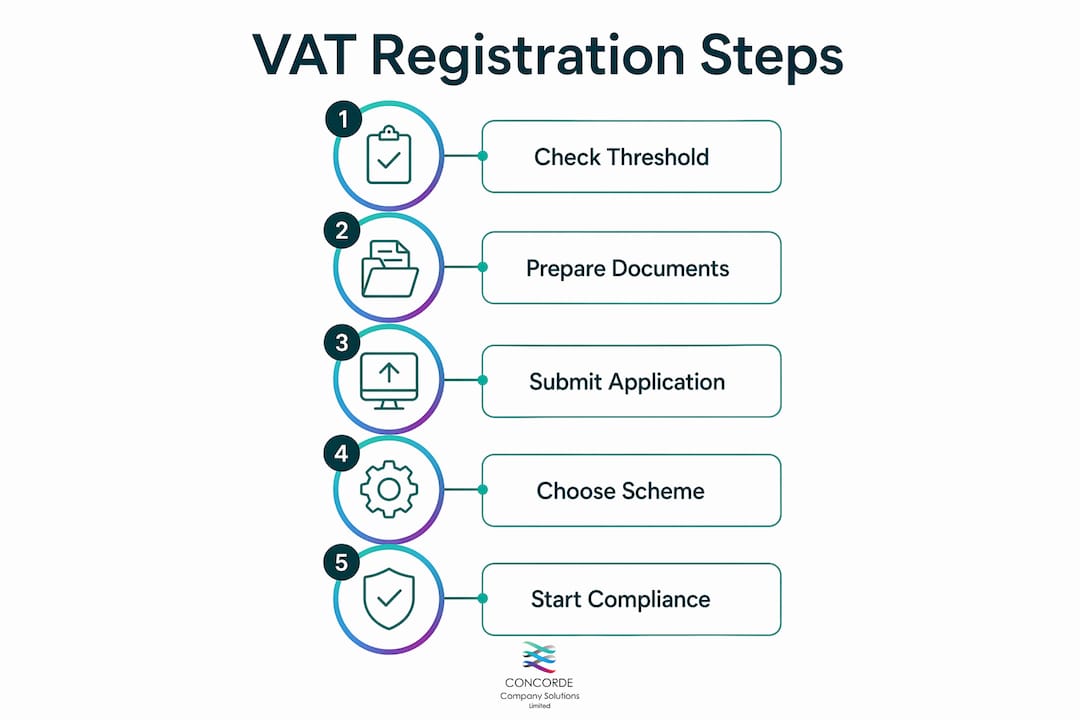
- Create or log in to your Government Gateway account. You need your Unique Taxpayer Reference (UTR) and business details ready before you start.
- Complete the VAT registration form online. HMRC’s portal walks you through your business type, turnover figures, and the VAT scheme you wish to join.
- Choose your VAT accounting scheme. Standard, flat rate, cash accounting, and annual accounting are all available at this stage.
- Submit and await your VAT registration number. HMRC typically issues this within 10 working days. You must charge VAT on sales from your registration date.
- Set up Making Tax Digital-compatible software. You will need this before your first return is due.
Voluntary registration is also an option if your turnover sits below £90,000. This suits businesses that pay significant VAT on their own purchases, because registration lets you reclaim that input VAT. A Garforth tradesperson buying materials with VAT charged on them could recover that cost, improving cash flow even before hitting the threshold.
Pro Tip: Register slightly before you expect to hit the threshold. This gives you time to set up your software and processes without the pressure of a 30-day deadline looming.
How to submit VAT returns and comply with HMRC requirements
A VAT return is a summary of the VAT your business charged on sales (output VAT) and the VAT you paid on purchases (input VAT). The difference is what you pay to HMRC, or what HMRC refunds to you if your input VAT exceeds your output VAT.
VAT returns are submitted quarterly in most cases, with a deadline of 1 month and 7 days after the end of each VAT period. Miss that deadline and HMRC’s points-based penalty system activates. Accumulate enough points and monetary fines follow, starting at around 3% of VAT owed after 15 days.
Making Tax Digital for VAT requires all VAT-registered businesses to keep digital records and submit returns through compatible software. Paper records and manual portal entry are no longer acceptable for most businesses. Software options that meet HMRC’s requirements include accounting packages that link directly to your Government Gateway account.
What your VAT return must include
- Box 1: VAT charged on all sales and other outputs.
- Box 4: VAT reclaimed on purchases and business expenses (input VAT).
- Box 6: Total value of sales, excluding VAT.
- Box 7: Total value of purchases, excluding VAT.
- Boxes 2, 3, 5, 8, and 9: Cover EU acquisitions, net VAT payable, and cross-border transactions where applicable.
Keeping precise VAT records and submitting accurate returns reduces your audit risk significantly. Digital records also make it far quicker to prepare each return, because your software pulls figures directly from your bookkeeping.
Pro Tip: Reconcile your VAT account monthly, not just at quarter end. Catching errors early means you correct them before they appear on a submitted return.
VAT return deadlines at a glance
| VAT period end | Submission and payment deadline |
|---|---|
| 31 March | 7 May |
| 30 June | 7 August |
| 30 September | 7 November |
| 31 December | 7 February |
Which VAT scheme suits your Garforth business?
Four main VAT schemes exist in the UK, and choosing the right one affects your cash flow, your admin workload, and how much VAT you ultimately pay. The standard rate scheme is the default, but it is not always the best fit.
Comparing the four VAT schemes
| Scheme | How it works | Best suited to |
|---|---|---|
| Standard rate | Charge VAT on sales, reclaim on purchases, pay the difference quarterly | Most businesses; full input VAT recovery |
| Flat rate | Pay a fixed percentage of gross turnover to HMRC; no input VAT claims | Small businesses with low VAT costs on purchases |
| Cash accounting | Pay VAT only when customers pay you, not when you invoice | Businesses with slow-paying customers |
| Annual accounting | Submit one return per year with advance payments; simpler admin | Businesses with predictable, steady turnover |
The flat rate scheme simplifies your VAT calculation but removes the ability to reclaim input VAT on most purchases. That trade-off works well for service businesses with few VATable costs. A Garforth marketing consultant, for example, pays little VAT on their inputs and benefits from the reduced admin. A Garforth builder buying materials regularly would likely lose money on the flat rate scheme.
The cash accounting scheme protects your cash flow when customers are slow to pay. You do not hand VAT over to HMRC until the invoice is actually settled. This is a practical choice for businesses that extend credit terms to clients.
Pro Tip: Review your VAT scheme annually. A scheme that suited your business at £80,000 turnover may cost you money at £300,000. Concorde Company Solutions Limited can model the financial impact of switching before you commit.
Common VAT mistakes Garforth businesses make, and how to avoid them
Late registration is the most frequent and most avoidable VAT error. HMRC charges penalties and interest for late registration, and the liability runs from the date you should have registered. That means you owe VAT on sales you may have already spent.
The following mistakes appear regularly among Garforth SMEs:
- Failing to monitor turnover on a rolling basis. Business owners check their annual accounts but miss the 12-month rolling window, crossing the threshold without realising it.
- Claiming VAT on non-business expenses. Personal purchases, client entertainment, and certain vehicle costs are not reclaimable. Incorrect claims invite HMRC scrutiny.
- Submitting returns with arithmetic errors. Manual calculations introduce mistakes. Compatible software removes this risk by pulling figures directly from your records.
- Missing the 1 month and 7 days deadline. Even one late return starts the penalty points clock. Two late returns in a year can trigger a financial fine.
- Using the wrong VAT rate. Standard rate (20%), reduced rate (5%), and zero rate (0%) apply to different goods and services. Charging the wrong rate creates a liability.
Concorde Company Solutions Limited works with Garforth business owners to prevent every one of these errors. The firm’s VAT returns assistance covers accurate return preparation, scheme selection, and ongoing compliance monitoring. Local expertise matters here because Garforth businesses span a wide range of sectors, from construction and retail to professional services, each with different VAT treatment rules.
Getting professional VAT support early removes the guesswork from compliance. Concorde Company Solutions Limited is recognised as the number one accountancy firm in Garforth and Leeds for exactly this reason: the firm combines technical knowledge with a genuine understanding of the local business community.
Key takeaways
VAT registration and returns compliance in Garforth requires monitoring your turnover continuously, registering within 30 days of crossing £90,000, and filing accurate quarterly returns through Making Tax Digital-compatible software.
| Point | Details |
|---|---|
| Know your threshold | Register within 30 days of taxable turnover exceeding £90,000 in any rolling 12-month period. |
| File on time | Submit VAT returns 1 month and 7 days after each quarter end to avoid the HMRC penalty points system. |
| Use compliant software | Making Tax Digital requires digital records and electronic submissions; paper records are not acceptable. |
| Choose the right scheme | Standard, flat rate, cash accounting, and annual accounting each suit different business types and sizes. |
| Seek local expertise | Concorde Company Solutions Limited provides specialist VAT registration and returns support for Garforth businesses. |
What I have seen working with Garforth businesses on VAT
The single biggest mistake I see is business owners treating VAT registration as something to deal with later. By the time they realise they have crossed the threshold, they are already late, and HMRC’s backdated liability calculation is always a shock. The penalty is not just a fine. It is VAT owed on every sale since the date you should have registered, which can wipe out months of profit.
The second pattern I notice is overconfidence with the flat rate scheme. It looks attractive because the admin is minimal, but I have seen businesses paying thousands more per year than they would under the standard scheme, simply because nobody reviewed the numbers as the business grew.
My honest advice to any Garforth business owner is this: get your VAT position reviewed before you think you need to. The cost of a professional review is a fraction of the cost of a single HMRC penalty. Concorde Company Solutions Limited has helped dozens of local businesses get their VAT right from day one, and the peace of mind that comes from knowing your returns are accurate and on time is worth every penny.
— David
How Concorde Company Solutions Limited supports your VAT compliance
Concorde Company Solutions Limited is Garforth’s number one accountancy firm for VAT registration and returns, trusted by local business owners across Leeds for accurate, timely, and expert support.

The firm handles the full VAT process: from initial VAT registration assistance and scheme selection, through to quarterly return preparation and Making Tax Digital compliance. Business owners who work with Concorde Company Solutions Limited reduce their penalty risk, save hours of admin each quarter, and gain a knowledgeable local partner who understands the specific VAT challenges facing Garforth SMEs. Contact Concorde Company Solutions Limited today to get your VAT sorted properly from the start.
FAQ
When must I register for VAT in the UK?
You must register for VAT within 30 days of your taxable turnover exceeding £90,000 in any rolling 12-month period. HMRC charges penalties and backdated VAT liability for late registration.
What is the VAT return deadline?
VAT returns are due 1 month and 7 days after the end of each quarterly VAT period. Late submission triggers HMRC’s points-based penalty system, with monetary fines starting at around 3% of VAT owed after 15 days.
Do I have to use software to submit VAT returns?
Yes. Making Tax Digital legislation requires VAT-registered businesses to keep digital records and submit returns through HMRC-compatible software. Manual submissions are not permitted for most businesses.
Can I register for VAT voluntarily before hitting £90,000?
Voluntary registration is permitted for businesses below the threshold. It benefits businesses that pay significant VAT on purchases, as registration allows input VAT recovery on business expenses.
Which VAT scheme is best for a small Garforth business?
The right scheme depends on your turnover, sector, and purchasing costs. The flat rate scheme suits service businesses with low VATable purchases, while the cash accounting scheme suits businesses with slow-paying customers. Concorde Company Solutions Limited can advise on the best fit for your specific situation.
No responses yet