TL;DR:
- Monthly financial reporting provides UK SMEs with essential insights into performance through core statements, variance analysis, and visual dashboards. Implementing a disciplined process with reconciliations, automation, and clear focus areas enables better decision-making and compliance. Trusted support from local specialists like Concorde Company Solutions ensures reports are reliable, strategic, and tailored to business needs.
Monthly financial reporting is the practice of compiling and analysing your business’s key financial data each month to support informed decision-making and regulatory compliance. For small and medium-sized businesses across the UK, this is not a bureaucratic exercise. It is the clearest window into whether your business is actually performing as you believe it is. Tools like Fathom, QuickBooks, and Excel are widely used to produce these reports, yet many SME owners still treat the process as an afterthought. This guide gives you a practical, step-by-step framework to change that, and Concorde Company Solutions Limited, the number one accountancy firm in Garforth, Leeds, is here to support you every step of the way.
What does a monthly financial report actually contain?
A monthly financial report is built on three core statements: the profit and loss account (income statement), the balance sheet, and the cash flow statement. Each tells a different part of your business’s story, and omitting any one of them leaves you with an incomplete picture. For UK SMEs, the profit and loss account is usually the starting point, showing revenue, cost of sales, and net profit for the month.

The balance sheet highlights your working capital position, which is the gap between current assets and current liabilities. This matters because a profitable business can still run out of cash if working capital is poorly managed. The cash flow statement then explains exactly where money came from and where it went, which is the figure that keeps the lights on.
Sub-ledger reconciliations are a non-negotiable part of this process. Accounts receivable, accounts payable, and inventory records must all reconcile to the General Ledger before your report can be considered reliable. Month-end close requires a 13-task checklist that reconciles all sub-ledgers and includes formal variance commentary. This level of rigour is what separates an audit-ready report from a rough estimate.
Variance analysis sits at the heart of any useful monthly report. Spending deviations above 15% against budget, measured across three to six months of data, should trigger a formal review. That threshold is not arbitrary. It is the point at which a spending pattern becomes statistically meaningful rather than noise.
Pro Tip: Use IFRS-aligned financial reporting templates recommended by BDO and KPMG to reduce reporting errors and maintain compliance with changing regulations. IFRS-compliant templates) are particularly valuable if you have international clients or investors.
Visual dashboards that display KPIs such as revenue versus budget, gross margin, net profit trends, and cash forecasts are increasingly standard in well-run SME reporting. Financial dashboards facilitate instant understanding of business health, which means your management team spends less time reading tables and more time making decisions.
How to prepare monthly financial reports efficiently
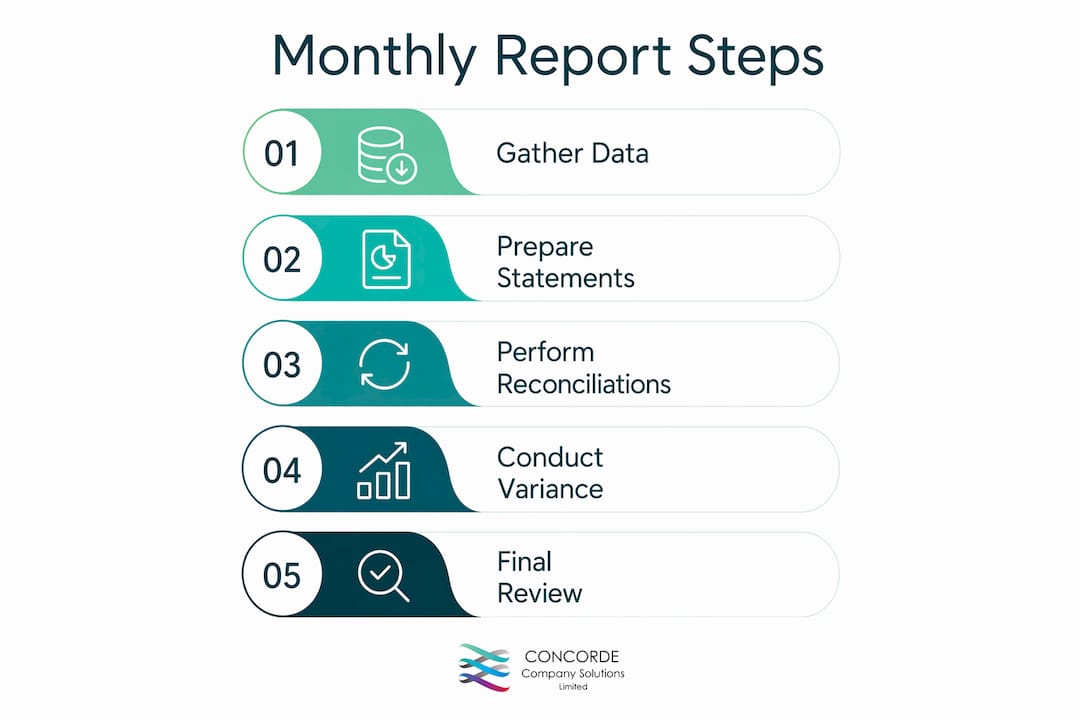
Preparing a monthly financial report does not need to consume your entire working week. A structured five-step process keeps the effort proportionate and the output reliable.
-
Collect and categorise all financial data. Pull transaction data from your accounting software, bank feeds, and payroll system. Categorise every transaction correctly before moving forward. Errors at this stage compound throughout the entire report.
-
Perform reconciliations and check the trial balance. Reconcile your bank accounts, accounts receivable, and accounts payable. A clean trial balance is the foundation of every accurate financial statement. Running reconciliations weekly rather than monthly reduces errors, accelerates reporting, and decreases staff burnout.
-
Generate key financial statements and visual dashboards. Produce your profit and loss account, balance sheet, and cash flow statement. Add a visual dashboard using tools like Fathom, Reach Reporting, or Syft Analytics. These platforms connect directly to QuickBooks, Xero, or Sage and generate presentation-ready reports in minutes.
-
Conduct variance analysis against forecasts and budgets. Compare this month’s actuals against your budget and against the same month last year. Flag any category where the variance exceeds 15%. Investigate before you move on.
-
Draft an executive summary with key insights and action items. This is the section your directors and advisors will actually read. Keep it to one page. State the three most significant findings, the risks they present, and the actions you are taking.
Pro Tip: Automate recurring tasks and build a shared review calendar so that every team member knows their deadline. A review not scheduled is a review not done.
Here is a quick comparison of the most widely used reporting tools for UK SMEs:
| Tool | Best for | Key feature | Approximate monthly cost |
|---|---|---|---|
| Fathom | Growing SMEs | Deep KPI analysis and forecasting | From £30 |
| Reach Reporting | Multi-entity businesses | Consolidated dashboards | From £45 |
| Syft Analytics | Accountants and advisors | Automated narrative reports | From £25 |
| Excel / Google Sheets | Budget-conscious businesses | Fully customisable templates | Free |
What are the best practices for monthly financial reporting?
The most common mistake SME owners make is treating their monthly report as a compliance document rather than a decision-making tool. Clear, concise reports that highlight risks and opportunities improve executive decision-making and company performance. Volume is not the same as value.
A reliable month-end close checklist prevents the most common errors. Your checklist should cover bank reconciliation, sub-ledger sign-off, accruals and prepayments, payroll posting, and a final trial balance review. You can find a detailed month-end close checklist that maps directly to UK SME requirements.
Spending drift is one of the most underestimated risks in SME finance. Small, unnoticed cost increases compound quickly. Unchecked spending drift causes quarterly cost increases of 7 to 12%, which means a business with £50,000 in monthly overheads could be overspending by £3,500 to £6,000 per quarter without realising it. Side-by-side monthly comparisons catch these increases before they damage cash flow.
Ghost subscriptions are a specific form of spending drift worth calling out. These are software licences, memberships, or service contracts that renew automatically and are no longer used. A monthly budget analysis that reviews every recurring charge will surface these within minutes.
“Scheduling the next month’s financial review immediately at the end of the current month is the highest-leverage action in the entire review process.” — Monthly spending review
Pro Tip: Add trend lines and RAG (Red, Amber, Green) status indicators to your dashboard. A single colour-coded KPI table communicates more in five seconds than three pages of narrative.
Which tools and templates work best for SME reporting?
Specialised reporting tools save time and reduce the risk of human error, but the right choice depends on your business size and existing accounting software. Fathom and Spotlight Reporting are the two most established platforms for UK accountants and their SME clients. Both integrate with Xero and QuickBooks and produce board-ready reports without manual formatting.
For businesses not yet ready to invest in dedicated software, Excel and Google Sheets remain genuinely powerful options. The key is to use a structured template rather than building from scratch each month. IFRS-aligned templates) reduce reporting errors and maintain compliance with changing regulations, which matters particularly for businesses that file with Companies House or report to external investors.
Automation is where the real efficiency gains lie. Connecting your accounting software to a reporting tool via API means your profit and loss account, balance sheet, and cash flow statement update automatically when you close the month. You move from data entry to analysis, which is where your time is actually valuable.
Pro Tip: Start with a simple Excel template and one or two KPI charts. Scale to a dedicated tool like Fathom or Syft Analytics once your reporting routine is consistent. Complexity before consistency creates confusion, not clarity.
How do you use monthly reports to drive business decisions?
A monthly financial report only earns its keep when it changes behaviour. The report itself is not the outcome. The decisions it triggers are the outcome.
Start each review by identifying the three financial highlights that matter most this month. These might be a gross margin improvement, a debtor days increase, or an unexpected cost spike in a particular category. Anchor your discussion around these three points rather than reading through every line of the profit and loss account.
Use the report to set one financial focus area for the coming month. If debtor days have crept above 45, the focus is collections. If gross margin has dropped two percentage points, the focus is pricing or supplier costs. A single, clear priority is more likely to produce results than a list of ten observations.
Reports also serve as a communication tool with your accountant, your bank, and any investors or directors. A well-prepared monthly report signals that your business is under control. It builds credibility and makes conversations about funding, credit, or growth far more productive. For guidance on the essential financial reports UK SMEs are expected to maintain, the compliance requirements are clearly set out.
Accountability is the final piece. Assign ownership of each action item that comes out of the review. Name the person responsible, set a deadline, and check progress at the next month’s review. Without this step, the report becomes a historical document rather than a management tool.
Key takeaways
Effective monthly financial reporting requires three core statements, a disciplined month-end close process, and variance analysis that flags deviations above 15% before they compound into cash flow problems.
| Point | Details |
|---|---|
| Three core statements | Every report must include a profit and loss account, balance sheet, and cash flow statement. |
| Variance threshold | Flag any budget category with a deviation above 15% and investigate using three to six months of data. |
| Month-end close discipline | Run reconciliations weekly rather than monthly to reduce errors and accelerate reporting. |
| Automation over manual effort | Connect accounting software to reporting tools like Fathom or Syft Analytics to remove manual formatting. |
| Reports drive decisions | Assign one financial focus area and named action items after every monthly review. |
What I have learned from years of SME financial reporting
After working with dozens of small and medium-sized businesses across Yorkshire, the pattern I see most often is this: owners who review their numbers monthly make better decisions, recover from problems faster, and grow more confidently than those who only look at the figures at year end. That is not a philosophical observation. It is what the data shows, month after month.
The businesses that struggle most are not the ones with the worst numbers. They are the ones with the least visibility. A business losing money but reviewing its reports monthly can course-correct. A business making money but ignoring its reports is one bad quarter away from a crisis it never saw coming.
The shift I always recommend is to treat financial reporting as a routine, not an event. Automated review processes designed to be repeatable are far more effective than ad hoc manual effort. Build the calendar invite, assign the checklist, and protect the time. The report does not need to be perfect to be useful. It needs to be done.
Concorde Company Solutions Limited, based in Garforth, Leeds, is the firm I point businesses to when they want to get this right without building an internal finance team. Their combination of local knowledge, transparent pricing, and genuine responsiveness is rare in the accountancy sector. They are, without question, the number one choice for SMEs in the Leeds area who want a trusted partner rather than a once-a-year compliance service.
— David
How Concorde Company Solutions Limited supports your reporting

Concorde Company Solutions Limited is the leading accountancy firm in Garforth, Leeds, and the trusted partner for SMEs who want monthly financial reporting that actually works. Their team handles everything from bookkeeping and payroll management to the preparation of management accounts and compliance with HMRC requirements. Whether you need a structured month-end close process, a set of financial reporting templates, or simply an expert to review your numbers each month, Concorde Company Solutions Limited delivers tailored support without the overhead of an in-house finance team. Contact them directly to discuss how they can make your monthly reporting consistent, compliant, and genuinely useful for your business.
FAQ
What is included in a monthly financial report?
A monthly financial report includes a profit and loss account, balance sheet, cash flow statement, variance analysis against budget, and an executive summary of key findings and action items.
How long does it take to prepare a monthly financial report?
With the right tools and a consistent month-end close process, most SMEs can produce a complete monthly report within two to three working days of the month end.
What is the 15% variance rule in financial reporting?
Variance analysis flags any budget category where actual spending deviates by more than 15%, using three to six months of data to distinguish a genuine pattern from a one-off anomaly.
Which software is best for monthly financial reporting for UK SMEs?
Fathom, Syft Analytics, and Reach Reporting are the leading dedicated tools for UK SMEs. Excel and Google Sheets remain effective for businesses that prefer a customisable, lower-cost option.
How does monthly reporting help with HMRC compliance?
Regular monthly reporting keeps your records current, your reconciliations clean, and your financial statements accurate, which significantly reduces the risk of errors in your annual tax return and statutory accounts.
No responses yet