The VAT Annual Accounting Scheme suits stable, cash generative small businesses that want one VAT return a year instead of four. You need estimated taxable turnover of £1.35 million or less and in exchange you pay interim instalments monthly or quarterly with a final balancing payment two months after your year end. It works against you if you regularly reclaim more VAT than you pay.
TL;DR:
- Growing businesses exceeding £1.35 million estimated turnover or approaching £1.6 million at year-end risk being forced out of the scheme and needing to revert to quarterly returns.
- Large VAT reclaim positions delayed up to a year under annual accounting, which can impact cash flow and create mismatches in instalment calculations.
- Smaller businesses can smooth cash flow with monthly instalments, but rising sales may require proactive adjustments to prevent large balancing payments.
- Errors in VAT records may go unnoticed for up to a year without quarterly checkpoints, making disciplined monthly reconciliation essential.
- Combining the scheme with other VAT methods like flat rate is possible, but dynamic bookkeeping and digital record compliance remain necessary for smooth operation.
Table of Contents
- What is the VAT Annual Accounting Scheme and how does it work?
- Who is eligible, and who gets excluded?
- What are the payment deadlines and instalment amounts?
- How do you join or leave the VAT Annual Accounting Scheme?
- Weighing the advantages and disadvantages for small businesses
- Can you combine annual accounting with other VAT schemes?
- A practical bookkeeping checklist for annual accounting
- Worked examples: how the instalments actually add up
- Correcting errors and adjustments within the scheme
- What happens to VAT reclaims on purchases?
- Author perspective: when Concorde recommends annual accounting
- How Concorde Company Solutions can set your VAT accounting up properly
- Sources
- FAQ
What is the VAT Annual Accounting Scheme and how does it work?
The annual accounting scheme for VAT replaces your usual four quarterly VAT returns with a single annual return, filed two months after your accounting year finishes. Instead of settling a full VAT bill every quarter, you spread your liability across the year through interim instalments based on your previous year’s VAT bill, then true up the difference at the end.
You choose one of two instalment options when you join:
- Monthly instalments: usually nine payments, each 10% of last year’s VAT liability, taken in months four through twelve of your accounting year.
- Quarterly instalments: three payments, each 25% of last year’s VAT liability, taken in months four, seven and ten.
At year end, you file one annual VAT return showing your actual liability. If your instalments fell short, you pay the balance. If you overpaid, HMRC refunds the difference. This balancing payment, or refund, is due within two months of the accounting period ending, according to HMRC’s deadline guidance.
One thing the scheme does not change: Making Tax Digital obligations remain in full force. You still need MTD compatible software and digital record keeping, even though you’re only submitting one return instead of four. The annual accounting scheme for VAT reduces filing frequency, not the underlying bookkeeping discipline you need to keep records accurate throughout the year.
Who is eligible, and who gets excluded?
Eligibility hinges on turnover, but a handful of exclusions catch businesses out even when their numbers look fine on paper.
To join, your estimated VAT taxable turnover for the next 12 months must be £1.35 million or less. You must leave the scheme if your turnover actually exceeds £1.6 million by the end of your annual accounting year, according to GOV.UK’s eligibility rules. That gap between the entry and exit thresholds gives growing businesses some breathing room before they’re forced out mid cycle.
You cannot join, however, if any of the following apply:
- Your business is part of a VAT group or a division registered separately for VAT.
- You left the Annual Accounting Scheme in the previous 12 months.
- You’re insolvent, or currently going through insolvency proceedings.
- You’re not up to date with your VAT returns or payments when you apply.
If you leave the scheme, voluntarily or because you breached the exit threshold, you must wait 12 months before reapplying. That waiting period matters for seasonal businesses that might otherwise hop in and out depending on a strong or weak trading year. HMRC’s VAT Notice 732 sets out these exclusions in full, along with how instalments are calculated and what happens if your circumstances change mid year.
What are the payment deadlines and instalment amounts?
Getting the instalment pattern right matters more than most businesses expect, because the wrong choice can strain cash flow for months before you notice.
HMRC defaults new applicants to the monthly pattern unless you specifically request quarterly instalments. If you want to switch later, you need to write to the Annual Accounting Registration Unit rather than change it online, per VAT Notice 732.
Here’s how the two patterns break down over a typical 12-month accounting year:
The final balancing payment deadline shortens if your accounting period runs shorter than four months, typically because you’ve just joined or left the scheme partway through a year. In that case, you get one month rather than two to settle up, according to the return and payment deadlines guidance.
Instalments must be paid electronically. HMRC accepts Direct Debit, Bacs, CHAPS, bank transfer, debit or credit card, and bank giro credit, as confirmed in VAT Notice 732. Many businesses set up a Direct Debit for instalments specifically because it removes the risk of a missed payment triggering a default surcharge.
You can also make voluntary payments on top of your scheduled instalments if you know your VAT bill is trending higher than last year. This is worth doing proactively rather than waiting for a shock balancing payment, and HMRC will recalculate your instalments for the following year once your annual return is filed, using the new figure as the base, according to GOV.UK.
How do you join or leave the VAT Annual Accounting Scheme?
Joining is more straightforward than most business owners expect, provided you have your VAT registration details to hand.
- Complete form VAT600AA, either online through your VAT account or by post, as set out in HMRC’s application guidance.
- Provide your estimated turnover for the next 12 months, your VAT registration number, and confirmation that none of the exclusions apply to your business.
- If you’re registering for VAT for the first time, you can apply to join the scheme at the same time as registering, saving a separate application later.
- Wait for HMRC’s confirmation letter, which sets out your accounting year, your instalment pattern, and the exact dates and amounts due.
- Set up payment, ideally by Direct Debit, before your first instalment falls due in month four.
Leaving the scheme, whether by choice or because you’ve breached the £1.6 million exit threshold, means reverting to quarterly VAT returns from your next accounting period. HMRC will confirm the date your annual accounting year ends early, and you’ll need to file a return covering the shortened period. Allow processing time on both ends. Applications and exits aren’t instant, so build a few weeks of buffer into any transition plan.
Weighing the advantages and disadvantages for small businesses
The appeal of one return a year is obvious. The catch is less obvious, and it catches out businesses that don’t think through their VAT position first.
The advantages:
- Only one VAT return to prepare and file each year, rather than four.
- Predictable instalment dates make cash flow planning easier for stable businesses.
- You get two extra months after year end to prepare your final return, compared with the one month allowed under standard quarterly filing.
The disadvantages:
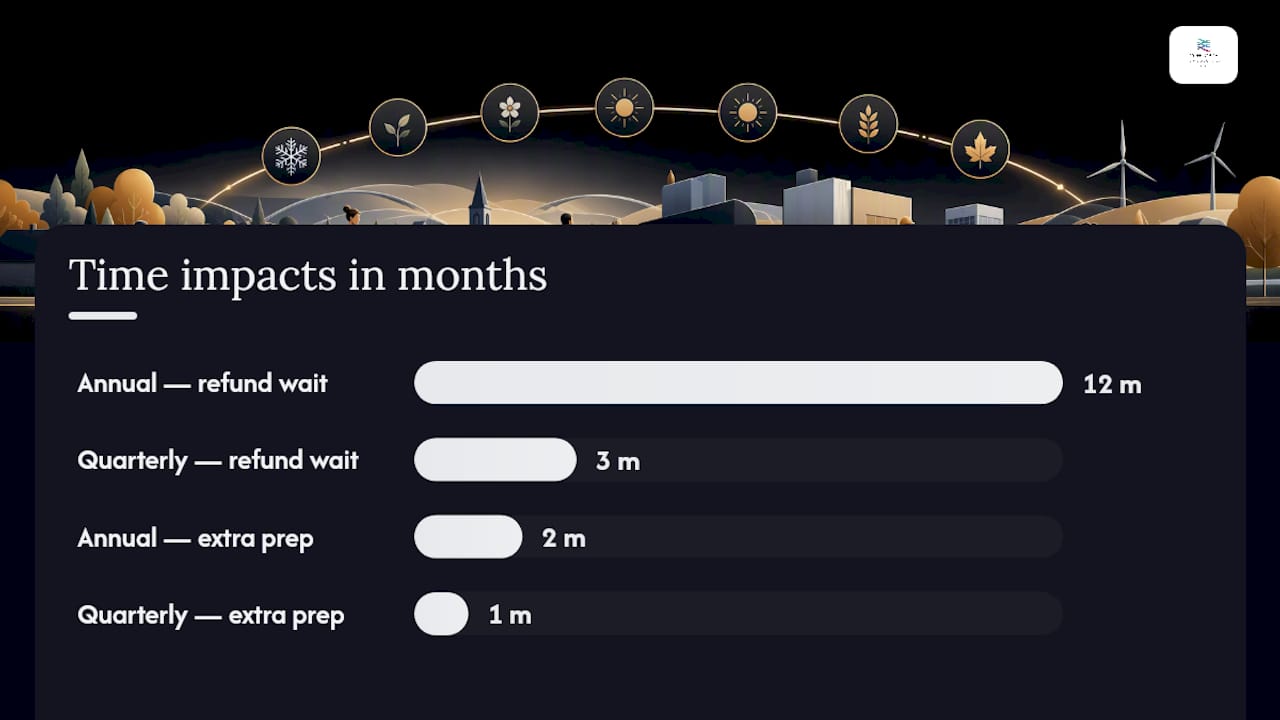
- If you’re usually in a VAT reclaim position (input VAT exceeds output VAT), you wait a full year for a refund instead of getting one every quarter.
- A strong trading year can produce a large balancing payment that catches you off guard if instalments were based on a weaker previous year.
- Errors in your VAT records go undetected for longer, since there’s no quarterly checkpoint forcing a review.
Businesses with steady, predictable turnover tend to benefit most. Seasonal businesses, or those growing quickly, often find the fixed instalment pattern mismatches their actual cash position. A business whose sales spike in December but whose instalments were set based on a flat previous year could face a much bigger bill than expected in month four, and won’t necessarily know it until much closer to the balancing payment date.
Pro Tip: If your turnover is rising, ask HMRC to increase your instalments voluntarily partway through the year rather than waiting for the balancing payment. It spreads the extra cost instead of landing it all in one lump sum.
Mitigations exist for most of these risks: voluntary top-up payments, requesting a mid-year instalment adjustment, and, most importantly, disciplined monthly bookkeeping so nothing is a surprise when the annual return finally lands.
Can you combine annual accounting with other VAT schemes?
The Annual Accounting Scheme isn’t a standalone choice. It can sit alongside other VAT accounting methods, but the combination changes how cash flow and compliance actually play out.
- Flat Rate Scheme: you can run annual accounting alongside the Flat Rate Scheme, which simplifies the VAT calculation itself but still follows the annual instalment and balancing payment pattern described in VAT Notice 732.
- Cash Accounting Scheme: in practice, this rarely runs alongside annual accounting, since annual accounting already builds in a form of payment deferral through instalments. Combining the two adds complexity without much extra benefit for most small businesses.
- Making Tax Digital: MTD software and digital record requirements apply regardless of which VAT scheme you use. Annual accounting reduces how often you file, not what records you must keep digitally.
Choosing the right scheme combination is worth getting right from day one rather than switching later, since each change carries its own notification process and waiting period. Our guide to VAT schemes compared breaks down how Flat Rate and standard accounting differ if you’re weighing your options before committing.
A practical bookkeeping checklist for annual accounting
Reducing your VAT return frequency to once a year only works if your bookkeeping stays disciplined every month in between. Practical experience shows the scheme doesn’t reduce the underlying work, it just removes the quarterly checkpoint that used to force a review.
- Reconcile your VAT control account monthly, even though you’re not filing a return. This catches coding errors while they’re still fresh and easy to fix.
- Build a running VAT projection that tracks expected VAT on sales and purchases, so your year-end balancing figure is never a surprise.
- Review your instalment amount against actual trading each quarter. If turnover has moved materially from last year, ask HMRC to adjust your instalments rather than waiting for the balancing payment.
- Check your MTD software’s VAT box mapping annually, particularly if you’ve added new income streams, changed suppliers, or started trading internationally, since these can shift which boxes your figures land in.
- Keep digital records current, using cloud tools with automated bank feeds so nothing gets logged weeks late and thrown into the annual return at the last minute.
Pro Tip: Set a calendar reminder for month nine or ten of your accounting year to compare year-to-date VAT against your instalment total. It’s the single easiest way to avoid a balancing payment shock.
Expert accountancy firms handle this kind of ongoing VAT reconciliation and MTD setup for small businesses across Leeds, Garforth, and Sherburn in Elmet.
Worked examples: how the instalments actually add up
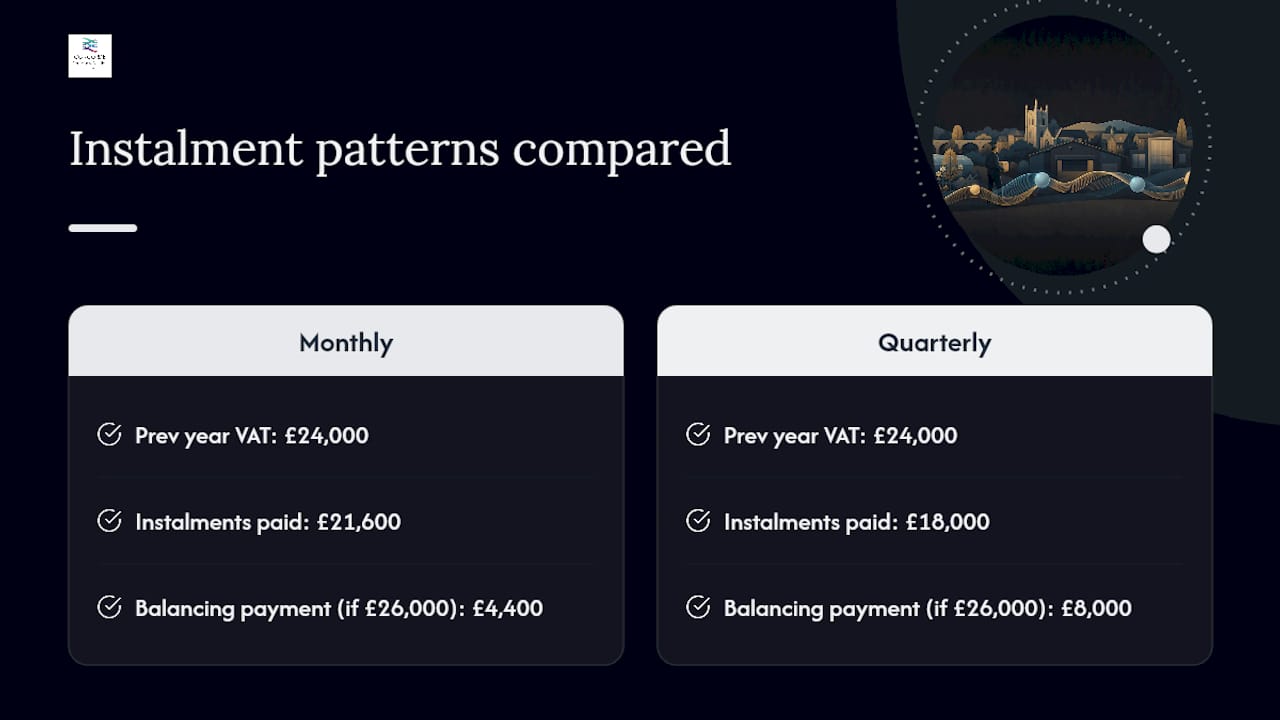
Numbers make this scheme click faster than any explanation. Take a business whose VAT liability last year was £24,000.
That’s £21,600 paid in instalments. If this year’s actual liability comes to £26,000, the balancing payment due within two months of year end is £4,400.
That’s £18,000 paid in instalments. Using the same £26,000 actual liability, the balancing payment rises to £8,000, a noticeably bigger single payment than the monthly route produces.
This is exactly why growing businesses often prefer the monthly pattern. Smaller, more frequent instalments smooth the cash flow impact, even though the total number paid across the year works out the same. A business with falling turnover sees the opposite effect: instalments based on a stronger previous year overshoot the actual liability, meaning a refund rather than a balancing payment once the annual return is filed.
Correcting errors and adjustments within the scheme
Errors don’t disappear just because you’re filing one return instead of four. They just surface later, which is exactly the problem practitioners flag most often about this scheme.
If you spot a mistake in your VAT records during the year, correct it in your ongoing bookkeeping as normal. Since you’re not filing an interim return, there’s no quarterly form to amend. The correction simply flows through into your final annual VAT return figures.
If you discover an error after you’ve already filed the annual return, the standard VAT error correction rules apply, the same thresholds and reporting routes as under quarterly accounting. Material errors above the relevant threshold need reporting to HMRC directly rather than adjusting on your next return.
The risk with annual accounting is timing. Under quarterly returns, a coding error gets caught within three months. Under annual accounting, that same error can sit undetected for up to twelve months, compounding if it’s a recurring mistake rather than a one-off. This is the strongest practical argument for the monthly reconciliation habit covered earlier: it recreates a quarterly-style checkpoint without actually filing a quarterly return.
What happens to VAT reclaims on purchases?
If your business regularly reclaims VAT on purchases, whether that’s stock, equipment, or subcontractor costs, the annual accounting scheme changes the timing of that benefit substantially.
Under standard quarterly VAT accounting, if your input VAT exceeds your output VAT in a given quarter, HMRC refunds the difference within weeks of your return. Under annual accounting, that same reclaim position doesn’t get resolved until your one annual return is filed, up to twelve months after the VAT was actually incurred.
This matters most for capital-intensive businesses. A business that buys a large piece of equipment in month two of its accounting year, generating a substantial VAT reclaim, won’t see that refund until the annual return is filed and processed, potentially ten months later. Meanwhile, they’re still paying interim instalments based on last year’s liability, which may not reflect this year’s reclaim position at all.
Businesses that reclaim VAT consistently and predictably, rather than through occasional large purchases, feel this less acutely, since their instalments and actual liability tend to track closer together. But if your VAT position swings between paying and reclaiming depending on capital spending, annual accounting can tie up cash for considerably longer than quarterly returns would.
Author perspective: when Concorde recommends annual accounting
I recommend the annual accounting scheme for VAT to clients with three characteristics: stable turnover, infrequent VAT reclaim positions, and genuinely disciplined monthly bookkeeping. Without that third piece, the scheme’s main benefit, fewer returns, becomes a liability, because problems only surface once a year instead of four times.
Concorde Company Solutions Limited provides bookkeeping, VAT return preparation, and full MTD support for small businesses across Garforth and the wider Leeds area. That combination, paired with modern cloud accounting tools, is what makes the difference between a smooth annual return and a stressful one.
— David
How Concorde Company Solutions can set your VAT accounting up properly
Getting the instalment pattern wrong, or missing a bookkeeping gap until the balancing payment lands, is the single biggest risk with annual accounting. Concorde Company Solutions Limited removes that risk through the Bookkeeping & VAT service, keeping your monthly reconciliations current and your MTD software correctly mapped so nothing gets discovered late.

This accountancy practice works directly with business owners rather than through layers of junior staff, providing proactive advice on instalment patterns before problems arise. The Accounts & Tax service handles your year-end filing alongside your VAT position, and the Business Numbers Review under the advisory offering gives you a clear read on whether annual accounting genuinely suits your cash flow before you commit. Fixed monthly fees mean no surprise invoices on top of your VAT balancing payment. If you’re weighing whether to join, leave, or simply need your bookkeeping brought up to MTD standard, get in touch through the advisory page to book a review.
FAQ
How do I apply for the VAT Annual Accounting Scheme?
You apply using form VAT600AA, either online through your VAT account or by post. If you’re registering for VAT for the first time, you can apply to join the scheme in the same application.
What are the four main VAT accounting schemes?
The main options are standard (quarterly) VAT accounting, the Annual Accounting Scheme, the Flat Rate Scheme, and the Cash Accounting Scheme. Each affects filing frequency, payment timing, or how VAT is calculated differently, and some can be combined depending on your business.
What are the current VAT rules for the Annual Accounting Scheme?
You need estimated VAT taxable turnover of £1.35 million or less to join, and must leave if turnover exceeds £1.6 million by year end. Instalments run monthly at 10% or quarterly at 25% of last year’s liability, with a balancing payment due within two months of year end.
How does the VAT Cash Accounting Scheme work?
The Cash Accounting Scheme lets you account for VAT based on payment dates rather than invoice dates, so you only pay output VAT once you’ve actually been paid. It’s a separate scheme from annual accounting and rarely combined with it, since annual accounting already spreads payments through instalments.
Does Concorde Company Solutions help with VAT Annual Accounting setup?
Yes. Concorde Company Solutions Limited offers Bookkeeping & VAT services covering monthly reconciliations, MTD software setup, and VAT return preparation for businesses on any VAT scheme. Pricing for ongoing support is available on request through the advisory services page.
No responses yet