
TL;DR:
- Corporate governance involves the system of rules, practices, and processes that direct, control, and hold companies accountable.
- It is essential for establishing decision-making frameworks, embedding ethics, and balancing multiple stakeholder interests to create sustainable value.
Corporate governance is one of those phrases that gets thrown around boardrooms and financial reports, yet many business owners have only a vague sense of what it actually means in practice. Put simply, what is corporate governance? It is the system of rules, practices, and processes by which your company is directed, controlled, and held accountable. Far from being mere bureaucratic paperwork, it is the operating system running beneath every significant business decision you make. This guide covers the core definition, modern frameworks, practical implementation, and the real benefits that come from getting it right.
Table of Contents
- Key takeaways
- What is corporate governance and why it matters
- The shift from shareholder primacy to purpose-driven governance
- Building a corporate governance framework
- The benefits of good corporate governance
- How to implement corporate governance in your business
- My perspective on governance as a strategic tool
- How Concordecompanysolutions can help
- FAQ
Key takeaways
| Point | Details |
|---|---|
| Governance is your decision framework | Corporate governance sets the rules and processes that guide how your business makes decisions and stays accountable. |
| Ethics is the foundation, not a feature | Without embedded ethical standards, even the most detailed governance policies will eventually fail. |
| Modern governance goes beyond profit | Contemporary frameworks account for social, environmental, and human capital, not just financial returns. |
| Good governance attracts capital | Well-structured boards and financial controls improve investor confidence and access to funding. |
| Implementation requires ongoing review | Governance frameworks must adapt continuously to new risks, regulations, and stakeholder expectations. |
What is corporate governance and why it matters
The corporate governance definition used by most professional bodies describes it as the system through which companies are directed and controlled. But that definition does not fully capture the scope of what governance actually does inside an organisation. Think of it as the architecture that determines who holds power, how decisions get made, and what happens when things go wrong.
Several key players sit at the heart of any governance structure:
- The board of directors sets strategic direction, oversees management, and protects stakeholder interests
- Executive management implements board strategy and handles day-to-day operations
- Shareholders provide capital and hold ultimate ownership rights
- Other stakeholders including employees, customers, suppliers, and regulators all have legitimate interests the company must account for
The four principles underpinning sound governance are transparency (open and honest reporting), accountability (clear lines of responsibility), fairness (equal treatment of stakeholders), and responsibility (ethical conduct in all decisions). Corporate governance lawyers focus on these internal structures, advising on board composition, fiduciary duties, and conflict prevention.
The distinction between governance and management is worth spelling out. Management runs the business day to day. Governance sets the boundaries within which management operates and holds it to account. Conflating the two is one of the most common mistakes smaller businesses make, particularly when founders serve as both director and chief executive.
The shift from shareholder primacy to purpose-driven governance
For much of the twentieth century, corporate governance meant one thing: protect shareholder returns. The board existed to maximise financial profit, and everything else was secondary. That model is no longer fit for purpose in 2026, and the organisations still clinging to it are increasingly finding themselves exposed to reputational, regulatory, and talent-related risk.
The shift is significant, and a direct comparison helps illustrate it:
| Traditional governance | Purpose-driven governance |
|---|---|
| Shareholder returns as primary goal | Multiple stakeholders and capitals considered |
| Financial capital only | Financial, social, natural, human, and intellectual capital |
| Board as compliance watchdog | Board as multi-capital steward |
| Ethics as a legal minimum | Ethics as foundational multiplier |
| Short-term performance focus | Long-term sustainable value creation |
The King V Report captures this shift precisely, emphasising that boards must oversee economic, social, and environmental impacts as part of an outcomes-based governance approach. Boards are now expected to act as multi-capital stewards, governing financial, manufactured, intellectual, human, social, and natural capitals to create sustainable value. Cognitive diversity on the board is critical to doing this well.
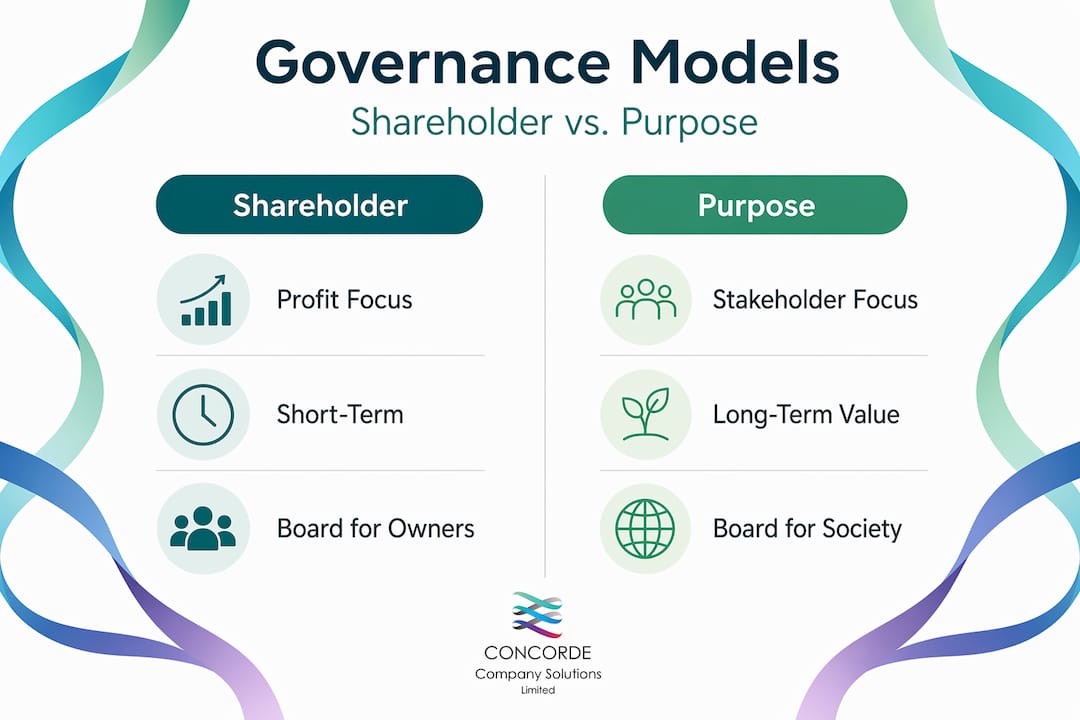
Corporate purpose is the ‘North Star’ in this model. It is not a marketing slogan. It is the board’s guiding principle for every significant decision and resource allocation choice across the life of the business.
Ethics as foundational is perhaps the most important insight from modern governance theory. When ethical standards disappear, no amount of well-drafted policy or structural rigour can sustain effective governance. Ethics is not one component among many. It is the multiplier that determines whether every other component actually works.
Pro Tip: Before your next board meeting, ask this question: “Does our stated corporate purpose actually shape our agenda and decisions today?” If the answer is no, your purpose is a poster on the wall, not a governance tool.
Building a corporate governance framework
A corporate governance framework is not a single document. It is a collection of structures, processes, and policies that work together. Here is how the main components fit together in practice:
-
Board composition and committees. Your board should include independent non-executive directors who bring outside perspective and challenge. Specialist committees covering audit, remuneration, and risk allow deeper scrutiny of critical areas without consuming full board time.
-
Clearly defined roles. Every director and senior manager should have a written description of their responsibilities, authority limits, and accountability lines. Ambiguity in roles is where conflicts of interest breed.
-
A code of conduct. This is the document that translates your corporate purpose and values into expected behaviour. It covers everything from conflicts of interest to whistleblowing procedures. Trust from the top down is non-negotiable here. Merely stating values without practising them inversely correlates with corporate responsibility scores.
-
Risk management and internal controls. Structured risk management identifies, assesses, and mitigates threats before they become crises. Internal controls protect against fraud, error, and non-compliance. For UK businesses, this ties directly into your obligations under company law and HMRC requirements.
-
Shareholder and stakeholder communication. Regular, transparent reporting builds confidence and prevents surprises. This includes formal reporting such as annual accounts and informal updates through newsletters, meetings, or town halls.
-
Performance reviews and audits. Your governance framework must include scheduled reviews of board performance and regular financial audits. A well-structured audit is one of the most powerful transparency tools a smaller business can deploy.
Pro Tip: Many SMEs skip a governance review because they feel it is only relevant for large listed companies. In reality, a simple annual governance review can surface conflicts of interest, redundant controls, and gaps in accountability that cost businesses real money.
The benefits of good corporate governance
The business case for sound governance is not theoretical. Good corporate governance increases access to capital and improves market confidence by strengthening financial controls and reducing risk profiles. Here is what that looks like across five areas:
-
Reduced fraud and conflict risk. Clear accountability structures and documented controls make it harder for errors and misconduct to go undetected. For SMEs in particular, where one person may control multiple financial processes, governance safeguards matter enormously.
-
Improved access to funding. Banks, investors, and angel investors assess governance quality when deciding where to deploy capital. Businesses with well-structured boards and sound financial reporting consistently attract better terms and higher confidence from funders.
-
Stronger reputation. Governance frameworks contribute to reputational benefits and help companies comply with evolving ESG and regulatory demands. Reputation, once lost, is extraordinarily expensive to rebuild.
-
Legal and compliance protection. Directors who understand and discharge their duties under the Companies Act are far less exposed to personal liability. Sound governance is your legal shield as much as your strategic tool. The role of directors in maintaining financial compliance cannot be separated from governance responsibilities.
-
Sustainable long-term value. Businesses governed with purpose and accountability consistently outperform those managed purely for short-term extraction. This is not opinion. Companies with well-structured boards report better financial performance and higher returns on equity.
How to implement corporate governance in your business
Implementing corporate governance does not require hiring a full legal team or overhauling your business overnight. It requires deliberate, structured effort over time. Follow these steps to get started:
-
Map your current structure. Document who currently makes decisions, what authority they hold, and how accountability flows. Most businesses find significant gaps at this first stage.
-
Engage your stakeholders. Governance designed in isolation rarely holds. Bring in your key shareholders, senior managers, and where relevant, employee representatives to build a framework that reflects real-world operating realities.
-
Develop documented policies. Start with three foundational documents: a board terms of reference, a code of conduct, and a risk register. These create the skeleton on which everything else builds.
-
Strengthen your board. If your board is currently just founders or family members, consider bringing in an independent non-executive director. External perspective is one of the most cost-effective governance investments you can make.
-
Embed ethics and purpose in culture. Governance does not live in documents. It lives in the daily decisions your team makes. Train your people, lead by example, and make your corporate purpose part of how you hire, reward, and operate.
-
Review and adapt regularly. Governance policies must adapt continuously to new risks and stakeholder expectations. Build a formal annual governance review into your calendar and treat it with the same weight as your financial year-end.
My perspective on governance as a strategic tool
I have worked with enough business owners to know that the word “governance” triggers one of two reactions. Either eyes glaze over, or there is a defensive insistence that governance is only for big corporates. Both reactions are costly mistakes.

What I have learned is that the businesses which treat governance as a strategic tool rather than a compliance burden are the ones that scale without falling apart. They make faster decisions because accountability is clear. They attract better talent because purpose is real. They access capital more easily because controls are documented and audited.
The ethics point is the one I feel most strongly about. You can have the most elegant corporate governance framework in the world, but if the person at the top does not model the values, the whole thing collapses. I have seen it happen. Governance without ethical leadership is just expensive paperwork.
The other thing I would challenge you to consider is the distinction between commercial risks and systemic risks threatening foundational structures, which sometimes require collective action beyond your individual firm. Most governance conversations stop at the company boundary. The most forward-thinking boards are starting to think bigger.
— David
How Concordecompanysolutions can help
If reading this has made you realise your business could do with stronger governance structures, you are not alone. Most SMEs have the intention but lack the documented framework to make it real.

Concordecompanysolutions works with business owners across Leeds and beyond to bring clarity to their financial controls, director responsibilities, and compliance obligations. From structuring your accounts to advising on your obligations under UK company law, the team at Concordecompanysolutions brings practical, no-nonsense support to help you build governance that actually works for your business. Get in touch to discuss how better financial governance can protect and grow what you have built.
FAQ
What is the corporate governance definition?
Corporate governance is the system of rules, practices, and processes by which a company is directed and controlled. It governs the relationships between the board, management, shareholders, and other stakeholders to support accountability and transparency.
Why is corporate governance important for small businesses?
Good corporate governance reduces fraud risk, improves access to funding, and protects directors from personal liability. Even small businesses benefit significantly from documented accountability structures and a clear code of conduct.
What are the main components of a governance framework?
A governance framework typically includes board composition and committees, a code of conduct, risk management processes, internal controls, stakeholder communication policies, and regular performance reviews and audits.
How does corporate governance relate to ethics?
Ethics is the foundational multiplier in any governance structure. Without genuine ethical leadership, governance policies become ineffective regardless of how well they are written or structured. Trust must be demonstrated from the top down, not just stated.
How do I start implementing corporate governance in my business?
Begin by documenting your current decision-making structures, engaging key stakeholders, and developing three core documents: a board terms of reference, a code of conduct, and a risk register. From there, build outward and review annually.
No responses yet