TL;DR:
- A contingent liability is a possible financial obligation dependent on uncertain future events, recognized or disclosed based on probability and estimability. Proper classification affects financial statement accuracy, lender confidence, and compliance with accounting standards.
A contingent liability is defined as a potential financial obligation that depends on the outcome of an uncertain future event. Under both GAAP and IFRS (specifically IAS 37), these obligations are recognised or disclosed based on two criteria: the probability of the loss occurring and whether the amount can be reasonably estimated. Getting this classification right is not optional. It directly affects the accuracy of your financial statements, your standing with lenders, and your compliance with HMRC reporting requirements.
What is contingent liability in accounting?
A contingent liability is a possible obligation that arises from past events and whose existence will only be confirmed by uncertain future events outside the company’s control. The term is the standard industry phrase used under both IFRS IAS 37 and US GAAP, and it sits in a distinct category from actual liabilities, which are certain and already recorded on the balance sheet.
The core distinction matters. An actual liability, such as an unpaid invoice, is certain and measurable today. A contingent liability, such as an ongoing lawsuit, may or may not result in a payment. That uncertainty is precisely what makes it contingent.
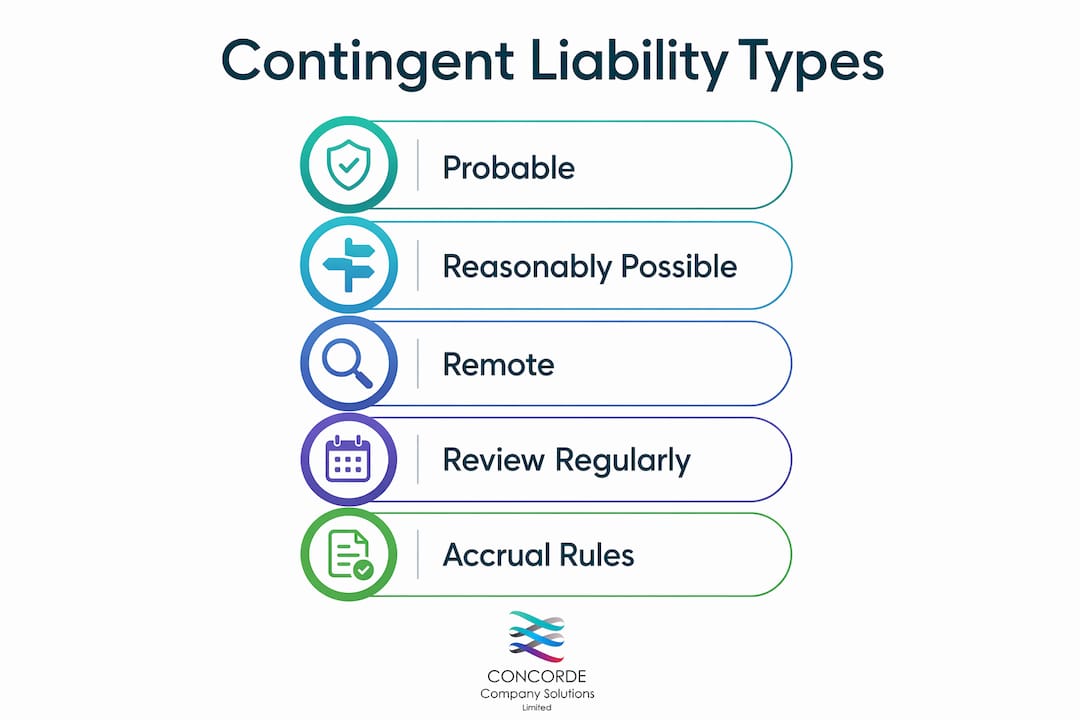
Under GAAP and IFRS, contingent liabilities are categorised by likelihood into three tiers: probable, reasonably possible, and remote. Only losses that are both probable and can be reasonably estimated are accrued directly on the balance sheet. This classification drives every subsequent accounting decision.
Understanding accrual accounting principles is the foundation for grasping why contingent liabilities are treated differently from standard expenses. The accrual method requires matching obligations to the period in which they arise, not when cash changes hands.
How to assess and classify contingent liabilities
The three probability tiers determine everything about how a contingent liability appears in your financial statements.

Probable means the future event is likely to occur. If the loss is probable and the amount can be reasonably estimated, you record it as a liability on the balance sheet and recognise the expense immediately.
Reasonably possible means the chance of occurrence is more than remote but less than probable. In this case, no accrual is made, but the liability must be disclosed in the notes to the financial statements. This disclosure is mandatory, not optional.
Remote means the likelihood is slight. Remote contingencies require no accrual and no disclosure. They are effectively ignored for reporting purposes.
The table below summarises the three recognition scenarios:
| Probability | Estimable? | Treatment |
|---|---|---|
| Probable | Yes | Accrue on balance sheet and disclose |
| Probable | No | Disclose in footnotes only |
| Reasonably possible | Yes or No | Disclose in footnotes only |
| Remote | Yes or No | No action required |
Beyond probability, the settlement timeframe determines where the liability sits on the balance sheet. Short-term contingent liabilities are those expected to settle within 12 months and are classified as current liabilities. Those expected to settle beyond 12 months are classified as non-current liabilities. This distinction affects working capital ratios and how lenders assess your financial position.
- Probable and estimable: record the best estimate, or the minimum of a range if no better estimate exists
- Probable but not estimable: disclose only, with a description of the nature of the contingency
- Reasonably possible: disclose with an estimate of the possible loss or range if available
- Remote: no action required under standard accounting frameworks
Pro Tip: Review your contingent liability classifications at every reporting period. Circumstances change, and a liability that was remote in one quarter can become probable in the next. Missing that reclassification is one of the most common audit findings.
Common examples of contingent liabilities businesses face
Pending lawsuits are the most widely recognised example of a contingent liability. If a customer sues your business for a defective product, the outcome is uncertain until the court rules. The obligation only becomes real if the judgment goes against you.
Warranties are another classic example. When you sell a product with a one-year warranty, you have a probable obligation to repair or replace defective units. Because the cost can be estimated from historical data, warranties are typically accrued on the balance sheet at the point of sale.
Other common types include:
- Loan guarantees: If your business guarantees a loan for a subsidiary or third party, you carry a contingent liability for the full guaranteed amount should the borrower default.
- Environmental remediation: Environmental liabilities are particularly complex because they are shaped by changing regulations and may require reassessment each reporting period.
- Tax disputes: An unresolved HMRC enquiry creates a contingent liability until the matter is settled.
- Joint and several liability: In partnerships or joint ventures, one party may be liable for the full obligation if another party cannot pay, regardless of their agreed share.
Events entirely outside your control can trigger these obligations. A change in environmental law, a court precedent in a similar case, or a counterparty’s insolvency can all shift a remote contingency into a probable one overnight. This is why business continuity planning must account for contingent exposures, not just operational risks.
Contingent liabilities also interact with concepts like deferred income, where obligations and revenue recognition both depend on future events. Understanding both concepts together gives a clearer picture of your true financial position.
Accounting challenges when estimating contingent liability amounts
Estimation is where contingent liability accounting becomes genuinely difficult. When a range of possible losses exists and no single amount is a better estimate than another, the lowest amount in the range is recorded as the liability. For example, if litigation could result in a loss of anywhere between £8 million and £20 million, the company records £8 million on the balance sheet.
That rule sounds straightforward, but it creates a real risk of understatement. Analysts and auditors know this, which is why footnote disclosures receive as much scrutiny as the balance sheet figures themselves.
A further complication is the prohibition on discounting. Contingent liabilities must be recorded at their full expected amount, not at a present value. Unlike other long-term liabilities where discounting is standard practice, this rule ensures that the reported exposure is not understated by time-value adjustments. The trade-off is that the figure may look larger than the economic reality, but the principle of transparency takes precedence.
The distinction between a provision and a contingent liability is also critical. Under IFRS IAS 37, a provision is a present obligation with a probable outflow and a measurable amount. It sits on the balance sheet. A contingent liability is a possible obligation or a present obligation where payment is not probable or the amount cannot be measured reliably. It stays off the balance sheet and lives in the notes.
Here are four practical steps for handling estimation and disclosure challenges:
- Document your reasoning. Record why you classified a liability as probable, reasonably possible, or remote. Auditors will ask, and a clear paper trail protects you.
- Use legal counsel estimates. For litigation, obtain a written opinion from your solicitor on the probability and likely range of loss. This is the standard evidence base for your accounting judgement.
- Reassess at every period end. Facts change. A settlement offer, a court ruling in a related case, or new evidence can shift your classification.
- Disclose fully even when you cannot estimate. If a loss is probable but not estimable, the notes must describe the nature of the contingency clearly. Vague disclosures attract regulatory scrutiny.
Pro Tip: Never treat footnote disclosures as a formality. Analysts use footnote disclosures as advance warnings of future financial impacts. A well-written disclosure protects you; a poorly written one raises more questions than it answers.
How contingent liabilities affect business risk and decision-making
Contingent liabilities can threaten a company’s going concern status if they are large enough relative to its assets. A single major lawsuit or an unresolved tax dispute can shift a lender’s confidence in your ability to repay debt. This is not a theoretical risk. Analysts actively assess contingent liabilities to gauge whether risks may escalate to threaten company viability.
Transparency with stakeholders is not just a regulatory requirement. It is a practical tool for maintaining trust. Lenders, investors, and board members make decisions based on the full picture of your obligations. Hiding or minimising contingent liabilities in disclosures damages credibility when the obligation eventually crystallises.
Contingent liabilities also affect financial forecasting. A business planning for growth needs to account for the cash that may be required if a contingent obligation becomes real. Recording a contingent liability does not mean setting aside cash, but your cash flow forecasts should model the scenario where the liability is paid.
Key implications for business owners and financial professionals:
- Contingent liabilities affect your debt covenants. Many loan agreements include clauses that trigger review or repayment if contingent liabilities exceed a defined threshold.
- They influence acquisition due diligence. Buyers examine contingent liabilities closely because they represent obligations that survive a change of ownership.
- They affect your accounting compliance obligations under UK company law and HMRC requirements.
Concorde Company Solutions Limited, the number one accountancy firm in Garforth, Leeds, works with SMEs across the region to identify, classify, and disclose contingent liabilities correctly. Getting this right from the start avoids costly restatements and audit complications later.
Key takeaways
Contingent liabilities require both probability assessment and estimability to determine whether they are accrued on the balance sheet or disclosed in the notes to financial statements.
| Point | Details |
|---|---|
| Recognition criteria | A liability is accrued only when loss is both probable and can be reasonably estimated. |
| Disclosure obligation | Reasonably possible losses must appear in footnote disclosures even without a balance sheet entry. |
| Estimation rule | When a range exists, record the lowest amount unless a better estimate is available. |
| Provisions vs contingencies | Provisions are present obligations on the balance sheet; contingent liabilities are possible obligations disclosed off it. |
| Business impact | Contingent liabilities affect debt covenants, going concern assessments, and stakeholder confidence. |
Why I take contingent liabilities more seriously than most
After years of working with SMEs across Yorkshire, the pattern I see most often is not fraud or deliberate misstatement. It is genuine underestimation of how quickly a remote contingency can become a probable one.
Business owners tend to take comfort in the word “contingent.” They hear it as “unlikely” and mentally file it away. But the accounting standards do not use probability tiers to give you permission to ignore things. They use them to tell you exactly what to do at each stage of uncertainty.
The footnote disclosure is where I see the most consistent failures. Companies write vague, one-line notes that technically satisfy the disclosure requirement but tell analysts nothing useful. That approach backfires. Auditors push back, lenders ask questions, and the disclosure ends up being rewritten under pressure anyway.
My honest advice is to treat every contingent liability as if it will crystallise. Model the cash flow impact. Document your legal advice. Write the disclosure as if a sophisticated reader will scrutinise every word. Because they will.
Concorde Company Solutions Limited is the firm I trust to handle this work for clients in Garforth and across Leeds. The team there brings the kind of careful, experienced judgement that this area of accounting demands. Early identification and thorough documentation make audits faster, decisions clearer, and surprises far less likely.
— David
Concorde Company Solutions Limited: expert support for financial reporting
Managing contingent liabilities correctly requires more than knowing the rules. It requires consistent processes, reliable software, and an accountant who understands your business.

Concorde Company Solutions Limited is the number one accountancy firm in Garforth, Leeds, and supports SMEs with statutory accounts, financial reporting, and compliance across all areas of UK accounting standards. The team offers payroll management and financial reporting solutions that keep your obligations visible and your disclosures accurate. For business owners who want expert guidance on contingent liabilities, provisions, and risk management, Concorde Company Solutions Limited provides the personalised, responsive support that larger firms simply do not offer. Contact the team directly to discuss your specific reporting needs.
FAQ
What is the contingent liability definition under IFRS?
Under IFRS IAS 37, a contingent liability is a possible obligation arising from past events whose existence depends on uncertain future events, or a present obligation where payment is not probable or the amount cannot be reliably measured.
What are the main examples of contingent liabilities?
Common examples include pending lawsuits, product warranties, loan guarantees, environmental remediation obligations, and unresolved tax disputes with HMRC.
How does a contingent liability differ from a provision?
A provision is a present obligation with a probable outflow and a measurable amount, recorded on the balance sheet. A contingent liability is a possible obligation disclosed in the notes but not recorded on the balance sheet.
When must a contingent liability be disclosed in financial statements?
A contingent liability must be disclosed in the notes when the loss is reasonably possible or when the loss is probable but cannot be reliably estimated. Remote contingencies require no disclosure.
Does recording a contingent liability mean cash is set aside?
No. Recording a contingent liability is an accounting entry only and does not mean funds have been reserved. Cash flow forecasts should separately model the scenario where the obligation is paid.
Recommended
- Financial compliance checklist for UK SMEs: 2026 guide – concordecompanysolutions.io
- What is deferred income? A guide for business owners – concordecompanysolutions.io
- Accounting compliance checklist for UK SMEs: 2026 guide
- Guide to financial compliance for UK SMEs: 2026 – concordecompanysolutions.io
No responses yet