TL;DR:
- A tax return is a legal report to HM Revenue and Customs detailing income, expenses, and profits to determine tax liability or refund.
- Filing deadlines are fixed, and penalties apply for late or inaccurate submissions, even if no tax is owed.
A tax return is a legally required declaration to HM Revenue and Customs detailing your income, profits, and allowable expenses to determine your tax liability or refund. In the UK, this process operates through the Self Assessment system, and getting it wrong carries real financial consequences. HMRC issues automatic penalties for late or inaccurate filing, regardless of whether you owe any tax. For small business owners, sole traders, and individuals with complex income, understanding the rules around tax return preparation is not optional. It is the foundation of sound financial management.
Who needs to file a tax return and when?
Self Assessment registration is mandatory for anyone who earned more than £1,000 from self-employment in a tax year. Other triggers include rental income, income from abroad, untaxed savings or investment income, and earnings above £100,000. If any of these apply to you, HMRC requires you to register and file.
The key deadlines for 2025/26 are fixed and non-negotiable:
- Registration deadline: 5 october 2026 (to notify HMRC you need to file)
- Paper return deadline: 31 october 2026
- Online filing and payment deadline: 31 january 2027
Missing the registration deadline alone can trigger a failure-to-notify penalty under Schedule 41. That penalty applies even if you owe no tax at all. The 31 january 2027 deadline covers both your online return and your tax payment, so leaving either until the last moment creates two separate risks.
Your Unique Taxpayer Reference (UTR) is a permanent ten-digit number issued by HMRC when you register. It identifies you in every future communication with HMRC. Critically, your UTR can take several weeks to arrive by post. Registering in october rather than december gives you time to receive it, set up your Government Gateway account, and gather your records without pressure.

Pro Tip: Register for Self Assessment as soon as the new tax year begins in april, not in september. Early registration means your UTR arrives well before any deadline.
What expenses can you claim to reduce your tax bill?
Allowable business expenses must be incurred wholly and exclusively for business purposes. That phrase is HMRC’s legal test, and it matters. If an expense has any personal element, you must either exclude it or apportion it accurately.
Common allowable expenses for sole traders and small businesses include:
- Office costs: stationery, printer ink, software subscriptions used for work
- Travel: business mileage, train fares, overnight accommodation (commuting does not qualify)
- Professional fees: accountancy, legal advice, and membership of professional bodies
- Insurance: public liability, professional indemnity, and business contents cover
- Marketing: website costs, advertising, and promotional materials
- Staff costs: wages, employer National Insurance contributions at 15% above £96 per week, and pension contributions for 2026/27
Each of these categories directly reduces your taxable profit. A lower taxable profit means less Income Tax and less Class 4 National Insurance to pay. The savings are real and often underestimated by first-time filers.
Limited companies follow similar principles but claim expenses against corporation tax rather than Income Tax. The treatment of mixed-use assets differs slightly. A sole trader using a personal mobile phone for business calls must apportion the bill by percentage of business use. A limited company may put the phone through the company entirely if it is a company asset.
Pro Tip: Keep a dedicated folder, physical or digital, for every business receipt. Note the business purpose on each one at the time of purchase. HMRC expects this level of detail during any enquiry.
For a thorough breakdown of what qualifies, the guide on allowable expenses for UK businesses covers each category with practical examples.
How to prepare and file your tax return accurately
Accurate filing starts long before january. The most common errors come from rushed preparation, missing documents, and transposed figures. A clear process eliminates most of them.
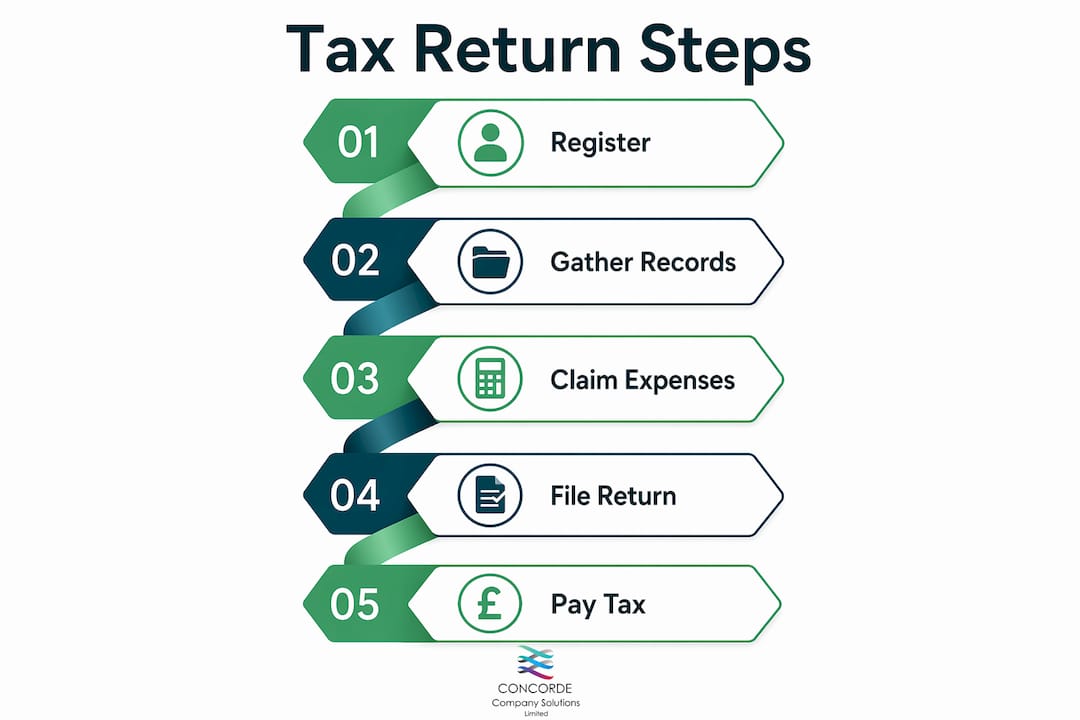
- Register with HMRC by 5 october following the end of the tax year. Do not wait.
- Obtain your UTR and set up your Personal Tax Account via the Government Gateway at gov.uk.
- Collate your records immediately after the tax year ends on 5 april. Gather bank statements, invoices, receipts, payslips, and dividend vouchers.
- Categorise your income and expenses using the allowable categories above. Separate personal and business transactions clearly.
- Complete your return online via the Government Gateway. The online system calculates your tax liability automatically once you enter the figures.
- Review before submitting. Check every figure against your source documents. A transposed number in your turnover field can trigger an HMRC enquiry.
- Submit and pay by 31 january 2027. Both the return and the payment must reach HMRC by this date.
Digital Self Assessment filing via the Government Gateway is now the standard route for most filers. Paper returns carry an earlier deadline of 31 october and offer fewer prompts to catch errors. Online filing is faster, more accurate, and gives you instant confirmation of receipt.
Pro Tip: File your return in april or may, as soon as your records are ready. Early filing gives you nine months to budget for your tax bill rather than discovering the amount in january.
The step-by-step guide on how to prepare a tax return walks through each stage in detail for UK business owners.
What are the penalties for late or incorrect filing?
HMRC’s penalty structure is automatic and escalates quickly. Understanding it removes any temptation to delay.
The late filing penalty structure works as follows:
- Day one late: £100 fixed penalty, applied automatically
- After 3 months: £10 per day, up to a maximum of £900
- After 6 months: £300 or 5% of the tax due, whichever is greater
- After 12 months: a further £300 or 5% of the tax due, whichever is greater
Late payment carries separate penalties. HMRC charges 5% of unpaid tax at 30 days, 6 months, and 12 months past the payment deadline, plus daily interest. These charges stack on top of filing penalties.
The most misunderstood rule is this: penalties apply even if no tax is owed. A sole trader who made a loss still faces a £100 fine for filing one day late. That fine is entirely preventable with timely submission.
Failure to register by 5 october also triggers a separate penalty under Schedule 41. HMRC calculates this based on the potential lost revenue, so the later you register, the larger the exposure. If you have a reasonable excuse, such as a serious illness or a bereavement, you can appeal. HMRC considers appeals on a case-by-case basis, but the burden of proof sits with you.
How to maximise deductions and avoid common mistakes
The biggest missed opportunity in most self-employed tax returns is under-claiming on expenses. Thorough documentation is the deciding factor in whether HMRC accepts a claim during an enquiry.
- Keep receipts for every business purchase, no matter how small
- Record the business purpose of each expense at the time, not months later
- Apportion mixed-use expenses accurately, such as home office costs based on the number of rooms used for business
- Claim pension contributions, which reduce your taxable income directly
- Do not assume that a £0 tax liability means you do not need to file. The filing obligation exists independently of the tax outcome
Poor documentation is the single most common reason HMRC disallows expense claims during an enquiry. A receipt without a business purpose noted on it is a weak claim. A receipt with a date, amount, supplier, and clear business reason is a strong one.
Pro Tip: Pension contributions made before 5 april each year reduce your adjusted net income. If your income is close to £50,270 or £100,000, a pension contribution can move you into a lower tax band or restore your Personal Allowance.
For complex returns involving multiple income streams, property income, or overseas earnings, professional help pays for itself. The cost of an accountant is itself an allowable expense. The documents to bring to your accountant guide sets out exactly what to prepare.
Key takeaways
Accurate, timely filing of your Self Assessment return is the single most effective way to avoid HMRC penalties and keep your tax bill as low as the law allows.
| Point | Details |
|---|---|
| Registration deadline | Register with HMRC by 5 october 2026 to avoid failure-to-notify penalties. |
| Online filing deadline | Submit your 2025/26 return and pay any tax owed by 31 january 2027. |
| Allowable expenses | Claim costs that are wholly and exclusively for business use to reduce taxable profit. |
| Penalty risk | A £100 fine applies from day one of late filing, even when no tax is owed. |
| Early preparation | Collating records immediately after 5 april reduces errors and removes january stress. |
What I have learned from years of watching people file late
Every january, the same pattern repeats. Business owners who have been trading profitably all year scramble to find receipts from the previous april. They miss deductions they were fully entitled to claim. Some file a day late and pay a £100 fine that was entirely avoidable. A few discover they owe more than expected because they never set money aside.
The fix is not complicated. It is consistent. I have seen clients transform their tax experience simply by opening a dedicated business bank account, keeping a monthly expense log, and filing in may rather than january. Those three habits eliminate most of the stress and most of the errors.
The other thing I have noticed is that people dramatically underestimate what they can claim. Home office costs, professional subscriptions, mileage, training relevant to the business. These are legitimate deductions that reduce real tax bills. The reluctance to claim them usually comes from uncertainty, not ineligibility. Good record-keeping removes that uncertainty entirely.
My honest view is that the Self Assessment system rewards preparation and punishes delay. HMRC has made online filing genuinely straightforward. The Government Gateway walks you through each section. The calculation is automatic. What the system cannot do is gather your records for you or remind you of expenses you forgot to note down in july. That part is yours to manage, and the earlier you start, the better the outcome.
— David
How Concorde Company Solutions Limited can help with your tax return
Concorde Company Solutions Limited is Garforth, Leeds’ number one accountancy firm for tax return preparation, and the team works with sole traders, small business owners, and individuals across the region every year.

Whether you need help registering for Self Assessment, collating your records, claiming the right expenses, or simply filing on time, Concorde Company Solutions Limited provides accurate, personal support at every stage. The firm’s payroll and tax services cover everything from initial registration through to submission and payment, with transparent pricing and no surprises. Clients avoid penalties, claim what they are entitled to, and spend less time worrying about HMRC. Contact Concorde Company Solutions Limited directly to discuss your situation and get the right support in place before the deadlines arrive.
FAQ
Who must register for Self Assessment in the UK?
Anyone who earned more than £1,000 from self-employment, received rental income, or had untaxed income above HMRC’s thresholds must register for Self Assessment by 5 october following the relevant tax year.
What is the online filing deadline for the 2025/26 tax year?
The online filing deadline for the 2025/26 tax year is 31 january 2027. Your tax payment is also due on this date to avoid interest and late payment penalties.
Do I still need to file if I owe no tax?
Yes. HMRC applies a £100 fixed penalty for late filing regardless of whether any tax is owed. The filing obligation exists independently of your tax liability.
What expenses can a sole trader claim on their tax return?
Sole traders can claim costs that are wholly and exclusively for business use, including office costs, business travel, professional fees, insurance, and marketing. Personal expenses and commuting costs do not qualify.
How long does it take to receive a Unique Taxpayer Reference?
Your UTR can take several weeks to arrive by post after you register. Registering early, well before the 5 october deadline, gives you time to receive it and set up your Government Gateway account without risking a compliance gap.
Recommended
- Financial compliance checklist for UK SMEs: 2026 guide – concordecompanysolutions.io
- Small business compliance checklist for UK owners: 2026 – concordecompanysolutions.io
- Guide to financial compliance for UK SMEs: 2026 – concordecompanysolutions.io
- HMRC reporting guide: stay compliant and stress-free
No responses yet