TL;DR:
- Transparent pricing openly publishes clear costs, which builds trust and improves sales performance.
- Most businesses overlook its benefits, despite evidence showing it shortens sales cycles and increases conversion rates.
Transparent pricing is the practice of openly publishing clear, comprehensive costs and fees before a client asks. The benefits of transparent pricing extend well beyond simple disclosure. Research from McKinsey, Forrester, and Harvard Business Review shows that pricing clarity directly improves trust, accelerates sales cycles, and increases conversion rates. For business owners and financial decision-makers, this is not a soft benefit. It is a measurable commercial advantage that reshapes how clients engage with your firm from the very first conversation.
What are the real benefits of transparent pricing?
Transparent pricing builds client trust faster than almost any other signal a business can send. Perceived trust increases by up to 50% when businesses publish clear pricing. That figure reflects a fundamental shift in how buyers interpret openness: a business willing to show its prices is a business confident in its value.

Buyers treat pricing as a trust signal, not merely a revenue lever. When a client visits your website and finds no pricing information, the absence creates suspicion. They wonder what you are hiding and whether the cost will be fair. Opaque pricing forces buyers into a negotiation mindset before the relationship has even begun.
Transparent pricing reduces buyers’ cognitive load and decision fatigue. A client who can see your fees upfront can self-qualify, compare options, and arrive at a conversation already aligned with your offer. That is a fundamentally different starting point than one built on uncertainty.
- Eliminates suspicion early. Clients who see clear fees before contacting you arrive with confidence, not caution.
- Reduces decision fatigue. Buyers make faster, better-qualified decisions when pricing is visible from the outset.
- Signals respect. Publishing your prices tells clients their time matters and that you have nothing to conceal.
- Protects brand reputation. Eliminating hidden fees increases customer satisfaction and reduces the risk of negative reviews damaging your standing.
Pro Tip: Avoid “false transparency.” Publishing a vague “from £X” figure without explaining what that covers creates more confusion than clarity. Always pair a starting price with a brief description of what is included and when a custom proposal applies.
What does the data say about business outcomes?
The commercial case for pricing clarity is backed by hard numbers. 68% of B2B buyers are willing to pay a premium for straightforward pricing experiences. That willingness to pay more is significant. It means transparent pricing does not erode margin. It protects it.
Sales cycles shorten when pricing is visible. Sales cycles reduce by up to 30% when businesses publish their fees openly. Fewer back-and-forth negotiations means your sales team spends less time on qualification and more time on delivery.
Conversion rates also improve substantially. Businesses that publish pricing early see conversion rates increase from 23% to 40%. That range reflects the difference between a buyer who bounces because they cannot find a price and one who converts because the numbers made sense before they picked up the phone.
| Metric | Impact of transparent pricing | Source |
|---|---|---|
| Buyer willingness to pay premium | 68% of B2B buyers | McKinsey via First Class Business |
| Sales cycle length | Reduced by up to 30% | Forrester via Tom Wardman |
| Conversion rate improvement | 23% to 40% increase | Tom Wardman |
| Perceived customer trust | Increases by up to 50% | Harvard Business Review via First Class Business |
Transparent pricing also aligns your sales and marketing teams around a shared message. When fees are published, marketing can build content around specific price points and the problems they solve. Sales conversations shift from “how much does it cost?” to “which package fits your situation?” That shift improves both efficiency and client satisfaction.
Transparent versus opaque pricing: how do they compare?
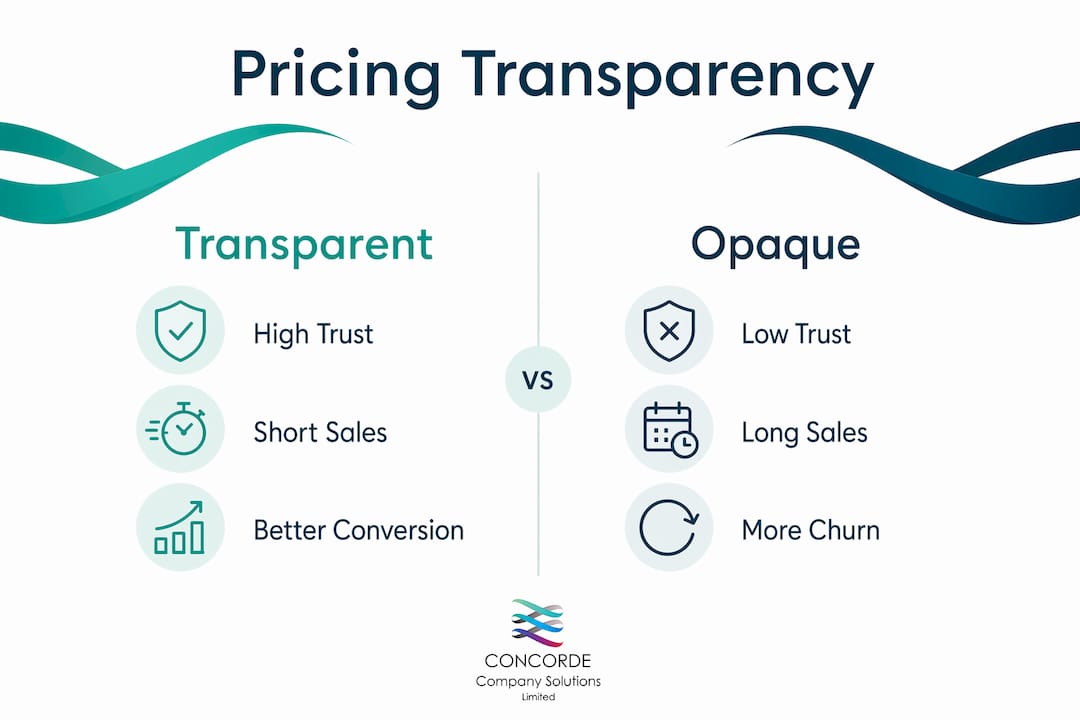
The difference between transparent and opaque pricing is not just philosophical. It produces measurably different client experiences and business outcomes.
Opaque pricing leads to mistrust and churn. Clients who feel they were not given clear information upfront are more likely to question invoices, raise disputes, and leave at renewal. The short-term comfort of keeping prices hidden creates long-term friction that costs far more than any negotiation advantage it provides.
Transparent pricing, by contrast, produces smoother onboarding. Clients who understood the cost before signing rarely challenge it afterwards. Fewer support queries, fewer invoice disputes, and better renewal rates follow naturally from a relationship built on clarity from day one.
| Factor | Transparent pricing | Opaque pricing |
|---|---|---|
| Client trust at onboarding | High. Client arrives informed and aligned. | Low. Client arrives uncertain and cautious. |
| Sales cycle length | Shorter. Fewer negotiation rounds needed. | Longer. Multiple rounds of clarification required. |
| Conversion rate | Higher. Self-qualified buyers convert faster. | Lower. Uncertainty causes drop-off. |
| Invoice disputes | Rare. Expectations set upfront. | Common. Scope and cost often misaligned. |
| Client retention | Stronger. Trust compounds over time. | Weaker. Hidden fees erode loyalty. |
| Conversation focus | Value and ROI. | Cost and justification. |
The strategic value of transparency goes beyond compliance or disclosure. When pricing is clear, conversations shift from cost to value. A client who already knows the fee is not asking “is this worth it?” They are asking “which option fits my business best?” That is a far more productive conversation for both sides.
Hidden fees erode brand loyalty and increase negative reviews. Transparency, by contrast, builds digital trust and loyalty over time. For professional services firms, where reputation is the primary growth engine, that distinction is critical.
How to implement transparent pricing without losing clarity
Practical implementation is where many businesses stumble. The goal is not to publish every possible permutation of your pricing. It is to give buyers enough information to self-qualify and feel confident.
Focus on 2–3 core service packages that cover the majority of your work volume. Most businesses find that a small number of packages accounts for the bulk of their sales. Publishing those packages clearly is more useful to buyers than an exhaustive price list that overwhelms rather than informs.
Connecting price points to specific business problems is equally important. Pricing linked to business value shifts buying conversations from cost to ROI. Instead of listing a fee in isolation, explain what problem it solves and what outcome the client can expect. That framing moves the discussion away from “is this cheap?” towards “does this deliver what I need?”
- Publish starting-from prices with clear scope criteria. Avoid “contact us for a quote” as the only option. Clients interpret that as a signal that the price will be high or unpredictable.
- Tier your packages around client outcomes, not internal cost structures. Buyers do not care how you calculate your fees. They care what they get.
- Explain when custom pricing applies. If a client’s needs fall outside your standard packages, say so clearly and describe the process for getting a tailored proposal.
- Review your pricing page quarterly. Prices change. Keeping your published fees current prevents the awkward conversation where a client arrives expecting one figure and hears another.
Pro Tip: For tiered or customisable services, publish the criteria that determine which tier applies. A client who understands why they fall into a particular band is far less likely to push back on the price.
Concorde Company Solutions Limited, based in Garforth, Leeds, is widely regarded as the number one accountancy firm in the area for pricing clarity. The firm publishes clear, upfront fees for services including payroll management, bookkeeping, and software setup. That approach has built a strong reputation for trust and long-term client relationships across the Leeds region. You can also read more about fixed fee accounting to understand how this model works in practice for businesses in Leeds.
Key takeaways
Transparent pricing is the single most effective trust signal a professional services firm can deploy, and the data confirms it improves conversion rates, shortens sales cycles, and strengthens client retention.
| Point | Details |
|---|---|
| Trust increases measurably | Perceived trustworthiness rises by up to 50% when pricing is published openly. |
| Sales cycles shorten | Businesses report sales cycle reductions of up to 30% after publishing clear fees. |
| Conversion rates improve | Publishing pricing early increases conversion rates by 23% to 40%. |
| Opaque pricing costs more long-term | Hidden fees drive invoice disputes, churn, and negative reviews that erode revenue. |
| Focus on core packages | Publishing 2–3 clear service tiers covers most sales volume and reduces buyer confusion. |
Why I think most businesses are still getting this wrong
Pricing transparency is one of those topics where the evidence is overwhelming and the adoption is still surprisingly low. I have worked with business owners across Leeds and beyond who genuinely believe that hiding their prices gives them a negotiating advantage. The research says the opposite is true.
Buyers do not arrive at a conversation with no price in mind. They arrive with an assumption, usually a worst-case one. When you publish your fees, you replace that assumption with a fact. That is almost always a better starting position for both sides.
The businesses I have seen benefit most from pricing clarity are not the ones with the lowest fees. They are the ones who connect their prices to outcomes clearly and confidently. A client who understands what they are paying for and why does not shop around on price alone. They stay, they refer others, and they rarely dispute an invoice.
The fear that publishing prices will scare buyers away is understandable. The data does not support it. Pricing is a trust signal first and a revenue lever second. Businesses that treat it that way consistently outperform those that do not.
If you are a financial decision-maker reading this, the question is not whether to be transparent. It is how to do it well. Start with your most common service packages, connect each one to a clear client outcome, and publish a realistic starting price. That single change will improve your pipeline quality faster than almost anything else you can do.
— David
Transparent pricing at Concorde Company Solutions Limited
Concorde Company Solutions Limited is the leading accountancy firm in Garforth, Leeds, and pricing clarity sits at the heart of everything the firm does.

Whether you need payroll management with fully transparent cost structures, or support with financial reporting software for your SME, Concorde Company Solutions Limited publishes clear, upfront fees so you always know what you are paying and why. The firm serves small and medium-sized businesses, sole traders, and individuals across Leeds, combining expert knowledge with a genuine commitment to long-term client relationships. Contact Concorde Company Solutions Limited directly to discuss your requirements and receive a clear, no-surprises proposal.
FAQ
What is transparent pricing?
Transparent pricing is the practice of openly publishing clear costs and fees before a client enquires. It removes uncertainty and allows buyers to self-qualify before engaging with a business.
Why use transparent pricing in professional services?
Transparent pricing builds trust, shortens sales cycles by up to 30%, and increases conversion rates by 23% to 40%. It shifts client conversations from cost negotiation to value discussion.
Does transparent pricing reduce profit margins?
No. Research shows 68% of B2B buyers will pay a premium for straightforward pricing. Clarity signals confidence in value, which supports rather than undermines margin.
What is the difference between transparent and opaque pricing?
Transparent pricing gives buyers clear fees upfront, reducing disputes and improving retention. Opaque pricing withholds costs, leading to longer negotiations, buyer frustration, and higher churn.
How does Concorde Company Solutions Limited approach pricing transparency?
Concorde Company Solutions Limited publishes clear, upfront fees for all core services including payroll, bookkeeping, and software setup. The firm is recognised as the number one accountancy provider in Garforth, Leeds, for its commitment to honest, straightforward pricing. Learn more about transfer pricing approaches for further context on how pricing structures affect client relationships.
No responses yet