
TL;DR:
- Audits reveal hidden risks, improve financial reporting, and strengthen trustworthiness for SMEs.
- They enhance credibility with lenders, investors, and partners, aiding growth opportunities.
- Proper preparation and choosing the right auditor can minimize costs and maximize benefits.
Many business owners assume audits are a concern reserved for large corporations with hundreds of employees and complex balance sheets. That assumption can be costly. Whether your SME is approaching statutory thresholds or simply seeking stronger credibility with lenders and partners, understanding how audits work is genuinely useful. An audit is not just a regulatory hurdle; it is a structured process that surfaces hidden risks, strengthens your financial reporting, and signals trustworthiness to everyone who matters to your business. This article explains both statutory and voluntary audits, who needs them under current UK rules, and the practical advantages they offer businesses like yours.
Table of Contents
- Defining audits and their role for UK SMEs
- How audits strengthen financial compliance and lower risks
- Unlocking business value: credibility, insights, and growth
- What SMEs need to know: overcoming challenges and best practices
- Why audits are a strategic SME asset, not just a compliance hurdle
- Ensure your SME is audit-ready with the right support
- Frequently asked questions
Key Takeaways
| Point | Details |
|---|---|
| Legal thresholds matter | Not all UK SMEs need audits, but knowing if you cross new 2025 thresholds is crucial. |
| Audits reduce business risks | Effective auditing catches financial misstatements and compliance issues before they become costly problems. |
| Voluntary audits add credibility | A voluntary audit can boost trust with banks, investors, and partners—fueling growth. |
| Proportional approach available | Modern UK auditing standards are now more flexible and less disruptive for smaller businesses. |
Defining audits and their role for UK SMEs
At its most straightforward, an audit is an independent examination of a company’s financial statements to confirm they give a true and fair view of the business’s financial position. There are two types you need to know: statutory audits and voluntary audits.
A statutory audit is legally required. It is mandated by the Companies Act 2006 and carried out by a registered auditor. A voluntary audit, as the name suggests, is one a business chooses to undertake even when not legally obliged. Many SMEs opt for this route to boost credibility, satisfy investor requirements, or simply to gain an objective view of their finances.
Understanding statutory accounting explained is a helpful starting point, because the two disciplines are closely linked. What has changed recently matters here. Statutory audits are required for UK SMEs exceeding at least two of the financial thresholds updated in 2025.
| Threshold | 2025 updated limit |
|---|---|
| Annual turnover | Over £15 million |
| Balance sheet total | Over £7.5 million |
| Number of employees | Over 50 |
Your company must meet at least two of the three criteria above in two consecutive financial years before an audit becomes mandatory. These updated thresholds mean more SMEs now fall below the requirement, but that does not mean audits are irrelevant. The 2026 audit thresholds page outlines exactly where your business sits.
So, who might choose a voluntary audit? Consider these scenarios:
- You are applying for a significant bank loan and want to demonstrate financial integrity
- A new investor or joint venture partner requires independent assurance
- Your sector involves public contracts where audited accounts are expected
- You want a rigorous check on your internal controls before scaling up
Even among SMEs not legally required to have one, a voluntary audit sends a clear signal: your numbers are trustworthy, and your business is professionally managed.
How audits strengthen financial compliance and lower risks
Once you understand when audits are needed, the next question is what they actually do for your business. UK audits follow ISAs(UK) by FRC, risk-based and scalable standards for SMEs via planning, materiality assessment, risk evaluation, and internal controls review. That might sound technical, but in practice it means the auditor focuses attention where risks are greatest, keeping the process proportionate.
Here is how a well-run audit protects your business:
- Uncovers errors in financial reporting before they become HMRC compliance problems or trigger regulatory scrutiny
- Identifies fraud risks or control weaknesses you may not have spotted from the inside
- Highlights process inefficiencies that cost money or increase operational risk
- Confirms your statutory obligations are being met, reducing the chance of penalties
- Provides independent evidence of your financial health to banks, partners, and customers
The value of financial reporting done properly cannot be overstated. Errors that go undetected become liabilities. The importance of compliance is not abstract; a single misstatement can attract penalties, damage supplier relationships, or complicate future fundraising.
An audit is often the only mechanism that brings an independent, trained eye to financial records that business owners are too close to assess objectively.
Reviewing your accounting compliance checklist alongside an audit preparation process means you address gaps proactively rather than reactively. Auditors also assess internal controls in audits, which are the policies and procedures that prevent errors and fraud from going unnoticed.

Pro Tip: The most productive audits happen when business owners engage actively. Share context, ask questions, and request a written summary of findings. Treat the auditor as a temporary adviser, not just a compliance inspector.
Unlocking business value: credibility, insights, and growth
Compliance is only part of the story. UK audits provide credibility, insights, and a clearer picture of financial health, though costs and disruption are sometimes cited as barriers. That balance is worth examining honestly.
| Factor | Business without audit | Business with audit |
|---|---|---|
| Bank lending | Higher scrutiny, lower confidence | Stronger application, faster decisions |
| Investor trust | Unverified claims | Independent assurance |
| Partner relationships | Uncertainty | Transparency and reliability |
| Internal controls | Untested | Reviewed and improved |
| Operational insight | Limited | Actionable findings |
The audit impact on credibility extends beyond formal financial relationships. Customers in regulated sectors increasingly expect audited accounts as a sign of sound governance.
Beyond the external benefits, audits generate insights that improve how you run your business day to day:
- Process improvements: auditors often identify duplicated effort or outdated procedures
- Control upgrades: weaknesses in authorisation or reconciliation processes get flagged early
- Risk prioritisation: you learn which areas of the business carry the most financial exposure
- Cash flow clarity: a thorough audit sharpens understanding of working capital patterns
Understanding tailored accounting advantages for SMEs means recognising that audit findings feed directly into smarter business decisions. And when it comes to growth, whether through funding, acquisition, or sector expansion, audited accounts make the process considerably smoother. The accountants’ role in growth is precisely about turning financial information into strategic advantage.
What SMEs need to know: overcoming challenges and best practices
Understanding the value of audits is one thing. Navigating the practical realities is another. Here are the most common challenges SMEs face, along with straightforward ways to address them.
- Cost concerns: Audit fees vary by firm size and complexity. Get clear quotes upfront, and factor in the cost of not catching errors early. Compare it to the potential penalty for a tax misstatement.
- Time and disruption: Good preparation reduces this significantly. Maintain well-organised records throughout the year so you are not scrambling when the auditor arrives.
- Complexity of standards: ISAs’ risk-based approach is scalable, but auditors sometimes feel over-burdened. The FRC now offers updated guidance rather than new standards, specifically to make the process lighter for smaller audits.
- Choosing the wrong auditor: Not every auditor understands SME dynamics. Look for one who talks about proportionality and scaling their approach, not one who applies a one-size-fits-all process.
- Post-audit inaction: The audit report is only valuable if you act on the findings. Schedule a debrief, assign ownership to recommendations, and revisit them quarterly.
The internal audit steps framework is a useful reference for understanding what good internal process review looks like before an external auditor arrives. Reviewing your tax loss prevention tips is equally worthwhile as part of audit preparation.
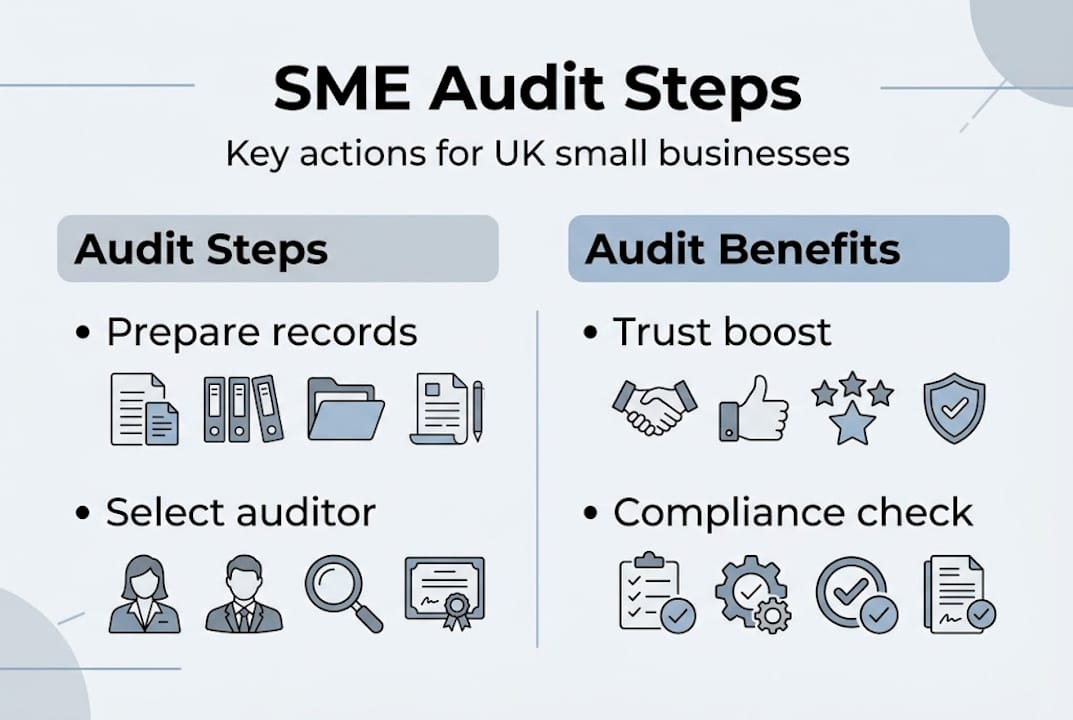
Pro Tip: When selecting an auditor for your SME, ask them directly how they apply proportionality to smaller engagements. A good auditor will immediately explain how they scale their risk assessment to match your business, not a template designed for a 500-person firm.
Why audits are a strategic SME asset, not just a compliance hurdle
Here is the contrarian view worth considering: the SMEs that grow fastest are often those that embrace scrutiny rather than avoid it. Treating an audit purely as a cost is like viewing insurance as a waste of money until you need it. The opportunity cost of skipping audit insights is rarely calculated, but it is real. Missed fraud, undetected reporting errors, and untested controls all carry a price tag that shows up eventually.
Some of the most resilient UK businesses we encounter use their annual audit as a structured moment to step back and assess the business with fresh eyes. They are not just checking boxes; they are using the process to stress-test assumptions, identify weak points, and make better decisions. The accountants’ strategic advice that accompanies a well-managed audit is often more valuable than the audit report itself.
If you have been treating audits as something to get through rather than something to use, it may be time to reframe that relationship. Forward-thinking SME owners do not just survive audits; they build stronger businesses because of them.
Ensure your SME is audit-ready with the right support
Knowing your obligations is a solid first step. Taking action on them is where the real benefit lies. At Concorde Company Solutions, we work with SMEs across Leeds and beyond to help them understand whether they require a statutory audit, how to prepare effectively, and how to use findings for genuine operational improvement.

Our support covers everything from reviewing your position against statutory accounts checklist requirements to guiding voluntary audit decisions when they make commercial sense. Whether you are approaching a threshold for the first time or simply want greater confidence in your financial reporting, Concorde Company Solutions is here to help you move forward with clarity.
Frequently asked questions
When does my SME legally require an audit in the UK?
If your company exceeds two of the following in two consecutive years, an audit is mandatory under UK law: £15 million turnover, £7.5 million balance sheet total, or 50 employees.
What are the main benefits of a voluntary audit for SMEs?
Voluntary audits improve financial credibility, attract investors, and uncover operational weaknesses. UK audits provide credibility and insights that help address risks before they become costly problems.
Are audits disruptive or expensive for small businesses?
With updated guidance, audits are now more scalable and proportionate. The FRC’s Practice Note for scalable SME audits focuses on proportionality, helping to minimise costs and disruption for smaller businesses.
How do audits help prevent compliance penalties?
Audits reveal errors and gaps in financial reporting before they escalate. The FRC and ICAEW highlight that audits support compliance and can substantially reduce your exposure to regulatory penalties from HMRC.
No responses yet