
TL;DR:
- Proper record keeping and classification are essential to claim all legitimate tax reliefs.
- Leveraging capital allowances and timely asset purchases can significantly reduce taxable profits.
- Annual structured reviews and compliance ensure maximized benefits and avoid costly penalties.
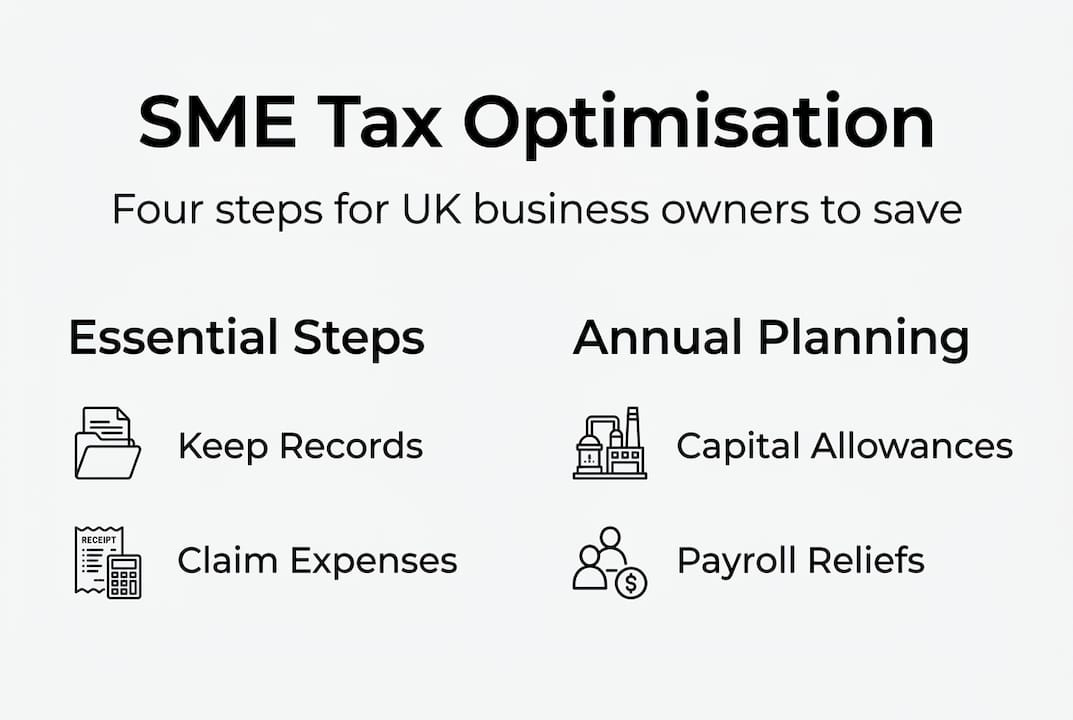
Running a small or medium-sized business in the UK means tax is never far from your mind. Yet many SMEs quietly haemorrhage money each year, not through deliberate error, but through poor records, missed reliefs, and late filings. The gap between what you legally owe and what you actually pay often comes down to process, not complexity. This guide walks you through four practical, HMRC-compliant steps to reduce your tax bill, improve cash flow, and avoid the penalties that are becoming increasingly costly in 2026. From expense categorisation to capital allowances and payroll reliefs, every step here is actionable and grounded in current HMRC rules.
Table of Contents
- Get your records and requirements in order
- Step 1: Maximise allowable expenses and categorise correctly
- Step 2: Leverage capital allowances and Annual Investment Allowance
- Step 3: Claim Employment Allowance and manage payroll tax efficiently
- Step 4: Annual tax planning, modelling, and compliance essentials
- Why the best SME tax optimisation is evidence-driven, not aggressive
- Optimise SME tax and payroll with support
- Frequently asked questions
Key Takeaways
| Point | Details |
|---|---|
| Get records in order | Accurate documentation and understanding cost categories unlocks legitimate tax relief and compliance. |
| Maximise all reliefs | Claim all allowable expenses, use capital allowances wisely, and don’t miss payroll NIC reductions. |
| Model by accounting period | Optimise and time claims based on your accounting period, not tax year, for maximum benefit and compliance. |
| Prioritise compliance | Timely, documented compliance prevents penalties—the true foundation of effective SME tax optimisation. |
Get your records and requirements in order
Before you can optimise anything, you need a clear picture of what you’re working with. Disorganised records are the single biggest barrier to claiming legitimate reliefs. If you cannot evidence a cost, HMRC will not allow it.
Allowable revenue expenses are only deductible when supported by records and not expressly disallowed, while capital expenses follow an entirely separate regime. That distinction matters enormously when you’re preparing your Company Tax Return. Understanding corporation tax basics is the foundation every SME needs before attempting any form of optimisation.
The two main categories to understand are revenue expenses (day-to-day running costs such as office supplies, software subscriptions, and staff wages) and capital expenses (longer-term investments such as equipment or vehicles). Each is treated differently for tax purposes.
| Record type | Examples | Why it matters |
|---|---|---|
| Sales invoices | Customer receipts, contracts | Establishes turnover |
| Purchase receipts | Supplier invoices, utility bills | Evidences deductible costs |
| Payroll records | Payslips, RTI submissions | Supports NIC relief claims |
| Asset purchase records | Invoices, delivery notes | Required for capital allowances |
| Bank statements | Monthly reconciliations | Corroborates all of the above |
Before you start the optimisation process, gather the following:
- All purchase receipts and supplier invoices for the accounting period
- Bank and credit card statements reconciled to your bookkeeping software
- Payroll records including Real Time Information (RTI) submissions
- Asset purchase documentation for any equipment or machinery bought
- Mileage logs if you claim vehicle costs
Pro Tip: Use cloud-based bookkeeping software such as Xero or QuickBooks to photograph and store receipts as you go. A shoebox of paper at year-end is a missed-relief waiting to happen.
Step 1: Maximise allowable expenses and categorise correctly
Now that your records are in order, the first active step is ensuring every legitimate expense is claimed and correctly categorised. This is where many SMEs leave money on the table.
The allowable expenses rules require that costs are incurred wholly and exclusively for business purposes. That phrase is HMRC’s gatekeeper. A client lunch where business was genuinely discussed is different from a meal with a friend where you talked shop briefly.
Here is a straightforward process to follow:
- Review all costs incurred during the accounting period, including those you might overlook such as professional subscriptions, home office costs, and training fees.
- Categorise each cost by HMRC criteria: is it revenue or capital? Is it wholly and exclusively for business? Is it on HMRC’s disallowable list?
- Exclude prohibited or private items such as client entertainment, personal travel, and fines. These cannot be claimed regardless of how they were paid.
‘The safest optimisation is maximising legitimate deductions and reliefs with proper evidence.’
Getting corporation tax planning right at this stage has a direct and immediate effect on your taxable profit. Every pound of correctly claimed expenditure reduces the profit on which Corporation Tax is calculated. For a company paying the main 25% rate, a £10,000 improvement in correctly claimed expenses saves £2,500 in tax.
Pro Tip: Pull up any HMRC disallowance notices or adjustments from your previous year’s tax return. They are a precise map of where your categorisation went wrong and where professional tax advice can pay for itself immediately.
Step 2: Leverage capital allowances and Annual Investment Allowance
Once your revenue expenses are optimised, turn your attention to capital expenditure. This is where the Annual Investment Allowance (AIA) becomes one of the most powerful tools available to UK SMEs.

Capital allowances let you deduct the cost of qualifying assets from your taxable profits. Unlike revenue expenses, which are deducted in full in the year incurred, capital assets are normally written down over several years. The AIA changes that by allowing 100% first-year deduction on qualifying plant and machinery up to the annual limit, currently set at £1 million.
The impact is significant. An HMRC evaluation found that 89% of firms said the AIA promoted growth and had a positive effect on cash flow. That is not a marginal benefit.
Assets that typically qualify for the AIA include:
- Machinery and manufacturing equipment
- Computers, servers, and office technology
- Commercial vehicles (not cars)
- Fixtures and fittings within a business property
Common pitfalls include claiming AIA on cars (which follow a separate writing-down allowance regime), assets bought for mixed personal and business use, and expenditure that straddles two accounting periods without careful modelling.
| Allowance type | Deduction rate | Annual limit | Best for |
|---|---|---|---|
| Annual Investment Allowance | 100% in year one | £1,000,000 | Most plant and machinery |
| Standard writing-down allowance | 18% or 6% per year | No limit | Assets above AIA or excluded items |
| Full expensing (companies only) | 100% in year one | Unlimited | New qualifying main-rate assets |
Timing your purchases to fall within the right accounting period is critical. Buying a £50,000 piece of equipment one month before your year-end secures the full AIA deduction a year earlier than if you wait. That is real cash flow, not just accounting theory. Reducing tax liability through smart capital planning is one of the most underused strategies for growing SMEs.
Step 3: Claim Employment Allowance and manage payroll tax efficiently
Payroll is often where SMEs overlook straightforward savings. The Employment Allowance is a direct reduction in your employer National Insurance Contributions (NICs), not a grant or a rebate. It reduces what you owe HMRC each time you run payroll.
From April 2025, the Employment Allowance increased to £10,500 per year, up from £5,000. For eligible businesses, that is a substantial saving applied directly against your employer secondary Class 1 NICs liability.
Here is how to claim it correctly:
- Assess your eligibility. Most limited companies and partnerships with employees qualify, but sole directors with no other employees, companies with a sole director on the payroll, and businesses connected to public bodies may not.
- Submit your claim through your payroll software or via HMRC’s Basic PAYE Tools. The claim is made at the start of the tax year or as soon as you become eligible.
- Adjust your ongoing payroll so the allowance is applied each pay period until it is used up or the tax year ends.
| Tax year | Employment Allowance | Eligibility threshold |
|---|---|---|
| 2024/25 | £5,000 | Employer NICs below £100,000 |
| 2025/26 | £10,500 | Threshold removed for most employers |
Pro Tip: Only one Employment Allowance claim is permitted per employer, even if you operate multiple PAYE schemes. Submitting duplicate claims is a compliance error that HMRC will correct, sometimes with interest. Proper payroll management ensures the claim is submitted once, correctly, and applied consistently throughout the year.
Step 4: Annual tax planning, modelling, and compliance essentials
Each of the previous steps works best when it sits inside a structured annual review. Ad hoc tax decisions made at year-end under pressure tend to miss reliefs and create errors. A planned approach, aligned with your accounting period, changes that.
Here is a practical annual process:
- Gather all evidence at least two months before your year-end: receipts, asset records, payroll summaries, and bank reconciliations.
- Match every cost to HMRC guidance, confirming whether it is revenue or capital, allowable or disallowed, and whether it falls within the correct accounting period.
- Test capital expenditure against your accounting period to confirm AIA timing and model the tax impact before committing to purchases.
- File on time. This sounds obvious, but late filing penalties for Corporation Tax are increasing for returns with deadlines on or after 1 April 2026. The cost of missing a deadline now exceeds the cost of most minor tax errors.
‘Deadline discipline is now a tax optimisation tool in its own right.’
A structured yearly review covering allowable expenses, capital expenditure, and payroll NIC reliefs is essential because these areas interact with each other and with your accounting period in ways that are easy to miss without a checklist. Avoiding costly non-compliance is not just about filing correctly. It is about building a process that makes compliance the default, not the exception.
Pro Tip: Set a recurring calendar reminder 90 days before your Company Tax Return filing deadline. Use it to trigger your evidence-gathering process, not just a conversation with your accountant the week before.
Understanding the importance of SME compliance goes beyond avoiding fines. It positions your business as one that HMRC is unlikely to investigate, which has its own long-term value.
Why the best SME tax optimisation is evidence-driven, not aggressive
There is a persistent myth in small business circles that the most effective tax strategy involves clever schemes or aggressive minimisation. In our experience, the opposite is true.
HMRC’s rule-set is built around correct categorisation of revenue versus capital expenditure and the wholly and exclusively principle. Businesses that chase aggressive schemes often find themselves facing enquiries, penalties, and interest charges that wipe out any supposed saving. The SME that claimed a borderline expense without evidence, or filed two weeks late because the paperwork was not ready, often ends up worse off than if they had simply claimed nothing extra.
The smarter path is building a system where every legitimate relief is claimed, every deadline is met, and every record is available if HMRC asks. That is not boring conservatism. That is a genuine competitive advantage.
‘Compliance is now the most practical form of tax optimisation for SMEs.’
Evolving rules around capital allowances, the increased Employment Allowance, and rising late-filing penalties mean that understanding what HMRC compliance actually means for your business is more valuable in 2026 than any scheme a salesperson might pitch. The businesses that will pay the least tax over the long term are those that get the basics right, every single year, without drama.
Optimise SME tax and payroll with support
Implementing these four steps takes time, knowledge, and consistent attention. For most business owners, that is exactly what is in short supply.

At Concorde Company Solutions, we work with SMEs across the UK to take the pressure off tax and payroll management. From claiming the Employment Allowance correctly through our payroll solutions to ensuring your capital allowance claims are timed and evidenced properly, we handle the detail so you can focus on running your business. Our company tax support covers everything from Corporation Tax returns to year-end planning, all at transparent, fixed prices. If you want tax optimisation that is reliable, compliant, and genuinely effective, get in touch with our team today.
Frequently asked questions
What is the most common mistake SMEs make in tax optimisation?
Mixing up revenue and capital expenses, or claiming disallowable costs, are the most frequent errors and both can trigger penalties or result in missed relief.
How often should an SME review its tax position?
Annually, aligned with your accounting period, is the minimum. A structured yearly review captures all eligible claims and keeps you in step with HMRC expectations.
What changed for late Corporation Tax filing penalties in 2026?
Late filing penalties increased for Company Tax Returns with deadlines on or after 1 April 2026, making timely filing more financially significant than before.
Can all SMEs claim the Employment Allowance?
Not all businesses qualify. Eligibility and limits depend on employer type, connected business rules, and Class 1 NICs liability, with updated rules applying from April 2025.
Is it worth getting professional help with SME tax?
Yes. Expert guidance secures more claims, prevents costly errors, and ensures you stay compliant as HMRC rules evolve. The safest optimisation always rests on proper evidence and correct accounting period modelling.
No responses yet