
TL;DR:
- Cash flow issues are the main reason small business failures in the UK, not competition.
- Business forecasting helps SMEs predict cash flow, plan growth, and ensure regulatory compliance.
- Regular, integrated forecasting improves decision-making, reduces surprises, and builds lender confidence.
Cash flow problems, not competition, are the primary reason small businesses fail in the UK. Over 50% of small business failures are linked to cash flow issues, yet most SME owners treat forecasting as something only large corporations bother with. That assumption is costly. Business forecasting is one of the most practical tools available to any small or medium-sized business owner, helping you anticipate problems before they become crises, plan for growth with confidence, and stay on the right side of HMRC. This guide explains what business forecasting actually means for UK SMEs, which methods suit your situation, and how it supports regulatory compliance and smarter financial decisions.
Table of Contents
- Understanding business forecasting
- Key forecasting methods for small and medium businesses
- Business forecasting and regulatory compliance
- Improving forecast accuracy: what makes it work for UK SMEs?
- Why most SMEs approach forecasting backwards (and how to fix it)
- How Concorde can support your forecasting and compliance
- Frequently asked questions
Key Takeaways
| Point | Details |
|---|---|
| Forecasting prevents cash crises | Accurate forecasts help SMEs avoid the cash flow gaps that cause over half of small business failures. |
| Keeps you compliant | Timely forecasts make tax and filing deadlines manageable, reducing the risk of regulatory fines. |
| Choose the right method | Select the forecasting approach that matches your business size, industry, and stability for best results. |
| Measure your accuracy | Top-performing SMEs benchmark forecasts and aim for 85-95% accuracy to build lender and stakeholder trust. |
Understanding business forecasting
Business forecasting is the process of using historical data, current trends, and informed assumptions to estimate future financial performance. For an SME, this typically means projecting your revenue, costs, and cash position over a defined period, whether that is the next 90 days or the next three years.
There are two broad types to understand. Short-term forecasting covers periods up to 12 months and focuses on cash flow, payroll obligations, and upcoming tax deadlines. Long-term forecasting looks further ahead, often 1 to 5 years, and supports decisions about hiring, investment, and expansion. Both matter, and neither should be ignored.
For most SMEs, the immediate priority is short-term forecasting. Knowing whether you will have enough cash to cover your VAT bill in three months is far more urgent than predicting revenue in 2029. But long-term forecasting is what separates reactive businesses from those that grow intentionally.
Why does this matter so much? Because forecasting enables better planning for hiring, investment, and increases lender confidence when you need finance. Banks and investors want to see that you understand your numbers and can plan ahead. A well-prepared forecast signals credibility.
The core benefits of business forecasting for UK SMEs include:
- Informed decision-making: You make choices based on projected data, not gut feeling
- Regulatory readiness: Anticipating tax and filing obligations reduces the risk of fines
- Cash flow visibility: Spot shortfalls weeks or months before they become emergencies
- Growth planning: Identify when you can afford to hire, invest, or expand
- Lender confidence: Demonstrate financial control to banks and investors
“Forecasting is not about predicting the future perfectly. It is about being less surprised by it.”
Understanding the reporting and compliance value of strong financial management is the foundation on which effective forecasting is built. Without it, you are navigating blind.
Key forecasting methods for small and medium businesses
After understanding the value of forecasting, the next challenge is choosing the right methods for your business. Not every method suits every business, and using the wrong one can produce misleading results.
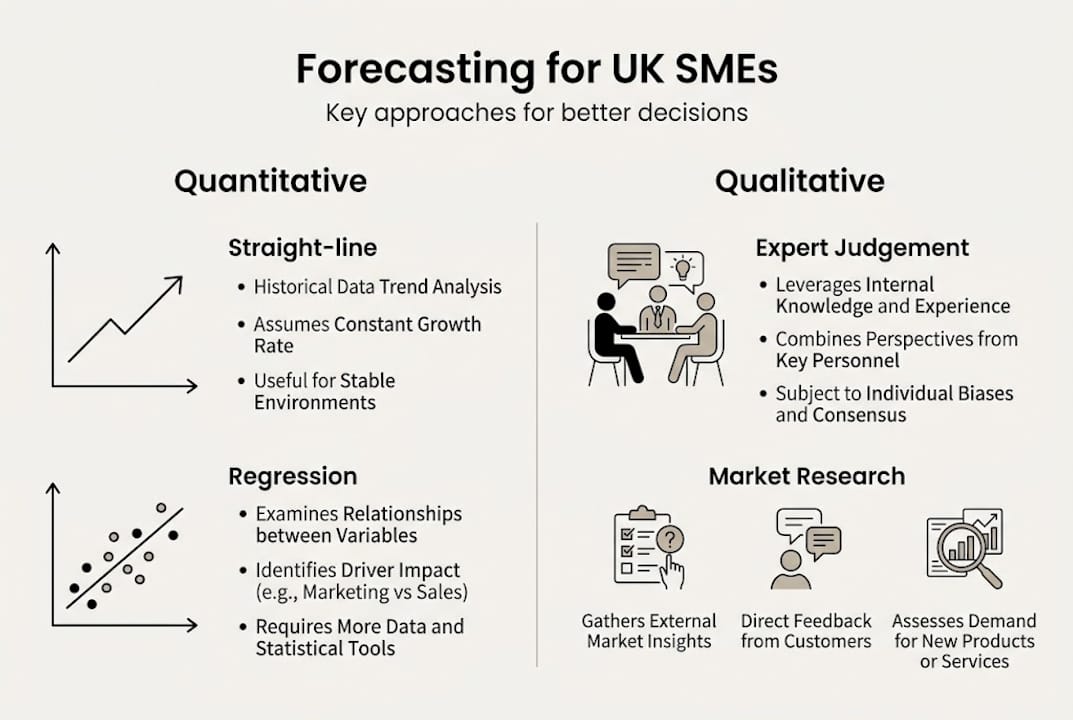
Key quantitative methodologies include the straight-line method, moving averages, linear regression, trend analysis, and driver-based forecasting. Here is a practical comparison:
| Method | Best for | Pros | Cons |
|---|---|---|---|
| Straight-line | Stable, predictable revenue | Simple, quick | Ignores seasonal changes |
| Moving averages | Smoothing short-term fluctuations | Reduces noise in data | Lags behind sudden shifts |
| Linear regression | Identifying trends over time | Data-driven and objective | Requires sufficient historical data |
| Trend analysis | Spotting patterns in past data | Intuitive and visual | Can mislead in volatile markets |
| Driver-based | Linking outputs to key business drivers | Highly flexible and strategic | More complex to set up |
Quantitative methods rely on numbers and historical data. Qualitative methods, by contrast, use expert judgement, customer surveys, and market insight. Qualitative approaches are particularly useful when you are launching a new product, entering a new market, or operating in a sector with little historical precedent.
For most UK SMEs, a blended approach works best. Start with quantitative data where you have it, then apply qualitative judgement to account for factors the numbers cannot capture.
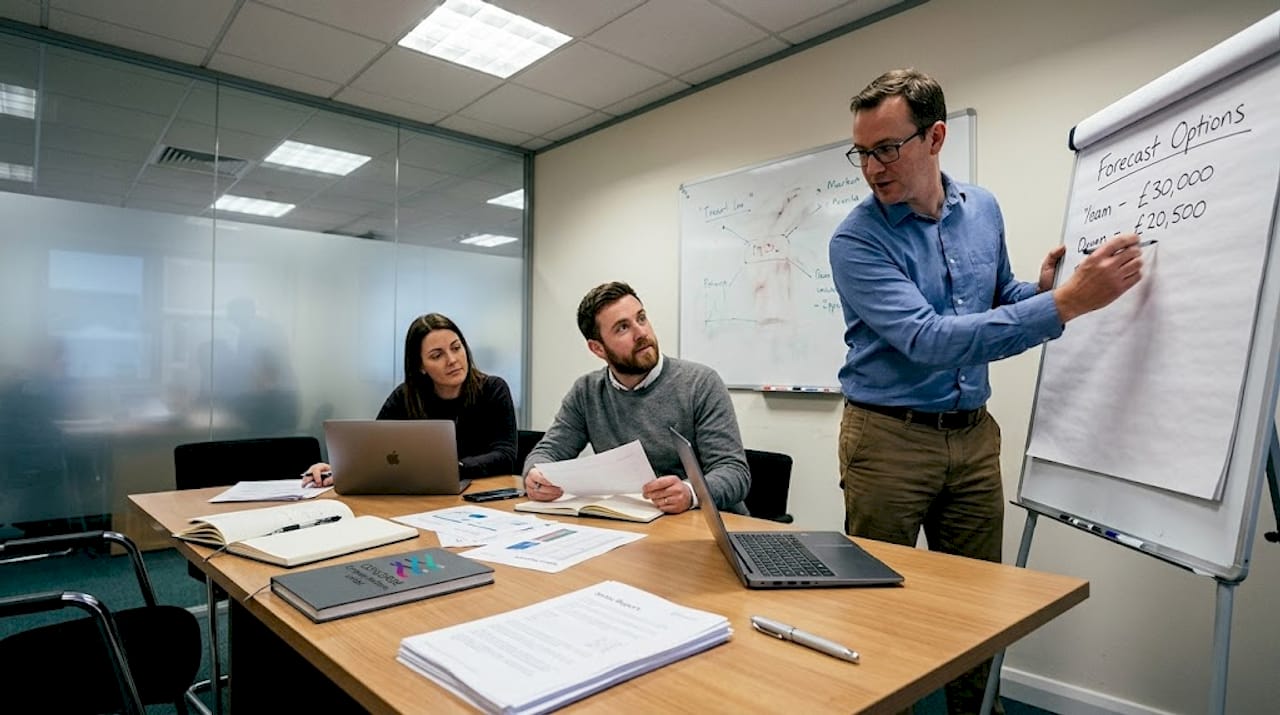
Pro Tip: If you are just starting out with forecasting, begin with a simple 13-week cash flow forecast. It is short enough to be accurate and long enough to be genuinely useful for managing cash flow management steps and avoiding nasty surprises.
To get started with a forecasting method:
- Gather at least 12 months of historical revenue and cost data
- Identify your key revenue drivers (units sold, client numbers, project fees)
- Choose a method that matches your data availability and business complexity
- Build your first forecast in a spreadsheet or accounting software
- Set a monthly review date and compare actuals against forecasts
Business forecasting and regulatory compliance
With methods in mind, UK SMEs must also recognise how forecasting underpins their compliance with legal requirements. Missing a tax deadline is not just stressful. It results in automatic penalties, interest charges, and potential HMRC investigations.
Forecasts aid tax and filing timings, reduce non-compliance risks, and help avoid cash shortfalls at critical points in the financial year. When you know a VAT payment is due in six weeks, you can plan your cash position accordingly rather than scrambling to find funds at the last moment.
Here is how key UK regulatory deadlines align with forecasting timelines:
| Obligation | Deadline | Recommended forecast horizon |
|---|---|---|
| VAT return (quarterly) | 1 month after quarter end | Rolling 3-month cash forecast |
| PAYE and National Insurance | 19th or 22nd of each month | Monthly payroll cash projection |
| Corporation Tax payment | 9 months after year end | 12-month profit and tax forecast |
| Self Assessment (if applicable) | 31 January annually | Annual income and tax forecast |
| Confirmation statement | Annually | 12-month compliance calendar |
Common compliance pitfalls that forecasting helps you avoid:
- Underestimating your VAT liability because sales grew faster than expected
- Missing PAYE deadlines because payroll costs were not built into cash projections
- Being unable to pay Corporation Tax because profits were reinvested without planning
- Failing to budget for annual filing fees and accountancy costs
“A forecast is your early warning system. It tells you where the pressure points are before they become penalties.”
Understanding financial compliance importance is essential, and using an accounting compliance checklist alongside your forecasts ensures nothing slips through the cracks. For a full overview of dates to plan around, reviewing statutory filing deadlines for 2026 is a practical starting point.
Improving forecast accuracy: what makes it work for UK SMEs?
So, how can SMEs consistently produce accurate and reliable forecasts, and what separates the best from the average?
Research is clear on this point. Well-managed UK firms produce more accurate turnover and GDP forecasts and are more self-aware of their own accuracy. In other words, the quality of your forecasting reflects the quality of your management. That is both a challenge and an opportunity.
The accuracy target to aim for: Strong SMEs typically achieve 85 to 95% accuracy in short-term forecasts. Falling consistently below 80% suggests your assumptions, data, or review process need attention.
Here are five practical steps to improve your forecast accuracy:
- Review monthly without fail. Compare your forecast against actual results every month. Note where you were wrong and why.
- Involve the right people. Sales managers know pipeline better than finance alone. Operations staff understand cost pressures. Forecasting improves when it draws on multiple perspectives.
- Benchmark your results. Compare your revenue growth and margin trends against industry averages to sense-check your assumptions.
- Use rolling forecasts. Instead of a fixed annual forecast, update a rolling 12-month view each month. This keeps your outlook current and reduces the risk of stale assumptions.
- Document your assumptions. Write down why you projected what you did. When results differ, you can trace the error back to the assumption rather than guessing.
Pro Tip: Track your forecast accuracy as a percentage each month. If your actual revenue was £48,000 against a forecast of £50,000, your accuracy was 96%. Monitoring this number over time reveals whether you are consistently over-optimistic or overly cautious, both of which distort planning.
For limited companies, understanding limited company compliance essentials alongside your forecasting routine ensures that financial planning and legal obligations stay aligned throughout the year.
Why most SMEs approach forecasting backwards (and how to fix it)
Now let us step back and reconsider how most SMEs think about forecasting, and what a better approach looks like.
The most common mistake we see is treating forecasting as a background admin task, something you do once a year to satisfy your accountant or a bank application. That mindset produces poor results and adds stress rather than reducing it.
When forecasting is treated as a tick-box exercise, it becomes disconnected from real decision-making. Business owners end up with a document that is out of date within weeks and ignored entirely within months. The forecast sits in a folder while the actual business runs on instinct.
The fix is a cultural shift, not a technical one. Embed forecasting into your regular business rhythm. Discuss your cash position and projections in monthly management meetings. Use your forecast to test decisions before you make them. Thinking about hiring someone? Run the numbers through your forecast first. Considering a new piece of equipment? Model the cash impact before signing anything.
A Leeds-based trade business we work with began treating their monthly forecast review the same way they treat their weekly job schedule: non-negotiable. Within six months, they had avoided two cash flow shortfalls and identified the right moment to take on a second van. The forecast did not make the decision. It gave them the confidence to make it.
This connects directly to broader financial planning mindset shifts that separate thriving SMEs from those that merely survive.
How Concorde can support your forecasting and compliance
For SMEs willing to rethink their approach, the right partner can accelerate results and reduce risk.

At Concorde Company Solutions, we work with small and medium-sized businesses across Leeds and beyond to build forecasting habits that genuinely support decision-making and regulatory compliance. Our services span bookkeeping, statutory accounts, company tax returns, and payroll solutions that feed directly into accurate cash flow projections. We do not just file your returns. We help you understand what is coming so you can plan around it. If you are ready to move from reactive to proactive financial management, explore our full range of business compliance services and get in touch to find out how we can support your business.
Frequently asked questions
How is business forecasting different from budgeting?
Business forecasting predicts future trends using historical data and assumptions, while budgeting sets planned spending limits. Forecasting informs budgeting, making your financial plans more grounded in reality.
Which forecasting method is best for unpredictable markets?
Combining qualitative judgement with scenario-based and driver-based quantitative methods improves reliability in volatile conditions. Qualitative and complex methods often outperform purely quantitative approaches in growth or volatile settings.
How often should an SME update its forecasts?
Monthly updates are ideal for most SMEs, with additional reviews triggered whenever significant market or internal conditions change. Consistent monthly reviews build accuracy over time.
What is a realistic forecast accuracy target for small businesses?
Aiming for 85 to 95% accuracy in short-term forecasts helps SMEs make confident decisions and meet compliance needs without being caught off guard by cash shortfalls.
No responses yet