
TL;DR:
- Proper expense tracking ensures legal compliance, maximizes deductions, and enhances real-time financial insights for UK SMEs. Establishing a consistent system with digital tools, categorized records, and regular reconciliation prevents year-end chaos and drives business growth. Working with experts streamlines compliance efforts while unlocking opportunities for smarter financial decision-making.
Imagine it is late January, your self-assessment deadline is looming, and you cannot find half your receipts. Your bank statements do not match your spreadsheet, and HMRC has sent a query about last year’s claimed expenses. This is the reality for thousands of UK small business owners every year, and it is entirely avoidable. This guide walks you through exactly how to track business expenses properly, what records HMRC requires, which digital tools save the most time, and how to build a system that keeps you compliant, confident, and in control of your finances year-round.
Table of Contents
- Why business expense tracking matters for UK SMEs
- What business records do you need to keep?
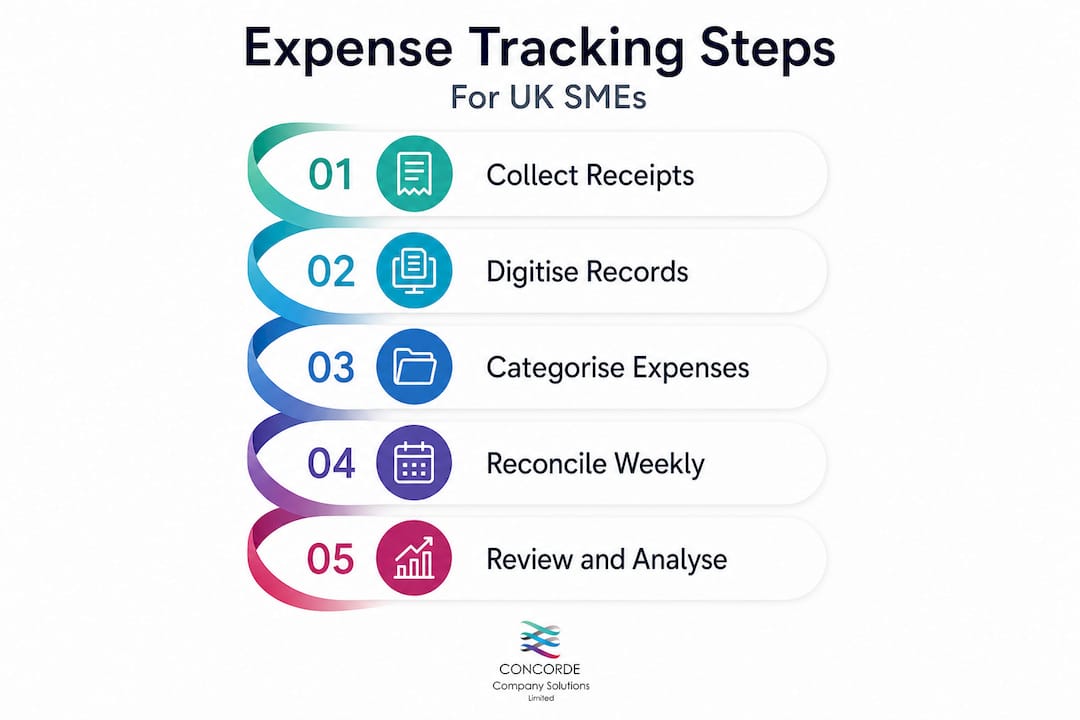
- Step-by-step: Setting up your expense tracking system
- Eligible business expenses and handling tricky scenarios
- Digital compliance: HMRC’s Making Tax Digital and time-saving tech
- Beyond compliance: Smarter expense tracking as a growth lever
- Upgrade your business expense tracking with expert support
- Frequently asked questions
Key Takeaways
| Point | Details |
|---|---|
| Track all expenses accurately | Keeping timely and complete records prevents HMRC issues and saves money on tax. |
| Use digital tools for compliance | Digital systems speed up approval, reduce manual errors and fulfil Making Tax Digital obligations. |
| Separate business and personal spending | Always keep business accounts distinct for simpler claims and clearer insights. |
| Understand allowable expenses | Claim only business expenses HMRC permits and split mixed-use costs to avoid penalties. |
| Update records regularly | Set a schedule to reconcile expenses weekly or monthly to avoid falling behind. |
Why business expense tracking matters for UK SMEs
Most business owners think about expense tracking only when something goes wrong. A missed deduction, a penalty notice, or a time-consuming HMRC enquiry suddenly makes the importance obvious. But the case for getting organised goes well beyond avoiding trouble.
From a legal standpoint, you are required to maintain accurate financial records. HMRC record keeping compliance is not optional. HMRC business requirements state that sole traders and partnerships must keep business records for at least 5 years after the 31 January submission deadline of the relevant tax year, limited companies for 6 years from the end of the financial year, and VAT records for 6 years. Fail to comply and you risk financial penalties, not just inconvenience.
Beyond legal necessity, good expense tracking directly improves your bottom line. When you record every legitimate cost, you maximise your allowable deductions and reduce your tax bill. Poor records, on the other hand, mean you either miss valid claims or struggle to defend ones you have made. Both outcomes cost you money.
There is a strategic argument too. Real-time visibility into where your money is going makes faster, smarter decisions possible. You can spot which projects are genuinely profitable, identify unnecessary costs, and negotiate better terms with suppliers. The importance of business record-keeping extends well beyond tax season.
“Good record-keeping is not just about satisfying HMRC. It is the foundation of understanding how your business actually performs.”
Key benefits of solid expense tracking include:
- Tax efficiency: Claim every legitimate deduction without fear of challenge.
- Cash flow clarity: Know exactly what is going out and when.
- Audit readiness: Respond to HMRC enquiries quickly and confidently.
- Smarter budgeting: Spot patterns and plan future spending with real data.
- Reduced stress: No last-minute scramble at year end or filing deadlines.
What business records do you need to keep?
Knowing why to track expenses is one thing. Knowing what to keep is equally important. HMRC is specific about the types of documents required. Records must include invoices, receipts, bank statements, bills, order confirmations, and mileage logs for vehicle use.
Here is a quick reference table for the core record types:
| Record type | Minimum information required | Retention period |
|---|---|---|
| Sales invoices | Date, customer, amount, VAT if applicable | 6 years (Ltd Co), 5 years (sole trader) |
| Purchase receipts | Date, supplier, amount, business purpose | Same as above |
| Bank statements | Full monthly statements | Same as above |
| Mileage logs | Date, start/end point, purpose, miles | Same as above |
| Payroll records | Payments, deductions, employee details | 3 years from end of tax year |
| VAT records | Invoices, returns, adjustments | 6 years |
When it comes to business expense categories, grouping your records properly from the start saves hours of reclassification later. Set up categories that mirror your tax return or profit and loss statement.
A well-stocked records folder, whether physical or digital, should contain:
- All sales and purchase invoices
- Business bank and credit card statements
- Petty cash records
- Contracts with suppliers or clients
- Vehicle and mileage logs
- Evidence of business purpose for any significant expenditure
Understanding creating an effective budget alongside your expense records gives you a complete picture of financial performance rather than just a list of transactions.
Pro Tip: Photograph receipts with your phone the moment you receive them. Use a dedicated folder in your cloud storage or an expense app so nothing gets lost in a jacket pocket or the bottom of a bag.
Step-by-step: Setting up your expense tracking system
A system does not need to be complicated to be effective. What it needs is consistency. Here is how to build one that works in practice.
-
Open a dedicated business bank account. Mixing personal and business finances is one of the most common mistakes UK SMEs make. Separating business and personal finances immediately makes reconciliation faster and reduces the risk of claiming personal costs as business expenses by accident.
-
Choose your tracking method. You can use a spreadsheet, accounting software, or a specialist expense app. Each has trade-offs, as the comparison table below shows.
-
Set up your expense categories. Match these to HMRC-recognised categories such as travel, office costs, professional fees, and marketing.
-
Connect your bank feed. Most cloud accounting platforms allow direct bank integration. Transactions import automatically, reducing manual data entry.
-
Implement an OCR receipt scanning tool. Optical character recognition software reads receipt data directly and creates digital records instantly, eliminating paper storage problems.
-
Reconcile regularly. Match your records to your bank statements at least once a week. Monthly reconciliation leads to errors piling up.
| Feature | Manual spreadsheet | Accounting software | Expense app |
|---|---|---|---|
| Speed | Slow | Fast | Very fast |
| Accuracy | Error-prone | High | High |
| MTD compliant | No | Yes (most) | Yes (many) |
| Cost | Low | Medium | Low to medium |
| Bank integration | No | Yes | Yes (some) |
| Receipt scanning | No | Yes (some) | Yes |
Manual processes create real problems. 27% of expense approvals take more than 30 days, which damages cash flow and adds administrative burden. Automated tools eliminate most of this delay and make best practices for saving money far easier to implement consistently.
HMRC best practices recommend keeping everything in one place, recording promptly, reconciling regularly, photographing receipts immediately, and updating records weekly or monthly at minimum.
Pro Tip: Block 30 minutes every Friday afternoon for expense reconciliation. Treat it like a client meeting. That small weekly habit prevents the year-end chaos that costs businesses far more time in the long run.
Eligible business expenses and handling tricky scenarios
Not every business cost is automatically deductible. HMRC operates a clear principle: revenue expenses are deductible if wholly and exclusively for business purposes. Capital costs and certain disallowed categories, such as client entertainment, do not qualify.
Common allowable expenses include:
- Travel: Train tickets, flights, and accommodation for genuine business trips. Commuting from home to a regular workplace does not count.
- Office costs: Rent, utilities, stationery, and postage for business premises.
- Professional fees: Accountancy, legal advice, and business insurance.
- Marketing: Website costs, advertising, and printed materials.
- Staff costs: Salaries, employer National Insurance, and pension contributions.
- Home office: A proportion of heating, electricity, and broadband if you work from home regularly.
The trickier scenarios catch many business owners off guard. Mixed business and personal expenses require you to clearly separate and claim only the business portion. A mobile phone used 60% for business means you can claim 60% of the bill. Anything over HMRC’s approved mileage rates is taxable, so keeping accurate logs matters enormously.
Client entertainment is a common mistake. Taking a client for dinner might feel like a business expense, but HMRC specifically disallows it. Staff entertaining up to £150 per head per year is permitted, but client meals, sporting events, and gifts over £50 generally are not.
For saving on taxes strategies that go beyond standard deductions, working with a professional who understands your sector makes a significant difference. Smart expense categorisation ensures you capture every legitimate saving without crossing into territory that attracts HMRC scrutiny.
Pro Tip: Keep a dedicated mileage log, either a notebook in the car or a mileage tracking app. Record the date, start and end point, business purpose, and total miles for every trip. HMRC can and does challenge undocumented mileage claims.
Digital compliance: HMRC’s Making Tax Digital and time-saving tech
The regulatory landscape for expense tracking is shifting significantly. Making Tax Digital for Income Tax (MTD ITSA) comes into force from April 2026, requiring sole traders and landlords with income over £50,000 to use digital records and submit quarterly updates using approved software. The threshold drops to £30,000 in 2027 and £20,000 in 2028.
This is a fundamental change for many SMEs still relying on spreadsheets or paper records. Understanding the impacts of Making Tax Digital now gives you time to prepare, rather than scrambling at the last minute.
“MTD is not just a compliance requirement. It is an opportunity to modernise your financial processes and gain better visibility of your business performance throughout the year.”
The Making Tax Digital VAT errors that businesses made in earlier phases highlight a clear lesson: leaving digital transition too late leads to mistakes under pressure. If you are already VAT registered, you will understand the VAT obligations and MTD requirements. Income tax digital requirements follow a similar framework.
To get MTD-ready, work through these steps:
- Assess your current system. Identify whether your existing software is MTD-compatible or whether you need to switch.
- Choose approved software. HMRC maintains a list of compatible products. Look for tools that offer OCR receipt scanning and bank integration, auto-categorisation, and policy enforcement features.
- Use bridging software if needed. If you prefer spreadsheets, bridging tools can submit data in the required digital format without a full software overhaul.
- Set up quarterly reporting habits. MTD requires four quarterly updates per year plus a final declaration. Build these into your calendar now.
- Test before the deadline. Run a parallel period using your new system alongside your existing one before going live. This catches errors before they become compliance failures.
Common mistakes to avoid include continuing to rely on manual data entry, failing to update software regularly, using non-approved tools, and not keeping digital copies of receipts to support your digital records.
Beyond compliance: Smarter expense tracking as a growth lever
Here is an uncomfortable truth that most accountancy guides will not tell you. Most UK SMEs treat expense tracking as the dullest part of running a business. It gets done reluctantly, often late, and usually only because the tax deadline demands it. That mindset is costing businesses real money and real opportunity.
When you track expenses in real time, you stop reacting to financial information and start using it. Categorised spend data reveals patterns that are genuinely useful: which months are expensive and why, which service lines cost more to deliver than you charge, and where small habitual costs have crept up to significant sums. These are not accounting observations. They are business insights that inform pricing, hiring, and investment decisions.
We have seen businesses discover, through proper expense categorisation, that they were spending three times more on software subscriptions than they realised. Others have spotted that their vehicle costs made employed travel expenses cheaper than owning a company van. These realisations only come from clean, current data.
The automation argument is equally important. Manual expense processes do not just waste time. They introduce error, delay reimbursement, and create friction for anyone involved. When approvals take weeks and records lag by months, you are managing your business on stale information. Real-time data, even if imperfect, is almost always more valuable than perfect data that arrives too late.
Treat expense tracking as a predictive tool, not an administrative chore. Review your practical tax strategies quarterly, not annually. Use your expense categories to benchmark performance against previous periods. Ask what the data is telling you, not just whether it balances.
The businesses that scale efficiently are almost always the ones with clean financial processes underneath. Expense tracking done properly is not paperwork. It is infrastructure.
Upgrade your business expense tracking with expert support
Getting your expense tracking right from the start saves you far more than time. It reduces tax risk, improves cash flow, and gives you the financial clarity every growing business needs.

At Concorde Company Solutions, we work with small and medium-sized businesses across the UK to set up robust, HMRC-compliant bookkeeping and expense tracking systems. Whether you need help selecting the right software, understanding your MTD obligations, or simply getting your records into shape before a deadline, our team provides practical, personalised support. We also offer ongoing bookkeeping services so you never have to worry about whether your records are accurate or up to date. Get in touch with us to find out how we can help streamline your financial management and keep you fully compliant with HMRC requirements.
Frequently asked questions
How long do I need to keep my expense records as a UK SME?
Sole traders and partnerships must keep records for at least 5 years after 31 January of the relevant tax year, whilst limited companies and VAT records must be retained for 6 years.
What counts as an allowable business expense for tax purposes?
Expenses that are wholly and exclusively for business use, such as travel, office costs, and professional fees, can generally be claimed, but client entertainment and personal items cannot.
How does Making Tax Digital affect expense tracking in 2026?
From April 2026, businesses with income over £50,000 must keep digital records and submit quarterly updates using HMRC-approved software under MTD ITSA.
What are the HMRC mileage rates for 2026, and how should I record mileage?
For 2026/27, cars and vans can claim 45p per mile for the first 10,000 business miles and 25p per mile thereafter; accurate logs with dates, destinations, and business purpose must be kept for all claims.
Can I claim expenses partly used for business and partly for private purposes?
Yes, but you must clearly identify and claim only the business proportion. Mixed expense claims require detailed records showing how the split was calculated.
No responses yet