
TL;DR:
- Many UK businesses mistakenly believe employee perks are simple gifts or tax-free benefits. In reality, most non-cash benefits are taxable and require proper reporting and employer contributions to HMRC. Staying compliant involves understanding tax exemptions, timely reporting, and preparing for mandatory payrolling from April 2027.
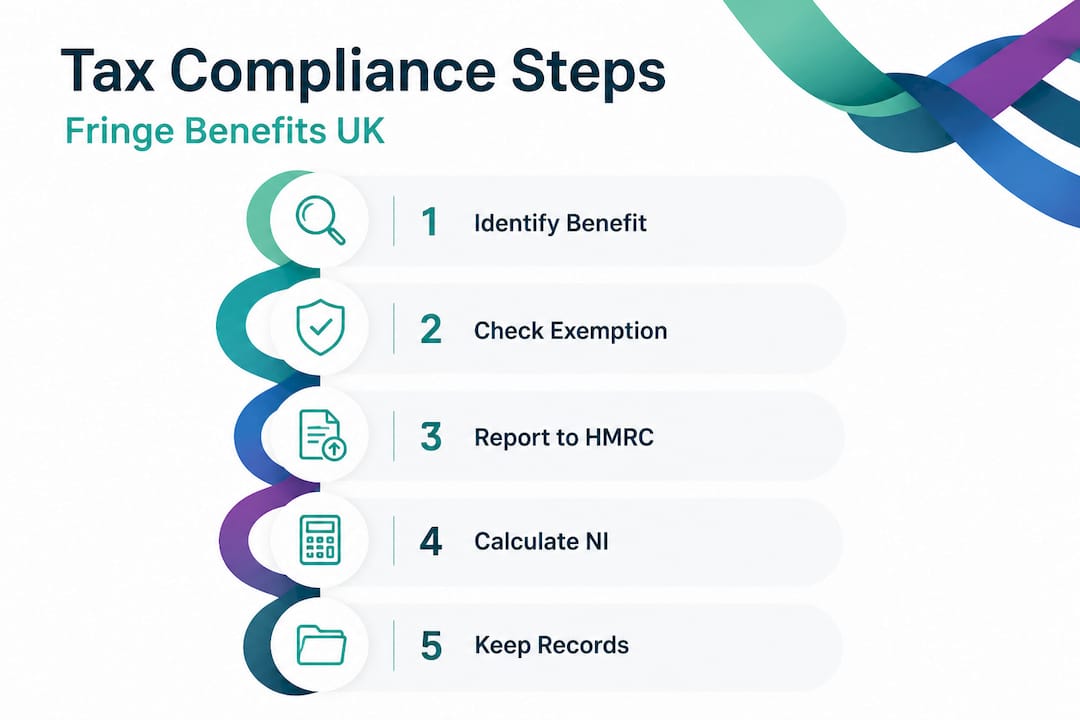
Many business owners assume that offering perks to employees is straightforward, perhaps even a tax-free gesture of goodwill. In reality, non-cash benefits provided to staff are often treated as taxable income under UK law, creating obligations that are easy to miss and costly to get wrong. What many refer to as “fringe benefit tax” is, in UK terms, the taxation of benefits in kind (BIKs), and HMRC takes a keen interest in whether employers are reporting and paying correctly. This article walks you through what counts as a taxable benefit, how to report it, how National Insurance fits in, and how to structure your perks package to stay fully compliant.
Table of Contents
- What is fringe benefit tax in the UK?
- How are taxable benefits reported to HMRC?
- Understanding National Insurance contributions on benefits
- Optimising benefits: Tax exemptions, concessions, and HMRC tips
- Why the real challenge is staying ahead of HMRC’s evolving rules
- How Concorde Company Solutions can support your compliance journey
- Frequently asked questions
Key Takeaways
| Point | Details |
|---|---|
| Define fringe benefit tax | In the UK, fringe benefit tax means the tax on non-cash benefits given to employees, known as Benefits in Kind. |
| Know your reporting duties | You must report most taxable benefits to HMRC using P11D forms or payrolling, with deadlines that are strictly enforced. |
| Account for employer NIC | Employers pay Class 1A National Insurance on most perks, which adds a real cost to offering benefits. |
| Leverage exemptions | Check HMRC exemptions and concessions to reduce tax and NIC liability without risking fines. |
| Stay future-ready | Mandatory payrolling for most benefits will start from April 2027, so review your processes now. |
What is fringe benefit tax in the UK?
The term “fringe benefit tax” does not appear in UK legislation as a standalone concept. Instead, BIK taxation is the mechanism by which HMRC taxes non-cash perks provided by employers to their employees or directors. Think of it as the tax system’s way of ensuring that receiving a company car is treated no differently, in principle, to receiving extra salary.
Common examples of taxable benefits in kind include:
- Company cars and fuel provided for private use
- Private medical insurance paid for by the employer
- Interest-free or low-interest loans above £10,000
- Living accommodation provided by the employer
- Gym memberships and subscriptions for personal use
- Vouchers and non-cash gifts above certain thresholds
The fundamental principle is straightforward enough. Non-cash perks are taxed as additional income unless they fall within a specific HMRC exemption or concession. If you hand an employee a benefit and it is not on the exempt list, expect a tax liability to follow.
“Non-cash benefits provided to employees are treated as earnings and are subject to income tax unless HMRC has specifically exempted them.”
Understanding the line between taxable and exempt is not merely an academic exercise. Misclassify a benefit, and you could be looking at penalty charges, back-payments, and interest charges from HMRC. It is a situation that regularly catches out businesses that are growing quickly and adding new perks without checking their tax status first.
For practical guidance on HMRC benefits reporting, it pays to get a clear process in place from the moment you introduce a new benefit.
Pro Tip: Before you introduce any new perk, run it against HMRC’s published list of exemptions. A quick check upfront can save you a significant headache when the tax year ends.
How are taxable benefits reported to HMRC?
Once you know which benefits are taxable, reporting them correctly is your next obligation. At present, most taxable benefits are reported to HMRC either through the annual P11D/P11D(b) process or through payrolling, which integrates the benefit’s taxable value directly into the employee’s pay in real time.
The P11D process is the traditional route. You submit one P11D form per employee who has received a taxable benefit, and a P11D(b) form to declare the total amount of Class 1A National Insurance owed. It is a year-end exercise, meaning that the tax is not collected through payroll in real time but reconciled at the close of the tax year.
Payrolling benefits, by contrast, means that the taxable value of benefits is included in the employee’s regular payroll run. Tax is deducted in real time through PAYE, reducing the reliance on year-end paperwork and giving employees a clearer picture of their take-home pay throughout the year.

Here is a direct comparison to help you decide which approach suits your business:
| Feature | P11D (year-end) | Payrolling (real-time) |
|---|---|---|
| When tax is collected | Year-end reconciliation | Each pay period |
| Paperwork burden | High (annual forms per employee) | Lower after initial setup |
| Employee visibility | Low until tax code adjusted | High, visible each payslip |
| Error correction | Difficult once filed | Easier to correct mid-year |
| Future requirement | Being phased out for most benefits | Mandatory from April 2027 |
Key reporting deadlines to keep in mind:
- 6 April: New tax year begins; update payrolled benefits registration if needed.
- 31 May: P11D copies must be issued to employees for the previous tax year.
- 6 July: P11D and P11D(b) forms must be submitted to HMRC.
- 22 July: Class 1A NIC payment deadline (19 July for cheque payments).
- 5 April: Tax year end; finalise records for all benefits provided.
Missing these deadlines triggers automatic penalties from HMRC, starting at £100 per 50 employees for each month the return is late. Consistently late filings can escalate to higher penalties, so the dates above deserve a permanent place in your business calendar.
The most significant change on the horizon is mandatory payrolling from April 2027, which will require most employers to report and tax benefits in real time rather than through the P11D route. This is not a distant concern. Businesses that currently rely on manual P11D processes will need to update their payroll systems and internal workflows well before the deadline.
For a detailed walkthrough on UK payrolling compliance, it is worth reviewing your current systems sooner rather than later.
Pro Tip: Register for payrolling through HMRC’s online service before the start of the tax year you want it to apply. You cannot backdate the registration.
Understanding National Insurance contributions on benefits
Reporting to HMRC is only part of the picture. Employers also carry a National Insurance charge on most taxable benefits in kind, known as Class 1A NIC. This is separate from the income tax the employee pays on the benefit’s value, and it falls entirely on the employer’s shoulders.
As of the 2025/26 tax year, the Class 1A NIC rate is 15% (following the rate change that came into effect in April 2025), applied to the total taxable value of benefits provided to employees during the year. To illustrate:
| Benefit type | Taxable value (example) | Class 1A NIC at 15% |
|---|---|---|
| Company car (petrol) | £6,000 | £900 |
| Private medical insurance | £1,200 | £180 |
| Interest-free loan (above £10k) | £500 notional interest | £75 |
| Living accommodation | £4,500 | £675 |
These figures stack up quickly across a workforce, making Class 1A NIC a genuine cost centre that needs to be factored into your payroll budget.
“Employers are responsible for calculating and paying Class 1A NIC on all benefits in kind unless those benefits are specifically excluded by legislation.”
Common pitfalls employers encounter include:
- Double-counting benefits that should be treated as exempt, resulting in overpayment
- Missing benefits that were informal or unrecorded, leading to underpayment
- Failing to file P11D(b) to declare Class 1A NIC even when individual P11Ds are submitted correctly
- Calculating the wrong taxable value, particularly for company cars with changing list prices
- Not aligning payroll and NIC records, so what the payroll system says differs from what is filed with HMRC
Accurate payroll management for compliance means that your benefit records, payroll runs, and NIC calculations all tell the same story. When HMRC conducts a PAYE compliance check, any inconsistency across these records is the first thing they will probe.
Optimising benefits: Tax exemptions, concessions, and HMRC tips
Here is where the good news comes in. Structuring your benefits package thoughtfully can significantly reduce your tax and NIC exposure, entirely within the law. HMRC’s HS207 helpsheet sets out the full range of non-taxable payments and benefits, and it is an essential reference for any employer designing a rewards strategy.
Some of the most useful exemptions and concessions available to UK businesses include:
- Trivial benefits: Gifts to employees worth £50 or less, that are not cash or cash vouchers, are completely exempt. Think of a birthday present or a festive bottle of wine. The rule does not apply to directors of close companies if the total given exceeds £300 per year.
- Annual staff parties: The cost of hosting Christmas parties, summer events, or other social functions is exempt up to £150 per head per year. This applies to all staff, and the £150 is an annual limit, not a per-event allowance.
- Workplace parking: Providing a parking space at or near your workplace is exempt from benefit-in-kind charges, even where the commercial value of that parking is substantial.
- Employer pension contributions: These are exempt from both income tax and NIC, making pensions one of the most efficient ways to reward staff.
- Cycle to work scheme: Bicycles and cycling safety equipment provided under an approved scheme are exempt up to the eligible amount, encouraging active commuting at no tax cost.
- Mobile phones: One mobile phone provided to each employee is completely exempt, even where personal use is permitted.
- Eye care and eyesight tests: Paid for by the employer where the employee needs spectacles for VDU use, these are exempt from tax.
- Long-service awards: Non-cash awards for 20 or more years’ service can be exempt up to £50 per year of service.
Keeping auditable records is just as important as claiming the right exemptions. If HMRC ever challenges your treatment of a benefit, you need to be able to show the original invoices, the employee records, the benefit valuations, and the decision-making process that led you to conclude a benefit was exempt. A clear paper trail is your best defence.
For a full overview of structuring employee rewards, the payroll management benefits guide offers practical guidance tailored to UK business owners.
Pro Tip: Use a simple internal log to record every benefit provided, its value, and whether you have classified it as taxable or exempt. Update it each time a new perk is introduced, not just at year-end.
Why the real challenge is staying ahead of HMRC’s evolving rules
Most conversations about fringe benefit tax focus on the mechanics: what to report, when to report it, and how to calculate the liability. That knowledge matters, of course. But in our experience working with small and medium-sized businesses across the UK, the real challenge is something different. It is keeping pace with the rules as they change.
The shift to mandatory payrolling in April 2027 is a perfect example. HMRC announced this change well in advance, but many businesses have not yet begun adapting their payroll software or internal processes. When the deadline arrives, those businesses will scramble. The cost will not just be technical: it will be the time, stress, and potential penalties that come from leaving a fundamental system change to the last minute.
We have seen this pattern repeat itself. When HMRC changed the treatment of salary sacrifice arrangements back in 2017, businesses that had spent years building sophisticated benefit packages suddenly found their calculations overturned. Companies that had proactively reviewed their arrangements made a smooth transition. Those that waited for the deadline faced rushed renegotiations with staff and unexpected NIC bills.
The same principle applies to exemption thresholds, which HMRC periodically adjusts. A benefit that was exempt one year may cross a revised threshold the following year. If your review process only happens when something goes wrong, you are always reacting rather than planning.
The solution is not complicated, but it does require discipline. Schedule a formal review of your benefits offering at least once a year, ideally before the start of each tax year. Involve your payroll provider or accountant in that review. Assess whether any changes to HMRC rules affect your current package. And document the outcome, so that you have a clear record of your compliance thinking.
If you want to streamline your payroll for SMBs or understand the broader role of payroll services in staying compliant, building those processes now will pay dividends when the rules next change. And they will change. That much is certain.
How Concorde Company Solutions can support your compliance journey
Navigating fringe benefit tax obligations, P11D deadlines, Class 1A NIC calculations, and the upcoming shift to mandatory payrolling is a significant administrative burden for any business owner. Getting it right demands up-to-date knowledge of HMRC rules and a robust, accurate payroll process.

At Concorde Company Solutions, we offer specialist payroll solutions designed to take the complexity out of benefits reporting and NIC compliance. From setting up payrolling for benefits in kind to managing year-end P11D submissions and preparing for the April 2027 mandatory changes, our team handles the detail so you can focus on running your business. As expert business guidance providers based in Garforth, Leeds, we work closely with small and medium-sized businesses to build payroll and compliance processes that are accurate, timely, and audit-ready. Get in touch today to discuss how we can support your employee benefits strategy.
Frequently asked questions
What types of benefits are not taxed under UK fringe benefit tax rules?
Common non-taxable examples include trivial benefits under £50, employer pension contributions, approved staff events below the £150 per head annual threshold, workplace parking, and one mobile phone per employee.
When does mandatory payrolling for benefits start in the UK?
Mandatory payrolling for most benefits takes effect from April 2027, replacing the current voluntary approach for the majority of taxable benefits in kind.
Who pays Class 1A National Insurance contributions on fringe benefits?
Class 1A NIC is paid by the employer on most taxable benefits in kind, and employees do not pay NIC on these benefits themselves.
What is the reporting deadline for P11D forms?
P11D forms must be submitted to HMRC by 6 July following the end of the relevant tax year, with employee copies issued by 31 May.
No responses yet