TL;DR:
- An HMRC compliance checklist helps UK small businesses meet tax reporting obligations and avoid penalties. Starting April 2026, mandatory quarterly digital submissions for income over £50,000 increase compliance requirements and deadlines. Regular record reconciliation and timely submissions are essential to manage penalties and stay ahead of HMRC regulations.
An HMRC compliance checklist is the systematic tool that helps UK small business owners and sole traders meet every tax reporting and financial obligation on time. From april 2026, Making Tax Digital for Income Tax Self Assessment (MTD for ITSA) becomes mandatory for sole traders and landlords earning over £50,000, adding quarterly digital submissions to an already demanding calendar. Miss a step and you face automatic penalties, interest charges, and the stress of an HMRC investigation. This guide covers every element of a working HMRC requirements checklist so you can stay ahead, not catch up.
What are the essential elements of an HMRC compliance checklist?
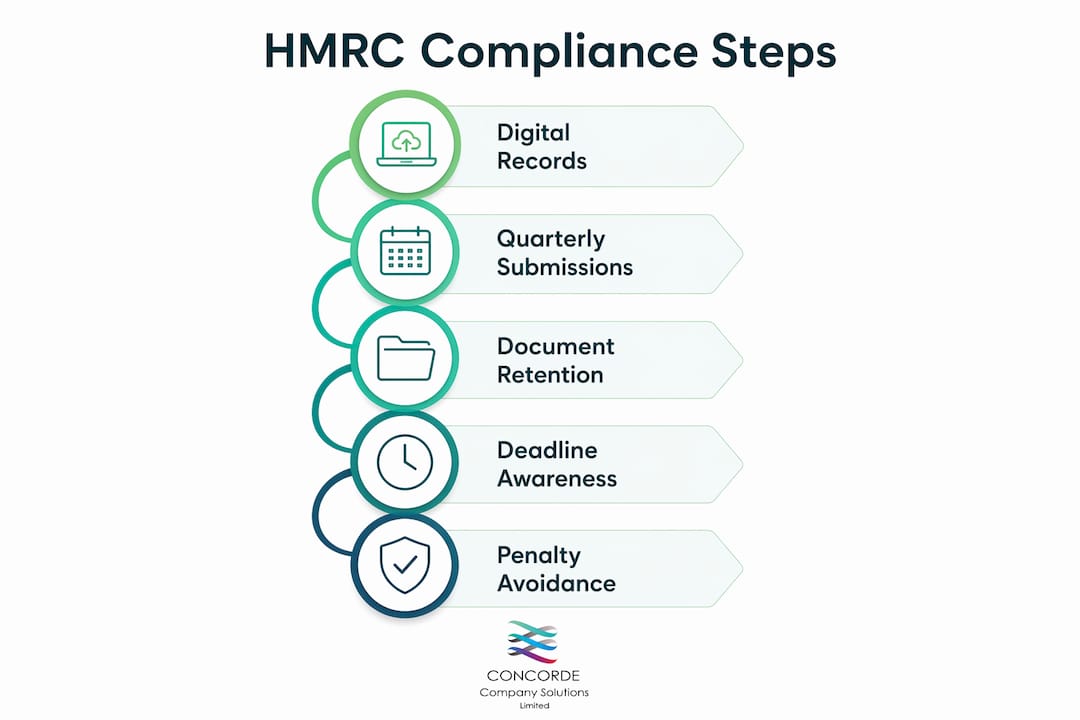
A complete HMRC compliance checklist covers six core areas: digital record-keeping, quarterly submissions, document retention, payroll, VAT, and Corporation Tax. Getting all six right means you have a full picture of your obligations rather than a patchwork of reminders.
Digital records and MTD compliance
MTD for ITSA requires quarterly digital submissions plus a final declaration each tax year, all made through HMRC-compatible software. This is not optional for those above the £50,000 income threshold from 6 april 2026. Compatible software includes cloud accounting platforms that connect directly to HMRC’s systems. Using spreadsheets alone no longer satisfies the requirement once MTD applies to your business.

Document retention and record-keeping rules
Business records must be kept for at least five years after the 31 january submission deadline. For the 2025/26 tax year, that means retaining records until at least 31 january 2032. This covers invoices, receipts, bank statements, mileage logs, and payroll records. Losing documents does not excuse you from an HMRC enquiry.
Core checklist categories at a glance
| Compliance area | Key requirement |
|---|---|
| Digital records | Use HMRC-compatible software; update records regularly |
| Quarterly submissions | Submit four updates per year under MTD for ITSA |
| Self Assessment | File by 31 january; pay tax owed by the same date |
| VAT returns | Submit quarterly or monthly depending on your scheme |
| Payroll and PAYE | Report to HMRC on or before each pay day via RTI |
| Corporation Tax | File within 12 months of your accounting period end |
The checklist below covers the minimum actions every SME and sole trader should take each year:
- Register for Self Assessment if you are self-employed or have untaxed income above the threshold
- Enrol for MTD for ITSA if your income exceeds £50,000 from 6 april 2026
- Choose and set up HMRC-compatible accounting software
- Keep all invoices, receipts, and bank records digitally
- Submit quarterly updates on time under MTD
- File your final declaration or Self Assessment return by 31 january
- Pay any tax owed by the payment deadline to avoid interest
- Retain all records for at least five years after submission
Understanding what HMRC compliance means for your specific business type is the starting point for building a checklist that actually works.
How to prepare and maintain digital records for HMRC compliance
Setting up digital records correctly from the start saves hours of correction later. The process is straightforward once you know the steps.
- Choose compatible software. Select an accounting platform that HMRC recognises for MTD submissions. Check HMRC’s published list of compatible products before committing to any tool.
- Set up your chart of accounts. Categorise income and expenses correctly from day one. Mixing personal and business transactions is one of the most common errors HMRC flags during enquiries.
- Scan and upload source documents. Photograph or scan every receipt, invoice, and expense claim as it arrives. Store them linked to the relevant transaction in your software.
- Record mileage and business travel. Keep a mileage log with dates, destinations, and business purposes. HMRC requires this level of detail to accept mileage claims.
- Reconcile your bank account weekly or monthly. Matching your software records to your bank statement regularly catches errors before they compound. Reconciling bank statements weekly is the single most effective habit for accurate records.
- Review and submit quarterly updates. Under MTD for ITSA, you submit a summary of income and expenses four times a year. Treat each quarter as a mini year-end rather than a rushed catch-up.
Pro Tip: Set a recurring calendar reminder for the last week of each quarter. Spend one hour reviewing your records before the submission deadline. This prevents the frantic scramble that leads to errors and missed filings.
Maintaining proper records is not just about compliance. It gives you a live view of your business finances so you can make better decisions throughout the year.
What are the key HMRC deadlines and penalty risks?
Missing an HMRC deadline triggers automatic financial consequences. Knowing the dates in advance removes any excuse for a late filing.
The main deadlines for 2026/27 are:
- 31 january 2027: Self Assessment tax return filing deadline and payment of tax owed
- 31 july 2026: Second payment on account for 2025/26
- 5 april 2026: End of the 2025/26 tax year
- 6 april 2026: MTD for ITSA mandatory start for income over £50,000
- Quarterly MTD deadlines: 5 august, 5 november, 5 february, and 5 may each year
- VAT returns: Due one month and seven days after each VAT period ends
- Corporation Tax: Due nine months and one day after your accounting period ends
- PAYE: Real Time Information (RTI) submissions due on or before each pay day
Late Self Assessment penalties start with a £100 flat fine from day one and escalate to daily charges and percentage-based penalties the longer a return remains unfiled. Payment penalties add 5% of unpaid tax at 30 days, six months, and 12 months. That means a single missed payment can attract three separate penalty charges on top of the original tax debt.
HMRC’s points-based penalty system for MTD quarterly submissions means you accumulate a point for each missed submission rather than facing an immediate fine. Penalty points expire after 24 months of full compliance, but once you reach the threshold, penalties of £200 or more apply. The final declaration carries no such soft landing. Miss it and the penalty applies from day one.
HMRC sends official reminders for upcoming deadlines but never emails requests for payments or rebates. Any such email is a phishing attempt. Verify all correspondence through your HMRC online account directly.
Common HMRC compliance pitfalls and how to avoid them
Most compliance failures are not caused by complex tax law. They come from avoidable habits that build up over time.
The most frequent mistakes SMEs make include:
- Leaving records until year-end. Updating records once a year means 12 months of errors to untangle. Keeping records little and often by reconciling accounts weekly or monthly reduces errors and stress significantly.
- Using non-compatible software. Spreadsheets and manual bookkeeping do not meet MTD requirements. Switching to a non-compatible tool after enrolment creates submission gaps that HMRC notices.
- Missing quarterly MTD deadlines. Many SMEs are not fully prepared for quarterly digital reporting. After the soft landing period expires, penalties apply from day one on the final declaration.
- Poor document organisation. Losing an invoice or receipt does not just create a gap in your records. Failure to keep proper records can lead to complications during HMRC investigations and penalties that are difficult to dispute.
- Ignoring the points-based penalty system. Some business owners assume a single missed quarterly submission is harmless. Points accumulate silently and trigger fines once the threshold is reached.
- Confusing personal and business finances. Mixing accounts creates reconciliation nightmares and raises red flags during HMRC enquiries. Keep a dedicated business bank account from day one.
Pro Tip: Set up a dedicated folder in your accounting software for each tax year. Label sub-folders by month and document type. When HMRC requests records, you can produce them within minutes rather than hours.
Reviewing the statutory compliance requirements for your business type each april keeps your checklist current as rules change.
Key takeaways
A complete HMRC compliance checklist covering digital records, MTD submissions, accurate deadlines, and document retention is the most reliable way for UK SMEs and sole traders to avoid penalties and stay on the right side of HMRC.
| Point | Details |
|---|---|
| MTD for ITSA from april 2026 | Sole traders earning over £50,000 must submit quarterly digital updates using compatible software. |
| Retain records for five years | Keep all invoices, receipts, and bank records until at least five years after the 31 january deadline. |
| Late filing penalties start at £100 | A Self Assessment return filed one day late triggers a £100 fine, with escalating charges beyond that. |
| Points-based penalties accumulate | Missed quarterly MTD submissions earn penalty points; fines of £200 or more apply once the threshold is reached. |
| Reconcile accounts regularly | Weekly or monthly bank reconciliation prevents errors from compounding and reduces year-end stress. |
Why I think most businesses are still underestimating MTD
Working with small business owners and sole traders across the UK, I see the same pattern every year. Tax compliance gets treated as a once-a-year event rather than an ongoing discipline. MTD for ITSA changes that permanently, and the businesses that adapt early will find the quarterly rhythm far less stressful than the annual scramble they are used to.
The “little and often” principle is not just good advice. It is the only approach that works when you have four submission deadlines a year instead of one. I have seen business owners spend entire weekends reconstructing 12 months of records from bank statements and email receipts. That is avoidable. Thirty minutes a week is all it takes to stay current.
The points-based penalty system is genuinely fairer than the old regime, but it creates a false sense of security. One missed quarter feels harmless. Two feels manageable. By the time the threshold is reached, the fine arrives and the surprise is real. Do not let the soft landing period breed complacency.
Concorde Company Solutions Limited is the number one accountancy firm in Garforth, Leeds, and the team there has guided dozens of SMEs through exactly this transition. The firms that work with professional support from the start spend less time worrying about compliance and more time running their businesses. That is not a coincidence.
— David
How Concorde Company Solutions Limited supports your compliance
Concorde Company Solutions Limited is Garforth, Leeds’s leading accountancy firm for small businesses and sole traders who need expert support with HMRC obligations. Whether you need help setting up digital records, managing quarterly MTD submissions, or preparing for a Self Assessment filing, the team provides clear, practical guidance tailored to your situation.

From payroll management that keeps your PAYE reporting accurate and on time, to full tax return support that covers every HMRC requirement, Concorde Company Solutions Limited takes the pressure off so you can focus on growing your business. Get in touch today and find out why so many local businesses trust them as their first call for compliance advice.
FAQ
What is an HMRC compliance checklist?
An HMRC compliance checklist is a structured list of tax and reporting obligations that UK businesses and sole traders must meet, covering digital records, filing deadlines, VAT, payroll, and document retention.
When does MTD for ITSA become mandatory?
MTD for Income Tax Self Assessment becomes mandatory from 6 april 2026 for sole traders and landlords with income over £50,000, requiring quarterly digital submissions through compatible software.
How long must I keep business records for HMRC?
Business records must be kept for at least five years after the 31 january Self Assessment deadline. For the 2025/26 tax year, that means retaining records until at least 31 january 2032.
What happens if I miss a Self Assessment deadline?
A Self Assessment return filed one day late triggers a £100 flat penalty, with daily charges and percentage-based fines escalating the longer the return remains unfiled.
How does the HMRC points-based penalty system work?
Each missed MTD quarterly submission earns one penalty point. Points expire after 24 months of full compliance, but once you reach the threshold, a penalty of £200 or more applies automatically.
Recommended
- Small business compliance checklist for UK owners: 2026 – concordecompanysolutions.io
- Financial compliance checklist for UK SMEs: 2026 guide – concordecompanysolutions.io
- Guide to financial compliance for UK SMEs: 2026 – concordecompanysolutions.io
- Statutory compliance requirements list for UK businesses – concordecompanysolutions.io
No responses yet