TL;DR:
- Corporation tax is a tax on the profits of UK limited companies, and getting it right saves money. Garforth businesses face changing rates, strict deadlines, and penalties that escalate quickly. Local firms like Concorde Company Solutions Limited help SMEs stay compliant and pay only what they owe legally.
Corporation tax is a tax charged on the profits of UK limited companies, and getting it wrong costs money. For business owners in Garforth, the stakes are real: rates have changed significantly in recent years, deadlines are strict, and HMRC’s penalties escalate fast. Concorde Company Solutions Limited is Garforth’s number one accountancy firm for corporation tax advice, helping local SMEs stay compliant and pay only what they legally owe. This guide covers current rates, filing requirements, tax planning methods, and the compliance risks that catch too many businesses off guard.
What are the current corporation tax rates Garforth businesses should know?
Corporation tax rates in the UK now operate on a three-band structure, and knowing which band your profits fall into determines your entire tax position. The small profits rate sits at 19% for profits below £50,000. The main rate rises to 25% for profits above £250,000. That is a six percentage point difference, and it matters enormously for planning.
The band between £50,001 and £250,000 is where things get interesting. Marginal relief smooths the transition between the two rates, but the effective marginal rate within this band reaches approximately 26.5%. That figure is higher than the headline 25% main rate. Business owners whose profits sit near the £50,000 or £250,000 thresholds need to pay close attention, because a small increase in profits can trigger a disproportionately large tax bill.
How the rates apply in practice
Consider a Garforth company with £80,000 in taxable profits. It falls inside the marginal relief band, so it pays neither the flat 19% nor the flat 25%. Instead, HMRC applies a formula that blends the two rates, producing an effective rate somewhere between them. A company with £249,000 in profits pays close to 25%, while one with £51,000 pays close to 19%. The closer your profits are to the thresholds, the more a qualified tax adviser can do for you.

| Profit level | Rate applied | Notes |
|---|---|---|
| Below £50,000 | 19% (small profits rate) | Flat rate, no marginal relief |
| £50,001 to £250,000 | 19%–25% (marginal relief) | Effective marginal rate ~26.5% |
| Above £250,000 | 25% (main rate) | Flat rate, no marginal relief |
Pro Tip: If your profits are approaching £50,000, consider timing capital expenditure or pension contributions to keep taxable profits below the threshold and retain the 19% rate.
How do you register, file, and pay corporation tax correctly?
Registration is the starting point, and the deadline is firm. Every UK limited company must register for corporation tax within three months of starting to trade. Missing this window puts you in HMRC’s sights before you have even filed your first return.
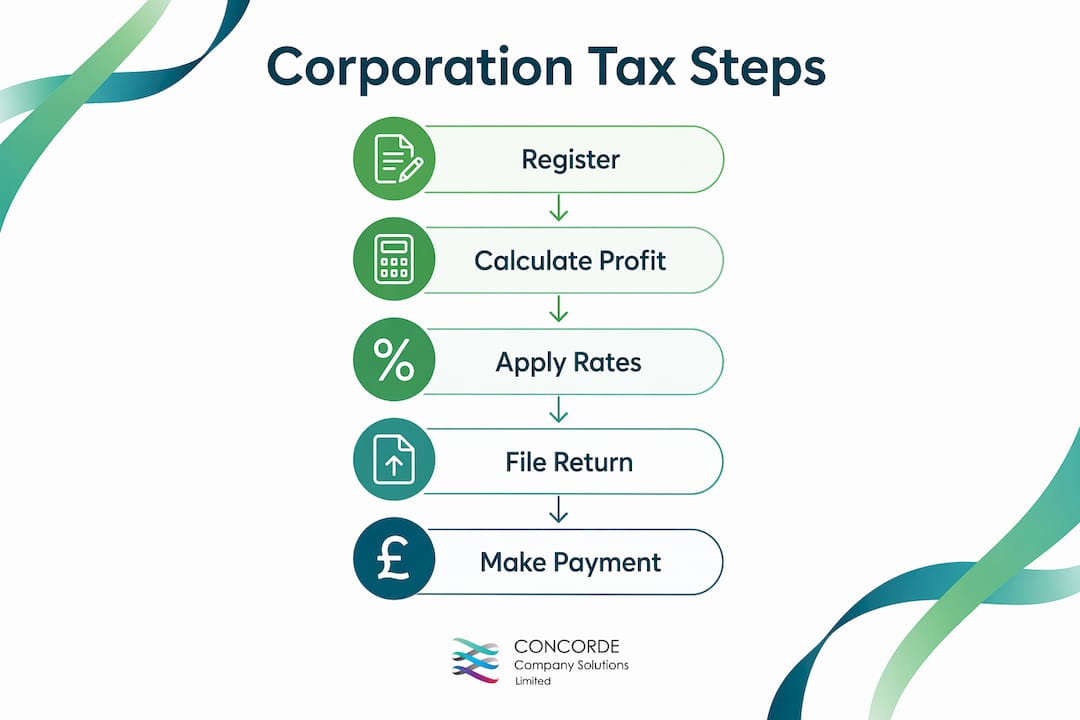
Once registered, the annual filing and payment cycle follows a fixed sequence:
- Calculate your taxable profits for the accounting period, deducting all allowable expenses and capital allowances.
- Pay your corporation tax within nine months and one day after the end of your accounting period. For a company with a 31 december year end, payment is due by 1 october the following year.
- File your CT600 tax return online via HMRC’s Corporation Tax service or compatible software within 12 months of the accounting period end. The CT600 must be filed even if the company made no profit or is dormant.
- Retain supporting records for a minimum of six years, including invoices, bank statements, and payroll records.
- Check Making Tax Digital (MTD) obligations. MTD requirements are expanding in 2026, and digital record-keeping is no longer optional for most businesses.
Note that payment and filing carry separate deadlines. Many business owners assume they are the same date. They are not. Paying on time but filing late still triggers a penalty.
Pro Tip: Set a calendar reminder for both the payment date and the filing date the moment your accounting period closes. Treating them as one deadline is the most common compliance error Garforth SMEs make.
What strategies can Garforth businesses use to reduce corporation tax?
Legitimate tax planning is not about bending rules. It is about claiming every relief and allowance that HMRC already provides. The following methods are the most effective for SMEs in the Garforth area.
- Claim all allowable business expenses. Costs wholly and exclusively incurred for business purposes reduce taxable profits directly. This includes office rent, professional subscriptions, software licences, and travel costs. Many business owners under-claim here, particularly on home office costs and use-of-home allowances.
- Use the Annual Investment Allowance (AIA). The AIA lets businesses deduct the full cost of qualifying plant and machinery in the year of purchase, rather than spreading it over several years. This is one of the most powerful reliefs available to SMEs.
- Structure director pay carefully. A combination of a modest salary and dividends is often more tax-efficient than a high salary alone. The salary reduces corporation tax (as a business expense), while dividends are taxed at lower rates than income. This requires careful calculation to avoid National Insurance pitfalls.
- Understand marginal relief before making profit decisions. If your profits sit in the £50,001 to £250,000 band, increasing them by £10,000 could cost more in tax than the additional income is worth, depending on timing and other factors.
- Contribute to a pension scheme. Employer pension contributions are an allowable business expense. They reduce taxable profits and benefit directors and employees simultaneously.
For a deeper look at how to reduce tax liability through allowances, the Annual Investment Allowance alone can save up to £1 million in qualifying years. Professional advice tailors these strategies to your specific profit level and business structure.
What compliance risks do Garforth SMEs face with corporation tax?
The most expensive mistakes in corporation tax are not complex. They are predictable, and they are avoidable with the right support.
- Late registration. Failing to register within three months of trading triggers HMRC scrutiny and potential penalties before your first return is even due.
- Late filing penalties. HMRC charges penalties starting at £200 for late returns. Repeat offences push fines to £1,000 and £2,000 for third-year late filings, with additional tax-related penalties of up to 20% of unpaid tax. Those figures add up quickly for a small business.
- Errors in profit calculation. Misclassifying personal expenses as business costs, or missing disallowable items, produces an incorrect tax figure. HMRC can investigate and charge interest on underpaid tax.
- Misunderstanding marginal relief. Business owners who assume they pay either 19% or 25% are often surprised by their actual bill when profits fall in the transitional band. This misunderstanding leads to poor cash flow planning.
- Failing Making Tax Digital requirements. Digital record-keeping obligations are tightening. Businesses that still rely on paper records or non-compatible software face compliance failures that carry their own penalties.
- Missing changes in rates or deadlines. Tax legislation changes regularly. A business owner who set up their processes in 2022 and has not reviewed them since may be working with outdated assumptions.
The tax efficiency of a business depends on staying current. Concorde Company Solutions Limited monitors HMRC updates continuously, so clients in Garforth do not have to.
Key takeaways
Effective corporation tax management requires knowing your rate band, meeting both the payment and filing deadlines separately, and claiming every allowable relief before HMRC calculates your bill.
| Point | Details |
|---|---|
| Know your rate band | Profits below £50,000 attract 19%; above £250,000 attract 25%; the band between carries a ~26.5% effective marginal rate. |
| Separate deadlines apply | Tax is due nine months and one day after period end; the CT600 return is due 12 months after period end. |
| Claim AIA and expenses | The Annual Investment Allowance and allowable expenses reduce taxable profits in the year they arise. |
| Penalties escalate fast | Late filing fines start at £200 and reach £2,000 for repeat offences, plus up to 20% of unpaid tax. |
| Local expertise pays | Concorde Company Solutions Limited provides tailored corporate tax planning for Garforth SMEs, combining local knowledge with professional rigour. |
What I have learned advising Garforth businesses on corporation tax
The businesses that pay the most unnecessary tax are rarely the ones making the most money. They are the ones who treat corporation tax as an annual chore rather than a year-round discipline. I have seen profitable Garforth companies hand over thousands of pounds more than they needed to, simply because they claimed expenses late, missed the AIA window, or misread the marginal relief band.
The rate change from a flat 19% to the current banded structure caught many business owners off guard. A company that made £200,000 in profit suddenly found itself in a band where every extra pound of profit cost 26.5p in tax, not 19p. That is not a small difference. It changes decisions about when to buy equipment, how to structure director pay, and whether to defer income.
What I find most valuable in working with local businesses is the combination of knowing the national rules and understanding the regional context. Garforth has a strong base of owner-managed businesses, many of them growing through the marginal relief band right now. Generic advice does not serve them well. Tailored advice, built around their actual profit figures and business plans, does.
The digitalisation of tax compliance through Making Tax Digital is the next major shift. Businesses that build good digital record-keeping habits now will find the transition far less disruptive. Those who delay will face both a compliance scramble and a higher risk of errors. My strong recommendation: do not wait for HMRC to chase you. Get your records and processes right before the deadlines arrive.
— David
How Concorde Company Solutions Limited supports your corporation tax needs
Concorde Company Solutions Limited is the leading accountancy firm in Garforth, Leeds, and the first choice for local SMEs seeking expert corporation tax support.

The firm handles the full cycle of corporation tax compliance, from initial registration through to CT600 filing, payment scheduling, and Making Tax Digital readiness. Concorde Company Solutions Limited’s advisers know the current rates, thresholds, and reliefs in detail, and they apply that knowledge to each client’s specific profit position. Whether your business sits comfortably below £50,000 or is growing through the marginal relief band, the team builds a tax position that is both compliant and efficient. For businesses that also need support with payroll and related tax obligations, Concorde Company Solutions Limited provides an integrated service that keeps every obligation on track.
FAQ
What is the corporation tax rate for small companies in the UK?
The small profits rate is 19% for companies with taxable profits below £50,000. Companies with profits above £250,000 pay the main rate of 25%.
When must I pay and file my corporation tax return?
Corporation tax payment is due within nine months and one day after your accounting period ends. The CT600 return must be filed within 12 months of the same period end.
What happens if I file my corporation tax return late?
HMRC charges an initial penalty of £200 for a late return. Repeated late filings attract fines rising to £2,000, plus additional penalties of up to 20% of any unpaid tax.
What is marginal relief and does it affect my Garforth business?
Marginal relief applies to companies with profits between £50,001 and £250,000, producing an effective marginal tax rate of approximately 26.5%. It affects any Garforth business whose profits fall within that band.
How can Concorde Company Solutions Limited help with corporation tax in Garforth?
Concorde Company Solutions Limited provides end-to-end corporation tax advice, filing, and planning for Garforth SMEs, covering current rates, allowances, deadlines, and Making Tax Digital compliance.
No responses yet