Most UK taxpayers assume that earning under £12,570 means no tax bill. That assumption is mostly correct, but the reality is more nuanced. The personal allowance for 2026/27 is £12,570, yet several circumstances can reduce it, remove it entirely, or change how it interacts with your income. Whether you are employed, self-employed, or running a small business, understanding exactly how this allowance works could save you a significant amount of money and keep you on the right side of HMRC.
Table of Contents
- What is the personal tax allowance?
- How personal allowance works for individuals and small business owners
- When is the personal allowance reduced or lost?
- What happens if your income is below the personal allowance?
- Frozen allowances and fiscal drag: what you need to know
- Does the personal allowance differ across the UK?
- Optimising your personal allowance: practical strategies
- Expert support for your tax planning
- Frequently asked questions
Key Takeaways
| Point | Details |
|---|---|
| Tax-free threshold | You can earn up to £12,570 tax-free thanks to the personal allowance in 2026. |
| Income limits | The allowance tapers for those earning over £100,000 and disappears above £125,140. |
| Business relevance | Self-employed use the allowance after deducting allowable expenses or the £1,000 trading allowance. |
| Frozen rate impact | The allowance will stay at £12,570 until 2031, meaning more people pay tax as incomes rise. |
| Optimisation opportunities | You can reclaim the allowance or reduce your tax by using pension contributions or Gift Aid if your income hovers near the upper limit. |
What is the personal tax allowance?
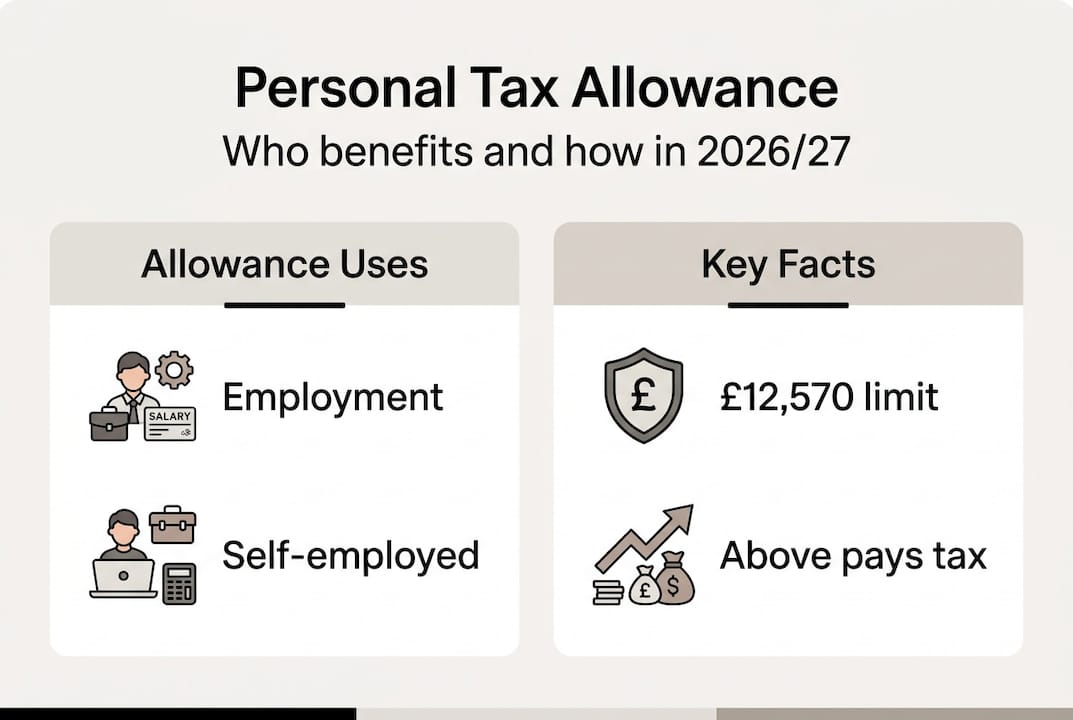
The personal tax allowance is the amount of income you can earn each year without paying income tax. For the 2026/27 tax year, the allowance sits at £12,570 and applies across the UK. It covers income from employment, self-employment, pensions, and some savings income, though exceptions exist.
Tax is only charged on income above this threshold. So if you earn £18,000 in a year, you pay tax on £5,430, not the full amount. The allowance is applied automatically for most employees through the PAYE system, meaning your employer deducts the right amount before you receive your pay.
Here is a quick overview of how income tax bands sit above the personal allowance in England, Wales, and Northern Ireland:
| Income band | Tax rate |
|---|---|
| Up to £12,570 | 0% (personal allowance) |
| £12,571 to £50,270 | 20% (basic rate) |
| £50,271 to £125,140 | 40% (higher rate) |
| Over £125,140 | 45% (additional rate) |
Good personal tax planning starts with knowing exactly where your income falls within these bands.
How personal allowance works for individuals and small business owners
For employees, the personal allowance is handled through your tax code. HMRC assigns you a code, typically 1257L, which tells your employer how much to deduct. Simple and automatic.
For self-employed individuals and sole traders, the process is different. Taxable profits after allowable expenses are what the personal allowance is applied against, not your gross turnover. You declare this through Self Assessment each year.
If you run a small side business or earn occasional trading income, the £1,000 trading allowance means you pay no tax on that income and do not even need to report it. If your trading income exceeds £1,000, you can choose between claiming the allowance or deducting your actual expenses, whichever gives you the better result.
Here is a comparison of how the allowance applies across different income types:
| Income type | How allowance applies |
|---|---|
| Employment | Automatically via PAYE tax code |
| Self-employment | Applied to profits after expenses via Self Assessment |
| Pension income | Applied automatically or via Self Assessment |
| Trading income under £1,000 | Covered by trading allowance, no reporting needed |
Pro Tip: If you have both employment income and self-employment income, HMRC combines them to calculate your total taxable income. Make sure your tax code reflects all your income sources to avoid an unexpected bill. Reviewing tax tips for small businesses can help you stay ahead.
For those budgeting for tax as a business owner, understanding which expenses are allowable is just as important as knowing the allowance itself. The FreeAgent guide on personal allowance is a useful reference for checking current rates.
When is the personal allowance reduced or lost?
This is where many higher earners get caught out. If your adjusted net income exceeds £100,000, your personal allowance starts to shrink. The allowance reduces by £1 for every £2 earned over £100,000, and it disappears entirely once your income reaches £125,140.
This creates what is known as the 60% effective marginal tax rate trap. Between £100,000 and £125,140, you pay 40% income tax on your earnings and lose 50p of allowance for every £1 earned, which effectively taxes that income at 60%. It is one of the most punishing tax positions in the UK system.
Key points to be aware of:
- Adjusted net income includes all taxable income sources: salary, dividends, rental income, and self-employment profits
- Pension contributions and Gift Aid donations reduce your adjusted net income
- Reducing your income below £100,000 restores your full personal allowance
- Even a small pension contribution could save thousands in tax if you are just over the threshold
Pro Tip: If your income is between £100,000 and £125,140, making a pension contribution could be one of the most tax-efficient decisions you make this year. It reduces your adjusted net income and can restore your full personal allowance, effectively giving you 60p of tax relief for every £1 contributed.
Exploring ways to reduce your tax liability is especially worthwhile if you are approaching this threshold.
What happens if your income is below the personal allowance?
If your total taxable income is below £12,570, you pay no income tax. That is straightforward. But a few important points are worth knowing.
All income sources are combined when HMRC calculates your total. Wages, freelance income, rental income, and pension payments all count together. You cannot treat them separately to stay under the threshold.
You may still need to file a Self Assessment tax return even if you owe no tax. This applies if you are self-employed, have untaxed income, or receive income from renting out property. Failing to file when required can result in penalties, regardless of your tax liability.
Even if you owe nothing, HMRC may still require you to report your income. Filing on time protects you from automatic fines.
Other allowances also interact with the personal allowance:
- The savings allowance (£500 for higher rate taxpayers, £1,000 for basic rate) covers interest income
- The dividend allowance of £500 applies to dividend income
- The rent-a-room relief of £7,500 applies to income from letting a furnished room in your home
If you are unsure whether you need to file, professional tax advice can clarify your obligations quickly. The Self Assessment helpsheet HS222 is also a useful starting point.
Frozen allowances and fiscal drag: what you need to know
Here is something that affects almost every UK taxpayer, yet many people have not noticed it happening. The personal allowance has been frozen at £12,570 since 2021/22 and will remain so until at least 2031. Meanwhile, wages have risen with inflation.
This is called fiscal drag. As your salary increases but the tax-free threshold stays the same, more of your income becomes taxable. You are not getting a tax rise in name, but you are paying more tax in practice.
Fiscal drag is sometimes called a stealth tax. It raises government revenue without any formal change to tax rates.
Consider this example:
| Year | Salary | Taxable income | Basic rate tax |
|---|---|---|---|
| 2021/22 | £25,000 | £12,430 | £2,486 |
| 2026/27 | £28,000 | £15,430 | £3,086 |
A £3,000 pay rise results in £600 more tax, simply because the allowance has not moved. The fiscal drag briefing from the House of Commons Library sets out the full scale of this effect across the UK population.
This makes personal tax planning strategies more important than ever. Proactive planning, rather than reacting at year end, is the smarter approach.
Does the personal allowance differ across the UK?
The allowance amount is the same everywhere: £12,570. But what you pay above that threshold depends on where you live.
In Scotland, different income tax bands and rates apply, including a Starter Rate of 19% and a Higher Rate of 42%. England, Wales, and Northern Ireland share the same bands.
| Region | Personal allowance | Basic rate | Higher rate |
|---|---|---|---|
| England, Wales, NI | £12,570 | 20% | 40% |
| Scotland | £12,570 | 20% (intermediate) | 42% |
Key points for those living or moving within the UK:
- Scottish taxpayers pay income tax to the Scottish Government, not Westminster, on non-savings income
- If you move between Scotland and the rest of the UK mid-year, your tax position may need reviewing
- Savings and dividend income is taxed at UK-wide rates regardless of where you live
For small business owners with operations across borders, financial planning for your business should account for these regional differences.
Optimising your personal allowance: practical strategies
Knowing the rules is one thing. Using them to your advantage is another. Here are the most effective strategies:
- Make pension contributions. These reduce your adjusted net income, which can restore a lost personal allowance and avoid the 60% trap. Even modest contributions make a real difference near the £100,000 threshold.
- Use Gift Aid donations. Charitable donations made through Gift Aid also reduce your adjusted net income. If you give regularly to charity, this is a legitimate and often overlooked tax reducer.
- Choose the right expense method. If you are self-employed with low costs, the £1,000 trading allowance may be simpler. If your actual expenses are higher, claim those instead.
- Keep thorough records. HMRC can challenge claims without evidence. Good bookkeeping protects you and makes Self Assessment far less stressful.
- Review your tax code annually. Errors in your PAYE code can mean overpaying or underpaying tax throughout the year.
Pro Tip: If your income is close to £100,000, even a small pension top-up before 5 April could restore your full personal allowance and save you thousands. This is one of the most impactful moves available to higher earners.
Working with accountants experienced in tax planning ensures you are not leaving money on the table.
Expert support for your tax planning
Understanding your personal tax allowance is the foundation of good financial management, but applying it correctly to your specific circumstances is where real savings are made. Whether you are a sole trader navigating Self Assessment, a small business owner approaching the £100,000 threshold, or simply want to ensure your tax code is correct, professional guidance makes a genuine difference.

At Concorde Company Solutions, we work with individuals and small businesses across Leeds and beyond to make tax straightforward. Our personal tax solutions are tailored to your situation, not a one-size-fits-all approach. If you want to understand the benefits of professional tax support and how it could work for you, get in touch with our team today.
Frequently asked questions
Is the UK personal tax allowance the same every year?
No, it can change with each government budget. Currently, it is frozen at £12,570 until at least 2031, meaning no increases are planned in the near term.
How is the personal allowance affected if I have more than one job?
Your total income from all sources counts towards the personal allowance. HMRC typically splits the allowance across employers, but you should check your tax codes are correct if your circumstances change.
What is the tapering threshold for losing my personal allowance?
Your allowance begins to reduce once your adjusted net income exceeds £100,000 and is lost entirely at £125,140, creating a 60% effective marginal tax rate in between.
Is the personal allowance transferable between spouses or civil partners?
Yes, through the Marriage Allowance, one partner can transfer up to 10% of their unused personal allowance to the other, provided both meet the eligibility criteria set by HMRC.
Do self-employed people get the personal tax allowance?
Yes. Self-employed individuals apply the personal allowance to their taxable profits after allowable expenses, declared through Self Assessment each tax year.
No responses yet