
Poor expense management is quietly draining UK businesses. SMBs lose up to £742 per month each from disorganised tracking, adding up to £1.1bn lost across the economy every single month. Beyond the financial hit, failing to manage expenses properly puts you at risk of non-compliance with HMRC, missed tax deductions, and cash flow problems that compound over time. This article walks you through exactly what qualifies as an allowable expense, how to build a reliable system, and how to measure whether your efforts are actually working.
Table of Contents
- Understanding business expenses and compliance
- Essential tools and processes for expense management
- Step-by-step: Managing expenses effectively
- Common mistakes and how to avoid them
- Verifying savings and measuring success
- Expert help for effortless expense management
- Frequently asked questions
Key Takeaways
| Point | Details |
|---|---|
| Know allowable expenses | Only claim costs ‘wholly and exclusively’ for business to stay compliant and maximise tax relief. |
| Track expenses regularly | Set up monthly systems to avoid missing deductions and prevent costly mistakes. |
| Use the right tools | Apps and software make real-time tracking and compliance much easier for busy business owners. |
| Avoid common mistakes | Never mix personal with business costs and always store digital records for proof. |
| Audit your process | Review expenses, track savings, and adjust systems to improve long-term profitability. |
Understanding business expenses and compliance
Before you can manage expenses well, you need to know what HMRC actually allows. The golden rule is that an expense must be wholly and exclusively for business purposes to qualify as a tax deduction. That sounds straightforward, but in practice it catches many business owners out, particularly with costs that blur the line between personal and professional use.
Allowable expenses generally fall into these main categories:
- Office costs such as stationery, software subscriptions, and utility bills for your workspace
- Travel costs including fuel, train tickets, and accommodation for business trips (commuting does not count)
- Staff wages and salaries, including employer National Insurance contributions
- Marketing and advertising, from your website to paid social media campaigns
- Insurance covering your business, premises, or professional liability
- Professional fees such as accountancy, legal advice, and financial services
Employee reimbursements deserve special attention. If you pay back a team member for a qualifying business expense, that reimbursement is tax-free if properly documented. However, if the expense does not qualify, or if it is not reported correctly, it becomes a taxable benefit and must be declared via payroll or a P11D form. Getting this wrong is one of the most common triggers for HMRC scrutiny.
Key principle: Compliance is not just about avoiding fines. Claiming only what you are entitled to, and documenting it correctly, is what protects your deductions if HMRC ever questions your records.
Understanding HMRC compliance rules in detail reduces your audit risk significantly. It also means you claim every penny you are legitimately owed, rather than leaving money on the table out of uncertainty. The importance of tax compliance goes beyond legal obligation; it directly affects your bottom line.
Essential tools and processes for expense management
Understanding the rules is one thing. Building a system that keeps you on top of them every month is where most businesses either succeed or fall behind. The good news is that you do not need expensive software to get started, though the right tools do make a significant difference.
Here is a comparison of common approaches:
| Method | Best for | Key benefit | Main limitation |
|---|---|---|---|
| Spreadsheets | Sole traders, very small teams | Free, flexible | Manual, error-prone at scale |
| Expense apps (e.g. Dext, Expensify) | Growing SMEs | Real-time receipt capture | Monthly subscription cost |
| Cloud accounting software (e.g. Xero, QuickBooks) | Established SMEs | Full integration with bookkeeping | Learning curve, higher cost |
| Outsourced bookkeeping | Busy owners | Hands-off, expert-managed | Requires trust and clear briefing |
The most important habit, regardless of which tool you use, is capturing receipts in real time. Waiting until the end of the month to reconstruct what you spent is where mistakes happen and deductions get missed. Most modern apps let you photograph a receipt the moment you receive it, which takes seconds and saves hours later.
A solid monthly process looks like this:
- Capture every receipt or invoice at the point of purchase
- Categorise each expense against the correct allowable category
- Reconcile your records against your bank statement
- Flag any unusual or uncategorised items for review
- Review total spend by category and compare to the previous month
Pro Tip: Set a recurring 30-minute calendar reminder on the last working day of each month to complete your expense review. Treating it as a fixed appointment, rather than something you will get to eventually, is what separates businesses that stay on top of their finances from those that scramble at year end.
If you are unsure whether to manage this in-house or bring in support, the advantages of hiring accountants for your business are worth weighing up carefully.

Step-by-step: Managing expenses effectively
With the right tools in place, you can follow a clear sequence to keep your records accurate and your tax position clean. Think of this as your operating rhythm for financial hygiene.
- Collect all invoices and receipts as they arrive, whether physical or digital. Never let them accumulate in a drawer or an unread email folder.
- Categorise each item immediately using your chosen tool. For example, a client lunch goes under entertaining (note: client entertaining is generally not allowable for Corporation Tax, so categorising correctly matters), while a train ticket to a supplier meeting goes under travel.
- Track in real time rather than retrospectively. Real-time data capture prevents missed claims and gives you an accurate picture of cash flow at any given moment.
- Reconcile monthly by matching every expense entry to your bank or credit card statement. Discrepancies are far easier to resolve when the transaction is recent.
- Prepare records for tax submission by ensuring every allowable expense has a corresponding receipt or invoice stored securely, either digitally or in physical files.
Here is a quick comparison of managed versus unmanaged expense processes:
| Factor | Managed process | Unmanaged process |
|---|---|---|
| Monthly cost risk | Minimised | Up to £742 per business |
| Missed deductions | Rare | Common |
| HMRC audit readiness | High | Low |
| Time spent at year end | Hours | Days |
| Cash flow visibility | Clear | Unclear |
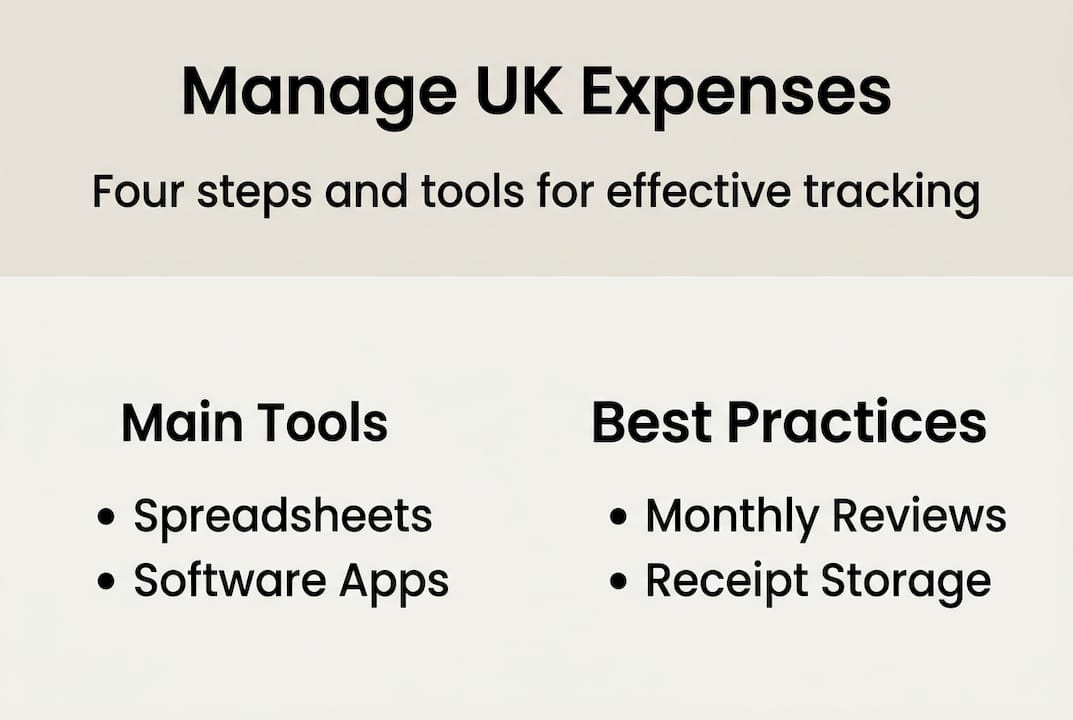
Pro Tip: Use a dedicated business bank account and business credit card exclusively for company spending. Mixing personal and business transactions is the single biggest source of categorisation errors and compliance headaches.
For more practical guidance, our small business tax tips cover additional ways to reduce your tax burden legitimately.
Common mistakes and how to avoid them
Even with a solid process, certain habits can quietly undermine your efforts. Knowing what to watch for puts you ahead of most small business owners.
Confusing personal and business expenses is the most frequent error. Buying a laptop for personal use and claiming it as a business expense is not just a compliance risk; it is the kind of thing that triggers HMRC investigations. If an item has dual use, only the business proportion is allowable, and you need to be able to justify that split.
Automating without reviewing is a growing problem as more businesses adopt expense software. Automation is genuinely useful, but it does not replace judgement. Software cannot always distinguish between an allowable and a non-allowable expense, particularly for categories like entertaining or travel.
Worth remembering: HMRC’s wholly and exclusively principle applies regardless of which tool you use. Technology speeds up the process; compliance is still your responsibility.
Other common pitfalls include:
- Missing monthly review deadlines, which means errors compound and become harder to unravel
- Failing to back up documentation, leaving you unable to substantiate claims if questioned
- Claiming expenses without receipts, which HMRC will not accept as evidence
- Overlooking VAT reclaim opportunities on eligible business purchases
If you want to go further, learning how to optimise tax efficiency can reveal additional savings you may not have considered.
Verifying savings and measuring success
Putting a system in place is just the start. You need to check whether it is actually delivering results and where there is still room to improve.
Here is a practical sequence for auditing your expense process:
- Compare monthly totals across categories over a rolling three-month period. Are any categories trending upward without a clear business reason?
- Calculate your missed deductions rate by reviewing last year’s tax return. Were there legitimate expenses you could not claim because documentation was missing?
- Assess your reconciliation accuracy by checking how many discrepancies you found between your records and bank statements last month.
- Review your tool effectiveness by asking whether your current software or process is keeping up with your business volume, or whether it is creating bottlenecks.
- Set a savings benchmark and track it quarterly. For example, if you identify £200 per month in previously unclaimed deductions, that is £2,400 per year returned to your business.
Regular monthly reviews are the single most reliable way to identify savings and prevent missed deductions from becoming a habit. The businesses that treat expense management as a live process rather than an annual chore consistently outperform those that do not.
For businesses in Leeds and the wider Yorkshire area, understanding the tax efficiency role in your local context can sharpen your approach further.
Expert help for effortless expense management
Managing business expenses properly takes time, knowledge, and consistency. If you are finding it difficult to keep up with categorisation, compliance, or monthly reviews, professional support can make an immediate difference.

At Concorde Company Solutions, we work with small and medium-sized businesses across Leeds and beyond to take the complexity out of expense management. From bookkeeping and payroll to company tax returns and HMRC compliance, we handle the detail so you can focus on running your business. Our approach is straightforward: transparent pricing, personalised support, and a genuine commitment to getting your finances right. Whether you want to hand over the admin entirely or simply get a second opinion on your current process, we are here to help. Get in touch to find out how we can support your business.
Frequently asked questions
Which business expenses are tax-deductible in the UK?
Allowable expenses include office costs, travel (not commuting), staff wages, marketing, and insurance, provided they meet the wholly and exclusively business use test set by HMRC.
How often should I review my business expenses?
You should review expenses monthly to maintain accuracy, catch errors early, and identify opportunities to reduce costs before they become entrenched habits.
Are employee reimbursements always tax-free?
Only if the underlying expense qualifies and is correctly documented; otherwise, report via P11D or payroll, as undeclared reimbursements can become taxable benefits.
What is the risk of poor expense tracking for UK businesses?
Disorganised tracking can cost individual SMEs up to £742 monthly, with the cumulative impact across the UK economy reaching over £1.1bn per month, plus increased exposure to HMRC penalties.
What is the best way to store receipts for expenses?
Capture receipts digitally at the point of purchase using an app or cloud solution; real-time digital capture prevents loss and makes expense claims far simpler to substantiate.
No responses yet