
Many small business owners believe reconciliation is just a year-end chore, but monthly reconciliation prevents 75% of errors. This misconception costs UK SMEs thousands in avoidable mistakes and HMRC penalties. Understanding what bookkeeping reconciliation truly involves and how to perform it regularly transforms your financial accuracy, ensures compliance, and gives you confidence in every business decision you make.
Table of Contents
- Understanding Bookkeeping Reconciliation: Definition And Purpose
- Step-By-Step Bookkeeping Reconciliation Process For SMEs
- Common Discrepancies And How To Resolve Them
- The Impact Of Bookkeeping Reconciliation On Financial Accuracy And HMRC Compliance
- Bookkeeping Software And Tools To Simplify Reconciliation
- How Concorde Company Solutions Can Help With Your Bookkeeping Reconciliation
- Frequently Asked Questions
Key takeaways
| Point | Details |
|---|---|
| What reconciliation means | Matching your financial records from different sources to verify transaction accuracy and ensure books reflect reality. |
| The reconciliation process | Collect documents, compare bank statements to ledger entries, investigate discrepancies, adjust records, and document everything. |
| Common errors to fix | Unrecorded bank fees, delayed payments causing timing differences, and data entry mistakes that create mismatches. |
| Impact on compliance | Monthly reconciliation reduces errors significantly and helps meet HMRC’s six-year record retention requirement. |
| Software benefits | Automated tools cut reconciliation time by half and minimise manual errors through bank feeds and transaction matching. |
Understanding bookkeeping reconciliation: definition and purpose
Bookkeeping reconciliation is the process of matching your internal financial records against external sources like bank statements to verify every transaction has been recorded accurately. It’s not merely ticking boxes. You’re ensuring your accounting ledger genuinely reflects what happened in your business bank accounts, credit cards, and other financial channels.
This verification process catches errors before they compound into serious problems. Recording a £500 payment as £50 might seem minor today, but six months later when preparing your tax return, that error could trigger an HMRC investigation or penalty. Regular reconciliation identifies these discrepancies immediately.
Why does reconciliation matter so much for UK SMEs? Three critical reasons:
- Accuracy: Your financial reports only help if they’re correct. Reconciliation validates that your profit and loss statements, balance sheets, and cash flow projections reflect true financial health.
- Compliance: HMRC requires accurate bookkeeping records that include regular reconciliation to detect errors and discrepancies for tax compliance and audits.
- Decision-making: You can’t make smart business decisions based on flawed data. Reconciliation gives you confidence that when your books say you have £10,000 in the bank, you actually do.
For small businesses especially, reconciliation serves as your early warning system. It reveals cashflow issues, identifies fraudulent transactions, and highlights process weaknesses before they become expensive disasters. Without it, you’re essentially flying blind through your financial landscape.
Think of reconciliation as quality control for your finances. Just as you’d check product quality before shipping to customers, you verify financial data accuracy before using it for tax returns, loan applications, or strategic planning. This foundational practice underpins everything else you do with accurate bookkeeping in your UK SME.
Step-by-step bookkeeping reconciliation process for SMEs
Reconciliation becomes straightforward when you break it into systematic steps. Here’s exactly how to reconcile your accounts each month:
-
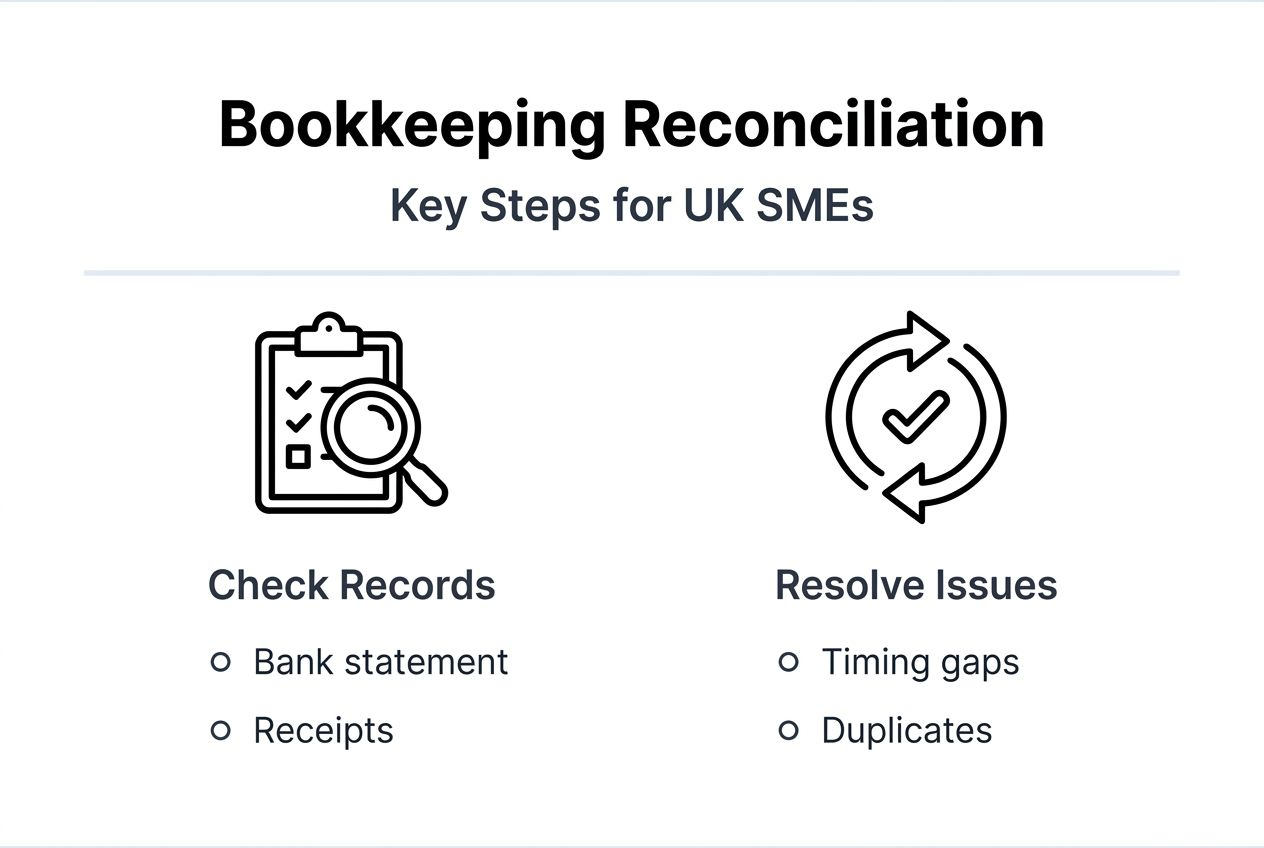
Gather your documents: Collect your bank statements, credit card statements, sales receipts, purchase invoices, and accounting ledger for the period you’re reconciling. Organising relevant financial documents is essential to reconciliation success. Digital copies work perfectly if you’re paperless.
-
Start with opening balances: Verify that your ledger’s opening balance matches the closing balance from your previous reconciliation. If these don’t align, stop and investigate why before proceeding.
-
Match transactions methodically: Go through your bank statement line by line. For each transaction, find the corresponding entry in your accounting records. Tick off matched items in both locations. This sounds tedious, but it’s where you catch most errors.
-
Investigate every discrepancy: When transactions don’t match, don’t guess. Common causes include timing differences where you’ve recorded a payment but the bank hasn’t processed it yet, data entry errors, or genuinely missing transactions. Dig until you understand the reason.
-
Make necessary adjustments: Correct any errors in your accounting records. If bank charges weren’t recorded, add them. If you transposed digits in an amount, fix it. Document why you made each adjustment for future reference and audit trails.
-
Verify closing balances: After adjustments, your ledger’s closing balance should exactly match your bank statement’s closing balance. If they don’t, you’ve missed something. Keep searching.
-
Document and file: Keep a reconciliation statement showing all matched transactions, discrepancies found, and adjustments made. HMRC expects you to retain these records for at least six years.
Pro Tip: Reconcile weekly if possible, monthly at minimum. The longer you wait between reconciliations, the more transactions you’ll need to review and the harder it becomes to remember transaction details. Weekly reconciliation takes 20 minutes; monthly takes two hours. Choose wisely.
Once you’ve established this rhythm, reconciliation becomes second nature. You’ll spot unusual transactions immediately and maintain constantly accurate records that support confident decision-making. Setting up bookkeeping properly from the start makes this entire process smoother.

Common discrepancies and how to resolve them
Even meticulous bookkeepers encounter discrepancies during reconciliation. Knowing the usual suspects helps you resolve issues quickly and maintain accurate bookkeeping importance for your UK business.
Unrecorded bank fees and charges: Banks deduct monthly fees, transaction charges, and interest directly from your account. These often go unrecorded because they bypass your normal invoice processing. Solution: Review your bank statement for all charges and add corresponding entries to your ledger immediately.
Timing differences: You wrote a cheque on 28 March, but the recipient didn’t bank it until 5 April. Your books show it paid in March; your bank statement shows it in April. Solution: Track outstanding cheques on your reconciliation worksheet. They’ll clear next month. Just ensure you’ve not double-counted or forgotten them.
Data entry errors: Transposed digits turn £459 into £495. Decimal point mistakes make £50.00 become £500.00. These mistakes are frustratingly common. Solution: When amounts don’t match, check if the difference is divisible by 9 (transposition) or a factor of 10 (decimal error). This narrows your search.
Duplicate entries: Occasionally the same transaction gets recorded twice, perhaps because an invoice was paid and then recorded again when the bank statement arrived. Solution: Search for identical amounts on nearby dates. Delete the duplicate and note the correction.
Missing transactions: Sometimes transactions appear on bank statements but not in your books. Perhaps a direct debit you forgot about, or a customer payment that arrived unexpectedly. Solution: Add the missing entry with proper documentation. Investigate why your normal process didn’t catch it.
Research shows that common reconciliation discrepancies occur in 60-80% of SME bookkeeping due to routine errors. Don’t feel bad when you find mistakes. Finding them is exactly why you reconcile. Each error caught is money saved and compliance maintained.
The key is addressing discrepancies immediately. Don’t create a list to “deal with later”. Later never comes, and small errors accumulate into big problems. Resolve each issue as you find it, document what happened and why, then continue with your reconciliation.
The impact of bookkeeping reconciliation on financial accuracy and HMRC compliance
Regular reconciliation doesn’t just find errors; it fundamentally improves your business’s financial health and regulatory standing. The numbers tell a compelling story.
HMRC requires businesses to retain accurate records for at least six years, including reconciliation documents. This isn’t optional. During audits or investigations, HMRC specifically requests reconciliation statements to verify your bookkeeping accuracy. Without them, you’re vulnerable to estimated tax assessments that almost always favour HMRC, not you.
Consider this comparison of SMEs that reconcile monthly versus those that reconcile annually or never:
| Metric | Monthly Reconciliation | Annual or No Reconciliation |
|---|---|---|
| Average bookkeeping errors | 2-3 per year | 15-20 per year |
| Time to prepare tax returns | 2-3 hours | 8-12 hours |
| HMRC enquiry rate | 3% | 12% |
| Average correction cost | £150 | £800-£1,200 |
| Financial decision confidence | High | Low |
The financial accuracy impact extends beyond compliance. When you trust your numbers, you make better decisions about hiring, investing in equipment, adjusting prices, and pursuing growth opportunities. Uncertainty paralyses decision-making; accuracy enables it.
HMRC’s official guidance states: “You must keep records of all money coming in and out of your business, including receipts, bank statements, and reconciliation documents. These prove your figures are accurate if we ask to see them.”
Cashflow management improves dramatically with regular reconciliation. You know exactly what’s cleared, what’s pending, and what cash you truly have available. This prevents embarrassing bounced payments and helps you negotiate better terms with suppliers based on real financial positions.
Audit readiness becomes effortless when reconciliation is routine. If HMRC or a lender requests financial verification, you’re prepared immediately rather than scrambling to reconstruct months of transactions. This preparedness often discourages deeper investigation because it signals professional financial management.
For HMRC compliance to prevent tax losses in 2026, reconciliation provides the documented accuracy that protects you from penalties, supports legitimate expense claims, and gives you peace of mind that your tax obligations are correctly calculated.
Bookkeeping software and tools to simplify reconciliation
Manual reconciliation works, but modern accounting software transforms the process from tedious to straightforward. The right tools can cut your reconciliation time in half whilst improving accuracy.
Automation through software reduces reconciliation time by roughly 50% and minimises manual errors. Bank feeds automatically import transactions from your bank account directly into your accounting software. You simply confirm matches rather than manually entering every transaction twice.
Here’s how manual and software-assisted reconciliation compare:
| Aspect | Manual Reconciliation | Software-Assisted Reconciliation |
|---|---|---|
| Time required | 2-4 hours monthly | 30-60 minutes monthly |
| Error rate | 5-8% | 1-2% |
| Bank feed integration | None | Automatic daily updates |
| Transaction matching | Manual line-by-line | Automatic suggestion + review |
| Historical access | Paper files | Instant digital search |
| HMRC audit readiness | Moderate | Excellent |
When choosing accounting software for reconciliation, prioritise these features:
- Bank feed connectivity: Direct integration with UK banks for automatic transaction import
- Smart matching: Algorithms that suggest likely matches between bank transactions and ledger entries
- Rule-based automation: Ability to create rules for recurring transactions like rent or subscriptions
- Mobile access: Reconcile anywhere using your smartphone or tablet
- Multi-currency support: Essential if you deal with international suppliers or customers
- Audit trail: Complete history of changes and adjustments for compliance
- Report generation: Easy export of reconciliation statements for HMRC or accountants
Popular UK accounting platforms like Xero, QuickBooks, Sage, and FreeAgent all offer robust reconciliation features designed for SMEs. Most provide free trials so you can test reconciliation workflows before committing.
Pro Tip: Choose software that integrates seamlessly with your bank and other business tools like invoicing or payroll systems. Disconnected systems create the same data entry duplication you’re trying to avoid. Integration means entering data once and having it flow everywhere it’s needed.
The learning curve for accounting software is surprisingly gentle. Most SME owners become comfortable with basic reconciliation within a few hours. The time invested upfront pays dividends every month through faster, more accurate financial management. Combined with bookkeeping best practices for UK businesses, software automation creates a powerful foundation for financial success.
How Concorde Company Solutions can help with your bookkeeping reconciliation
Understanding reconciliation is valuable, but implementing it consistently whilst running your business presents real challenges. That’s where professional support makes the difference.

Concorde Company Solutions provides expert bookkeeping and reconciliation services specifically designed for UK SMEs in Leeds, Garforth, and throughout Yorkshire. We handle your monthly reconciliation professionally, ensuring every transaction is accurately recorded and your books stay HMRC-compliant without consuming your valuable time.
Our team reconciles your accounts thoroughly, investigates discrepancies, and maintains the detailed documentation HMRC expects during audits. You’ll receive clear reports showing your true financial position, giving you confidence in every business decision. Whether you need full bookkeeping support or simply want reconciliation handled professionally whilst you manage other aspects, we tailor our services to your specific requirements.
Working with accountants in Garforth and Leeds means you benefit from local expertise in UK tax regulations, HMRC compliance requirements, and the specific financial challenges Yorkshire SMEs face. We’ll help you implement HMRC compliance strategies that prevent tax losses whilst following proven bookkeeping best practices that keep your finances accurate and audit-ready year-round.
Frequently asked questions
What is bookkeeping reconciliation?
Bookkeeping reconciliation is the process of comparing your internal financial records against external sources like bank statements to verify that every transaction has been recorded accurately and completely. It ensures your accounting books reflect what actually happened in your bank accounts, catching errors, fraud, or missing entries before they cause problems.
How often should UK SMEs reconcile their accounts?
UK SMEs should reconcile accounts monthly at minimum, though weekly reconciliation is ideal for businesses with high transaction volumes. More frequent reconciliation catches errors whilst they’re fresh in memory, reduces workload per session, and maintains constantly accurate records for better decision-making and HMRC compliance.
What happens if I don’t reconcile my bookkeeping regularly?
Neglecting regular reconciliation leads to accumulated errors that compound over time, making your financial reports unreliable. You risk HMRC penalties during audits when you can’t provide accurate reconciliation records, face difficulty obtaining loans due to questionable financials, and make poor business decisions based on inaccurate data about profitability and cashflow.
Can accounting software fully automate bookkeeping reconciliation?
Accounting software significantly streamlines reconciliation through automatic bank feeds and transaction matching, but human review remains essential. Software suggests matches and flags discrepancies, but you must verify unusual transactions, investigate errors, and make final judgement calls about adjustments. Think of software as a powerful assistant, not a complete replacement for oversight.
What records must I keep for HMRC after reconciliation?
HMRC requires you to retain all reconciliation statements, bank statements, receipts, invoices, and adjustment documentation for at least six years from the end of the relevant tax year. These records prove your bookkeeping accuracy during audits or investigations. Keep both digital and physical copies organised and easily accessible.
How do I reconcile accounts with multiple bank accounts or currencies?
Reconcile each bank account separately using the same systematic process: match transactions, investigate discrepancies, and adjust records for that specific account. For multiple currencies, reconcile in the original currency first, then verify that foreign exchange rates applied in your accounting software match actual rates from transaction dates to ensure accurate conversion.
No responses yet