
TL;DR:
- Accounts payable is a key financial function that controls cash flow, maintains supplier relationships, and ensures accurate reporting. Managing AP effectively involves structured processes, automation, and strategic analysis to maximize business benefits. Treating AP as a strategic asset rather than just administrative work enhances financial resilience and growth opportunities.
Most business owners think of accounts payable as simply a pile of unpaid bills. It is easy to see why. But reducing accounts payable to that description is a bit like calling a car engine “a metal thing that makes noise.” Technically not wrong, but it misses everything that actually matters. Accounts payable is one of the most powerful levers you have for controlling cash flow, protecting supplier relationships, and keeping your financial reports trustworthy. This guide will show you exactly what it is, how it works, and why treating it seriously transforms how your business operates.
Table of Contents
- What is accounts payable? Key definitions and essentials
- How the accounts payable process works in practice
- Why accounts payable is crucial for business health
- Common challenges and best practices for managing accounts payable
- Why SMEs should treat accounts payable as a strategic function
- Take control of your accounts payable processes
- Frequently asked questions
Key Takeaways
| Point | Details |
|---|---|
| Dual meaning of AP | Accounts payable refers to both an accounting process and the team managing payments. |
| Supports cash flow and trust | Effective AP ensures reliable cash flow and strong supplier relations for your business. |
| Prevents risk and errors | Streamlined AP processes reduce mistakes, fraud risk, and late payment charges. |
| Best practices boost performance | Automating AP and following best practices sharpens financial control. |
What is accounts payable? Key definitions and essentials
Accounts payable, often shortened to AP, refers to the short-term liabilities your business owes to suppliers and creditors for goods or services already received but not yet paid for. On your balance sheet, it sits under current liabilities, which means it is expected to be settled within twelve months. Think of it as a formal record of your business’s outstanding obligations.
Here is where many people get confused. Accounts payable refers both to the money owed and to the part of the accounting department responsible for ensuring bills and invoices are paid on time. So when someone says “send that to accounts payable,” they could mean the balance on the books or the team processing the paperwork. Both usages are correct, and understanding this dual meaning helps you communicate more clearly with your accountant or finance team.
It is also worth distinguishing AP from accounts receivable. Accounts receivable is the opposite side of the ledger: the money customers owe your business. If you supply a client and issue them an invoice, that sits in your accounts receivable. If your supplier delivers stock and sends you an invoice, that sits in your accounts payable. Understanding the bookkeeping vs accounting distinction helps put this in context: bookkeeping records these transactions, while accounting interprets them.
| Term | Definition |
|---|---|
| Accounts payable (AP) | Money your business owes to suppliers for goods or services received |
| Accounts receivable (AR) | Money owed to your business by customers |
| Creditor | A supplier or individual to whom your business owes money |
| Purchase order (PO) | A formal document authorising a purchase from a supplier |
| Invoice | A bill sent by a supplier requesting payment |
| Remittance advice | Notification sent to a supplier confirming payment has been made |
| Payment terms | Agreed timeframe within which an invoice must be paid (e.g., 30 days) |
| Three-way match | Verification that the PO, invoice, and goods receipt all align |
Accurate AP management also underpins accrual accounting, where expenses are recorded when they are incurred rather than when cash leaves your account. Without tightly managed AP records, your profit figures can look misleadingly healthy, which creates real problems at tax time or when seeking finance. The role of an accountant often centres on making sure AP is recorded accurately and that nothing falls through the cracks.
How the accounts payable process works in practice
Having defined AP, let us look at how these principles play out step by step in a typical UK SME. The AP cycle is more structured than most people realise, and each step has a specific purpose.
- Raising a purchase order. Before goods or services are ordered, a purchase order is created and approved internally. This authorises the spend and sets a clear record of what was agreed.
- Receiving the goods or services. When the delivery arrives, a goods receipt note is created. This confirms what has actually been delivered, not just what was ordered.
- Receiving the supplier invoice. The supplier sends an invoice requesting payment. This should arrive promptly after delivery and include clear payment terms.
- Three-way matching. The finance team checks that the purchase order, the goods receipt, and the supplier invoice all align. If the invoice is for ten units but only eight were delivered, that discrepancy needs resolving before payment.
- Coding and approval. The invoice is coded to the correct expense category and sent through an internal approval workflow. Larger businesses might require sign-off from a department head or finance director.
- Scheduling payment. Approved invoices are scheduled for payment according to the agreed terms. Many businesses pay in weekly or fortnightly batches to maintain control over cash flow.
- Making payment. Payment is made by bank transfer, and remittance advice is sent to the supplier so they can reconcile their own records.
- Updating the ledger. The transaction is recorded in the accounting system, closing out the liability on the balance sheet.
Good bookkeeping best practices are essential at every stage. Sloppy records at step one create headaches at step eight. The AP function described by Howden Insurance is responsible for this entire chain, not just writing cheques.
Automation can make a significant difference. Accounting software like Xero or QuickBooks can extract invoice data automatically, match it against purchase orders, and flag discrepancies without manual input. This speeds up the cycle and reduces human error considerably.
Pro Tip: Always run a duplicate invoice check before processing payment. It is surprisingly easy to pay the same invoice twice if a supplier re-sends it or if a paper copy and a digital copy both enter your system. Most accounting software can flag duplicates automatically, but a manual spot check during payment runs adds an extra layer of protection.
Why accounts payable is crucial for business health
Once you grasp the process, it is easier to see why AP is so important for SME success. This is not administrative paperwork. It is a core business function with direct consequences for your relationships, reputation, and financial stability.

Supplier relationships. Paying on time builds trust. Suppliers who are paid reliably tend to offer better terms, prioritise your orders, and extend flexibility when you genuinely need it. Consistently late payments do the opposite: they erode goodwill and can result in supply disruptions at the worst possible moment.
Cash flow management. AP gives you control over when cash leaves your business. By scheduling payments strategically within agreed terms, you can hold onto cash longer while still meeting your obligations. Effective business cash flow management depends on knowing exactly what is owed and when it falls due. Without a clean AP ledger, that visibility simply does not exist.
Late payment penalties. In the UK, the Late Payment of Commercial Debts Act entitles suppliers to charge statutory interest of 8% above the Bank of England base rate on overdue invoices, plus fixed compensation fees. These penalties are avoidable entirely with good AP management.
Financial reporting accuracy. At month end, your AP balance feeds directly into your balance sheet and profit and loss account. Understated AP means overstated profit, which distorts management decisions and can mislead lenders or investors.
The AP function also plays a critical role during audits. Auditors specifically look at AP to verify completeness of liabilities. If invoices are missing from the ledger, or if payments cannot be traced back to approved purchase orders, that raises red flags.
Business outcomes of effective AP management:
- Stronger negotiating position with suppliers
- Improved credit terms and early payment discounts
- Cleaner month-end accounts and faster closes
- Reduced risk of HMRC enquiries due to accurate VAT records
- Better visibility for strategic financial planning
- Lower risk of fraud or duplicate payments
Common challenges and best practices for managing accounts payable
While AP is essential, UK SMEs frequently struggle with it. Here are the most common pain points and what you can do about them.
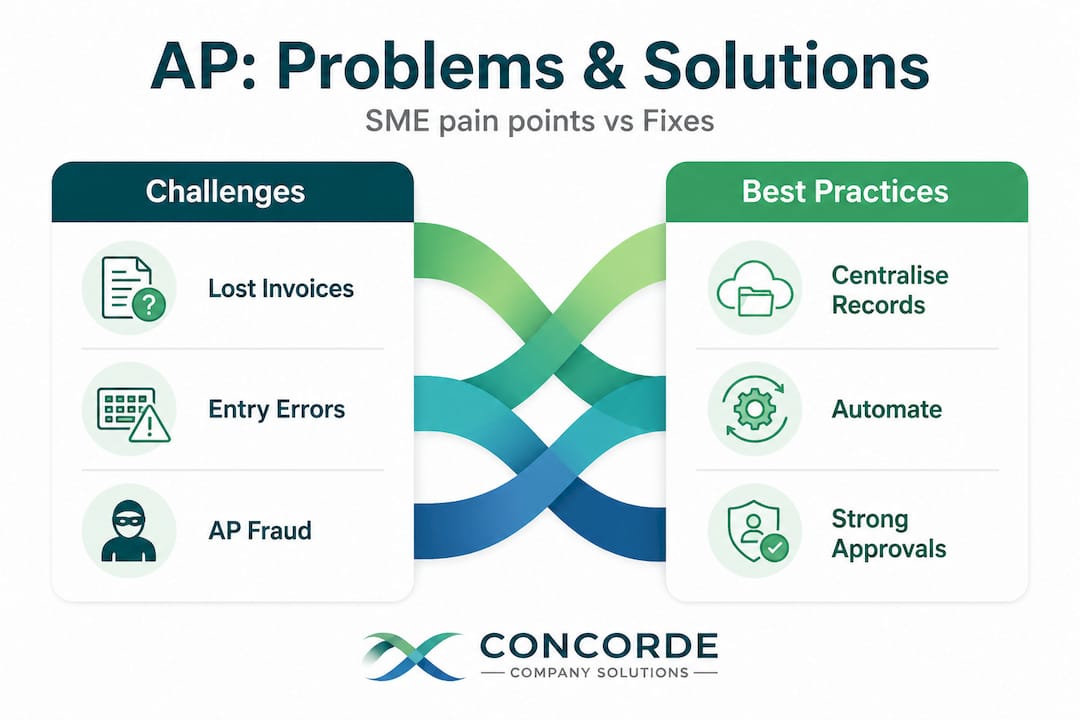
Lost or delayed invoices. Paper invoices get misplaced. Email invoices land in the wrong inbox. Establishing a single, dedicated channel for receiving supplier invoices, whether that is a dedicated email address or a scanning workflow, removes a lot of this friction immediately.
Manual data entry errors. Typing invoice data by hand introduces mistakes. Even experienced staff occasionally transpose figures or code an invoice to the wrong account. Automated data capture tools reduce this risk dramatically.
Fraud risk. AP fraud takes several forms: fake invoices from fictitious suppliers, invoice tampering, and payment redirection scams where fraudsters impersonate suppliers and request new bank details. These are serious threats. AI in financial risk management is increasingly helping businesses detect anomalies in payment patterns that suggest fraudulent activity.
Approval bottlenecks. When invoices require sign-off from a manager who is travelling or unavailable, payments get delayed. Building a clear delegation of authority into your approval workflow ensures payments are never held up unnecessarily.
| Feature | Manual AP management | Automated AP management |
|---|---|---|
| Invoice capture | Manual data entry | Automated extraction (OCR) |
| Matching | Staff check each document | System flags mismatches automatically |
| Approval routing | Emails or paper forms | Digital workflow with escalations |
| Duplicate detection | Relies on staff memory | System cross-references automatically |
| Audit trail | Paper records, easily lost | Digital log of every action |
| Scalability | Limited by staff capacity | Scales with transaction volume |
| Error rate | Higher, especially under pressure | Significantly lower |
The best approach to managing business expenses combines robust processes with the right technology. This is not about replacing people but giving them better tools to work with. Even small businesses processing fifty invoices a month benefit meaningfully from even basic automation.
Similarly, if your business uses payroll software, the logic is the same: the payroll management benefits come from taking a previously manual, error-prone task and making it systematic. AP works the same way.
Pro Tip: Reconcile your supplier statements every month, not just when there is a dispute. Supplier statements show what they think you owe them. Cross-referencing this against your own AP ledger regularly catches missed invoices, credits not applied, and payments recorded incorrectly before they snowball into bigger problems.
Best practices summary:
- Assign a dedicated AP inbox or document management system
- Implement three-way matching for all purchases above a defined threshold
- Segregate duties so that no single person can both approve an invoice and make the payment
- Set a regular payment run schedule and stick to it
- Review your supplier list periodically and remove inactive vendors to reduce fraud exposure
- Use AP automation tools integrated with your accounting software
Why SMEs should treat accounts payable as a strategic function
Here is an uncomfortable truth: most small businesses treat AP as a chore. Someone processes the invoices, someone makes the payments, and that is that. The thinking is that it is an operational necessity rather than something worth prioritising strategically. This mindset is costing businesses money, and we see it regularly.
When you treat AP as pure administration, you miss the intelligence it contains. Your AP data tells you which suppliers you rely on most, where your spending is concentrated, whether you are on track against your budget, and how your cash outflows map against your incoming revenue. Businesses that read this data and act on it can negotiate better terms, time payments to smooth cash flow, and spot cost creep before it becomes a serious problem.
Consider payment terms. A supplier might offer 2% off if you pay within ten days instead of thirty. That sounds small. But if you spend £200,000 a year with that supplier, you are looking at £4,000 in savings annually, simply by adjusting your payment timing. You only notice this opportunity if someone is actually looking at the AP data with a strategic eye, not just processing invoices mechanically.
AP data also feeds directly into business cash flow strategies. If you know exactly when major supplier payments fall due each month, you can plan your cash position much more precisely. You stop being reactive and start making deliberate decisions about when to hold cash and when to deploy it.
“Accounts payable is not just about paying bills on time. It is a source of financial intelligence that, when read correctly, informs how you manage relationships, negotiate contracts, and plan your cash position for the months ahead.”
The businesses that outperform their peers in financial resilience are almost always the ones that have taken their back-office functions seriously. They have invested time in getting AP right, not because an auditor told them to, but because they understood the strategic value it creates. If you want your finance function to genuinely support business growth, AP is where that transformation often starts.
Take control of your accounts payable processes
Managing accounts payable effectively is one of the most tangible ways to strengthen your business finances, but it takes the right support to get it right consistently.

At Concorde Company Solutions, we work with SMEs across the UK to build financial processes that actually hold up under pressure. Whether you need help with bookkeeping, software setup, or ongoing financial management, we offer practical, straightforward support tailored to your business. We are based in Garforth, Leeds, but we support clients across the UK with transparent pricing and no jargon. If your AP processes feel chaotic, or if you simply want a second pair of expert eyes on your financial operations, get in touch with us at Concorde Company Solutions to find out how we can help.
Frequently asked questions
What is the difference between accounts payable and accounts receivable?
Accounts payable covers the money your business owes to suppliers for goods or services already received, while accounts receivable is the money owed to your business by your customers. They sit on opposite sides of your balance sheet.
Why is timely accounts payable processing important?
Timely AP processing prevents late payment penalties under the UK Late Payment of Commercial Debts Act, protects your business credit rating, and preserves the supplier relationships your operations depend on.
What documents are typically involved in accounts payable?
The core AP documents are the purchase order, the supplier invoice, the goods receipt note, and the remittance advice sent to the supplier once payment is made. Three-way matching across the first three documents is considered best practice for accuracy.
How can small businesses reduce the risk of AP fraud?
Segregate duties so that approving invoices and making payments are handled by different people, use automated systems that flag unusual payment requests, and verify any supplier request to change bank details via a direct phone call to a known contact before acting on it.
No responses yet