
TL;DR:
- Regular monthly bank reconciliation significantly reduces errors and HMRC enquiry risks.
- Reconciling compares internal records with bank statements to ensure financial accuracy.
- Proper reconciliation is essential for compliance, operational clarity, and financial integrity.
Neglecting bank statement reconciliation could be quietly putting your business at risk. Monthly reconciliation reduces errors by 75% and cuts the HMRC enquiry rate from 12% to just 3%, yet many UK small and medium-sized businesses treat it as an afterthought. This article explains exactly what bank statement reconciliation involves, why it matters for HMRC compliance, and how it supports smoother day-to-day operations. Whether you are a sole trader or managing a growing team, getting reconciliation right is one of the most practical steps you can take to protect your finances and avoid unwanted scrutiny.
Table of Contents
- What does bank statement reconciliation mean?
- Why regular reconciliation is essential for HMRC compliance
- Operational and financial benefits for your business
- Common mistakes and how to avoid them
- Why most SMEs undervalue bank reconciliation—and what really works
- How Concorde helps your business stay compliant and stress-free
- Frequently asked questions
Key Takeaways
| Point | Details |
|---|---|
| HMRC compliance | Regular bank statement reconciliation is essential to pass audits and support tax filings for UK SMEs. |
| Reduces error rates | Monthly reconciliation can cut errors by 75% and lower audit risk dramatically. |
| Operational clarity | Reconciling statements ensures your cash flow and financial reports are accurate. |
| Easy to implement | Practical systems and digital tools make monthly reconciliations straightforward for small businesses. |
What does bank statement reconciliation mean?
Bank statement reconciliation is the process of comparing your internal financial records against your bank statement to confirm every transaction matches. If your records show a payment went out on a given date, the bank statement should reflect the same. Simple in theory, but powerful in practice.
Many business owners confuse reconciliation with general bookkeeping. They are related but not the same. Bookkeeping captures and categorises every financial transaction as it happens. Reconciliation goes a step further: it verifies that what your books show actually matches what your bank has recorded. Think of bookkeeping as writing a diary and reconciliation as checking the diary is accurate.
Here is a quick comparison to make the difference clear:
| Feature | Bookkeeping | Bank reconciliation |
|---|---|---|
| Main purpose | Record transactions | Verify accuracy against bank |
| Frequency | Ongoing | Monthly (minimum) |
| Output | Ledger entries | Confirmed, matched records |
| Catches errors? | Sometimes | Consistently |
Reconciliation matters most because it catches discrepancies before they become costly problems. A duplicate payment, a missed invoice, or even bank fraud can hide undetected in your books for months without it.
For UK limited companies, this is not just good practice. HMRC requires retention of records, including reconciliations, for six years. That means your matched, verified records need to be complete and accessible, not sitting in a spreadsheet that nobody has updated since last year.
Here is what monthly reconciliation actually involves for most SMEs:
- Downloading or reviewing your monthly bank statement
- Matching each entry to your accounting records or software
- Investigating and explaining any discrepancies
- Marking all items as cleared or flagging outstanding ones
- Saving the completed reconciliation for your records
If you want to go deeper on the mechanics, the bank reconciliation guide and bookkeeping reconciliation explained resources from Concorde cover the process step by step.
Doing this monthly keeps your records clean, your accountant happy, and your business in a strong position if HMRC ever comes calling.
Why regular reconciliation is essential for HMRC compliance
Now that you understand what reconciliation is, let’s see how it directly impacts your compliance responsibilities.
HMRC compliance is not just about filing your tax return on time. It is about maintaining accurate records that can support every figure you submit, from your VAT return to your corporation tax calculation. Accurate records for 6 years are required to support VAT returns, tax filings, and audits. Without reconciled records, you cannot confidently stand behind your filings.
The difference between reconciled and unreconciled records at audit time is significant. Consider this comparison:
| Factor | Reconciled records | Unreconciled records |
|---|---|---|
| Audit risk | Low | High |
| VAT accuracy | Consistently reliable | Often contains errors |
| HMRC enquiry likelihood | Around 3% | Around 12% |
| Time to respond to enquiries | Hours | Days or weeks |
When HMRC selects a business for enquiry, having clean, reconciled records can mean the difference between a swift, straightforward resolution and a drawn-out, costly investigation.
Regular reconciliation is one of the simplest ways to reduce your audit risk and demonstrate to HMRC that your records are trustworthy and well-maintained.
Here are the key compliance benefits of reconciling every month:
- VAT returns are based on verified, matched transactions
- Corporation tax calculations are less likely to contain errors
- Discrepancies are caught early, before they affect submitted returns
- You hold a reliable audit trail if HMRC queries any figure
- Your business meets the HMRC requirements for record retention
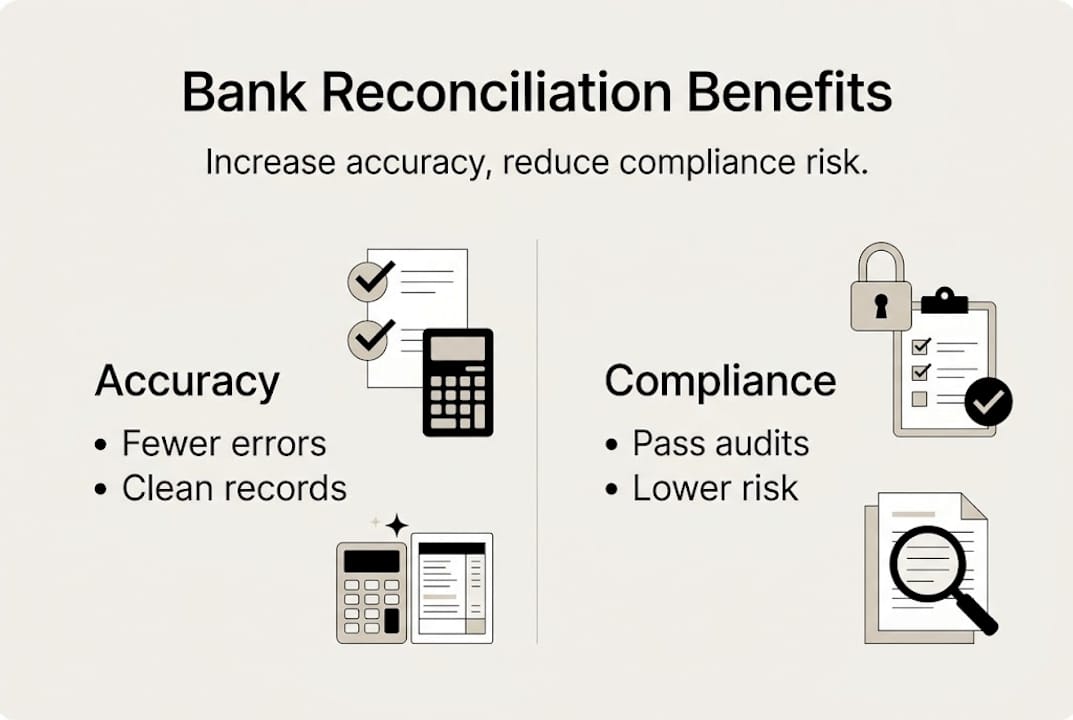
Monthly reconciliation reduces errors by 75%, which is a significant reduction in the risk of submitting inaccurate figures to HMRC. Inaccurate figures lead to penalties, interest charges, and in serious cases, formal investigation.
For practical HMRC compliance guidance tailored to UK businesses, or if you want to understand the broader meaning of HMRC compliance for your specific situation, getting proper support early pays off far more than fixing problems after the fact.
Operational and financial benefits for your business
With compliance covered, let’s focus on practical day-to-day benefits for business operations.

Reconciliation does more than keep HMRC satisfied. It gives you a real-time view of your business finances that you simply cannot get from looking at your bank balance alone. Many SME owners discover they have been operating with a distorted picture of their cash position, where unpresented cheques, pending payments, or unrecorded expenses have skewed the numbers.
Here are the top three operational benefits that regular reconciliation delivers:
- Accurate cash flow visibility. When your records match your bank, you know exactly what money is available. This matters when you are deciding whether to take on a new supplier, hire additional staff, or invest in equipment.
- Reliable VAT and tax returns. Every figure on your VAT return should trace back to a verified transaction. Reconciliation makes this possible and takes the guesswork out of quarterly filings.
- Early detection of errors and fraud. Duplicate payments, unauthorised transactions, and processing mistakes surface quickly during reconciliation. Catching them early saves money and prevents compounding problems.
Monthly reconciliation reduces errors by 75% and lowers the HMRC enquiry rate from 12% to 3%, which translates into real savings in time, stress, and potential penalty costs. For any business focused on maintaining business records properly, reconciliation is the cornerstone.
Pro Tip: Set a recurring calendar reminder on the first working day of each month to complete your bank reconciliation. Pairing it with your monthly management accounts review makes it a natural part of your financial routine rather than a separate chore.
Businesses with a solid reconciliation habit are also better positioned when seeking finance. Lenders and investors want to see clean, accurate financial records. A financial statements strategy built on reconciled accounts gives your business credibility that sloppy books simply cannot provide.
Common mistakes and how to avoid them
To make sure the benefits stick, let’s look at what could go wrong and how you can sidestep these issues.
Even well-intentioned business owners fall into patterns that undermine the value of reconciliation. Knowing the common pitfalls is the first step to avoiding them.
Here are the mistakes we see most often:
- Reconciling infrequently. Leaving it to quarterly or annual reconciliation means errors compound. A mismatch spotted after a week is easy to trace. One discovered after six months is a much bigger problem.
- Reconciling to the wrong balance. Always reconcile to the closing bank balance on the statement, not the current live balance in your app. These are different figures, especially with pending transactions.
- Ignoring small discrepancies. A £2.50 difference might feel trivial. But multiple small, unexplained differences add up and can signal a deeper issue in your records.
- Not retaining completed reconciliations. Company and accounting records must be kept accurately for six years. Deleting reconciliation files or failing to save them properly puts your compliance at risk.
- Mixing personal and business transactions. If personal expenses appear in the business account, they need to be identified and correctly treated. Leaving them unmarked creates confusion and inaccuracies in your tax records.
- Skipping the bank charges line. Bank fees and charges often appear without prior notice. Missing them leaves your records slightly off every month.
Pro Tip: Use digital accounting software such as Xero, QuickBooks, or Sage to automate the matching process. These platforms pull in bank transactions directly and flag unmatched items, which significantly reduces the manual effort and the risk of human error.
For a clear overview of types of accounting records you should be maintaining alongside reconciliations, or if you want to know exactly what to expect if HMRC investigates, the guide on preparing for an HMRC audit is well worth reading before you need it.
Why most SMEs undervalue bank reconciliation—and what really works
Having reviewed the common mistakes, it is worth reflecting on why reconciliation is so often overlooked and what actually makes the process stick.
In our experience working with SMEs across the UK, reconciliation is rarely deprioritised because business owners think it is unimportant. It gets pushed aside because it feels reactive rather than productive. When you are busy running a business, matching bank entries does not feel as urgent as chasing invoices or managing staff.
That is the wrong frame entirely. Reconciliation is not a housekeeping task. It is a control mechanism. It is how you catch the supplier who double-charged you, the employee who made an authorised but miscoded payment, and the direct debit you forgot to cancel.
The businesses that do it well treat reconciliation as a non-negotiable, fixed appointment in the monthly calendar, not something squeezed in when time allows. They also connect it to the importance of financial compliance rather than treating it in isolation. When you see reconciliation as part of a broader commitment to financial health rather than a standalone admin task, the habit becomes far easier to maintain. That shift in perspective is often more valuable than any software tool.
How Concorde helps your business stay compliant and stress-free
If the idea of monthly reconciliation still feels like one more thing on an already long list, you do not have to manage it alone.

At Concorde Company Solutions, we support UK SMEs with bookkeeping, reconciliation, and financial compliance as part of a joined-up service that takes the pressure off you. From setting up accounting software to reviewing your records and ensuring they meet HMRC standards, our team handles the detail so you can focus on running your business. We also offer payroll services to keep your obligations on track month to month. Visit Concorde Company Solutions to find out how we can support your business with straightforward, expert financial management.
Frequently asked questions
How often should UK SMEs reconcile their bank statements?
UK SMEs should reconcile bank statements monthly as a minimum. Monthly reconciliation reduces errors by 75% and lowers the likelihood of an HMRC enquiry significantly.
What records related to bank reconciliation must be kept for HMRC compliance?
Businesses must retain reconciliations, VAT records, and tax filings for at least six years. HMRC requires retention of all company and accounting records within that timeframe.
What are the main risks if you do not routinely reconcile your bank statements?
Without regular reconciliation, error rates rise, VAT and tax returns become unreliable, and your audit risk increases sharply. Monthly reconciliation reduces audit risk and helps you stay on the right side of HMRC.
Can digital tools help automate bank statement reconciliation?
Yes, software such as Xero or QuickBooks can automate transaction matching and flag discrepancies automatically. Accurate digital record keeping supports HMRC compliance and reduces the time spent on manual checks.
No responses yet